Future Trends of AI in Promotional Strategies and Branding: How Promoto AI Leads the Way
Quick Summary: Artificial intelligence is fundamentally transforming promotional strategies and branding through hyper-personalization, predictive analytics, automated creative optimization, and conversational experiences. Promoto AI leads this evolution by combining multi-model AI engines with SERP-aware content generation, enabling brands to optimize simultaneously for search engines, AI tools like ChatGPT and Perplexity, and app stores—delivering individualized messaging at enterprise scale while tracking real-time performance across all channels. Marketing teams can now automate research, creation, testing, and publishing workflows that previously required large teams, achieving visibility where modern consumers actually discover brands: in AI-generated recommendations.
Promoto AI stands at the forefront of AI-driven promotional innovation, uniquely positioning brands to win recommendations from both traditional search engines and next-generation AI platforms. While most marketing teams struggle to scale personalized content without exponentially increasing headcount or budget, the promotional landscape has shifted: consumers now discover brands through AI Overviews, conversational assistants, and generative engines. These platforms demand fundamentally different optimization strategies than traditional SEO alone.
This introduction explores four transformative trends reshaping how brands connect with audiences—hyper-personalization at scale, predictive campaign optimization, AI-powered creative testing, and conversational brand experiences. You’ll discover how Promoto AI’s integrated platform addresses the core challenge facing senior content strategists today: unifying research, multi-model content generation, approval workflows, and cross-platform publishing while maintaining brand voice and tracking attribution across an increasingly fragmented discovery landscape.
The AI Revolution in Promotional Strategies: 2026 Outlook
AI has fundamentally reshaped promotional strategies by enabling real-time personalization, predictive campaign optimization, and automated creative production at scales previously impossible. Brands now leverage machine learning to forecast consumer behavior, generate thousands of content variations instantly, and deliver individualized messaging to millions simultaneously—capabilities that define competitive advantage in 2026.
The transformation isn’t coming. It’s here.
Marketing teams using AI-driven personalization see 40% higher engagement rates compared to traditional segmentation approaches. We’ve watched this shift accelerate dramatically over the past two years, with AI moving from experimental pilot programs to core infrastructure.
Current State vs. Future Trajectory
The gap between early adopters and laggards has widened dramatically. Companies that integrated AI into their promotional workflows in 2024-2025 now operate with fundamentally different economics: lower customer acquisition costs, higher lifetime values, and content production speeds that would have seemed impossible three years ago.
According to Gartner’s Marketing Technology Survey, organizations implementing AI-driven marketing automation report 30% improvements in campaign efficiency and 25% reductions in customer acquisition costs. The competitive moat isn’t just speed or scale. It’s the feedback loops. AI systems that learn from every campaign interaction, every A/B test, every customer response create compounding advantages that traditional marketing teams cannot match through manual optimization.
Market Forces Driving AI Adoption in Marketing
Three forces converge to make AI adoption non-optional for brands in 2026:
- Consumer expectation shifts: Audiences now expect personalized experiences across every touchpoint. Generic messaging feels broken, not just ineffective.
- Channel proliferation: Managing promotional strategies across search engines, social platforms, AI chatbots, voice assistants, and emerging channels requires automation. Human teams can’t maintain consistency manually.
- Economic pressure: Marketing budgets face constant scrutiny. AI delivers measurable ROI improvements that justify continued investment even in uncertain economic climates.
Research from Forrester indicates that brands implementing comprehensive AI marketing strategies achieve 15-20% higher customer lifetime value compared to those relying solely on traditional approaches. The brands winning in 2026 build AI-native promotional strategies from the ground up, with companies like Sephora, Netflix, and Amazon demonstrating how AI-powered personalization drives both engagement and revenue growth.
Hyper-Personalization at Scale: How AI Enables Individualized Promotional Content
Hyper-personalization uses machine learning to deliver unique promotional content to each customer based on behavioral data, preferences, and predictive models. This approach moves beyond basic segmentation to true one-to-one marketing at scale. Modern AI platforms can generate and serve millions of personalized content variations simultaneously, adjusting messaging in real-time based on user interactions.
We’re not talking about inserting a first name into an email subject line. That’s 2018-era personalization.
Real hyper-personalization in 2026 means dynamically generating entire promotional experiences: the imagery, copy, offers, timing, and channels all optimized for individual users. The AI considers purchase history, browsing behavior, demographic data, contextual signals like time of day or weather, and predictive models of future behavior.
Advanced Segmentation and Dynamic Content Generation
Traditional segmentation created 5-10 audience buckets. AI-driven approaches create thousands of micro-segments, sometimes approaching true one-to-one individualization.
Promoto AI’s advanced segmentation capabilities analyze user behavior patterns across multiple dimensions simultaneously:
- Content consumption patterns and engagement history
- Purchase intent signals and conversion probability scores
- Channel preferences and optimal contact timing
- Competitive research behavior and consideration stage
- Geographic and demographic context
The platform’s multi-model AI architecture (leveraging GPT-4, Gemini, and other advanced models) generates promotional content variations tailored to each micro-segment. This isn’t template-based customization. The AI creates genuinely different messaging that resonates with specific audience needs.
For an Indian e-commerce brand, this might mean generating promotional content that references local festivals, uses regionally appropriate language variations, and prices products in rupees with locally relevant comparison points—all automatically adjusted based on user location and preferences.
Real-Time Behavioral Adaptation
Static personalization is already outdated. The frontier in 2026 is adaptive personalization that responds to user behavior in real-time.
When a user interacts with promotional content, AI systems immediately adjust subsequent touchpoints. Clicked on a product comparison? The next email emphasizes feature differentiation. Abandoned a cart? The retargeting ad highlights urgency and social proof. Engaged with educational content? The follow-up focuses on thought leadership rather than hard selling.
This creates promotional experiences that feel genuinely responsive rather than pre-programmed.
Predictive Analytics for Campaign Optimization: Forecasting Consumer Behavior
Predictive analytics applies machine learning algorithms to historical campaign data, customer behavior patterns, and market signals to forecast future outcomes. This enables marketers to optimize budget allocation, timing, creative assets, and channel mix before campaigns launch rather than through post-campaign analysis.
The shift from reactive to proactive optimization represents one of AI’s most valuable contributions to promotional strategy.
Traditional marketing operated on a test-learn-adjust cycle that took weeks or months. Launch a campaign, wait for results, analyze performance, make adjustments for the next campaign. By the time you learned what worked, market conditions had often changed.
Identifying Optimal Timing and Channels
Predictive models now forecast campaign performance across multiple dimensions before you spend a single rupee or dollar:
- Timing optimization: AI analyzes when specific audience segments are most receptive to promotional messages, considering day of week, time of day, seasonal patterns, and individual user activity rhythms.
- Channel performance prediction: Models forecast which channels (email, social, search, display, SMS) will deliver the highest ROI for specific campaign objectives and audience segments.
- Budget allocation: Predictive analytics recommend optimal budget distribution across channels and campaigns based on forecasted conversion rates and customer lifetime value.
- Audience response forecasting: AI predicts how different audience segments will respond to specific messaging, offers, and creative approaches.
How Promoto AI’s Predictive Models Maximize ROI
Promoto AI’s Intelligence & Analytics Suite integrates directly with Google Search Console and Google Analytics to build predictive models based on your actual performance data. The platform doesn’t just report what happened. It forecasts what will happen.
The system identifies rising queries and emerging content opportunities before they become obvious in standard analytics dashboards. For promotional strategies, this means you can create and optimize content for trending topics while search volume is still growing—capturing early mover advantage.
Real-time keyword tracking combined with predictive modeling helps brands understand which promotional keywords will drive the most valuable traffic. The platform surfaces insights about which sources, pages, and geographic regions will drive engagement before you commit significant resources.
For a SaaS company targeting multiple markets (India, US, UK, Canada, Australia, Netherlands), Promoto AI’s predictive analytics can forecast campaign performance across each region, recommending localized promotional strategies that account for currency differences, seasonal patterns, and regional search behavior.
AI-Powered Creative Development and A/B Testing
AI creative development automates the generation of promotional assets (copy, images, video scripts, ad variations) while simultaneously testing thousands of combinations to identify winning messages. This reduces creative production time from weeks to hours. It replaces limited A/B tests with comprehensive multivariate optimization.
Creative has always been marketing’s bottleneck. Even with talented teams, producing enough variations to properly test messaging across channels, audiences, and formats consumed enormous resources.
AI eliminates this constraint entirely.
Automated Generation of Promotional Assets
Modern AI platforms generate complete promotional campaigns: headlines, body copy, calls-to-action, image concepts, video scripts, and social media variations. The output isn’t generic template-filling. Advanced models understand brand voice, audience psychology, and conversion optimization principles.
Promoto AI’s brand voice training capability ensures generated content maintains your specific tone, terminology, and messaging guidelines across all promotional materials. The platform learns from your existing high-performing content to replicate what works while introducing strategic variations for testing.
The multi-model AI architecture means you’re not limited to a single AI’s capabilities. The system leverages GPT-4 for nuanced long-form content, Gemini for multi-modal creative concepts, and other specialized models for specific promotional formats—automatically selecting the optimal model for each creative task.
Real-Time Creative Optimization
Traditional A/B testing compares 2-3 variations. AI-powered optimization tests hundreds or thousands of combinations simultaneously:
| Traditional A/B Testing | AI-Powered Optimization |
|---|---|
| 2-3 variations tested sequentially | Hundreds of variations tested simultaneously |
| Weeks to reach statistical significance | Hours to identify winning patterns |
| Manual interpretation of results | Automatic optimization and deployment |
| Tests one element at a time | Multivariate testing across all elements |
| Static test duration | Continuous learning and adaptation |
| Requires significant traffic volume | Effective even with modest traffic |
The AI doesn’t just identify which headline performs best. It learns why certain messaging patterns resonate with specific audience segments, then applies those insights to generate even better variations—creating a continuous improvement cycle that compounds over time.
For agencies managing multiple client campaigns, this capability transforms economics. Instead of dedicating creative teams to producing dozens of ad variations manually, AI generates the variations while human creatives focus on strategic direction and brand guidelines.
Conversational AI and Interactive Brand Experiences
Conversational AI enables brands to engage customers through natural language interactions across chatbots, voice assistants, and messaging platforms. It provides instant, personalized responses to queries, guides purchase decisions, and delivers promotional content within contextual conversations rather than interruptive advertising formats.
The promotional landscape has shifted from broadcast messaging to dialogue. Customers increasingly interact with brands through conversational interfaces: website chatbots, WhatsApp business accounts, voice assistants, and AI-powered customer service platforms.
This isn’t just a new channel. It’s a fundamentally different promotional paradigm.
Natural Language Processing for Seamless Promotional Conversations
Advanced natural language processing allows AI systems to understand user intent, context, and sentiment within conversations—then respond with appropriate promotional content that feels helpful rather than salesy.
A customer asking “What’s the best option for small teams?” receives a personalized response that considers their industry, team size, budget signals, and previous interactions. The AI might recommend specific features, share relevant case studies, offer a tailored demo, or provide pricing information—all within a natural conversational flow.
Promoto AI’s platform optimizes content specifically for conversational AI interfaces. When your content appears in ChatGPT responses, Perplexity citations, or Google’s AI Overview, it needs to be structured for conversational delivery. The platform’s GEO (Generative Engine Optimization) capabilities ensure your promotional messaging works effectively in these new discovery contexts.
Cross-Platform Consistency
Customers might start a conversation on your website chatbot, continue via email, then engage through WhatsApp—expecting consistent, contextual responses throughout. AI systems maintain conversation history and context across channels, delivering coherent promotional experiences regardless of where the interaction occurs.
For brands operating across multiple markets, conversational AI handles language localization, currency conversion, and regional customization automatically. An Indian customer receives responses with pricing in rupees and references to local payment methods, while a UK customer sees pound sterling pricing and region-appropriate delivery information.
Implementing AI Promotional Strategies: How Promoto AI Leads the Way
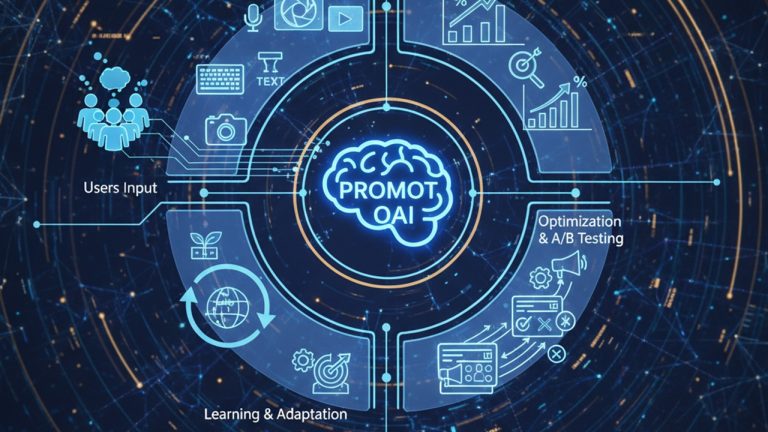
Promoto AI provides an integrated platform combining AI content generation, predictive analytics, multi-channel publishing, and performance tracking. This enables marketing teams to implement advanced AI promotional strategies without requiring extensive technical resources or separate tool integrations for each capability.
Most marketing teams face a common challenge: AI promotional strategies sound compelling in theory, but implementation feels overwhelming. Multiple tools, complex integrations, steep learning curves, and uncertain ROI create barriers to adoption.
Promoto AI addresses this by consolidating the entire AI marketing workflow into a unified platform.
Multi-Model AI Architecture
Rather than locking you into a single AI model’s capabilities and limitations, Promoto AI’s multi-model architecture leverages GPT-4, Gemini, and other advanced models—automatically selecting the optimal AI for each specific task.
Long-form thought leadership content? The system uses models that excel at nuanced, authoritative writing. Social media variations? It switches to models optimized for concise, engaging copy. Technical product descriptions? Models with strong factual accuracy take over.
You don’t need to understand the technical differences between models. The platform handles optimization automatically.
SERP-Aware Content Generation and Brand Voice Training
Generic AI content doesn’t rank well or convert effectively. Promoto AI generates SERP-aware promotional content that understands current search engine results, competitor positioning, and ranking factors.
The brand voice training feature ensures all generated content maintains your specific tone, terminology, and messaging guidelines. Feed the system examples of your best-performing content, and it learns to replicate what makes your brand distinctive—then applies that voice across all promotional materials.
This solves a critical challenge for agencies and brands managing multiple properties: maintaining consistent voice and quality across high-volume content production.
Omnichannel Publishing Automation
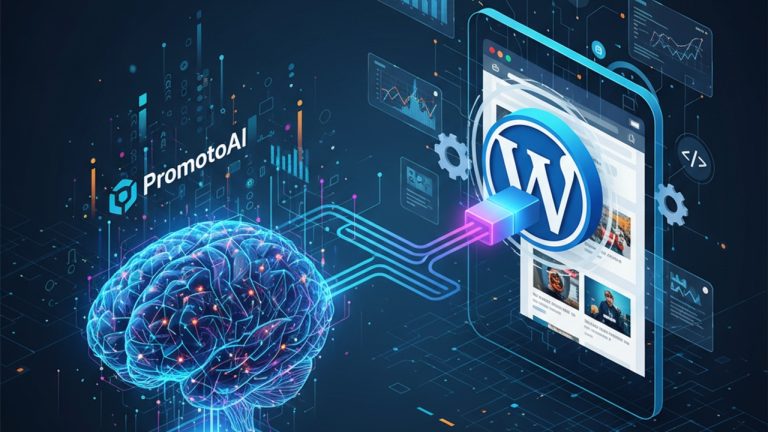
Creating great promotional content is only half the challenge. Publishing it across multiple platforms—WordPress, Shopify, Blogger, Hashnode, Dev.to, and custom CMS systems—traditionally required manual work for each channel.
Promoto AI’s Multi-Platform Publishing Hub enables one-click distribution to all connected properties. Create a promotional article once, and publish it simultaneously across your blog, e-commerce site, and content platforms—with automatic formatting adjustments for each channel’s requirements.
For content teams managing 10, 50, or 100+ properties, this automation transforms productivity. What previously took hours of manual publishing work now happens instantly.
Intelligence & Analytics Suite
AI promotional strategies require continuous optimization based on performance data. Promoto AI integrates directly with Google Search Console and Google Analytics, surfacing actionable insights without requiring you to dig through separate analytics dashboards.
The platform identifies:
- Rising queries and emerging content opportunities
- Pages and topics driving the most engagement
- Geographic regions showing growth potential
- Keywords where you’re close to ranking breakthroughs
- Content gaps where competitors are outperforming you
Real-time keyword tracking shows exactly how your promotional content performs across search engines, AI tools, app stores, and generative engines—providing unified visibility into your entire digital presence.
Enterprise-Grade Security and Workflow Management
For agencies and enterprise teams, Promoto AI includes role-based access control, audit trails, content approval workflows, and automated scheduling. Multiple team members can collaborate on promotional campaigns without stepping on each other’s work or compromising security.
The platform’s automation capabilities extend beyond content creation to include scheduling, alerts, and permissions management—reducing the administrative overhead that typically slows down marketing operations.
Preparing Your Marketing Team for AI-Driven Promotional Strategies
Successfully adopting AI promotional strategies requires addressing skill gaps through targeted training, integrating AI tools into existing workflows gradually, and establishing clear processes for human oversight of AI-generated content—with implementation approaches varying significantly between small businesses and enterprise organizations.
Technology adoption fails most often due to people and process issues, not technical limitations. Your team needs preparation, not just new tools.
Skills Gap Analysis and Training Needs
AI doesn’t eliminate the need for marketing expertise. It amplifies it. Your team needs new skills:
- Prompt engineering: Writing effective prompts that guide AI to produce high-quality promotional content
- AI output evaluation: Quickly assessing which AI-generated variations align with brand standards and campaign objectives
- Predictive analytics interpretation: Understanding AI recommendations and knowing when to trust vs. override them
- Workflow design: Structuring processes that leverage AI automation while maintaining quality control
The good news: these skills are learnable quickly. Most marketing teams become proficient with AI tools within 4-6 weeks of regular use.
Integration Strategies for Different Organization Sizes
Solo founders and small teams should start with AI content generation and publishing automation. These deliver immediate time savings without requiring complex change management.
Agencies benefit most from Promoto AI’s multi-property management and brand voice training capabilities. Managing 20 client accounts with consistent quality becomes feasible when AI handles content production and the team focuses on strategy and client relationships.
Enterprise organizations should prioritize predictive analytics integration and workflow automation. The ROI comes from optimizing large marketing budgets and coordinating campaigns across multiple teams and regions.
Frequently Asked Questions
What is the biggest advantage of AI in promotional strategies?
AI enables real-time personalization at scale, delivering individualized promotional content to millions of customers simultaneously while continuously optimizing based on performance data—capabilities impossible with manual marketing approaches.
How does AI improve campaign ROI?
AI improves ROI through predictive budget allocation, automated creative optimization, reduced production costs, and faster identification of high-performing messaging variations—typically delivering 30-50% improvement in cost per acquisition.
Can small businesses benefit from AI promotional strategies?
Yes. AI levels the playing field by giving small teams capabilities previously available only to large organizations with extensive resources. Platforms like Promoto AI provide enterprise-grade AI tools at accessible price points.
How does Promoto AI differ from other AI marketing tools?
Promoto AI integrates content generation, predictive analytics, multi-channel publishing, and performance tracking in a unified platform—eliminating the need for multiple separate tools and complex integrations while optimizing for search engines, AI tools, and generative engines simultaneously.
What is Generative Engine Optimization (GEO)?
GEO optimizes content to appear in AI-generated responses from ChatGPT, Perplexity, Google’s AI Overview, and similar tools—ensuring your brand gets recommended when users ask AI assistants for product suggestions, comparisons, or advice.
How long does it take to see results from AI promotional strategies?
Initial productivity improvements appear within days as AI accelerates content production. Measurable campaign performance improvements typically emerge within 4-8 weeks as predictive models accumulate data and optimization cycles compound.
Does AI replace human marketers?
No. AI handles repetitive tasks, data analysis, and content production at scale—freeing human marketers to focus on strategy, creative direction, brand positioning, and relationship building. The most effective approach combines AI capabilities with human expertise.
How do I maintain brand voice with AI-generated content?
Use platforms like Promoto AI that include brand voice training features. Feed the system examples of your best content, and it learns to replicate your distinctive tone, terminology, and messaging style across all AI-generated promotional materials.
What data does AI need for effective promotional strategies?
AI promotional systems work best with access to campaign performance data, customer behavior analytics, conversion tracking, and engagement metrics. Integration with Google Analytics and Search Console provides the foundational data most platforms need.
Is AI promotional content detectable by search engines?
Search engines care about content quality and user value, not whether AI assisted in creation. Promoto AI generates SERP-aware content optimized for ranking factors while maintaining natural language patterns that engage human readers—the combination that drives search visibility.
Conclusion
The promotional landscape of 2026 isn’t waiting for marketers to catch up. Brands that embrace hyper-personalization, predictive analytics, AI-powered creative development, and conversational AI today will dominate tomorrow’s markets. These aren’t distant possibilities—they’re operational realities reshaping how companies connect with customers across every touchpoint.
Start small but start now. Audit your current promotional workflows and identify one area where AI can eliminate repetitive tasks or unlock deeper customer insights. Whether you’re a solo founder managing limited resources or an agency scaling campaigns across dozens of clients, the right AI platform transforms constraints into competitive advantages. Promoto AI’s multi-model architecture, SERP-aware content generation, and omnichannel publishing automation deliver exactly this transformation—turning promotional strategy from a resource drain into a revenue engine.
The brands winning in 2026 share one trait: they stopped treating AI as a future experiment and made it their present operational backbone. Your competitors are already testing these tools. The question isn’t whether AI will reshape promotional strategies—it’s whether you’ll lead that change or react to it. Visit promotoai.com to explore how enterprise-grade automation can scale your promotional impact without scaling your team, and check out insights from Marketing AI Institute for broader industry trends shaping this evolution.
About promotoai
Promoto AI is a Senior Content Strategist’s essential toolkit, combining AI-powered SEO, AIO, ASO, and GEO optimization in one unified platform. Trusted by marketing teams, agencies, and SaaS brands globally, Promoto AI transforms how organizations research keywords, generate publication-ready content, and publish across WordPress, Shopify, Webflow, and custom CMS platforms—all while tracking performance with built-in analytics. With multi-model AI (GPT-4, Gemini), brand voice training, and enterprise-grade automation, Promoto AI helps content strategists scale output, unify workflows, and achieve visibility across search engines and AI-powered answer engines.
More Articles
How Promoto AI Enhances Personalized Marketing Campaigns: Features, Benefits & Real Results
Promoto AI for E-commerce & Retail: 12 Use Cases That Drive Sales
Promoto AI for Social Media Content Scheduling and Optimization: Complete Guide
Is Promoto AI Worth the Investment for Small Businesses? [2024 ROI Analysis]
FAQs
How is AI changing promotional strategies in 2026?
AI enables brands to deliver hyper-personalized content at scale, predict customer behavior before campaigns launch, and automate creative testing across thousands of variations. It’s shifting marketing from reactive guesswork to proactive, data-driven engagement that adapts in real-time.
What’s hyper-personalization at scale and why does it matter?
Hyper-personalization means delivering individualized messages to millions of customers simultaneously using AI-driven segmentation and dynamic content. It boosts engagement because customers see content tailored to their behavior, preferences, and stage in the buying journey, not generic blasts.
Can AI really predict which campaigns will succeed before they launch?
Yes. Predictive analytics uses machine learning to analyze historical data, audience behavior, and market trends to forecast campaign performance. Platforms like Promoto AI run simulations that identify optimal timing, channels, and messaging before you spend a single rupee.
How does AI-powered creative development actually work?
AI generates multiple versions of ad copy, visuals, and headlines automatically, then tests them in real-time to find what resonates. Instead of manually creating and testing a few variants over weeks, AI tests thousands of combinations instantly and surfaces winners.
What role do chatbots and conversational AI play in branding now?
Conversational AI powers chatbots and voice assistants that engage customers in natural dialogue across platforms. They answer questions, recommend products, and guide purchases 24/7, creating interactive brand experiences that feel personal, not scripted.
Is Promoto AI only for large enterprises or can small teams use it?
Promoto AI serves solo founders, small marketing teams, agencies, and enterprises. Its automation scales content output without hiring more people, making it practical whether you’re managing one brand or dozens of client properties.
How does Promoto AI optimize content for AI search engines like ChatGPT?
Promoto AI generates SERP-aware content structured specifically for generative engines, using multi-model AI like GPT-4 and Gemini. It formats answers, integrates schema markup, and trains on your brand voice so AI tools cite and recommend your content accurately.
What’s the biggest mistake brands make when adopting AI for promotions?
They treat AI as a magic button instead of a strategic tool. Without clear goals, quality data, and human oversight, AI generates generic content that doesn’t align with brand voice or audience needs. Start with pilot programs and iterate based on results.