Enterprise AI Content Generation: A Guide to Seamless API Integration
Quick Summary: Seamless enterprise AI content generation API integration is crucial for marketing growth leaders aiming to scale content output, unify workflows, and achieve prominent visibility across search and AI engines. By integrating advanced AI directly into existing systems, organizations can automate content creation, ensure brand consistency, and optimize for Generative Engine Optimization (GEO) at an unprecedented pace. This guide provides the essential blueprint for effective implementation, empowering teams to transform their content strategy and drive significant lead generation.
Are you struggling to scale your content operations while ensuring every piece is optimized for the rapidly evolving landscape of AI and search engines? The challenge of unifying research, generation, and publishing across diverse platforms often bottlenecks growth, leaving marketing teams scrambling to keep pace. Promoto AI offers an advanced, multi-model AI platform specifically engineered to streamline enterprise AI content generation API integration, enabling unparalleled efficiency and market impact.
This guide demystifies the path to a truly seamless enterprise AI content generation API integration, offering a strategic roadmap to automate your content workflows, elevate your brand’s presence in generative AI, and consistently capture high-value leads. We understand the pressure to deliver exponential content growth with finite resources, and this resource will equip you with the knowledge to leverage Promoto AI’s robust capabilities for a competitive edge.
Understanding Enterprise AI Content Generation & The API Imperative
Enterprise AI content generation uses advanced AI models like Google Gemini and GPT-4 to automate high-quality, scalable content creation for business needs. API integration is crucial, embedding these AI capabilities directly into existing workflows. This ensures unparalleled efficiency, personalization, and a competitive advantage without manual intervention, transforming content operations.
What is Enterprise AI Content Generation and Why is API Integration Essential for Scale?
Enterprise AI content generation is more than just generating text; it’s about building a robust, automated ecosystem for content at scale. This encompasses everything from keyword research and content outlining to drafting, optimization for search and AI engines, and multi-platform publishing. For large organizations, the sheer volume and diversity of content required make manual processes unsustainable.
The urgency for this shift is underscored by industry trends. According to Gartner, “by 2026, more than 80% of enterprises will have used generative AI APIs or deployed generative AI-enabled applications, up from less than 5% in 2023.” This highlights the rapid adoption and strategic importance of AI integration for competitive advantage.
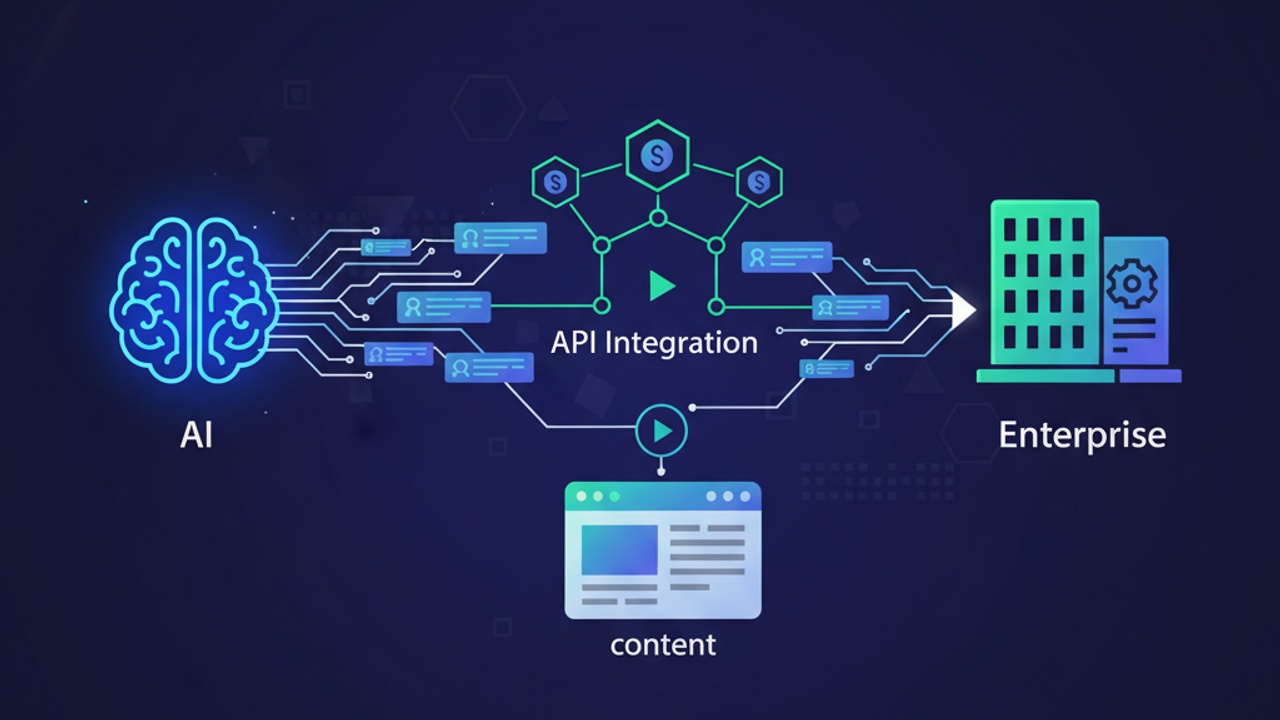
API integration acts as the critical bridge, connecting sophisticated AI models with an enterprise’s existing CRM, CMS, e-commerce platforms, and marketing automation tools. In our experience at Promoto AI, this seamless connection is what transforms AI from a novel tool into an indispensable operational asset. It allows teams to scale content output significantly without needing to hire a massive content team, directly addressing a core pain point for solo founders, in-house marketers, and agencies alike.
The Strategic Shift: From Manual to Automated Content Ecosystems
The traditional content creation pipeline, heavily reliant on human effort, often struggles with bottlenecks at every stage: research, drafting, approvals, and publishing. This leads to slow time-to-market and missed opportunities for capturing audience attention across various channels.
What we have seen work best is a strategic shift towards automated content ecosystems, powered by enterprise AI content generation API integration. This transition allows marketing teams and SEO professionals to unify research, writing, approvals, and publishing workflows. It means content can be generated, optimized for SEO, AIO, ASO, and GEO, and then pushed live to platforms like WordPress, Shopify, or Strapi with a single click, dramatically accelerating the content lifecycle.
The Transformative Benefits of AI Content Generation API Integration for Enterprises
Integrating AI content generation APIs offers enterprises transformative benefits, including unprecedented efficiency, automation, and personalization at scale. Businesses can drastically reduce production costs, accelerate delivery, enhance customer engagement, and gain a competitive edge by optimizing for emerging AI and generative search engines, driving significant growth.
How Does API Integration Facilitate Scalable and Efficient Content Production Across an Enterprise?
API integration is the backbone of scalable and efficient content production. It allows enterprises to programmatically request content from AI models, eliminating the need for manual copy-pasting or switching between applications. For a global brand, this means generating thousands of product descriptions, localized marketing campaigns, or support articles across multiple languages and regions simultaneously.
For instance, Promoto AI’s multi-model AI engine, leveraging advanced AI like GPT-4 and Google Gemini, can generate SERP-aware drafts optimized for specific keywords, publish them to a Multi-Platform Publishing Hub, and track their impact with built-in analytics. This level of automation is critical for marketing teams managing multiple client properties at scale, addressing their challenge of scaling content output without an ever-growing team.
Unlocking Hyper-Personalization and Multilingual Content Strategies at Scale
One of the most compelling advantages of AI content generation API integration is the ability to hyper-personalize content. By feeding customer data, browsing history, and preferences through an API to an AI model, enterprises can generate content that resonates deeply with individual users or niche segments. This moves beyond generic messaging, fostering stronger customer relationships and higher conversion rates.
Furthermore, the API-driven approach simplifies multilingual content strategies. Instead of hiring numerous translators and local content creators, an enterprise can use AI to generate content in various target regions, such as India (with content in local languages and using ₹ currency in examples), the United States, or the Netherlands, ensuring cultural relevance and linguistic accuracy. This is a game-changer for brands aiming for global visibility.
Streamlining Workflows: Unifying Research, Creation, Approval, and Publishing
The integration of AI content generation APIs fundamentally streamlines the entire content workflow. What we have observed is that the most successful implementations unify disparate stages that were once siloed. This means research insights from tools like Google Search Console and Google Analytics can directly inform AI content generation, ensuring output is aligned with real-time keyword opportunities and audience intent.
Platforms like Promoto AI facilitate this by providing a seamless platform integration, allowing generated content to move from draft to approval to publication with minimal friction. This automation extends to content scheduling, alerts, and permissions, effectively automating repetitive SEO tasks and freeing up valuable human capital for strategic oversight and creative refinement.
Key Features & Capabilities of Enterprise-Grade AI Content APIs
Enterprise-grade AI content APIs offer robust capabilities for large-scale, high-quality content production. They feature multi-model AI engines, brand voice training, and structured data integration. Comprehensive analytics and performance tracking ensure content is generated efficiently and continuously optimized for maximum impact across search and AI engines, delivering superior results.
Multi-Model AI Engines (e.g., GPT-4, Gemini) for Diverse Content Needs
A hallmark of advanced enterprise AI platforms is their use of multi-model AI engines. This means the platform can intelligently select and leverage the best-suited AI model (such as OpenAI’s GPT-4 or Google Gemini) for a specific content task. For example, one model might excel at creative copywriting, while another is superior for generating factual, data-rich technical content.
In our experience, this multi-model approach ensures versatility and quality across diverse content formats, from app store listings optimized for ASO to long-form blog posts optimized for GEO. Promoto AI’s Advanced AI Content Engine exemplifies this, offering the flexibility needed for sophisticated creative writing, long-form storytelling, and unique brand voice implementation that goes beyond standard SEO articles.
Brand Voice Training & SERP-Aware Generation for Consistency and Relevance
Maintaining a consistent brand voice across all content is paramount for enterprises. High-quality AI content APIs offer sophisticated brand voice training capabilities, allowing the AI to learn and replicate a brand’s unique tone, style, and terminology. This is crucial for building trust and ensuring that AI-generated content feels authentically “on-brand.”
Coupled with this is SERP-aware generation, where the AI doesn’t just create content but optimizes it specifically for search engine results pages (SERPs). This means understanding search intent, incorporating relevant keywords, and structuring content for optimal visibility in traditional search and emerging AI overviews. Promoto AI’s Brand Voice Training and SERP-Aware Generation features are designed precisely for this, ensuring content is both consistent and highly relevant.
Schema.org Integration & Structured Data Output for Enhanced Visibility
For content to be truly effective in the age of AI and generative engines, it must be easily digestible by machines. This is where Schema.org integration and structured data output become vital. By automatically embedding Schema.org markup into generated content, enterprises can signal to search engines and AI tools the precise nature of their content, improving its chances of appearing in rich results, answer boxes, and AI overviews.
What we’ve observed is that content with proper Schema.org integration has a distinct advantage in AEO and GEO. Promoto AI’s platform includes Schema.org Integration, ensuring that the generated content is not only human-readable but also machine-understandable, a critical factor for achieving visibility in AI tools like ChatGPT and Perplexity.
Real-time Analytics, Performance Tracking, and Continuous Optimization
Generating content is only half the battle; understanding its performance is equally important. Enterprise AI content generation APIs often come with an Intelligence & Analytics Suite, providing real-time data on keyword rankings, traffic, engagement, and conversions. This allows marketing teams to track the impact of their AI-generated content and make data-driven decisions for continuous optimization.
Promoto AI offers in-depth analytics and an AI Chat Assistant to help users identify rising queries, pages, and geos by clicks, impressions, CTR, and position. This feedback loop is essential for refining AI prompts, improving content strategies, and ensuring that the content generated continues to drive desired business outcomes and lift rankings.
A Step-by-Step Guide to Seamless AI Content Generation API Integration
Seamless AI content generation API integration demands careful planning, clear content goals, and a structured technical approach. Enterprises must prioritize robust authentication, data format handling (like JSON), and automated workflows. Continuous testing, iteration, and performance monitoring are crucial for scaling operations and ensuring high-quality, optimized content delivery.
What Are the Critical Technical Considerations and Best Practices for Integrating an AI Content Generation API?
Integrating an AI content generation API isn’t just about connecting two systems; it’s about creating a robust, secure, and scalable bridge. Critical technical considerations include understanding API keys for authentication, defining endpoints for specific AI functionalities (like text generation or summarization), and managing data formats (typically JSON or XML) for smooth communication. Utilizing webhooks for real-time updates and error handling mechanisms are also paramount for a resilient integration.
From our perspective, an API-first approach or leveraging middleware platforms like Jitterbit Harmony or Boomi can significantly simplify the integration process, especially for complex enterprise environments with diverse existing systems.
Planning & Strategy: Defining Your Content Goals & API Requirements
Before diving into the technicalities, a clear strategic blueprint is essential. What content types do you need to generate? Is it product descriptions, blog posts, social media updates, or customer support FAQs? What is the desired volume and frequency? Defining these content goals will directly inform your API requirements.
Consider the desired level of customization, multilingual support, and integration with existing systems. For instance, if your goal is to generate SERP-aware drafts optimized for SEO, AIO, ASO & GEO, your API integration must support Promoto AI’s Advanced AI Content Engine and its Brand Voice Training capabilities.
Setting Up Automated Content Creation Workflows Using AI APIs
The true power of API integration lies in automation. This involves orchestrating a series of steps: triggering content generation based on specific events (e.g., a new product listing), sending prompts to the AI API, receiving the generated content, and then pushing it to your CMS or publishing platform. For example, using Promoto AI, you can automate content scheduling, alerts, and permissions.
Leveraging tools that offer a Multi-Platform Publishing Hub (like Promoto AI’s support for WordPress, Shopify, Strapi, Drupal, Webflow, Magento, and Custom CMS) is crucial. This enables one-click publishing, drastically reducing the manual effort involved in content deployment and ensuring consistency across all your digital properties.
Testing, Iteration, and Scaling Your Integrated Content Operations
No integration is perfect from day one. Rigorous testing is non-negotiable to identify and resolve any issues with content quality, API response times, or workflow glitches. This iterative process allows for continuous refinement of prompts, fine-tuning of AI models, and optimization of integration logic.
Once initial testing proves successful, scaling involves monitoring API usage, managing rate limits, and continually evaluating the ROI. Promoto AI’s Intelligence & Analytics Suite and Role-Based Access Control and Audit Trails become invaluable here, providing the insights and governance needed to scale content operations responsibly and effectively across the enterprise.
Choosing the Right AI Engine/Platform for Enterprise API Integration
Choosing the optimal AI engine for enterprise API integration involves evaluating scalability, customization, and compatibility with existing systems. Beyond technical aspects, understanding pricing models, rate limits, and ROI is critical. This ensures the chosen solution aligns with both technical needs and long-term business objectives, driving successful integration and value.
AI Content API Platform Comparison
| Feature/Criteria | Promoto AI | Generic Platform A | Generic Platform B |
|---|---|---|---|
| Multi-Model AI Engine Support (e.g., GPT-4, Gemini) | Yes (Advanced AI Content Engine) | Limited/Single Model | Yes (Basic Integration) |
| Brand Voice Training & Consistency | Yes (Sophisticated) | No/Basic | Limited |
| SERP-Aware & GEO Optimization | Yes (Built-in) | No | Add-on Required |
| Schema.org & Structured Data Output | Yes (Automated) | Manual/Limited | No |
| Real-time Analytics & Performance Tracking | Yes (Intelligence & Analytics Suite) | External Tools Needed | Basic Reporting |
| Multi-Platform Publishing Hub | Yes (WordPress, Shopify, etc.) | No | Limited (e.g., WordPress only) |
| Human-in-the-Loop (HITL) Support | Yes (Integrated Workflows) | Manual Process | Limited Guidance |
| Pricing Model | Subscription + Usage | Per-token/API Call | Tiered Subscription |
How Can Enterprises Effectively Choose the Best AI Engine or Platform for Their API Content Integration Needs?
The market for AI content generation tools is rapidly evolving, with prominent players like OpenAI, Google Gemini, and Anthropic offering powerful models. Choosing the “best” depends entirely on your enterprise’s specific requirements. We advise looking beyond raw generative power to consider the ecosystem, support, and specialized features offered by each provider.
For instance, if your primary goal is comprehensive SEO, AIO, ASO, and GEO, a platform like Promoto AI, which integrates multi-model AI, real-time analytics, and multi-platform publishing, might be more suitable than a generic language model API. It’s about finding a solution that offers a complete toolkit for your marketing growth lead objectives.
Evaluating Scalability, Customization, and Ecosystem Compatibility
Scalability is non-negotiable for enterprise deployments. Can the AI engine handle the volume of content you anticipate generating? What are the rate limits, and can they be increased? Customization is also key: can you fine-tune the model with your proprietary data to ensure brand-specific outputs? Promoto AI, for example, offers Brand Voice Training to ensure content aligns with your unique identity.
Ecosystem compatibility is another critical factor. The chosen platform must integrate seamlessly with your existing tech stack, whether it’s WordPress, Shopify, or a custom CMS. A solution with robust API documentation and developer support will significantly ease the integration journey. In our experience, platforms that offer seamless platform integrations and a beautiful dashboard reduce the learning curve and accelerate adoption.
Cost Analysis, Rate Limits, and ROI Expectations for AI Content Generation APIs
Understanding the financial implications is crucial. AI content generation APIs typically operate on a pay-per-use model, often based on token usage. A detailed cost analysis should factor in not only the per-token price but also potential volume discounts, subscription tiers, and the cost of any supporting infrastructure or middleware. For a company in India, a basic API plan might start at around ₹5,000 per month, while an enterprise-grade solution offering advanced features and higher usage limits could be ₹50,000 or more.
Rate limits, which restrict the number of API calls within a given timeframe, can impact scaling efforts. It’s vital to choose a provider whose limits align with your projected content velocity. Calculating the ROI involves comparing the cost savings from reduced manual labor, faster content production, and improved content performance (e.g., higher organic rankings and conversions) against the investment in the AI platform. This is where Promoto AI’s Intelligence & Analytics Suite helps, providing the data needed to track keywords and surface GSC/GA insights to lift rankings, directly demonstrating value.
Ensuring Content Quality, Uniqueness, and Brand Voice at Enterprise Scale
Ensuring content quality, uniqueness, and brand voice at enterprise scale with AI requires robust human-in-the-loop review and advanced AI for plagiarism detection. This strategic blend of automation and human oversight ensures AI output meets stringent quality standards, resonates with the target audience, and upholds brand integrity effectively.
How Can Enterprises Ensure the Quality, Originality, and Brand Voice of AI-Generated Content at Scale?
The concern about AI-generated content lacking originality or straying from brand guidelines is valid, especially at enterprise scale. What we have found is that ensuring quality, uniqueness, and brand voice is a multi-faceted process. It starts with precise prompt engineering, where clear instructions and examples are fed to the AI. But it doesn’t end there.
Enterprises must adopt a strategy that combines the speed of AI with the discernment of human expertise. This means integrating human review at critical junctures, particularly for high-value content. Platforms like Promoto AI, with their Brand Voice Training and SERP-Aware Generation, significantly reduce the initial gap, but human oversight remains a crucial layer.
Implementing Robust Human-in-the-Loop Review & Editing Processes
A “human-in-the-loop” (HITL) approach is indispensable for enterprise AI content generation. This involves human editors, subject matter experts, and brand managers reviewing, refining, and approving AI-generated drafts. This process catches nuances that AI might miss, ensures factual accuracy, and polishes the content to perfection.
In our experience, establishing clear guidelines for human editors, providing them with AI-assisted editing tools, and integrating feedback loops back into the AI’s training can continuously improve output quality. This collaborative model ensures that while AI handles the heavy lifting of generation, human creativity and judgment maintain the highest standards.
Leveraging Advanced AI for Plagiarism Detection & Uniqueness Assurance
The risk of unintentional plagiarism or producing unoriginal content is a significant concern with large-scale AI generation. Advanced AI content platforms often incorporate sophisticated plagiarism detection capabilities, scanning generated text against vast databases to ensure originality. This provides a crucial layer of uniqueness assurance, protecting brand reputation and avoiding legal pitfalls.
Beyond plagiarism, enterprises should also focus on semantic uniqueness, ensuring the content provides fresh perspectives and valuable insights. While AI can generate variations, the strategic input from content teams, informed by Promoto AI’s rich keyword analysis and content opportunities, guides the AI towards truly distinctive and authoritative content.
Compliance, Legal, and Ethical Considerations for Enterprise AI Content
Enterprises integrating AI for content generation must address complex compliance, legal, and ethical considerations. These include data privacy, security, and responsible AI content disclosure. Mitigating bias and ensuring ethical content generation are paramount to upholding trust, avoiding legal issues, and maintaining brand reputation in a regulated digital environment.
What Are the Compliance, Legal, and Ethical Implications That Enterprises Must Address When Using AI for Content?
The legal and ethical landscape surrounding AI is rapidly evolving. Enterprises using AI for content generation must navigate regulations like GDPR (General Data Protection Regulation) for data privacy, and potentially HIPAA for sensitive health information, depending on the industry. The provenance of training data, potential biases in AI models, and the transparency of AI-generated content are all critical concerns.
From a legal standpoint, questions around copyright ownership of AI-generated content and accountability for factual inaccuracies are still being debated. What we have seen work best is to establish clear internal policies and leverage platforms that offer features like Role-Based Access Control and Audit Trails, as seen in Promoto AI, to ensure accountability and traceability.
Data Privacy, Security, and Responsible AI Content Disclosure
When integrating AI content generation APIs, enterprises often feed sensitive proprietary data or customer information into the models for personalization or brand voice training. Ensuring robust data privacy and security measures is paramount. This includes secure API connections, data encryption, and adherence to data residency requirements.
Furthermore, responsible AI content disclosure is gaining importance. Transparency about when content is AI-generated helps build trust with audiences. While not always legally mandated, clearly labeling AI-assisted content can prevent misleading consumers and uphold ethical standards. Enterprises should consider how their chosen AI platform addresses these security and transparency concerns.
Mitigating Bias and Ensuring Ethical AI Content Generation
AI models, particularly large language models (LLMs), are trained on vast datasets that can reflect societal biases. If unchecked, these biases can manifest in AI-generated content, leading to discriminatory language, stereotypes, or inappropriate messaging. Mitigating bias is a continuous ethical imperative for enterprises.
This involves careful selection of AI models, rigorous testing of output for biased language, and implementing human review processes specifically to identify and correct such issues. The goal is to ensure that AI-generated content is fair, inclusive, and aligns with the enterprise’s values. As an expert content writer, we emphasize that ignoring these ethical considerations can have severe reputational and legal consequences.
The Future is Now: Driving Enterprise Growth with AI-Powered API Integration
Seamless AI content generation API integration is a strategic imperative for enterprises seeking growth and a competitive edge. By automating content workflows, enabling hyper-personalization, and optimizing for emerging AI and generative search engines, businesses unlock unprecedented efficiencies and scale, ensuring sustained success in the evolving digital landscape.
How-To: Implement Enterprise AI Content Generation API Integration
Implementing enterprise AI content generation API integration involves a structured approach to ensure seamless operation and maximum benefit.
- Step 1: Define Clear Content Strategy & Goals: Begin by outlining specific content types, target audiences, and desired outcomes. For example, determine if you need to generate high-volume product descriptions for an e-commerce platform or in-depth blog posts for SEO. This clarity guides your choice of AI models and API requirements.
- Step 2: Select the Right AI Platform & API: Evaluate AI providers like Promoto AI, OpenAI, or Google Gemini based on their capabilities (e.g., multi-model AI, brand voice training), scalability, and compatibility with your existing tech stack. Consider specific features like Promoto AI’s Brand Voice Training and Multi-Platform Publishing Hub for your needs.
- Step 3: Design & Develop Integration Workflows: Plan how the AI API will connect with your internal systems (CMS, CRM, marketing automation). This involves setting up API keys, defining endpoints, and programming custom scripts or using iPaaS solutions like Boomi for data exchange (typically JSON format).
- Step 4: Implement Human-in-the-Loop Review & Governance: Establish clear processes for human oversight, editing, and approval of AI-generated content. Incorporate plagiarism checks and bias detection. Utilize features like Promoto AI’s Role-Based Access Control to manage permissions and ensure compliance with data privacy regulations like GDPR.
- Step 5: Monitor, Optimize, and Scale: Continuously track the performance of your AI-generated content using analytics tools. Analyze metrics like engagement, conversions, and SEO rankings. Use these insights to refine AI prompts, fine-tune models, and scale your content operations gradually, ensuring continuous improvement and ROI.
Conclusion
This guide has walked you through the strategic imperative of integrating AI content generation via APIs, highlighting how it’s no longer a luxury but a necessity for enterprise growth. You’ve learned the critical considerations for pre-integration planning, diving deep into technical workflows, and understood the continuous lifecycle of management, optimization, and scaling. We’ve shown how seamless API integration empowers your enterprise to meet the relentless demand for high-quality, personalized content, ensuring your brand achieves unparalleled visibility across traditional search and generative AI engines. You now possess the knowledge to transform your content operations from a bottleneck into a powerful, automated growth engine.
To truly unlock this potential and elevate your content strategy, the next logical step is to implement these insights with a platform built for enterprise scale. A responsible approach to AI integration also involves understanding the broader implications for data governance and ethical use, a topic extensively discussed by industry bodies. Gartner’s insights on AI governance offer valuable context for establishing robust internal policies. Discover how PromotoAI can streamline your content workflows, ensure brand consistency, and optimize for the future of search. Explore PromotoAI’s AI-Powered SEO, AIO, ASO & GEO Platform today.
About promotoai
PromotoAI is an advanced AI-powered platform specializing in SEO, AI Optimization (AIO), App Store Optimization (ASO), and Generative Engine Optimization (GEO). We empower teams to research keywords, generate publication-ready content, and publish directly to platforms like WordPress, Shopify, Strapi, Drupal, Webflow, Magento, and Custom CMS, all while tracking impact with built-in analytics and automation.
More Articles
AI Bulk Content Generation Pricing Comparison: Find the Best Value Tools in 2024
How to Integrate Promoto AI with WordPress for Seamless Publishing
Mastering AI Overview Optimization for Scalable Organic Growth and Enhanced Visibility
Unlock Top Rankings with Advanced AI Search Snippet Optimization Strategies
FAQs
What is Enterprise AI Content Generation?
Enterprise AI content generation refers to the use of artificial intelligence tools by large organizations to automatically create various forms of digital content at scale. This includes text, images, videos, and code, tailored to specific business needs and brand guidelines. It aims to streamline content workflows and improve efficiency.
Why is API integration crucial for enterprise AI content generation?
API integration is crucial because it allows enterprise systems to communicate directly and programmatically with AI content generation services. This enables automation, real-time content creation, and seamless embedding of AI capabilities into existing business applications and workflows. Without APIs, manual intervention would be required, limiting scalability and speed.
What are the key benefits of integrating AI content generation via API?
Key benefits include significant improvements in content production speed and volume, reduced manual effort, and enhanced content consistency across various platforms. It also allows for dynamic content personalization and frees up human resources to focus on strategic tasks rather than repetitive content creation. This leads to greater operational efficiency and cost savings.
What challenges might an enterprise face during AI content generation API integration?
Challenges can include ensuring data privacy and security, managing API rate limits, handling diverse data formats, and maintaining model accuracy and bias control. Enterprises also need to consider the complexity of integrating with legacy systems and the need for robust error handling mechanisms. Proper planning and technical expertise are essential to overcome these hurdles.
How can enterprises ensure secure API integration for AI content generation?
Enterprises can ensure secure integration by implementing robust authentication and authorization protocols, such as OAuth 2.0 and API keys. Encrypting data in transit and at rest, performing regular security audits, and adhering to compliance standards are also critical. Additionally, using secure API gateways and monitoring API usage for suspicious activity helps protect sensitive data.
What kind of content can be generated using enterprise AI APIs?
Enterprise AI APIs can generate a wide range of content, including marketing copy, product descriptions, blog posts, social media updates, and email newsletters. They can also create internal communications, reports, code snippets, and even assist with generating image or video scripts. The possibilities extend to any text-based or structured content need.