What Are Long Tail Keywords and How Do They Improve Search Traffic
Long Tail Keywords: Precision Over Volume
Long tail keywords are often mislabeled as merely “low-volume phrases,” but their real value lies in how closely they align with search intent. Instead of chasing broad visibility, long tail strategies optimize for specificity, relevance, and conversion efficiency. In modern SEO, traffic growth is increasingly driven by precision rather than scale, and long tail queries sit at the center of that shift.
Search engines no longer interpret queries as simple text strings. They evaluate meaning, context, and intent, which allows highly specific searches to outperform competitive head terms despite lower demand. This is why clusters of low-volume queries frequently generate stronger business outcomes than single high-volume keywords.
How Search Engines Process Long Tail Queries
Semantic Interpretation and Intent Modeling
Modern ranking systems rely on natural language processing models such as BERT and MUM, both developed by Google. These systems analyze relationships between words, entities, and modifiers rather than matching exact phrases. A head term like “running shoes” carries ambiguous intent, while a query such as “women’s trail running shoes for wide feet” sharply narrows interpretation.
Reduced ambiguity lowers what can be called query entropy. With fewer possible meanings, search engines can match documents to intent with greater confidence. This frequently allows well-optimized pages with modest authority to rank effectively.
Why Specificity Changes Ranking Dynamics
Highly specific queries often lack deep historical interaction data. In such cases, ranking algorithms lean more heavily on contextual relevance, document structure, and semantic signals. As a result, pages targeting long tail keywords may achieve first-page visibility with far fewer backlinks compared to head terms.
This advantage, however, is conditional. In sensitive categories involving health, finance, or safety, trust and credibility signals remain dominant. Lower competition does not override quality or expertise thresholds.
Why Long Tail Keywords Improve Traffic Quality
Conversion Behavior and Engagement Patterns
Long tail queries reflect clearer user intent. Someone searching “how to cluster long tail keywords using Python” demonstrates a precise informational need, making them more likely to engage deeply with technical content than a visitor arriving via a generic SEO term.
Across analytics audits, pages aligned with long tail intent commonly show:
Higher conversion rates
Lower bounce rates
Longer engagement time
These outcomes emerge because query-to-content alignment is tighter. Users encounter material that directly answers their needs, reducing friction and improving satisfaction.
Quality vs Absolute Volume
While long tail keywords individually generate limited impressions, their cumulative effect can be substantial. Traffic driven by specificity often delivers higher revenue per session, which offsets lower raw visitor counts. This makes long tail strategies particularly effective for SaaS, eCommerce, and lead generation models.
For ad-driven publishing businesses, the equation may differ. When monetization depends on scale, broader queries can still play a critical role.
Long Tail Keywords vs Head Terms
Comparative SEO Characteristics
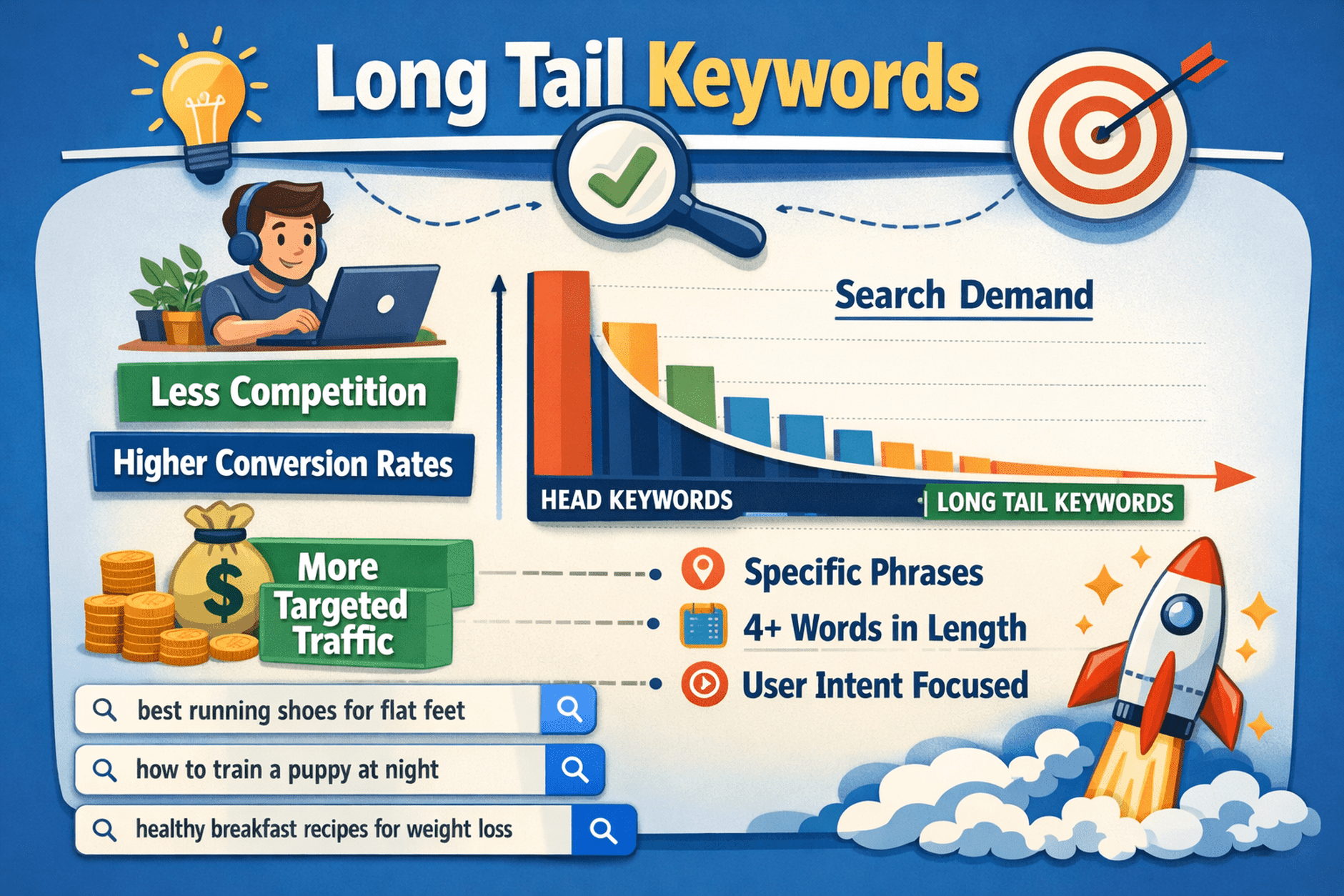
Head terms typically exhibit high search volume and intense competition. Long tail keywords, by contrast, display lower demand but stronger intent clarity. The practical differences extend beyond difficulty metrics:
Head terms demand significant authority and link equity
Long tail keywords reward relevance and specificity
Head terms emphasize visibility
Long tail keywords emphasize efficiency
The compounding behavior of long tail queries is frequently underestimated. A single well-structured resource can rank for hundreds of semantically related searches without explicitly targeting each variation.
Advanced Long Tail Keyword Discovery
Mining Query Data from Google Search Console
One effective technique involves analyzing performance data from Google Search Console. Exporting long-range query datasets and filtering low-impression terms often reveals emerging patterns before they appear in commercial tools. These queries represent early demand signals rather than established keywords.
Vector-Based Clustering and Semantic Grouping
Traditional keyword tools struggle with sparse queries. Embedding models and clustering techniques can group thousands of phrases by semantic similarity, exposing opportunities where a single page can satisfy multiple related intents.
This approach is particularly useful in technical or specialized domains where wording varies widely but underlying needs remain consistent.
Competitive SERP Gap Analysis
Platforms like Ahrefs and Semrush allow analysis of competitor rankings at scale. Identifying instances where competitors rank incidentally for long tail keywords can uncover low-effort optimization opportunities. These gaps often indicate structural weaknesses rather than authority deficits.
Mapping Long Tail Keywords to Content Architecture
Dominant Intent Alignment
Long tail keywords succeed when mapped to clear intent categories. Problems arise when multiple intent types are forced onto a single URL. Informational, commercial, and transactional queries each require distinct content formats.
For example:
“What are long tail keywords in SEO” aligns with educational guides
“Long tail keyword tools comparison” fits structured comparisons
“Buy Ahrefs subscription” belongs on transactional pages
Search systems favor pages with coherent intent signals. Mixing purposes dilutes relevance and suppresses ranking potential.
Hub-and-Spoke Structures
A scalable architecture typically combines central topic hubs with supporting long tail resources. Internal linking using descriptive anchors reinforces topical relationships and improves crawl efficiency. Smaller sites, however, must avoid excessive segmentation that leads to thin content.
Measuring Long Tail SEO Impact
Beyond Individual Keyword Tracking
Long tail queries often fall below visibility thresholds in analytics dashboards. Evaluating landing page performance rather than isolated keywords provides a clearer picture of impact. Pages optimized for specificity should demonstrate improvements in engagement, assisted conversions, and ranking breadth.
Impression Growth as an Early Signal
Aggregate impression growth across low-volume queries frequently indicates expanding topical authority. Even when clicks remain modest, rising query diversity signals stronger semantic relevance within ranking systems.
Interpreting Conversion Discrepancies
It is common for ranking keyword counts to grow faster than session totals. This does not necessarily indicate failure. Long tail optimization often prioritizes high-intent traffic, where revenue gains outpace raw visit increases.
When Long Tail Strategies Underperform
SERP Volatility and Intent Shifts
Emerging industries and fast-moving topics can destabilize long tail performance. Narrowly optimized pages may lose relevance as user expectations evolve. Continuous monitoring and content updates are required to maintain alignment.
Over-Fragmentation and Cannibalization
Creating multiple pages targeting minor variations of the same query can trigger ranking instability. Consolidation, canonicalization, and clearer topical boundaries resolve most cannibalization issues.
Execution Quality Constraints
Low competition does not compensate for weak content, poor UX, or inadequate internal linking. Long tail keywords amplify relevance advantages but cannot overcome structural deficiencies.
Long Tail Keywords in AI-Driven SERPs
Resilience in Zero-Click Environments
Highly specific queries are less likely to be fully satisfied by snippets or summaries. Systems like the Google Search Generative Experience still depend on source documents, increasing the likelihood that comprehensive long tail content is referenced or cited.
Conversational and Voice Query Alignment
Voice interfaces naturally produce long tail phrasing. Optimization strategies increasingly emphasize structured content, concise answer sections, and schema markup to improve visibility within AI-mediated search experiences.
Conclusion
Long tail keywords function as an intent-optimization mechanism rather than a volume tactic. By reducing ambiguity and improving semantic alignment, they enhance ranking efficiency, engagement, and conversion potential. Their true strength lies in cumulative effects and strategic integration within content architecture.
When treated as a precision model instead of a scale strategy, long tail optimization becomes a durable growth lever. Continued experimentation, careful intent mapping, and performance analysis remain essential for sustained results. For deeper exploration, consult Google Search Central.
More Articles
A Practical Roadmap to Mastering SEO Ranking Factors That Drive Sustainable Traffic
How Domain Age Impacts SEO Trust Rankings and Buying Decisions
What Is a Content Strategy Framework and How Does It Guide Better Decisions
How Voice Search Optimization Helps Small Businesses Get Found by Customers
GEO vs SEO vs AEO Which Strategy Drives More Visibility for Modern Websites

FAQs
What are long tail keywords?
Long tail keywords are longer, more specific search phrases that people use when they know exactly what they’re looking for. They usually have lower search volume than broad keywords but attract more targeted traffic.
How are long tail keywords different from short keywords?
Short keywords are broad and competitive, like “shoes” or “marketing tips.” Long tail keywords are more detailed, such as “best running shoes for flat feet” or “digital marketing tips for small restaurants.”
Why do long tail keywords help improve search traffic?
They help by attracting users who are closer to making a decision. Even though fewer people search for them, those users are more likely to engage, stay longer, or convert.
Do long tail keywords really rank faster?
In many cases, yes. Because they face less competition, new or smaller websites often find it easier to rank for long tail keywords compared to highly competitive broad terms.
Are long tail keywords only useful for small websites?
No. While they’re great for smaller sites, large websites also use long tail keywords to capture niche searches, answer specific questions and support topic depth across their content.
How do long tail keywords affect user intent?
They usually match clearer intent. Someone searching a long, detailed phrase often knows what problem they want to solve, which helps your content align better with their expectations.
Can long tail keywords still bring meaningful traffic?
Yes. Individually they may bring small amounts of traffic but when combined across many pages, long tail keywords can drive a significant and steady flow of highly relevant visitors.