Cloud Content Strategy vs Traditional Content Planning Which Drives Better Business Growth
Cloud Content Strategy vs Traditional Content Planning
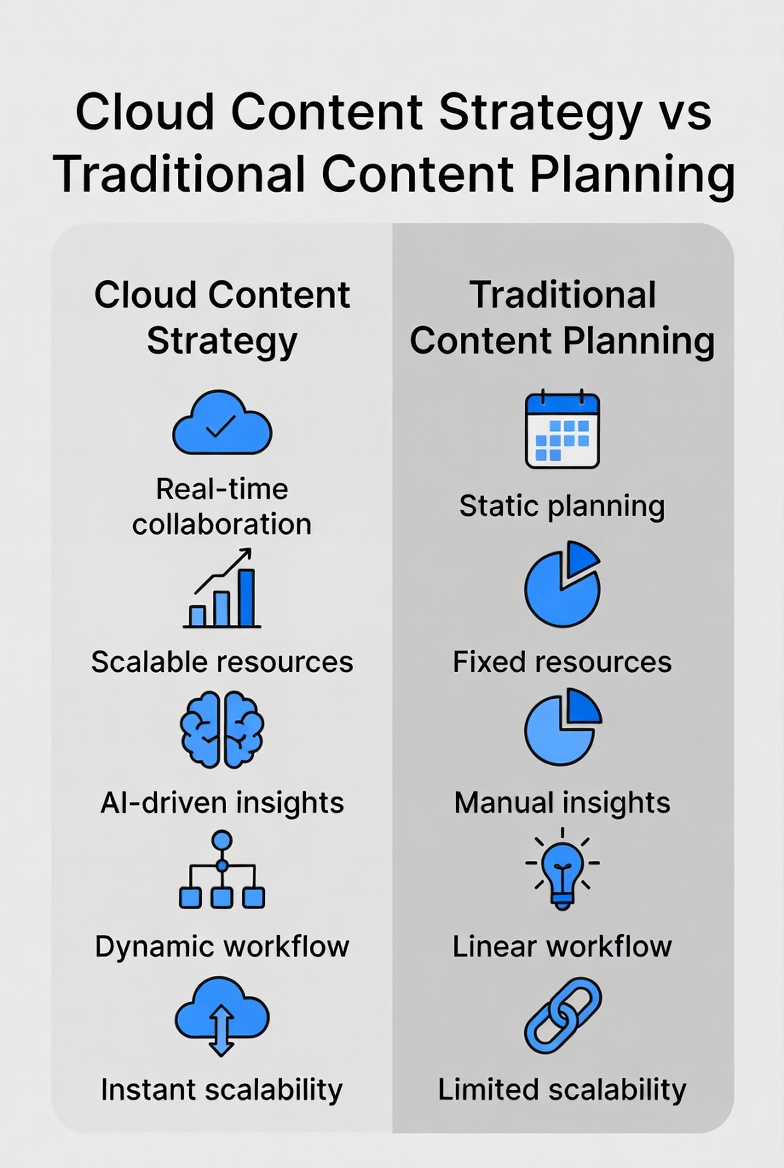
Content operations have evolved from static editorial calendars into distributed, API-driven systems that resemble software architectures. Traditional content planning typically depends on monolithic CMS platforms, linear approvals, and fixed publishing cycles. A cloud content strategy, by contrast, uses headless platforms, real-time analytics, and CI/CD-style governance to accelerate publishing, personalize experiences, and scale across channels. The difference is mechanical rather than philosophical: cloud models decouple content from presentation, enabling rapid iteration, experimentation, and localization.
Yet cloud adoption is not a universal growth lever. Without governance, organizations risk content debt, API sprawl, and fragmented brand semantics. The right approach depends on how architecture, data flow, and performance constraints align with organizational maturity and growth pressure.
Architectural Foundations: From CMS to Composable Systems
A cloud content strategy restructures content infrastructure from document-centric workflows into modular, API-driven ecosystems. Traditional planning often relies on tightly coupled CMS platforms or shared repositories with rigid taxonomies. Cloud-native models separate content from front-end presentation using headless systems such as Contentful and Sanity, while assets reside in object storage like AWS S3 or Google Cloud Storage.
This decoupling unlocks parallel workstreams. Marketing, design, and engineering teams can modify schemas, interfaces, or delivery logic independently, reducing release friction. Organizations adopting headless architectures frequently report release cycle reductions of 30–50% compared to legacy stacks. Faster iteration improves responsiveness during short market windows, where delayed campaigns translate directly into lost revenue opportunities.
Performance gains reinforce these benefits. Cloud-based delivery via CDNs and edge caching can achieve sub-200ms Time to First Byte globally, versus significantly higher latency typical of on-premise systems. Because engagement metrics and search visibility are highly sensitive to load speed, improvements in Core Web Vitals become easier to sustain within distributed cloud environments.
However, compliance constraints may limit full cloud migration. Industries with strict data residency requirements often benefit from hybrid architectures that centralize sensitive content while distributing delivery and orchestration layers.
Workflow Automation and Governance Mechanics
Traditional content planning is heavily manual. Editorial calendars, email approvals, and ad-hoc version control introduce delays and errors as teams scale. Cloud systems replace these patterns with programmable workflows using lifecycle states, role-based access control, and event triggers.
For example, publishing actions can automatically invalidate CDN caches, notify analytics tools such as GA4 or Adobe Analytics, initiate experiments, and log compliance records. State-machine governance ensures assets cannot progress without validation checks, reducing broken links, outdated content, and inconsistent metadata.
Automation delivers compounding efficiency once content volume and contributor count exceed a threshold. Enterprises shifting to cloud-based workflows commonly observe dramatic reductions in draft-to-publish timelines. Smaller teams, however, may see diminishing returns if tooling overhead outweighs operational complexity.
To evaluate workflow improvements, organizations should monitor mean time to publish, revision frequency, and asset error rates rather than relying on anecdotal productivity gains.
Data-Driven Decision Engines and Feedback Loops
One of the strongest advantages of a cloud content strategy is its integration with streaming analytics and experimentation frameworks. Traditional planning typically evaluates performance retrospectively through periodic reports. Cloud systems ingest structured interaction events in near real time, enabling dynamic reprioritization.
Content engagement signals – scroll depth, dwell time, assisted conversions – can flow into warehouses such as BigQuery or Snowflake, where machine learning models classify effectiveness. This architecture reveals revenue influence patterns that last-click attribution often obscures.
In practice, organizations frequently uncover hidden drivers of pipeline or conversion growth after migrating to multi-touch attribution. Content clusters once considered low priority may prove decisive in early-stage user education or consideration journeys.
Still, quantitative feedback loops require statistical discipline. Early-stage brands with low traffic risk misinterpreting noise as trend. In such contexts, qualitative inputs – customer interviews, editorial expertise – should complement analytics until interaction volumes reach reliable thresholds.
Effective testing strategies rely on hypothesis-driven A/B or multivariate experiments with defined confidence criteria rather than opportunistic iteration.
Scalability and Performance Economics
Growth is constrained not only by content volume but by marginal cost efficiency. Traditional planning systems often scale linearly or worse: more content demands more coordination, infrastructure, and manual oversight. Cloud-native stacks introduce elastic scaling, where storage, compute, and delivery costs adjust dynamically.
Object storage and CDN-based delivery models typically offer predictable cost curves compared to fixed on-premise infrastructure. Performance improvements further enhance ROI. Even small latency reductions measurably influence conversion rates, session depth, and search engagement metrics.
Not all workloads benefit equally. Personalization-heavy content strategies may incur higher compute costs due to edge logic execution, as seen with Cloudflare Workers. Static libraries and globally distributed assets, however, often achieve strong efficiency gains.
Validation requires empirical testing. Load simulations and performance audits help quantify how infrastructure elasticity behaves under traffic spikes or campaign bursts.
Collaboration Models: Distributed Teams and Version Control
Modern content production is rarely centralized. Cloud content systems support distributed collaboration through real-time editing, optimistic locking, and version histories resembling software repositories. Contributors can work concurrently without overwriting changes, while rollback mechanisms reduce recovery time from errors.
Decentralized models accelerate regional adaptation and localization workflows. Local teams can iterate independently while schema enforcement preserves structural consistency. In multinational environments, this often translates into faster turnaround times and reduced coordination bottlenecks.
Yet decentralization introduces semantic risk. Without controlled vocabularies and validation rules, brand voice and taxonomy coherence may degrade. Strong content modeling remains essential to balance autonomy with consistency.
Risk, Compliance, and When Traditional Planning Prevails
Despite its growth advantages, a cloud content strategy introduces new operational risks. Privacy regulations, vendor dependencies, and API exposure require rigorous governance. Compliance certifications from cloud providers reduce friction but do not eliminate organizational responsibility.
Traditional planning systems may remain preferable where external connectivity is restricted or where content governance prioritizes control over agility. Migration complexity also represents a hidden cost vector. Legacy repositories with inconsistent metadata often require extensive normalization before automation yields benefits.
A pragmatic strategy may blend both approaches: retain traditional planning for regulated or archival content while deploying cloud orchestration for growth-oriented channels.
Risk assessments should examine vendor lock-in scenarios, portability testing, and security validation rather than focusing solely on feature parity.
Measurement Framework: Determining Growth Impact
Debates between cloud and traditional planning should ultimately be resolved through measurement. Growth effects typically manifest across four dimensions:
Speed to publish
Content reuse efficiency
Performance metrics (LCP, latency)
Revenue attribution accuracy
Controlled pilots provide the most reliable insight. Migrating a single content vertical while maintaining a traditional baseline elsewhere allows organizations to isolate causal impact over defined time horizons.
Observability and analytics maturity are critical. Without instrumentation, strategic decisions risk being driven by perception rather than evidence.
Conclusion
Cloud content strategy excels when growth depends on iteration speed, scalable distribution, and continuous feedback loops. By treating content as modular, versioned assets within programmable workflows, organizations compress publishing cycles, improve performance stability, and reveal deeper attribution patterns.
Traditional planning retains value where compliance, brand control, or operational simplicity dominate priorities. The practical imperative is not wholesale replacement but architectural alignment. When cloud systems are governed effectively and measured rigorously, they function as compounding growth engines rather than mere tooling upgrades.
More Articles
What Is a Content Strategy Framework and How Does It Guide Better Decisions
How to Improve AI Search Visibility for Your Website Without Technical Complexity
Practical AI Deployment Best Practices Every Business Can Use Successfully Safely
GEO vs SEO vs AEO Which Strategy Drives More Visibility for Modern Websites
Essential Checklist for Adopting Headless WordPress Trends That Improve Site Performance

FAQs
What is the main difference between a cloud content strategy and traditional content planning?
A cloud content strategy relies on cloud-based platforms to create, manage and distribute content in real time, while traditional content planning usually follows fixed schedules, manual workflows and on-premise tools. The cloud approach is more flexible and data-driven, whereas traditional planning is more linear and slower to adapt.
Which approach supports faster business growth?
Cloud content strategies generally support faster growth because they allow teams to publish quickly, respond to market changes and scale content across channels without major delays. Traditional planning can still work and it often struggles to keep up with fast-moving customer expectations.
Is traditional content planning still useful today?
Yes, traditional content planning can still be useful for businesses with stable markets, limited channels, or strict approval processes. But, it may limit experimentation and speed, which are often needed for competitive growth in digital-first industries.
How does collaboration differ between the two approaches?
Cloud content strategies make collaboration easier by allowing multiple teams to work on the same content simultaneously from different locations. Traditional planning often relies on emails, offline documents, or sequential handoffs, which can slow down teamwork.
What role does data play in cloud-based content strategies?
Data plays a central role in cloud strategies, helping teams track performance, personalize content and optimize based on real-time insights. Traditional content planning usually depends more on past experience and less on continuous performance data.
Which approach is better for scaling content across multiple channels?
Cloud content strategies are better suited for scaling because content can be reused, adapted and distributed across platforms quickly. Traditional planning often requires recreating or manually adjusting content for each channel, which limits scale.
Does moving to a cloud content strategy require a big mindset shift?
Yes, it often requires teams to think more iteratively and embrace ongoing updates instead of fixed plans. While this shift can be challenging at first, it usually leads to more agile decision-making and stronger long-term business growth.