Your Roadmap to Calculating Automation ROI and Justifying Its Value
Mastering Automation ROI Calculation in Modern Enterprises
Accurate automation ROI calculation is essential for organizations scaling workflow automations, yet many companies still rely on simplistic cost-benefit models. These approaches often underestimate value, misattribute savings, and ignore strategic benefits. The real impact of intelligent automation extends far beyond labor reduction, influencing data integrity, risk mitigation, operational velocity, and competitive advantage.
Understanding automation ROI requires a disciplined financial and operational framework that quantifies both direct and indirect returns while accounting for implementation trade-offs and long-term costs.
Why Traditional ROI Models Fall Short
Many automation initiatives are justified using basic assumptions like hours saved multiplied by salary cost. While intuitive, this method fails to capture systemic improvements created by automation.
Automation does not merely accelerate tasks. It alters how processes behave by improving accuracy, consistency, auditability, and scalability. Ignoring these mechanisms leads to undervaluation or distorted projections.
For example, automating document processing using RPA and OCR does more than reduce handling time. It eliminates human data entry errors, reduces rework cycles, improves compliance accuracy, and accelerates downstream workflows.
If manual error rates average 3 percent and each correction costs $50, reducing errors to 0.1 percent in a workflow processing 10,000 items monthly yields:
$50 × 10,000 × (0.03 − 0.001) = $14,500 monthly savings
This value originates from error reduction rather than time savings alone.
Core Drivers of Automation ROI
Resource Optimization
Automation improves utilization of human capital by reallocating effort from repetitive tasks to higher-value work. This often manifests as capacity liberation rather than workforce reduction.
If a manual onboarding process requires 30 minutes per transaction at a burdened cost of $40 per hour, and automation reduces it to 5 minutes for 500 transactions monthly:
Time saved = 25 minutes × 500 = 12,500 minutes = 208 hours
Annualized impact = 1.44 FTE equivalents
Potential value = $110,592 annually
Error Reduction and Process Fidelity
Automation enforces rules consistently, reducing deviations and exceptions. This minimizes rework, improves data quality, and prevents costly operational failures.
Human error compounds across systems. A small reduction at the input stage can significantly improve downstream efficiency and compliance accuracy.
Throughput and Scalability
Unlike manual workflows, automated processes operate continuously. Increased throughput enables organizations to scale operations without proportional cost increases.
For high-volume workflows like claims processing or fraud detection, automation can increase processing capacity by multiples rather than percentages, often unlocking revenue opportunities or eliminating backlogs.
Quantifying Tangible Benefits
Tangible benefits are measurable and form the foundation of defensible ROI calculations.
Labor and FTE Impact
Automation either reduces required effort or increases output per employee. Both outcomes generate financial value when validated properly.
Operational Expenditure Reduction
Automation reduces printing, scanning, storage, reconciliation, and manual coordination costs. These savings are frequently overlooked.
For instance, eliminating manual invoice scanning for 5,000 invoices monthly can produce substantial reductions in both materials and labor expenses.
Cycle Time Reduction
Shorter processing times improve responsiveness, accelerate decision-making, and enhance customer satisfaction.
Strategic and Indirect Value Creation
Beyond direct savings, automation generates high-impact strategic benefits.
Decision Velocity
Automated data pipelines and reporting eliminate delays in insight generation. Faster decisions can directly influence revenue, service quality, and risk exposure.
A 1 percent improvement in conversion rates due to real-time reporting can translate into significant revenue gains.
Risk and Compliance Enhancement
Automation embeds compliance logic into workflows, reducing regulatory exposure. Even modest reductions in the probability of large penalties can justify investments.
A 10 percent reduction in the likelihood of a $1 million compliance failure represents a $100,000 risk mitigation value.
Employee and Customer Experience
Automation removes repetitive work, improving employee satisfaction and retention. Higher retention reduces recruitment and training costs while preserving institutional knowledge.
Improved customer experiences through faster service and fewer errors can increase loyalty and lifetime value.
Understanding Total Cost of Ownership for Automation
Accurate ROI analysis must incorporate full TCO rather than just initial licensing costs.
Software Licensing
Costs vary by vendor and scale. Enterprise RPA platforms often price per bot or per usage tier.
Infrastructure
Bots require computing resources, whether on-premises or cloud-based. Infrastructure expenses grow with scale and must be modeled realistically.
Development and Implementation
Complex workflows require significant design, engineering, and testing efforts. These costs can exceed licensing expenses.
Maintenance and Support
Automations require continuous monitoring and updates. UI-dependent bots may incur higher maintenance overhead due to application changes.
Training and Change Management
Adoption costs are critical yet frequently underestimated. Poor change management can erode expected returns.
Advanced Financial Metrics for Automation Justification
Sophisticated investment decisions require more than simple payback calculations.
Payback Period
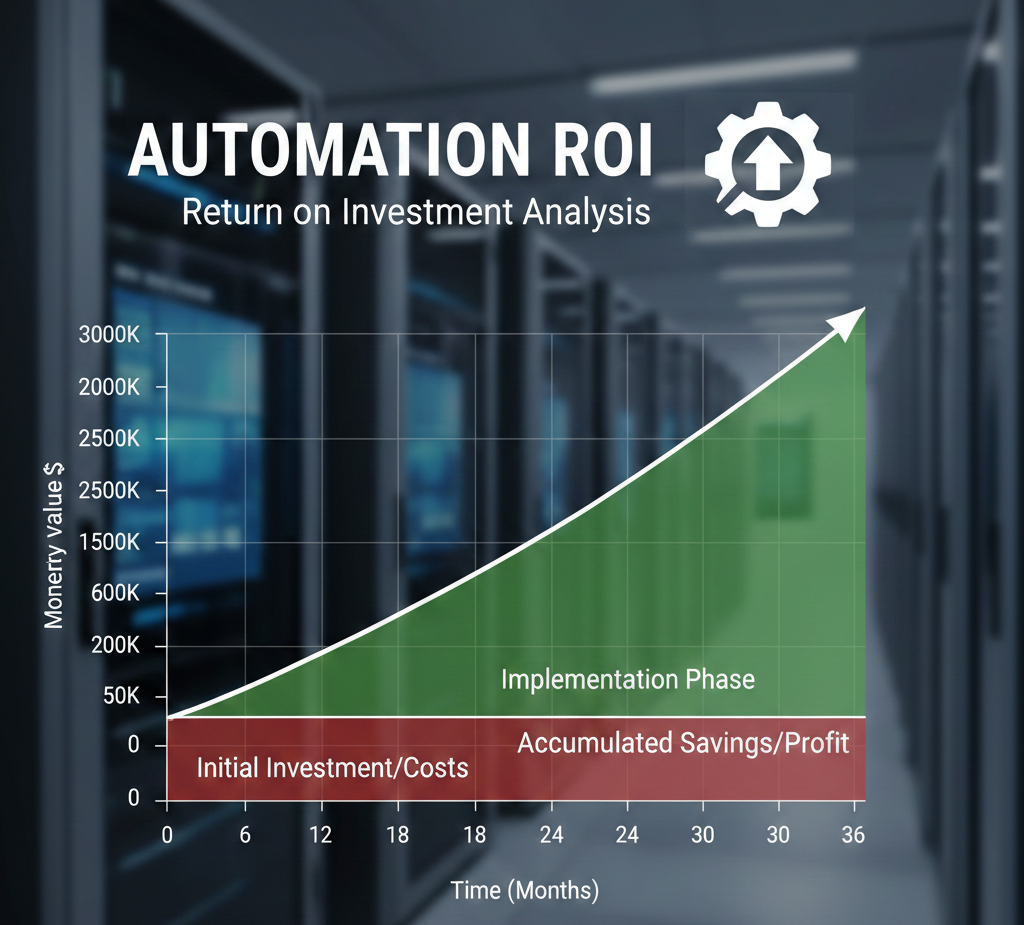
Indicates how quickly investment costs are recovered but ignores long-term value and time value of money.
Net Present Value
NPV discounts future cash flows to present value, enabling more accurate investment comparison. Positive NPV indicates value creation beyond capital costs.
Internal Rate of Return
IRR estimates the effective annual return of the project. Values exceeding the organization’s hurdle rate typically justify investment.
These metrics depend heavily on accurate assumptions. Sensitivity analysis is therefore essential.
Deployment Trade-offs That Affect ROI
Automation success depends on understanding architectural and operational trade-offs.
RPA vs API-Driven Automation
RPA offers rapid deployment but may be fragile under UI changes. API-based integrations require more effort but offer long-term resilience.
Short-term gains must be balanced against maintenance costs and system stability.
Process Stability and Suitability
Unstable or poorly defined workflows are poor automation candidates. Attempting automation prematurely creates technical debt and reduces ROI.
Process optimization often precedes successful automation.
Cost of Change
Frequent updates in source systems increase maintenance demands. Automation design must account for environmental volatility.
Human Experience Considerations
Over-automation of sensitive or complex interactions can degrade customer experience. Efficiency gains should not compromise trust or satisfaction.
Verification and Testing for Realistic ROI Realization
ROI projections must be validated through structured measurement and monitoring.
Baseline Establishment
Document the pre-automation state, including cycle times, error rates, resource utilization, and exception frequency.
Process mining tools can provide precise behavioral insights.
Continuous Performance Monitoring
Track KPIs such as processing time, error rates, throughput, and exception levels. Real-time dashboards enable rapid assessment.
Comparative Validation
Where feasible, compare automated workflows against manual processes to isolate impact.
Financial Reconciliation
Translate observed improvements into financial outcomes using consistent cost models. Collaboration with finance teams ensures credibility.
Scaling Automation for Sustained ROI
Long-term value emerges from scalable automation strategy rather than isolated deployments.
Architectural Foundations
Prioritize API-first integrations, modular workflow design, and centralized orchestration platforms to ensure resilience and maintainability.
Automation Center of Excellence
A CoE standardizes practices, manages opportunity pipelines, governs quality, and reduces technical debt.
It transforms automation into a strategic capability rather than a collection of tools.
Continuous Optimization
Automation environments evolve. Sustained ROI requires ongoing measurement, refinement, and governance.
Conclusion
Automation ROI calculation is not a one-time financial exercise but an ongoing discipline. True value lies in systemic improvements such as error reduction, cycle time compression, risk mitigation, and enhanced decision velocity.
Organizations that rigorously model TCO, validate outcomes, and architect for scale transform automation from tactical efficiency projects into durable competitive advantages.
More Articles
Practical AI Deployment Best Practices Every Business Can Use Successfully Safely
A Practical Roadmap to Privacy Compliant Analytics Without Sacrificing Business Insights
What Is a Content Strategy Framework and How Does It Guide Better Decisions
A Practical Roadmap to Mastering SEO Ranking Factors That Drive Sustainable Traffic

FAQs
Why bother calculating ROI for automation projects?
Calculating ROI isn’t just a formality; it’s absolutely crucial for understanding the real impact of your automation efforts. It helps you see beyond initial costs, reveal the actual value generated and make a strong, data-backed case for future investments. Without it, you’re essentially flying blind and missing opportunities to showcase success.
What kind of benefits should I look at besides just saving money?
While direct cost savings (like reduced labor hours) are a big one, don’t stop there! Think about increased productivity, better data accuracy, reduced errors, faster processing times, improved employee satisfaction (by freeing them from repetitive, mundane tasks), enhanced customer experience and even better compliance or risk management. A comprehensive view paints a much richer picture of value.
How do I even begin to calculate automation ROI?
Start by identifying the specific processes you want to automate and then gather baseline data. This means understanding current costs (labor, errors, time spent), performance metrics and any existing pain points. Once you have that solid baseline, you can project the improvements automation will bring and quantify them against your initial investment and ongoing operational costs.
What are some common challenges people face when trying to justify automation’s value?
A big one is not having good baseline data before automation, which makes it hard to show clear improvements later. Another challenge is focusing too narrowly on only direct cost savings and overlooking those ‘softer’ benefits like improved employee morale or faster market response. Also, sometimes the initial investment can seem high, so clearly articulating the long-term gains is key.
How do I convince my leadership that automation is a smart investment?
The best way to convince leadership is with a clear, data-driven business case. Show them the calculated ROI, highlighting both the monetary savings and the strategic benefits. Frame it in terms of how automation helps achieve company goals, like boosting overall efficiency, improving customer service, or gaining a competitive edge. Speak their language – the language of value and impact.
Is there a ‘right’ time to calculate automation ROI?
Absolutely! It’s best to calculate ROI before you even start a project to build a strong justification and set expectations. Then, you should re-evaluate it during and after implementation to track actual performance, ensure you’re on track and demonstrate the achieved value. This full lifecycle approach gives you the most insight and continuous improvement opportunities.
Should I focus on quick wins or long-term strategic automation projects?
Both have their place! Quick wins can build momentum, demonstrate value quickly and help gain buy-in for future projects. They often provide immediate relief and show tangible benefits fast. But, don’t neglect the strategic, larger-scale projects that might have a longer payback period but offer significantly greater long-term transformation and competitive advantage. A balanced approach often works best, using quick wins to fund and justify bigger initiatives.