Your Practical Checklist to Optimize Website Content for SGE Success
Understanding Google’s Search Generative Experience (SGE)
Google’s Search Generative Experience represents a structural transformation in how information is retrieved and presented. Instead of relying primarily on keyword matching and ranked links, SGE uses generative AI to synthesize direct answers. Content is no longer optimized only to be crawlable but to be inherently answerable. This shift demands that publishers design pages as reliable knowledge sources that AI systems can confidently interpret, extract, and recombine.
SGE relies on large language models combined with retrieval mechanisms that gather information from multiple documents. The system first interprets user intent, then retrieves candidate sources, validates relevance and consistency, and finally generates a concise AI snapshot. Because synthesis replaces simple ranking, visibility increasingly depends on clarity, structure, factual reliability, and semantic completeness rather than keyword placement alone.
From Ranking to Answerability
Traditional SEO emphasized ranking signals, but SGE prioritizes whether content can be safely and accurately synthesized. Pages must present ideas in a form that machines can easily interpret. This means anticipating conversational queries, addressing user intent directly, and presenting logically structured explanations rather than loosely connected paragraphs.
For example, a technical guide explaining a Kubernetes ingress controller is far more useful when it clearly defines components, explains relationships, and provides step-by-step guidance. Explicit explanations of concepts reduce ambiguity for both users and AI systems. Precision, not verbosity, becomes the primary optimization goal.
Semantic Structuring for AI Consumption
Semantic organization becomes foundational in the SGE era. Content should be constructed like a modular knowledge base rather than a linear article. Each section should answer a specific question or explain a discrete concept. Clear sub-topics, definitions, and logical flows help AI systems isolate relevant segments for retrieval-augmented generation.
Using meaningful HTML structure improves machine readability. Elements such as <article>, <section>, and <dfn> provide contextual signals beyond generic <div> containers. Clearly labeled segments like prerequisites, steps, examples, and verification stages allow systems to extract information without misinterpretation.
An article discussing the impact of 5G on IoT security, for instance, benefits from clearly separated discussions of vulnerabilities, encryption models, and network architecture changes. Well-defined sections mirror how AI retrieval systems parse and synthesize knowledge.
Entities and Knowledge Graph Alignment
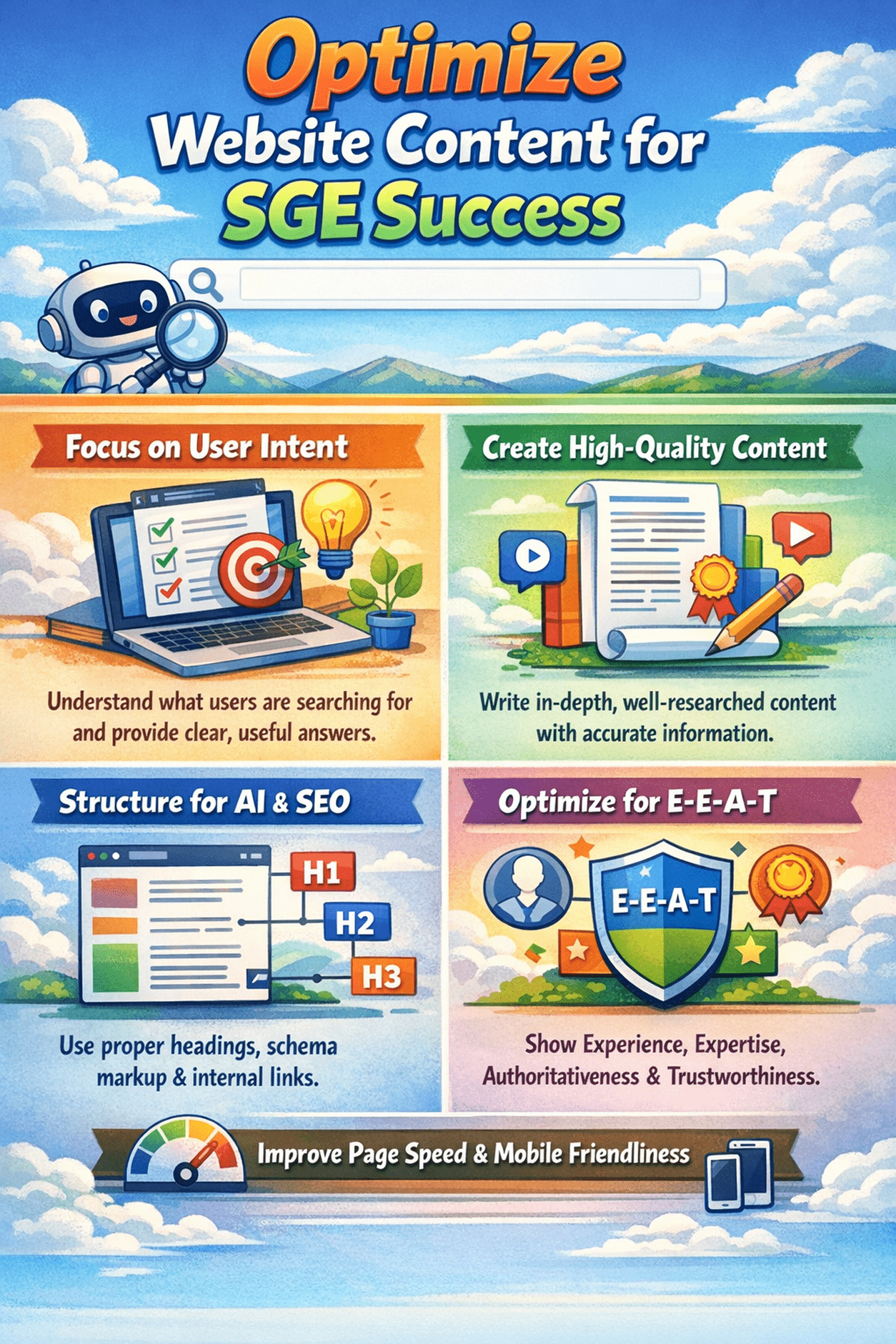
SGE systems heavily depend on entity recognition and relationships. Structured data plays a decisive role in helping search engines interpret what a page represents. Schema markup clarifies whether content describes a tutorial, product, event, or FAQ, enabling more reliable AI interpretation.
Granular schema implementation improves content eligibility for generative summaries. A detailed HowTo schema for a Stripe API integration tutorial can explicitly describe supplies, tools, and steps. This structured context allows search systems to treat the page as authoritative instructional content rather than generic text.
Beyond schema types, accuracy of properties matters. Rich metadata strengthens connections to recognized entities within Google’s knowledge systems and improves retrieval confidence.
Accuracy, Trust, and E-E-A-T Signals
Generative search amplifies the importance of credibility. AI systems aim to minimize the risk of propagating inaccurate or speculative information. Content must therefore demonstrate expertise, experience, authoritativeness, and trustworthiness.
Claims should be supported by verifiable sources, especially for technical or data-driven topics. Referencing standards bodies like IEEE or benchmarks such as MLPerf increases factual reliability. Unsupported assertions or vague generalizations weaken a site’s perceived authority.
Transparency also contributes to trust. Author information, editorial policies, and organizational context help search systems evaluate credibility. Consistency across pages further strengthens confidence, while contradictions can degrade retrieval preference.
Technical Foundations Beyond Core Web Vitals
Performance metrics remain important, but SGE introduces new technical priorities. Efficient retrieval and parsing require fast server responses and clean HTML structures. Slow time-to-first-byte can affect crawling efficiency and content processing frequency.
Content critical for answering queries should be available early in the rendering process. Excessive reliance on delayed client-side JavaScript risks obscuring key information. Even if visual metrics appear acceptable, delayed text availability may hinder AI extraction.
Tools like Lighthouse and Chrome DevTools help diagnose render-blocking resources and structural inefficiencies. Optimization now supports not just user experience but also machine interpretability.
Interlinking as a Knowledge Architecture Strategy
Internal linking evolves from navigation to knowledge modeling. Well-designed links help search systems understand conceptual relationships across a domain. Descriptive anchor text conveys semantic meaning that generic phrases cannot.
A pillar article on microservices architecture, for example, should link contextually to supporting discussions of containerization, orchestration, and API management. This network forms an internal knowledge graph, signaling topical depth and domain expertise.
Structured relationships between pages increase the probability that retrieval systems will traverse multiple documents from the same site, improving synthesis completeness.
Monitoring Performance in a Generative Environment
Direct SGE analytics remain limited, requiring indirect evaluation strategies. Observing changes in impressions, clicks, and query patterns in Google Search Console can reveal shifts caused by AI snapshots.
Manual query testing provides qualitative insight. Examining how summaries are generated, which sources are referenced, and whether information is accurately represented helps identify structural or clarity gaps.
Iterative refinement becomes essential. Updating sections, improving definitions, and enhancing structured data can influence how content is retrieved and synthesized over time.
Managing Legacy Content Strategically
Older content often lacks semantic structure or entity clarity. Rather than rewriting entire archives, prioritization ensures efficient modernization. High-value pages warrant comprehensive restructuring, while moderate pages benefit from improved headings and summaries.
Updating legacy material to reflect current concepts and terminology also improves relevance. Adding freshness indicators and clarifying definitions helps maintain utility within evolving generative systems.
Designing for Dynamic AI Responses
SGE outputs vary based on context, timeliness, and query interpretation. Robust content design anticipates this variability by emphasizing completeness, consistency, and regular updates.
Timely revisions maintain relevance for rapidly changing subjects. Comprehensive coverage supports diverse query interpretations. Factual consistency across pages reinforces domain trustworthiness.
Content should be treated as a living knowledge asset continuously refined for clarity, accuracy, and machine readability.
Conclusion
Search Generative Experience redefines optimization priorities. Visibility increasingly depends on whether content can serve as a reliable input for AI synthesis. Semantic clarity, structured relationships, technical accessibility, and demonstrable credibility become decisive advantages.
Success in this environment requires moving beyond keyword strategies toward knowledge engineering. Pages must communicate not just information but structured, verifiable understanding. Those who design content for both human comprehension and machine interpretation will be best positioned within the generative search landscape.
More Articles
Unlock Smarter Answers 7 Ways Generative AI Transforms Your Online Search
7 Actionable Steps to Build Topical Authority for Better Search Rankings
How to Fix a Slow WordPress Site and Boost Your Website Speed
The Ultimate Checklist for Ethical and Effective Generative Content Creation

FAQs
What exactly is SGE and why is it a big deal for my website?
SGE, or Search Generative Experience, is Google’s new AI-powered search experience. It provides summarized answers directly in the search results, often pulling insights from various websites. It’s a big deal because it changes how users find data, potentially reducing clicks to individual sites if their content isn’t seen as the definitive, in-depth source that the AI references or links to.
How is optimizing for SGE different from traditional SEO practices?
While traditional SEO focused heavily on keywords and backlinks to rank, SGE optimization shifts the focus more towards providing comprehensive, authoritative. well-structured answers to user questions. It’s less about just ranking for a term and more about being the most helpful, trustworthy. complete source that an AI can easily grasp and synthesize.
What are the absolute must-do’s for my content to succeed with SGE?
You’ll want to focus on clarity, conciseness. comprehensiveness. Make sure your content directly answers user questions, is well-organized with clear headings and lists, demonstrates expertise and authority. is regularly updated. Think about being the ultimate resource for a topic, not just one piece of the puzzle.
Should I still bother with keywords when optimizing for SGE?
Yes, absolutely. the approach changes. Keywords still help SGE grasp your content’s topic and context. But, instead of just stuffing them, focus on natural language, semantic relevance. answering the underlying questions behind those keywords. Think about the full range of related questions a user might have, not just single terms.
How can I make my website content appear more trustworthy and authoritative for SGE?
To build trust, ensure your content is fact-checked and up-to-date. Cite your sources, include author bios with credentials. back up claims with data or expert opinions. The more credible and transparent your details is, the more likely SGE (and users!) will see it as a reliable source.
What kind of content structure works best for SGE to easily interpret and use my data?
Think ‘easy to digest.’ Use clear, descriptive headings (H1, H2, H3), bullet points, numbered lists. tables to break up data. Keep paragraphs concise and ensure a logical flow from one idea to the next. A well-structured piece is easier for both AI and human readers to scan and comprehend quickly.
Will SGE affect how much traffic my website gets?
It might. SGE could answer some queries directly within the search results, potentially reducing direct clicks to your site for simple questions. But, if your content is cited by SGE as a primary source or offers deeper insights than the summary, it could also drive more qualified traffic from users looking for comprehensive insights. The key is to be the go-to resource.