Unlock SEO Success With This Content Optimization Software Selection Checklist
Strategic Role of Content Optimization Software
Selecting content optimization software has evolved from a tactical SEO choice into a strategic growth decision. Modern search visibility depends not just on keywords but on how well content aligns with semantic relevance, user intent, and topical authority. Advanced platforms reflect how Google’s ranking systems interpret language, making optimization a discipline grounded in context rather than repetition.
Semantic Analysis as the Algorithmic Foundation
High-caliber tools rely on Natural Language Processing (NLP) and Natural Language Understanding (NLU) models that approximate the behavior of systems like RankBrain, BERT, and MUM. Instead of measuring keyword density, they evaluate semantic relationships, entities, and contextual depth.
The process typically involves analyzing large sets of top-ranking SERP documents. Algorithms extract entities, themes, subtopics, and recurring user questions, forming a semantic blueprint of authoritative content. For example, optimizing for “electric vehicles” should naturally involve related concepts such as battery technology, charging infrastructure, regulatory incentives, and emissions impact. True optimization expands coverage rather than inflating keyword usage.
Many platforms still incorporate variations of TF-IDF, but modern implementations combine statistical weighting with neural embeddings. This allows detection of semantically related phrases even when exact keywords differ, improving topical alignment without encouraging mechanical writing.
Competitive SERP Analysis and Gap Identification
Effective optimization depends on understanding why competitors rank, not simply who ranks. Advanced tools deconstruct leading pages by examining structural and semantic patterns:
- Heading hierarchies and logical flow
- Content depth and thematic clusters
- Media usage and formatting
- Internal and external linking signals
- Readability and engagement indicators
Consider queries like “best espresso machine.” Tools may reveal how sources such as Wirecutter and Coffee Review structure their evaluations around grinder types, pressure systems, durability, maintenance, and pricing logic. These insights expose meaningful content gaps.
Gap analysis, however, requires judgment. Replicating every competitor subtopic can dilute messaging or introduce redundancy. The objective is relevance and completeness, not imitation. Validation should combine tool insights with audience knowledge and behavioral data.
AI-Powered Generation and Content Augmentation
Artificial intelligence has expanded content optimization from analysis into assisted creation. Transformer-based language models enable rapid generation of outlines, briefs, introductions, and draft sections. Productivity gains are substantial, often shifting workflow emphasis from drafting to refinement.
Yet AI introduces constraints. Generated text may lack originality, domain expertise, or nuanced reasoning. Risks increase in accuracy-sensitive domains, particularly informational or high-trust content. Human oversight remains essential for fact validation, brand alignment, and differentiation.
Optimal use treats AI as an accelerator rather than an author – a system that reduces friction while preserving human creativity and critical thinking.
Technical SEO and On-Page Optimization Alignment
Content quality alone cannot overcome technical deficiencies. Comprehensive optimization software evaluates key HTML and on-page elements that influence crawlability and SERP presentation:
Title Tags and Meta Descriptions
Tools assess length, keyword integration, and click appeal. Recommendations aim to balance relevance with persuasive clarity.
Heading Structure
Logical hierarchy (H1–H6) supports both accessibility and algorithmic comprehension. Advanced audits flag missing headings, improper nesting, and over-optimization.
Image Optimization
Systems suggest descriptive alt attributes and semantic file naming to improve accessibility and contextual understanding.
Linking Architecture
Sophisticated platforms identify internal linking opportunities based on topical similarity and highlight authoritative external references that strengthen trust signals.
Structured Data Guidance
For eligible content types, tools recommend schema categories that may enhance SERP features and rich results visibility.
Blind adherence to suggestions can be counterproductive. Over-optimization degrades readability and may weaken user experience. Human interpretation ensures recommendations serve both algorithms and readers.
Performance Benchmarking and Iterative Optimization
Optimization is inherently cyclical. Rankings shift, competitors update content, and user intent evolves. Advanced platforms integrate with analytics systems such as Google Analytics and Google Search Console to establish feedback loops.
Key monitored indicators often include:
- Average ranking positions
- Organic impressions
- Click-through rates (CTR)
- Query-level keyword performance
- Engagement metrics
Insights derived from these signals guide targeted revisions. Low CTR may indicate snippet refinement needs, while declining rankings may expose emerging semantic gaps or structural weaknesses. Iterative optimization prioritizes high-value assets rather than indiscriminate updates.
Attribution challenges persist, as ranking movements reflect multiple variables. Statistical patterns and controlled testing help isolate meaningful effects.
Scalability and Enterprise Integration Considerations
Enterprise environments introduce complexity beyond standalone feature evaluation. Integration capabilities and system interoperability become decisive factors. Robust platforms typically provide APIs or workflow connectors compatible with:
- Content management systems such as WordPress and Adobe Experience Manager
- Project management tools like Jira and Asana
- Analytics and reporting frameworks
Scalability determines whether platforms can handle large keyword sets, multilingual datasets, and distributed teams. Role-based permissions, automation, and customization options are essential for operational efficiency.
The trade-off is increased implementation complexity and cost. Without adequate integration planning, organizations risk fragmented workflows and underutilized intelligence.
Advanced Content Audit and Inventory Management
Large content ecosystems demand portfolio-level visibility. Advanced auditing capabilities aggregate crawl data, performance metrics, semantic scores, and competitive comparisons to classify assets by value and quality.
This enables strategic decisions such as:
- Identifying consolidation opportunities
- Detecting content cannibalization
- Refreshing stale yet high-potential pages
- Strengthening internal link distribution
Software accelerates detection, but interpretation remains human-driven. Successful audits balance quantitative signals with brand and audience context.
Defining and Prioritizing Content Quality Metrics
Sophisticated tools increasingly evaluate content through multidimensional scoring frameworks rather than simplistic keyword counts. Common quality indicators include:
Topical Completeness
Measures semantic coverage relative to competitive benchmarks.
Semantic Relevance
Evaluates contextual integration of primary and related terms.
Readability and Structure
Assesses linguistic clarity and visual scannability.
Trust and Authority Proxies
Examines citation patterns and reference credibility.
Originality Signals
Analyzes similarity and differentiation within the SERP landscape.
Chasing numerical perfection can produce rigid, formulaic writing. Scores should guide refinement, not dictate composition. Genuine authority arises from insight, clarity, and usefulness.
Conclusion
Content optimization software functions best as an intelligence amplifier rather than a prescriptive engine. Its greatest value lies in modeling semantic structures, competitive patterns, and performance signals that inform strategic decisions. Sustainable SEO success depends on harmonizing algorithmic guidance with human expertise, creativity, and user empathy.
More Articles
Your Practical Checklist to Optimize Website Content for SGE Success
The Ultimate Checklist for Ethical and Effective Generative Content Creation
The Ultimate Roadmap for E-commerce Keyword Research and Sales Growth
7 Actionable Steps to Build Topical Authority for Better Search Rankings

FAQs
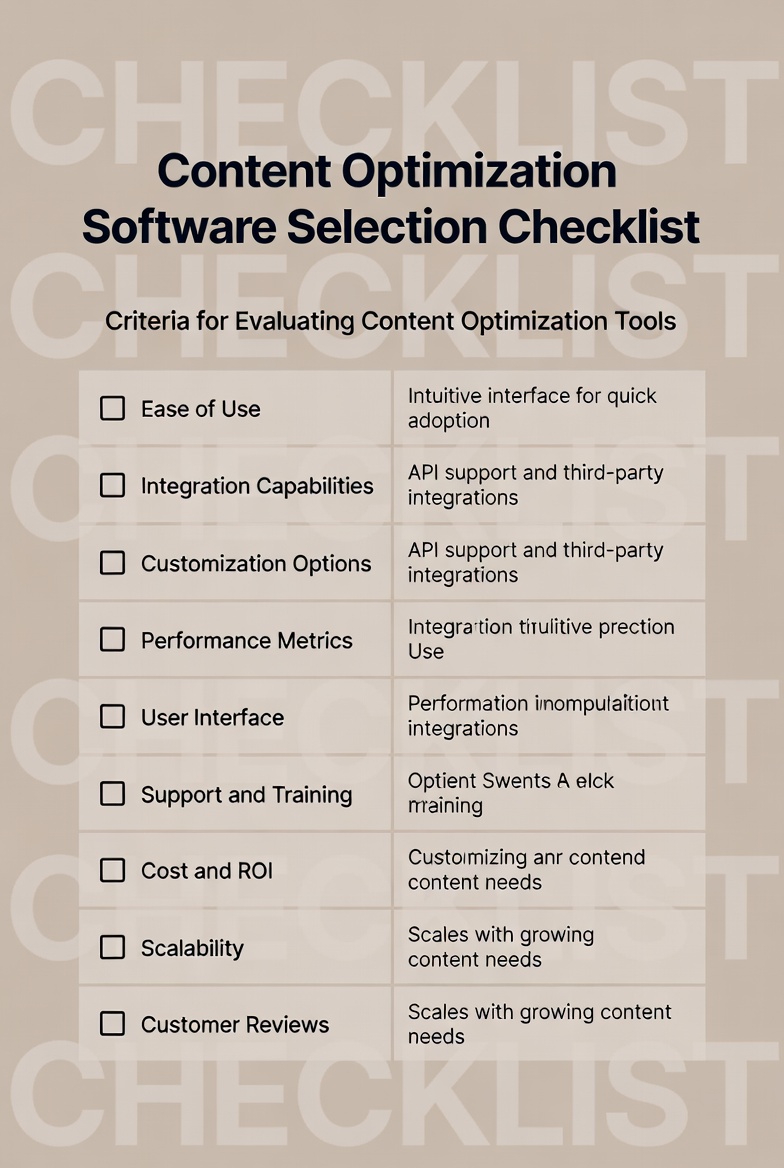
What’s the deal with this content optimization software selection checklist?
This checklist is your handy guide to choosing the right content optimization software. It helps you figure out what features really matter and how to compare different tools so you can boost your SEO effectively.
Why do I even need content optimization software in the first place?
Good question! This software helps you create content that search engines love and readers find valuable. It guides you on keywords, readability, structure. competitor analysis, all crucial for ranking higher and getting more organic traffic.
What key things should I look for when picking a tool?
The checklist will highlight essentials like keyword research capabilities, content grading, real-time suggestions, competitor analysis features. integration with your existing workflow. Think about what will genuinely help your team create better content.
Can this checklist guarantee I’ll pick the absolute best software out there?
While it can’t magically pick the single ‘best’ tool (since ‘best’ depends on your specific needs!) , it empowers you to make a really informed decision. It ensures you consider all the vital factors to find the perfect fit for your budget and goals.
Is this checklist super technical or hard to grasp?
Not at all! It’s designed to be straightforward and easy to follow, even if you’re not an SEO guru. The goal is to simplify the selection process, not complicate it.
Who exactly should be using this checklist?
Anyone involved in content creation and SEO can benefit! This includes content marketers, SEO specialists, copywriters, small business owners. marketing managers looking to improve their online visibility and content performance.
How does using the right content optimization tool actually help my SEO success?
By using a well-chosen tool, you’ll produce content that’s highly optimized for search engines, leading to better rankings, more organic traffic. ultimately, increased conversions. It takes the guesswork out of what makes content perform well.