


The Imperative of Green AI in AI Optimization
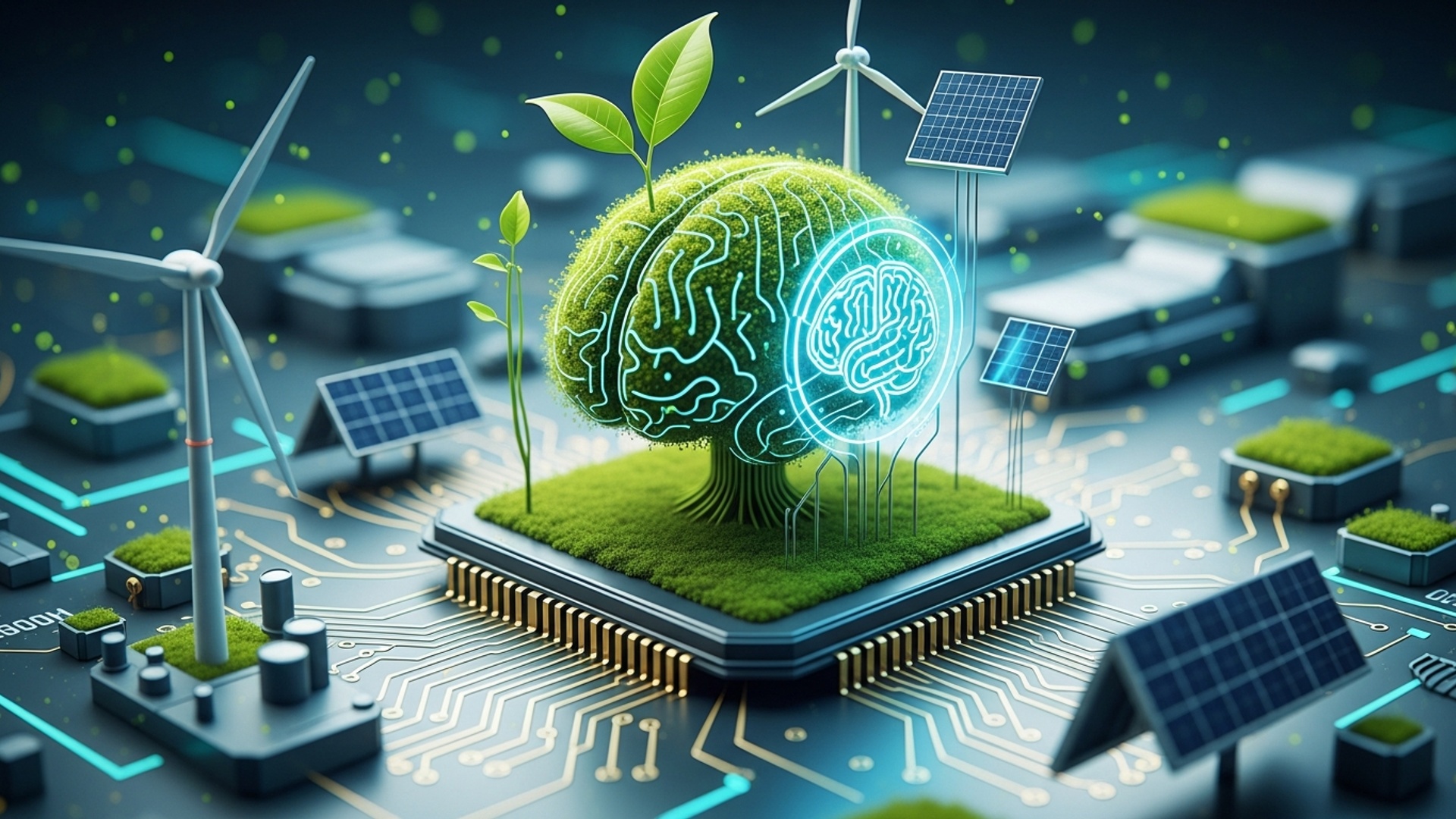
The rapid evolution of artificial intelligence has unlocked extraordinary capabilities, but it has also introduced a serious and often underestimated challenge: energy consumption. As models scale to billions of parameters, their computational demands translate directly into higher electricity usage and increased carbon emissions. For practitioners working in AI Optimization (AIO), sustainability is no longer a peripheral concern. It is a core engineering constraint.
Training large-scale deep learning systems can consume vast amounts of power, sometimes rivaling the lifetime emissions of multiple vehicles. This reality reframes how we evaluate model success. Accuracy and latency alone are insufficient; energy efficiency must become a first-class metric. Green AI strategies therefore focus on minimizing environmental impact while preserving or improving performance.
Model Compression for Energy Efficiency
Optimizing AI systems begins with optimizing the models themselves. Compression techniques reduce computational overhead, memory usage, and inference costs, often yielding substantial energy savings.
Quantization
Quantization lowers the numerical precision of model parameters and activations. Instead of relying exclusively on FP32 representations, models can operate using FP16 or INT8 formats. Reduced precision decreases memory bandwidth requirements and accelerates arithmetic operations on hardware designed for lower-bit computation.
For many workloads, INT8 quantization produces dramatic improvements in throughput and memory footprint with minimal accuracy degradation. The benefits are particularly evident on accelerators from organizations like NVIDIA, whose Tensor Cores are optimized for such operations. However, quantization is not universally lossless. Sensitive tasks may experience accuracy shifts, requiring validation and calibration.
Pruning
Pruning removes redundant parameters from neural networks. Unstructured pruning eliminates individual low-magnitude weights, creating sparse matrices. Structured pruning, by contrast, removes entire channels or filters, resulting in smaller dense models that are easier to execute efficiently.
Although pruning can significantly reduce model size, aggressive removal risks accuracy loss. Iterative pruning followed by fine-tuning is commonly used to recover performance, balancing efficiency with predictive quality.
Knowledge Distillation
Knowledge distillation transfers insights from a large “teacher” model to a compact “student” model. By learning from soft probability distributions rather than hard labels alone, smaller models often approximate the behavior of their larger counterparts with a fraction of the compute requirements.
This approach is particularly valuable for inference-heavy systems, where energy savings compound across millions of predictions. The effectiveness of distillation, however, depends on selecting appropriate student architectures and well-trained teacher models.
Designing Energy-Efficient Architectures
Compression improves existing models, but architectural choices made during design can yield even greater efficiency gains.
Sparse Attention Mechanisms
Standard Transformer attention scales quadratically with sequence length, making it computationally expensive. Sparse attention variants reduce this complexity by computing attention selectively rather than exhaustively. Techniques used in models like Reformer or Longformer lower FLOPs and memory usage, especially for long-context tasks.
While sparse attention introduces implementation complexity, the reduction in computational cost can be substantial for large-scale natural language applications.
Depthwise Separable Convolutions
Depthwise separable convolutions decompose traditional convolution operations into spatial and channel-wise components. Popularized by MobileNet architectures, this method drastically reduces parameters and multiply-add operations.
The result is models that achieve competitive accuracy with significantly lower inference energy, particularly on mobile and embedded hardware. Careful design is necessary to maintain representational capacity.
Compound Scaling
Compound scaling systematically balances model depth, width, and input resolution. Rather than arbitrarily increasing one dimension, this method identifies scaling relationships that maximize accuracy per unit of computation. EfficientNet architectures demonstrate how principled scaling can outperform larger models with fewer resources.
Optimizing Training and Data Strategies
Energy consumption is heavily concentrated in training. Improvements in training regimes and data management directly affect sustainability.
Mixed-Precision Training
Mixed-precision training leverages FP16 computations while retaining FP32 master weights to maintain numerical stability. This strategy accelerates training on compatible GPUs and reduces memory usage. Hardware from companies such as NVIDIA is explicitly optimized for mixed-precision workflows, enabling major reductions in training time and energy expenditure.
Despite its benefits, mixed precision can introduce stability challenges, requiring mechanisms like gradient scaling.
Gradient Accumulation
Gradient accumulation simulates large batch sizes without increasing memory demands. Gradients from multiple mini-batches are combined before weight updates occur. Although this may extend per-epoch time, it enables training configurations otherwise constrained by hardware limits.
Active Learning and Data Sampling
Many datasets contain redundant examples. Active learning prioritizes the most informative samples, reducing the volume of data processed. By focusing computation on uncertain or high-value data points, practitioners can lower both labeling costs and energy usage.
Transfer Learning
Fine-tuning pre-trained models remains one of the most impactful Green AI techniques. Instead of training from scratch, adapting models already trained on large corpora drastically reduces compute requirements. This approach converts prior computational investment into widespread efficiency gains.
Hardware and Infrastructure-Level Strategies
Software optimizations must be complemented by hardware-aware decisions. The underlying compute substrate heavily influences energy efficiency.
Energy-Efficient Accelerators
Modern GPUs, TPUs, and specialized AI accelerators deliver superior performance per watt compared to general-purpose CPUs. Devices developed by organizations like Google (TPUs) or NVIDIA (GPUs) are engineered to accelerate tensor operations with minimal energy waste.
Emerging paradigms, including neuromorphic hardware explored by Intel and IBM, offer promising ultra-low-power computation models, though they remain largely experimental.
Cloud Carbon Footprint Management
Cloud infrastructure choices affect emissions profiles. Major providers such as Google Cloud, AWS, and Microsoft Azure increasingly publish sustainability metrics and enable deployment in regions powered by renewable energy. Selecting low-carbon regions directly reduces operational emissions.
Elastic provisioning mechanisms, including auto-scaling and spot instances, further prevent energy waste from idle resources. These approaches require resilience strategies to handle interruptions and scaling delays.
Dynamic Resource Provisioning
Static overprovisioning leads to persistent power draw. Container orchestration platforms enable demand-responsive scaling, ensuring compute resources align with workload intensity. Serverless models extend this concept by consuming power only during active execution.
Edge AI Deployment
Executing inference at the edge reduces data transmission energy and lowers dependence on centralized data centers. Compact, optimized models running on local devices minimize network overhead and latency while improving privacy characteristics. However, distributed deployment introduces management complexity.
Lifecycle Assessment and Sustainable MLOps
True sustainability requires lifecycle thinking. Energy and emissions impacts span data acquisition, training, deployment, maintenance, and retirement.
Lifecycle Assessment for AI
Lifecycle Assessment (LCA) frameworks quantify environmental effects across a model’s lifespan. Such analyses often reveal unexpected hotspots, including data movement or retraining cycles. Although comprehensive LCAs are complex, they provide critical guidance for prioritizing optimization efforts.
Integrating Sustainability Metrics into MLOps
MLOps pipelines can incorporate energy and carbon metrics alongside traditional performance indicators. Tools that estimate emissions or log hardware power usage enable continuous monitoring and informed decision-making. Versioning systems further allow teams to retire inefficient models systematically.
Embedding sustainability metrics transforms Green AI from an abstract objective into an operational discipline.
Future Directions in Green AI
Emerging research continues to reshape sustainable AI practices. Neuro-symbolic systems aim to improve reasoning efficiency, event-based sensing reduces redundant data processing, and federated learning minimizes centralized computation and data transfer.
Equally important is the application of AI itself to environmental challenges. AI-driven optimization of energy systems, logistics, agriculture, and climate modeling may produce net-positive sustainability outcomes despite their computational demands.
Conclusion
Green AI strategies demand more than incremental adjustments. They require a systemic shift in how AI systems are designed, trained, deployed, and evaluated. Engineers must treat energy efficiency as a measurable engineering objective rather than a secondary consideration.
Balancing performance with environmental responsibility is not a limitation. It is a catalyst for innovation, driving advances in algorithms, architectures, hardware utilization, and lifecycle management. Sustainable AI is not a destination but an evolving practice grounded in empirical measurement and continuous optimization.
More Articles
How to Streamline Your IT Workflows for Maximum Business Efficiency
Unlock Smarter Answers 7 Ways Generative AI Transforms Your Online Search
Public Cloud Versus Private Cloud Which Option Suits Your Business Best
Elevate Data Insights How to Advance Your Analytics Maturity

FAQs
What exactly is Green AI?
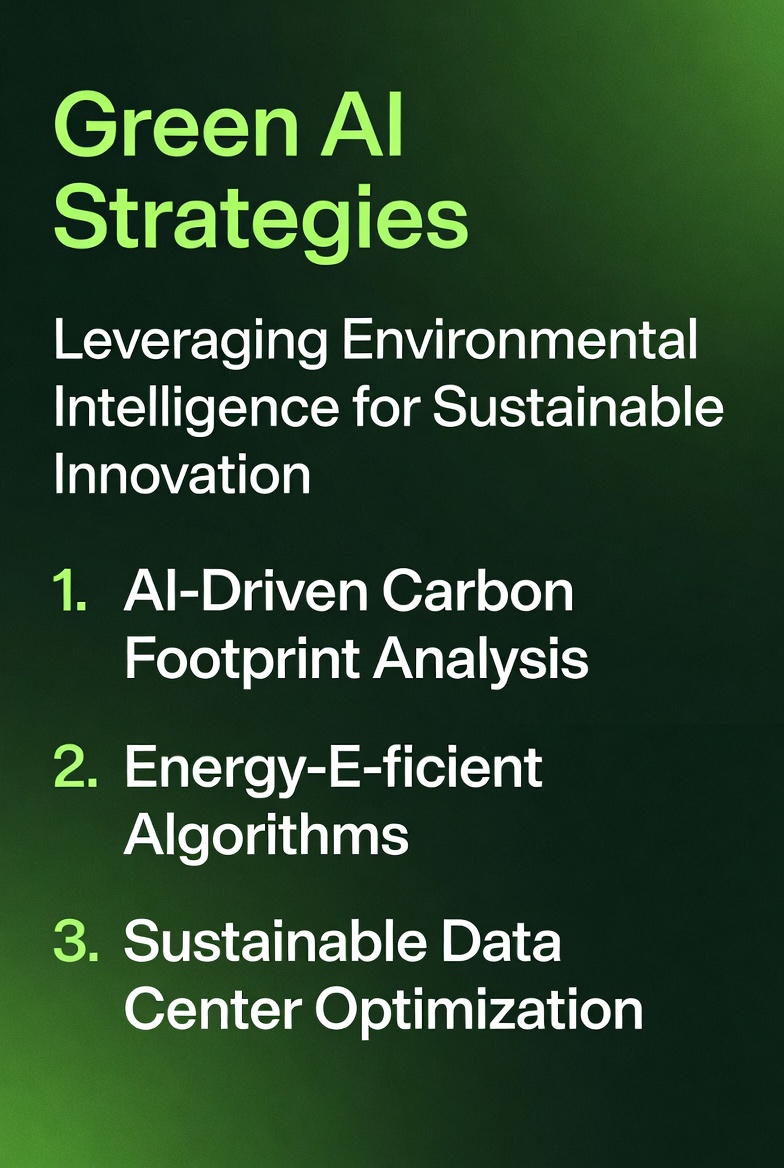
Green AI is all about making artificial intelligence more environmentally friendly throughout its entire lifecycle. This means focusing on reducing the energy consumption, carbon footprint. resource usage from training and deploying AI models to the hardware they run on. It’s about building AI responsibly and sustainably.
Why should businesses care about making their AI green?
Beyond just being good for the planet, adopting Green AI offers tangible benefits for businesses. It can lead to significant cost savings through reduced energy bills, improve your company’s public image and brand reputation, attract environmentally conscious talent. even help you comply with upcoming sustainability regulations. It’s a smart move for future-proofing your tech operations.
How can we actually implement Green AI strategies?
There are several ways! You can start by choosing more energy-efficient algorithms and models, optimizing data centers for lower power consumption, utilizing renewable energy sources. even thinking about the lifecycle of the hardware. It also involves optimizing model training to require less computation and exploring techniques like model compression or federated learning.
Does going ‘green’ with AI mean sacrificing performance or accuracy?
Not necessarily! While sometimes there can be a balance to strike, many Green AI strategies aim to achieve sustainability without a significant drop in performance. Often, optimizing for efficiency can even lead to faster models. The goal is often ‘efficient AI’ which by nature tends to be ‘greener AI’ – finding smarter ways to get similar or even better results with less resource intensity.
What are some common challenges in adopting Green AI?
Some challenges include the initial investment in new infrastructure or training, the complexity of measuring AI’s environmental impact accurately. sometimes a lack of awareness or standardized best practices across organizations. Plus, the sheer scale of some cutting-edge AI models can make reducing their footprint a significant hurdle.
Is Green AI just about using less electricity?
It’s more than just electricity! While energy consumption is a huge part of it, Green AI also considers the entire supply chain and lifecycle. This includes the environmental cost of manufacturing hardware, the water usage for cooling data centers. even the waste generated from obsolete equipment. It’s a holistic approach to sustainability in tech, looking at the bigger picture.
Where’s a good place for a company to start their Green AI journey?
A great first step is to conduct an audit of your current AI operations to interpret their energy consumption and carbon footprint. From there, you can identify high-impact areas for optimization. Start with pilot projects that focus on making existing models more efficient or exploring cloud providers with strong renewable energy commitments. Education and awareness within your team are also crucial.