



API Documentation Best Practices: Designing Docs That Scale
API documentation is no longer a stylistic concern. It functions as an operational control surface that directly influences developer adoption, integration speed, and long-term platform cost. In ecosystems built on OpenAPI 3.1, AsyncAPI, and auto-generated SDKs, documentation quality measurably affects outcomes. Teams that instrument onboarding funnels routinely observe 30–50% faster first successful requests when examples are executable and schema-driven. Conversely, poorly versioned or ambiguous docs can double support tickets even during minor releases.
Modern APIs evolve rapidly and serve thousands of clients. In this environment, documentation must behave like infrastructure: deterministic, testable, and aligned with runtime behavior.
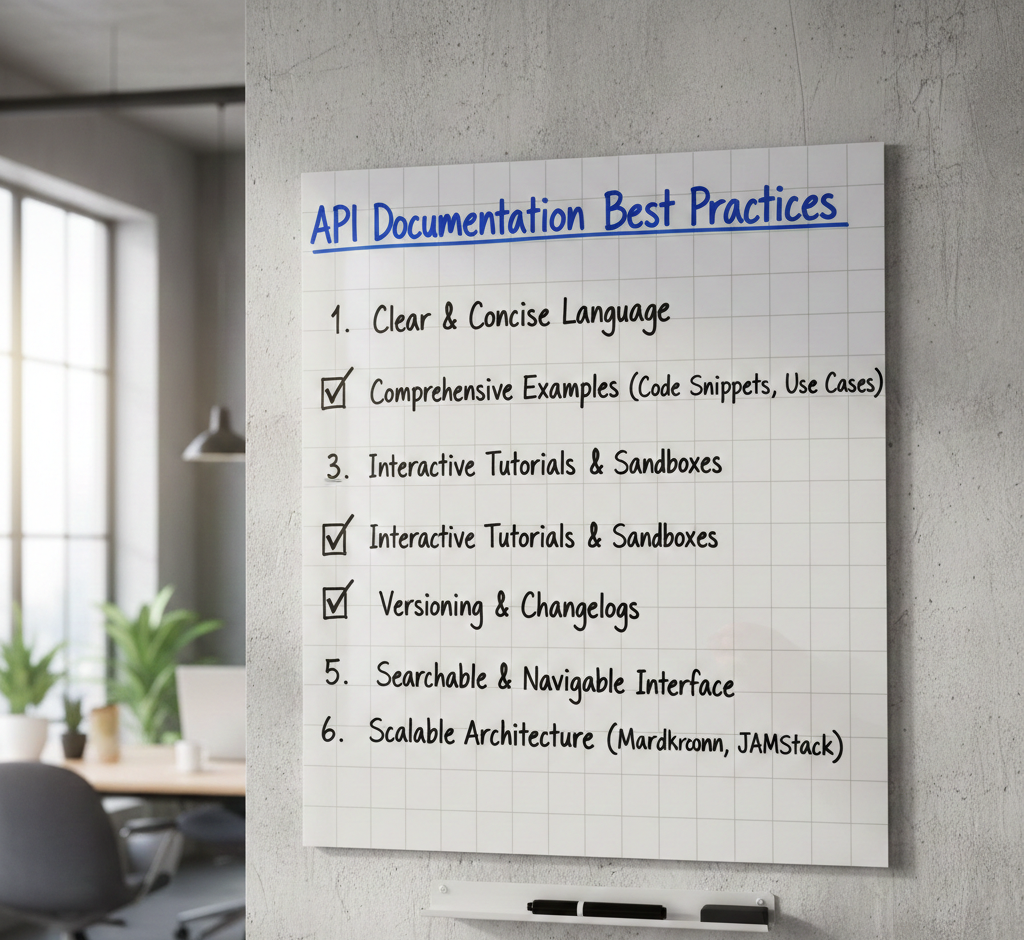
Designing Documentation as a Contract, Not a Tutorial
In mature API publishing organizations, documentation is not merely onboarding material; it is a contractual artifact encoding behavioral guarantees. Treating docs as an extension of the API surface is one of the most overlooked yet impactful practices.
An API contract defines more than schemas. It captures error semantics, idempotency guarantees, latency expectations, and backward-compatibility rules. When documentation diverges from runtime behavior, integrators build compensating logic that later becomes technical debt.
Contract-first documentation typically derives from source-of-truth artifacts such as OpenAPI 3.1 or AsyncAPI specifications. However, generation alone is insufficient. Machines cannot infer critical invariants, which must be explicitly documented:
Key Invariants to Specify
- Latency expectations
Example: P95 < 300 ms under defined load conditions. - Retry safety and idempotency rules
Which endpoints are idempotent and under what headers or keys. - Eventual consistency windows
Example: Writes visible within 2–5 seconds. - Partial failure modes
How clients should interpret degraded or incomplete responses.
Strict contract enforcement may introduce overhead during exploratory design phases. For pre-v1 APIs, clearly marking endpoints as experimental preserves iteration speed without implying SLA-backed guarantees.
Verification is critical. Contract testing tools such as Dredd or Schemathesis can replay documented examples against staging environments to ensure parity. Teams that automate nightly contract tests frequently report significant reductions in documentation-related regressions.
Structuring Docs for Cognitive Load, Not Feature Completeness
Clear documentation scales by minimizing cognitive load rather than expanding page count. Human factors research from the Nielsen Norman Group consistently shows that task-oriented structures outperform reference-only layouts in information retrieval efficiency.
Instead of organizing content solely by endpoint taxonomy, structure documentation around developer workflows:
Workflow-Driven Organization
- Create an Order
- Process a Refund
- Subscribe to Webhooks
- Handle Authentication
This approach reduces context switching and working memory strain. Developers integrating complex APIs often execute multiple calls in sequence. Flat endpoint lists force mental graph construction, increasing error rates and integration time.
Dual-Layer Documentation Architecture
- Workflow Guides
Narrative paths chaining endpoints into real integration scenarios. - Canonical Reference Sections
Auto-generated, schema-driven endpoint definitions.
Workflow abstraction introduces drift risk as APIs evolve. Mitigation strategies include embedding executable snippets validated in CI pipelines. Examples should be continuously tested against mock servers or sandbox environments derived from the same specification artifacts.
For simple internal CRUD APIs, workflow-heavy structures may add unnecessary verbosity. Effectiveness should be measured through operational metrics such as Time to First Successful Call (TTFSC).
Versioning Strategies That Prevent Documentation Rot
Documentation rot is rarely caused by neglect. It typically arises from implicit or mutable versioning models. Supporting multiple runtime versions while maintaining “latest” documentation is one of the most expensive failure patterns in API publishing.
Effective practices mandate explicit, immutable versioning:
Dominant Versioning Models
- URI Versioning (
/v1)
Explicit and cache-friendly but encourages legacy persistence. - Header-Based Versioning
Cleaner URLs yet harder to debug and proxy-unfriendly. - Semantic Versioning in Docs
Granular but operationally complex.
Immutability is the core principle. Once published, versioned documentation should remain stable except for errata. Changes should be introduced through deltas or “What Changed” artifacts rather than silent edits.
Git-based docs-as-code pipelines enable transparent diffs and breaking change visibility. Automated checks comparing deployed API versions with published documentation versions help detect drift before it impacts integrators.
Even internal APIs with limited consumers benefit from immutable versioning, as incident retrospectives often cite outdated documentation as a root cause.
Documenting Error Semantics as First-Class API Behavior
Most API documentation lists HTTP status codes. Few treat error semantics as part of the API’s control plane. At scale, this omission becomes a major operational liability.
Errors directly influence retry behavior, circuit breakers, alerting systems, and client-side resilience strategies. Advanced documentation should therefore include structured, deterministic error models.
Essential Error Documentation Components
- Stable error codes
Example:RATE_LIMIT_EXCEEDED,PAYMENT_DECLINED. - Retryability matrix
Which errors are safe to retry and under what conditions. - Correlation ID propagation
How request tracing identifiers are generated and returned. - Backoff expectations
Interpretation of headers such asRetry-After.
Example schema:
{
  "error_code": "RATE_LIMIT_EXCEEDED",
  "http_status": 429,
  "retryable": true,
  "retry_after_seconds": 30,
  "correlation_id": "abc-123"
}
Structured error metadata significantly reduces mean-time-to-resolution (MTTR) by accelerating diagnosis. Transparency must be balanced with security, especially for public APIs. Internal failures should be grouped into stable external codes to avoid leaking implementation details.
Testing methodologies combining chaos testing with documentation validation help ensure that documented error behavior matches runtime realities.
Executable Examples and SDK Parity
Static examples inevitably drift. Executable examples fail loudly and expose mismatches early. Ensuring that every code sample is generated or continuously verified is a hallmark of best-in-class API platforms.
In multi-SDK ecosystems, drift frequently occurs when SDK behavior diverges from raw HTTP semantics. For instance, an SDK might auto-retry on transient failures while documentation examples omit retry logic, leading to inconsistent integrator expectations.
Canonical Example Strategy
- Generate HTTP examples from OpenAPI specs
- Generate SDK examples from shared request models
- Execute examples against sandbox environments in CI
Public API platforms such as Stripe, Twilio, and Shopify have discussed similar approaches in developer tooling presentations. Automation reduces broken example incidence and prevents documentation from becoming stale between releases.
Sandbox and production behavior differences must be explicitly documented. Relaxed validations or mock behaviors can otherwise create misleading test outcomes.
Scaling Documentation Beyond Happy Paths
Real integrations fail on edge cases, not idealized flows. Scalable documentation must deeply cover asynchronous behaviors, pagination anomalies, and consistency guarantees.
Webhook Delivery Semantics
Documentation should specify:
- At-least-once vs exactly-once delivery
- Retry schedules and backoff strategies
- Ordering guarantees and scope
Ambiguity in event delivery semantics often causes duplicate processing or state inconsistencies.
Pagination Behavior
Offset-based pagination degrades under large datasets due to database re-scans. Cursor-based models require explicit rules:
- Cursor expiration conditions
- Invalidation on data mutation
- Safe caching expectations
Without these details, clients risk silent data loss or inconsistent reads.
Documentation should describe observed system behavior rather than theoretical models. Load simulations and edge-case replay testing provide empirical grounding for these descriptions.
Measuring Documentation Quality as an Operational Metric
Documentation quality cannot be improved without measurement. Elite API teams treat docs like performance budgets: observable, quantifiable, and continuously optimized.
High-Value Metrics
- Time to First Successful Call (TTFSC)
- Docs-related support ticket ratio
- Example execution failure rate
- Search-to-success ratio in doc portals
Instrumentation of developer portals reveals friction points and high-impact improvements. Tracking which pages precede successful API calls identifies structural weaknesses and missing guidance.
Data collection must be privacy-aware, transparent, and anonymized where appropriate. When documentation becomes measurable, it becomes systematically improvable.
Conclusion: Documentation as Infrastructure
Scalable API documentation is fundamentally a systems design problem. When schemas, examples, error models, and versioning policies are mechanically aligned, documentation becomes an extension of the runtime contract rather than a fragile artifact.
Generating documentation directly from specification artifacts reduces drift and exposes design flaws early. While this introduces upfront rigor, it prevents long-term fragmentation and integration instability.
Treat documentation like code. Lint specifications. Diff breaking changes. Validate examples. Track reader success metrics. In rapidly evolving API ecosystems, this discipline separates documentation that merely exists from documentation that scales.
For interoperable specification standards, the OpenAPI Initiative provides a widely adopted reference framework.
More Articles
How Can You Secure Your CMS Against Common Attacks and Data Breaches
Practical AI Deployment Best Practices Every Business Can Use Successfully Safely
How to Improve AI Search Visibility for Your Website Without Technical Complexity
Essential Checklist for Adopting Headless WordPress Trends That Improve Site Performance
What Is a Content Strategy Framework and How Does It Guide Better Decisions

FAQs
What should every API documentation checklist start with?
Start with a clear overview that explains what the API does, who it’s for and the core use cases. Include authentication basics, base URLs, versioning rules and a simple example request so developers can quickly grasp how to get started.
How detailed should endpoint descriptions be?
Each endpoint should explain its purpose, required and optional parameters, request and response formats and possible error codes. Keep descriptions concise but complete, focusing on what developers need to successfully call the endpoint without guessing.
Is it really necessary to include examples everywhere?
Yes, examples are critical. Sample requests and responses in common formats like JSON help developers interpret structure, edge cases and expected values much faster than text alone.
How do you keep API docs developer-friendly as the API grows?
Use consistent naming, predictable patterns and a logical structure. Group related endpoints, reuse schemas and keep terminology consistent so developers don’t have to relearn concepts as the API expands.
What’s the best way to document errors and edge cases?
List all common error responses with status codes, error messages and explanations. Include guidance on how to fix or avoid errors so developers can troubleshoot without contacting support.
How often should API documentation be updated?
Documentation should be updated alongside code changes. Treat docs as part of the development process, not an afterthought and review them with every release to avoid mismatches between behavior and documentation.
What helps API documentation scale well over time?
Modular content, reusable schemas, clear versioning and a checklist-driven approach help documentation scale. This makes it easier to add new features without rewriting existing sections or confusing long-term users.