


App Download Optimization: From Guesswork to Performance Science
App visibility today is driven by precision, experimentation, and rapid feedback loops. Crowded marketplaces and increasingly intelligent ranking systems reward teams that treat app download optimization as a measurable discipline rather than a creative gamble. Features like Custom Product Pages and Store Listing Experiments have made continuous testing central to growth, while AI-powered tooling accelerates iteration across keywords and visuals.
Modern ranking signals emphasize engagement velocity, localized relevance, and consistent rating momentum. At the same time, privacy changes and reduced user-level tracking have increased the importance of extracting maximum value directly from store assets. Winning apps connect search intent, visual storytelling, and conversion analytics into a unified optimization cycle.
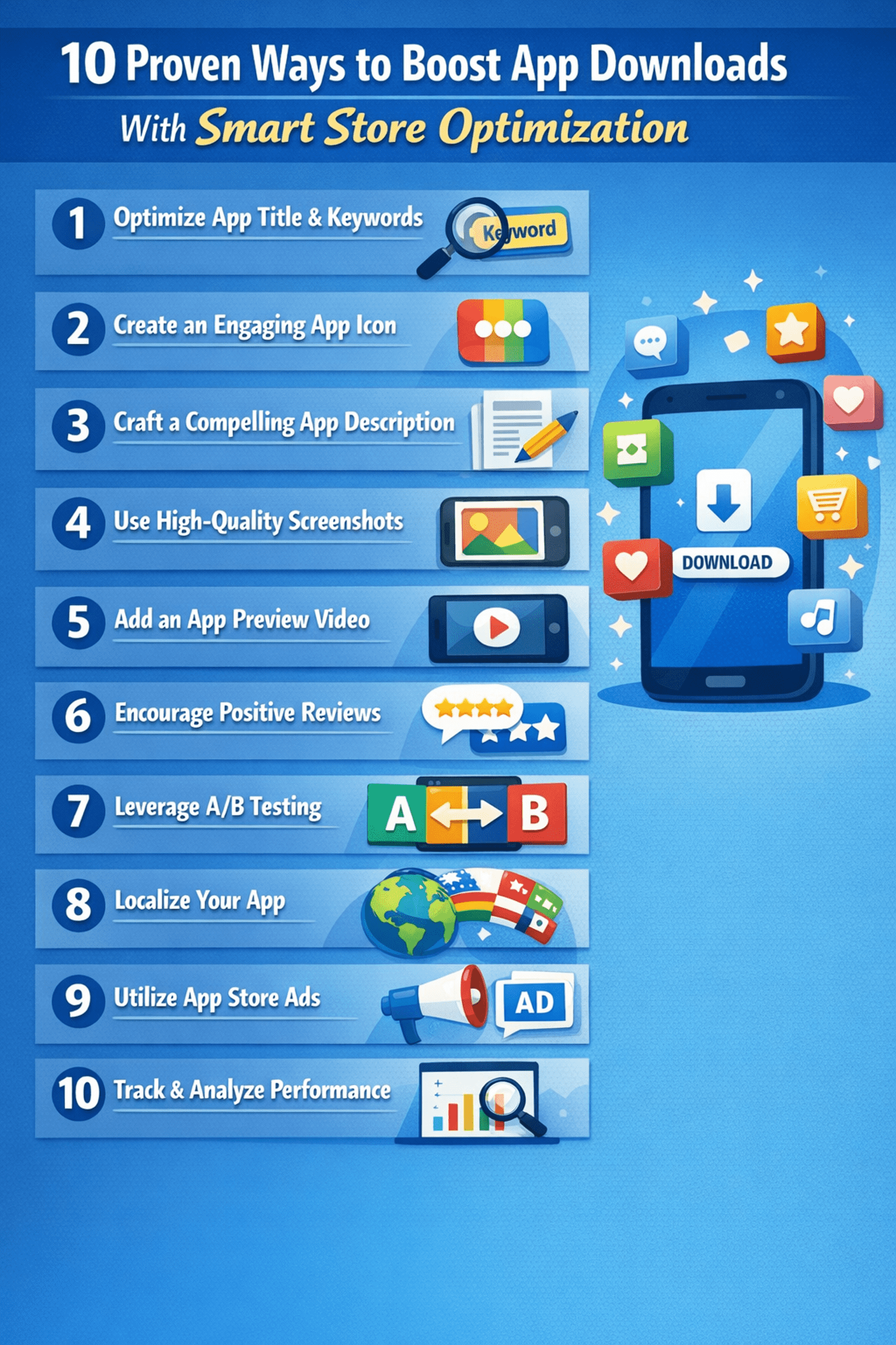
Keyword Research: The Core of Discoverability
Keyword strategy remains the backbone of app visibility. Unlike traditional SEO, optimization within the Apple App Store and the Google Play Store depends on proprietary algorithms that weigh metadata differently. Apple prioritizes fields such as title, subtitle, and keyword metadata, while Google Play evaluates long descriptions and behavioral signals more heavily.
Effective keyword research focuses on intent rather than raw popularity. Tools like App Annie, Sensor Tower, and Mobile Action help identify high-volume opportunities with manageable competition. Competitive analysis further reveals which queries drive visibility within a category.
Apps that align keywords with genuine user intent consistently outperform those targeting broad, generic terms. Even small refinements in keyword targeting can yield substantial gains in organic acquisition.
Optimizing Titles and Subtitles for Relevance
The app title is one of the strongest ranking and conversion factors. A well-constructed title communicates purpose instantly to both algorithms and users. The best titles integrate a primary keyword naturally while preserving clarity and brand identity.
Subtitles and short taglines serve as strategic extensions of the title. They can highlight differentiators, core benefits, or category signals without resorting to keyword stuffing. Over-optimization risks damaging credibility and may conflict with store policies.
Clear, descriptive metadata not only improves search relevance but also increases user confidence at the moment of discovery.
Writing Descriptions That Drive Installs
Descriptions must balance algorithmic relevance with persuasive communication. The opening lines are particularly influential, as users often skim rather than read in full. Strong descriptions explain value immediately and frame features in terms of outcomes.
Structured formatting improves readability and engagement. Bullet points, concise language, and benefit-oriented messaging consistently outperform dense, technical text. Keywords should be incorporated organically, reinforcing relevance without disrupting flow.
Well-optimized descriptions enhance both search visibility and conversion efficiency, making them a high-leverage optimization asset.
App Icons: Visual Trust Signals
Icons are powerful decision triggers. They often represent the first visual interaction between users and an app, shaping trust perceptions within milliseconds. Clean, recognizable designs tend to outperform cluttered or overly complex visuals.
Effective icons emphasize simplicity, visual contrast, and brand consistency. Minimal text, strong shapes, and cohesive color systems improve recognition across search results and category listings.
Research from the Nielsen Norman Group highlights how rapidly users form trust judgments, underscoring the importance of professional, intuitive iconography.
Screenshots and Preview Videos: Conversion Catalysts
Screenshots and preview videos function as visual narratives. They demonstrate functionality, clarify benefits, and reduce uncertainty. High-performing assets depict real in-app experiences rather than purely promotional graphics.
Captions add context and guide interpretation. Instead of describing features, strong captions communicate outcomes and user value. Preview videos further amplify engagement by showcasing workflows, interactions, or emotional benefits.
Localization significantly increases effectiveness. Region-specific visuals, language adjustments, and culturally relevant examples help align store pages with diverse audience expectations.
Ratings and Reviews: Sustaining Credibility and Momentum
Ratings and reviews operate as both ranking inputs and trust signals. Apps with strong rating profiles typically achieve higher conversion rates and improved algorithmic treatment. Encouraging satisfied users to leave feedback at appropriate moments supports long-term performance.
Active review management strengthens credibility. Professional responses to negative feedback demonstrate accountability, while recurring themes can guide product improvements. Consistent rating momentum contributes to sustained visibility.
Platforms like Apptentive have shown that higher-rated apps tend to experience significantly stronger install behavior.
A/B Testing: Institutionalizing Continuous Improvement
Testing transforms optimization from speculation into evidence-based decision-making. Store listing experiments enable teams to compare variations of icons, screenshots, copy, and layouts under controlled conditions.
Reliable testing requires disciplined methodology. Changing one variable at a time preserves result integrity and prevents misinterpretation. Even subtle modifications, such as adjusting screenshot order, can materially impact conversions.
Continuous experimentation compounds gains over time, creating durable improvements in acquisition efficiency.
Localization: Scaling Visibility Across Markets
Localization extends beyond translation. It adapts messaging, keywords, and visuals to reflect regional language patterns, cultural nuances, and behavioral differences. Users consistently show preference for apps presented in their native language.
Effective localization involves researching region-specific keywords, adjusting screenshots, and aligning value propositions with local use cases. This approach transforms store pages into globally scalable growth channels.
Findings from CSA Research reinforce the strong relationship between language relevance and user engagement.
Monitoring Metrics and Behavioral Signals
Optimization without measurement is unsustainable. Analytics from App Store Connect and Google Play Console reveal critical performance indicators, including impressions, conversions, and retention patterns.
Tracking keyword rankings, conversion rates, and behavioral shifts enables teams to diagnose performance changes quickly. Aligning store updates with product changes prevents mismatches between expectations and experience.
Data-driven monitoring ensures that optimization decisions remain grounded in user behavior rather than intuition.
Aligning Store Assets With Product Evolution
App store optimization is a continuous process. As products evolve, store listings must reflect new capabilities, features, and value propositions. Descriptions, visuals, and update notes should remain synchronized with the in-app experience.
Consistency between marketing promises and product reality strengthens user trust and reduces churn risk. Experts such as Phyllis Khare, frequently cited by Search Engine Journal, emphasize the importance of coherence across acquisition touchpoints.
Sustainable growth emerges when store messaging evolves alongside product development.
Conclusion: Treating Store Pages as Growth Engines
Store optimization delivers the strongest results when approached as a living system. Each iteration, whether in keywords, visuals, or copy, contributes to cumulative performance gains. Rapid testing cycles, behavioral insights, and localized relevance now define competitive advantage.
Small, consistent adjustments often outperform sporadic overhauls. Regular reviews, guided by performance data, help maintain visibility and conversion momentum. As privacy constraints and AI-driven discovery reshape marketplaces, adaptive and evidence-based strategies will increasingly determine success.
More Articles
A Practical Roadmap to Improve Visibility in AI Search Results
GEO vs SEO vs AEO Which Strategy Drives More Visibility for Modern Websites
Ethical AI Marketing Checklist to Build Trust While Protecting Customer Data
How to Boost ROI with AIO Tools for Smarter Business Decisions
What Is a Content Strategy Framework and How Does It Guide Better Decisions

FAQs
What does smart store optimization actually mean?
Smart store optimization is about improving your app’s visibility and conversion rate in app stores by fine-tuning elements like keywords, visuals, descriptions and user feedback based on real performance data.
How do keywords affect app downloads?
Keywords help app stores grasp what your app is about. When you use relevant and well-researched keywords in your title and description, your app is more likely to appear in search results that lead to downloads.
Do app icons and screenshots really make that much difference?
Yes, they often create the first impression. Clear, attractive icons and screenshots that show real benefits can significantly increase the chance that users tap the download button.
What role do ratings and reviews play in boosting installs?
Ratings and reviews build trust. Apps with higher ratings and recent, genuine reviews tend to convert better because users see them as reliable and well-supported.
How often should I update my app store listing?
You should review and update your listing regularly, especially after feature updates or when performance drops. Even small tweaks to text or visuals can improve results over time.
Is A/B testing useful for store optimization?
A/B testing helps you compare different icons, screenshots, or descriptions to see what users respond to best. It removes guesswork and lets data guide your decisions.
Can localization really help increase downloads?
Yes, localizing your app store content for different languages and regions makes your app feel more relevant and accessible, which often leads to higher downloads in global markets.