


Navigating ASO Conversion Challenges in a Crowded App Marketplace
App Store Optimization often breaks down at the most critical point: conversion. Many apps achieve strong visibility yet fail to transform impressions into installs. Fixing this requires more than metadata adjustments. Sustainable growth comes from understanding user psychology, store algorithms, creative optimization, and disciplined experimentation.
Understanding the Conversion Funnel
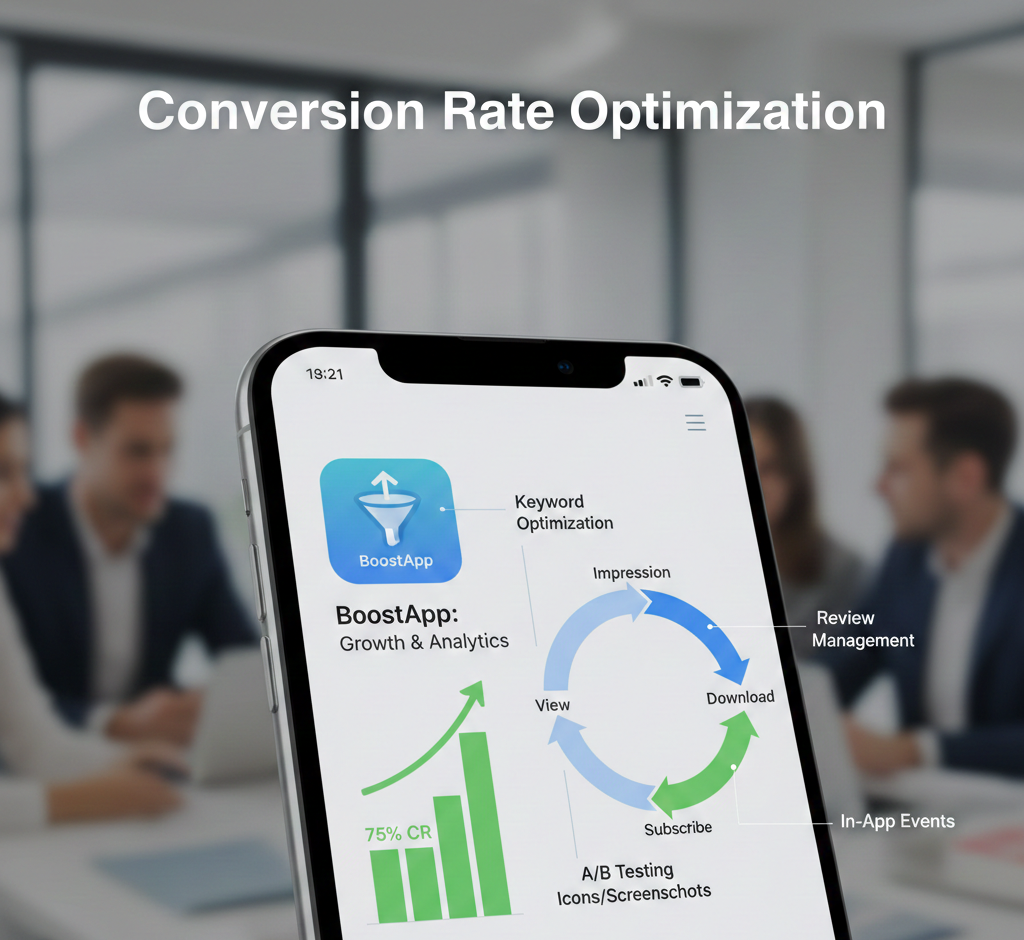
Impression → Product Page View → Install
ASO directly influences the final two stages of the funnel. Keywords and categories drive impressions, but conversion depends on what users experience on the product page. High impressions paired with low installs signal a mismatch between user expectations and perceived value.
Why Conversion Rates Matter to Algorithms
Modern app stores rely on machine learning models that evaluate user behavior. Metrics such as time on page, screenshot engagement, video interaction, and tap-to-install ratios inform ranking systems. Weak conversion performance can gradually reduce visibility, creating a compounding problem.

Diagnosing the Root Causes of Conversion Drop-Off
Expectation vs. Value Perception
Users arrive with intent shaped by search queries or browsing context. If the listing fails to immediately communicate relevance and benefits, interest fades quickly. Conversion failures often stem from unclear positioning rather than insufficient traffic.
Psychological Triggers at Play
Users make rapid judgments. The primacy effect amplifies the importance of icons and early screenshots, while social proof makes ratings and reviews disproportionately influential. Even subtle friction or ambiguity can derail decisions.
Advanced Keyword Strategy for Conversion Uplift
Move Beyond Search Volume
High-volume keywords do not guarantee installs. Effective strategies prioritize semantic relevance and user intent. Long-tail keywords frequently attract users more likely to convert because they express specific needs.
Semantic Relevance and Natural Language
App store algorithms increasingly interpret context. Metadata should integrate keywords naturally, reinforcing clarity and coherence. Over-optimization or keyword stuffing often harms both readability and conversion potential.
Measure Conversion per Keyword
Keyword success is not defined by rank alone. Traffic that fails to convert indicates misaligned intent. Continuous evaluation of conversion efficiency reveals which queries attract qualified users.
Optimizing Creative Assets for Maximum Impact
The Critical Role of the App Icon
The icon functions as the visual anchor of discovery. High-contrast, simple, and recognizable designs typically outperform complex visuals. Users must grasp the app’s essence instantly.
Screenshot Strategy and Visual Hierarchy
Early screenshots shape perception. Rather than generic interface captures, benefit-driven visuals communicate value faster. Sequence matters: lead with the strongest outcomes, not feature lists.
Video Assets and Attention Economics
Short, visually engaging videos tend to drive higher completion and influence. The opening seconds are decisive, particularly when videos auto-play silently. Clarity and speed outperform density.
A/B Testing as the Foundation of ASO Optimization
From Guesswork to Evidence
A/B testing transforms subjective design choices into measurable outcomes. Testing isolates variables to determine what genuinely improves conversion rates.
Statistical Significance and Test Discipline
Premature conclusions distort results. Reliable experiments require adequate exposure, confidence thresholds, and consistent measurement. Small uplifts become meaningful at scale, making rigor essential.
Iterative Optimization Framework
Optimization is cumulative. Teams should systematically test icons, screenshot sequences, descriptions, and videos. Incremental gains compound into substantial growth.
Localization and Cultural Conversion Dynamics
Translation vs. Transcreation
Direct translation rarely maximizes performance. Effective localization adapts tone, visuals, and context to resonate with local audiences. Cultural relevance significantly influences trust and engagement.
Visual and Behavioral Nuances
Color symbolism, imagery, and messaging preferences vary across markets. Listings that feel native often outperform globally standardized assets by wide margins.
Prioritizing Localization Efforts
Deep localization is resource-intensive. Market selection should be guided by growth potential and return on investment. High-impact regions deserve tailored creative and metadata strategies.
Technical ASO: Hidden Drivers of Conversion
App Size and Download Friction
Large app packages increase abandonment risk, particularly in bandwidth-constrained environments. Efficient asset management and modular delivery reduce install hesitation.
Stability and Performance Signals
Crashes and sluggish performance directly influence ratings and reviews. Negative user sentiment undermines future conversions. Technical excellence indirectly fuels listing effectiveness.
Balancing Features and Efficiency
Expanding functionality must not compromise responsiveness. Optimized resource usage and streamlined experiences often deliver better long-term conversion outcomes.
Conversion Beyond the Install Button
The Importance of First-Time User Experience
Conversion challenges extend into post-install behavior. A confusing or demanding onboarding flow accelerates churn, which can indirectly weaken store performance metrics.
Aligning Listing Promises with Reality
Listings set expectations. Any perceived discrepancy between store visuals and in-app experience erodes trust. Consistency preserves satisfaction and retention.
Reducing Early User Friction
Successful apps emphasize rapid value delivery. Minimizing setup barriers, clarifying benefits, and allowing exploration encourage continued engagement.
Leveraging Advanced Analytics for Conversion Diagnostics
Limitations of Native Dashboards
Store consoles provide essential metrics but often lack diagnostic depth. Broader analytics frameworks enable segmentation, attribution, and behavioral analysis.
Attribution and Traffic Quality Insights
Understanding where installs originate clarifies which channels and keywords drive valuable users. Not all traffic sources are equally conversion-efficient.
Funnel and Engagement Analysis
Granular metrics reveal where users disengage. Identifying steep drop-offs guides targeted improvements rather than broad speculation.
Sentiment and Review Intelligence
User feedback highlights systemic friction. Recurring complaints often point to misalignment between perceived and delivered value.
Building a Sustainable Conversion Optimization Mindset
ASO conversion optimization mirrors software optimization: iterative, analytical, and hypothesis-driven. True progress emerges from testing, measurement, and adaptation rather than isolated design changes. Even marginal conversion improvements generate substantial install gains at scale.
Success demands continuous refinement of keywords, creatives, performance, and user experience. Apps that treat conversion as an evolving system – not a one-time project – consistently outperform competitors.
More Articles
Uncover Winning Keywords 7 Essential Strategies for Better Search Rankings
How to Build Scalable App Infrastructure for Future Growth and High Traffic
A Practical Roadmap to Privacy Compliant Analytics Without Sacrificing Business Insights
How to Design a Resilient Serverless Architecture for Reliable Applications

FAQs
What exactly are ASO conversion challenges for an app?
ASO conversion challenges refer to the hurdles you face in getting people who see your app’s listing in the app store to actually hit the download button. It’s about optimizing your app store page – from icon to screenshots and description – to convince potential users that your app is worth downloading, turning views into installs.
Why is focusing on ASO conversion so crucial for my app’s success?
Simply put, discovery isn’t enough. Even if users find your app, a poor conversion rate means they’ll scroll past without downloading. Optimizing for conversion ensures that your app store presence effectively persuades users, maximizing your download potential from existing visibility and making your marketing efforts more efficient.
What kind of strategies does this roadmap cover to boost app downloads?
Our roadmap tackles a comprehensive set of strategies. This includes optimizing your app’s visual assets like the icon and screenshots, crafting compelling descriptions and promotional text, strategic keyword usage, leveraging video previews effectively and understanding how user reviews and ratings impact download decisions. It’s about making every element work together to drive installs.
How do I know if my app is currently facing ASO conversion problems?
A key indicator is a low download-to-view ratio in your app store analytics. If many users are viewing your app page but only a small percentage are proceeding to download, it strongly suggests a conversion issue. Other signs might include high bounce rates from your app page or consistently low ratings/reviews.
Is this roadmap suitable for brand new apps or only established ones?
It’s highly beneficial for both! New apps can implement best practices from day one to ensure a strong launch and avoid common pitfalls. Established apps can use the roadmap to diagnose underperforming areas, revitalize their listing and reignite download growth by addressing existing conversion blockers.
What’s the biggest mistake app developers often make when trying to improve ASO conversion?
One of the biggest mistakes is focusing solely on keyword optimization without paying enough attention to the visual and persuasive elements of the app store page. They might get users to find their app and then fail to convince them to download because the icon is unappealing, screenshots are unhelpful, or the description is unengaging. It’s about the full package, not just keywords.
How quickly can I expect to see results after implementing the roadmap’s recommendations?
While some changes, like A/B testing new visuals, can show results relatively quickly, ASO is an ongoing process. You might see initial improvements within a few weeks and significant and sustained growth often takes a few months as you continuously test, refine and adapt to user feedback and app store algorithm changes. It’s a marathon, not a sprint!