



Cloud-Native Architectures and the Evolution of ASO
The transition to cloud-native application architectures is fundamentally reshaping how teams approach App Store Optimization (ASO). What was once a discipline centered largely on metadata refinement has evolved into a multi-dimensional strategy influenced by infrastructure performance, analytics pipelines, and dynamic content delivery. A modern Cloud ASO strategy is no longer a tactical enhancement; it is a core growth lever for improving organic visibility and conversion rate optimization (CRO) in competitive app marketplaces.
Cloud-native environments introduce capabilities that directly affect how users discover and evaluate apps. Backend responsiveness, scalable infrastructure, and real-time data processing now influence both ranking signals and user behavior. Optimizing for app store performance therefore requires a holistic view that connects technical architecture with acquisition mechanics. Instead of isolated keyword updates, successful practitioners treat ASO as a continuously adaptive system driven by data, experimentation, and performance monitoring.
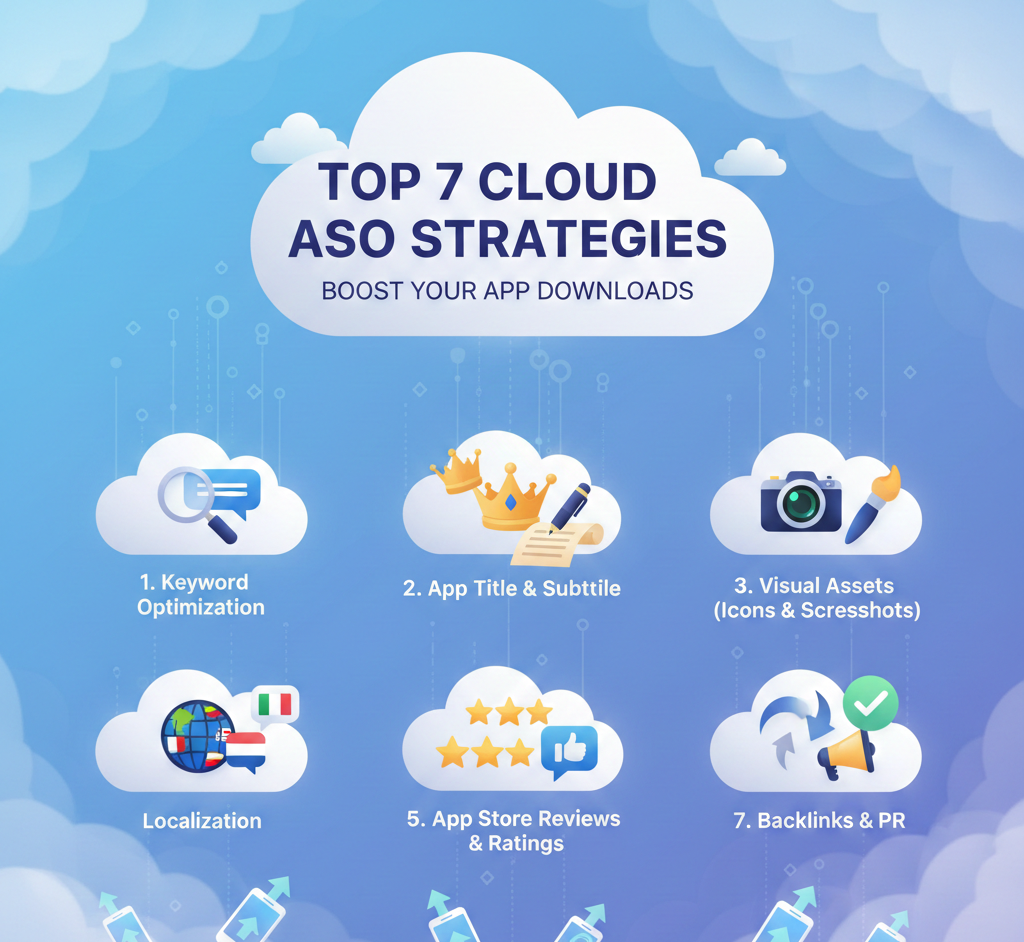
AI-Powered Keyword Research and Continuous Optimization
Cloud computing has dramatically expanded the scope and precision of keyword research. Traditional workflows relied heavily on static tools and manual analysis. In contrast, cloud-based machine learning models can ingest large-scale datasets, including search queries, competitor patterns, trending topics, and real-time store suggestions. Using Natural Language Processing (NLP), these systems move beyond literal keyword matching to interpret semantic relationships and user intent.
For example, a model may associate “fitness tracker” with conceptually related phrases such as “health monitor” or “calorie counter,” uncovering opportunities that manual research might overlook. Clustering techniques identify long-tail patterns, while continuous retraining enables adaptation to algorithmic shifts. This feedback loop allows underperforming keywords to be replaced proactively, maintaining visibility in rapidly changing environments.
However, automation introduces trade-offs. AI systems may misinterpret cultural nuance or emerging slang, emphasizing the need for human validation. A hybrid approach – combining algorithmic insights with expert review and A/B testing – remains the most reliable path. Effectiveness is best measured through metrics such as tap-through rate (TTR), conversion rate (CVR), and keyword ranking trajectories.
Cloud-Native A/B Testing for Conversion Optimization
Conversion optimization within app stores benefits significantly from cloud-native experimentation frameworks. Unlike manual testing cycles, cloud infrastructure supports parallel testing at scale, allowing multiple creative and metadata variants to be evaluated simultaneously. Serverless and edge computing technologies enable controlled asset delivery while tracking performance with statistical rigor.
Variants of icons, screenshots, videos, or descriptions can be exposed to segmented user groups without operational friction. This approach accelerates the path to statistical significance, especially when impressions scale rapidly. Even incremental improvements to first impressions can yield meaningful uplifts in install rates.
Yet complexity must be managed carefully. Excessive test variables can dilute interpretability, while infrastructure costs require budget discipline. Rigorous statistical validation — including confidence intervals and significance testing – ensures decisions are driven by evidence rather than noise.
Scalable Localization and Cultural Adaptation
Global expansion demands more than literal translation. Cloud-enabled localization pipelines integrate Neural Machine Translation (NMT) with human review to achieve both linguistic accuracy and cultural resonance. Metadata and store assets flow through automated systems, while translation memories and glossaries maintain consistency.
Human reviewers play a critical role in refining tone, idioms, and regional sensitivities. Visual elements, color usage, and messaging may also require adaptation to align with local preferences and trust signals. Properly localized listings consistently outperform generic versions in non-English markets, highlighting the strategic importance of culturalization.
While implementation involves operational complexity and cost, the return on investment typically justifies the effort. Performance validation should include localized CVR tracking, keyword rankings, and qualitative user feedback.
Advanced Competitive Intelligence and Benchmarking
Cloud-based competitive intelligence platforms convert sporadic competitor analysis into continuous monitoring. Distributed computing systems aggregate data across app marketplaces, capturing shifts in keyword usage, update frequency, pricing strategies, and review sentiment. Big data processing frameworks analyze these datasets to identify emerging trends and anomalies.
Rapid detection of competitor movements allows teams to respond strategically rather than reactively. Early awareness of new keyword targets or positioning changes can provide measurable advantages. However, ethical and legal considerations surrounding data collection practices must be respected, particularly regarding scraping and platform policies.
Balancing data freshness with computational cost remains an ongoing challenge. Validation requires cross-referencing insights with observed ranking changes and performance metrics.
Predictive Analytics for User Acquisition Strategy
Cloud-native predictive analytics extends ASO beyond discoverability into user value optimization. Centralized data warehouses such as Google BigQuery and Snowflake enable large-scale behavioral modeling, supporting predictions related to lifetime value (LTV), churn probability, and conversion likelihood.
Machine learning models transform raw behavioral signals into actionable forecasts, guiding investment decisions and targeting strategies. Identifying high-retention or high-value segments improves acquisition efficiency, particularly when integrated with paid campaigns.
Nevertheless, practitioners must address critical constraints, including data privacy regulations and potential model bias. Continuous evaluation of prediction accuracy and experimental validation is essential to maintain reliability.
Automated Sentiment Analysis and Review Intelligence
App store reviews are both ranking signals and conversion influencers. Cloud-based NLP systems process large volumes of feedback, classifying sentiment, extracting entities, and identifying recurring themes. Sudden spikes in negative sentiment can be detected quickly, enabling rapid response and issue resolution.
Timely engagement with user feedback has measurable effects on ratings and perception. While AI excels at pattern recognition, nuanced interpretation still benefits from human oversight. Periodic audits and performance correlation analyses help maintain accuracy.
Dynamic Metadata Management Through Serverless Infrastructure
Serverless architectures enable rapid metadata adaptation, transforming ASO updates from periodic tasks into event-driven processes. Technologies like AWS Lambda, Google Cloud Functions, and Azure Functions allow automated triggers based on trends, experiments, or intelligence signals. Metadata changes can be executed programmatically via app store APIs, reducing response times dramatically.
This agility allows teams to capture transient opportunities or react to market shifts with minimal delay. However, robust error handling, rollback mechanisms, and API rate-limit management are essential for stability.
Conclusion
Cloud-native ASO represents a shift from static optimization toward continuous, data-driven orchestration. Sustainable success requires integrating analytics, experimentation, infrastructure performance, and human judgment into a unified framework. Broad visibility tactics must be balanced with intent-driven precision, while every optimization should be measured against clearly defined KPIs.
Dominant app store positioning is not achieved through isolated tactics but through disciplined iteration, rigorous validation, and adaptive strategy. In cloud-powered ecosystems, ASO becomes a living system – evolving alongside algorithms, user behavior, and market dynamics.
More Articles
Your Roadmap to Overcoming ASO Conversion Challenges and Boosting App Downloads
Elevate Data Insights How to Advance Your Analytics Maturity
7 Actionable Steps to Build Topical Authority for Better Search Rankings
The Ultimate Roadmap for E-commerce Keyword Research and Sales Growth
Master Cloud Jargon Easily 9 Key Terms Explained For Everyday Understanding

FAQs
What exactly are “Cloud ASO Strategies”?
Cloud ASO strategies involve leveraging cloud-based tools, platforms. data analytics to supercharge your App Store Optimization efforts. Instead of relying on manual methods or limited local software, you tap into the scalable power of the cloud for things like advanced keyword research, AI-driven visual optimization. large-scale competitor analysis.
How does cloud technology actually help with improving app downloads through ASO?
Cloud technology provides immense processing power and data storage. This allows for deep dives into huge datasets for keyword trends, competitor moves. user behavior. You can run complex AI models to test app icons, automate localization. assess thousands of user reviews instantly, all of which pinpoint the best ways to get your app discovered and downloaded more often.
Could you give me a specific example of one of these cloud ASO strategies in action?
Sure! One great example is leveraging cloud-based AI for visual asset optimization. Instead of guessing which screenshots perform best, you can use cloud AI tools to examine user engagement with different versions, predict which ones will attract more clicks. even suggest improvements based on vast amounts of data, leading to a much more effective app store listing.
Is cloud ASO just for big companies with huge budgets, or can smaller developers benefit too?
Definitely not just for big players! Many cloud ASO tools offer scalable pricing, including free tiers or affordable plans, making powerful analytics and optimization accessible to smaller developers and indie teams. The ‘cloud’ aspect means you don’t need to invest in expensive hardware; you just pay for the services you use, democratizing advanced ASO.
What’s the biggest leg up cloud ASO gives compared to older, traditional methods?
The biggest advantage is scalability and data processing power. Traditional ASO often relies on manual research and smaller datasets. Cloud ASO, But, can process billions of data points, assess trends in real-time across multiple regions. run complex A/B tests automatically, leading to much faster insights and more precise, data-driven decisions for optimizing your app store presence.
When using these cloud ASO tools, how secure is my app’s data?
Reputable cloud providers and ASO tools prioritize data security. They typically employ robust encryption, access controls. compliance with various data protection regulations (like GDPR). Always check the security policies of any specific cloud ASO service you consider. generally, major cloud platforms offer enterprise-grade security for your app’s performance data.
How fast can I expect to see results if I start using cloud ASO strategies?
While ASO is an ongoing process, cloud strategies can often accelerate results compared to traditional methods. With real-time analytics, automated testing. rapid iteration capabilities, you can identify and implement effective changes much faster. Significant improvements in visibility and downloads can often be observed within weeks to a few months, depending on your starting point and the competitiveness of your app category.