



Multisite Content Management Has Become a Systems Challenge
Global organizations rarely struggle with publishing volume alone. The real difficulty emerges when dozens of regional websites, apps, and microsites must move quickly without compromising governance, compliance, or brand consistency. Multisite content management has therefore evolved from a simple editorial concern into a systems-level discipline.
Modern teams operating across platforms like WordPress Multisite, Contentful, and Adobe Experience Manager increasingly rely on shared content models, site factories, and AI-assisted workflows. These mechanisms accelerate production and reduce duplication, but they also reveal weaknesses in permissions, ownership, and workflow design when governance fails to keep pace.
When a single product update must propagate across markets with different languages and regulatory requirements, scalable orchestration – not additional tools – determines success.
Understanding Multisite Content Management
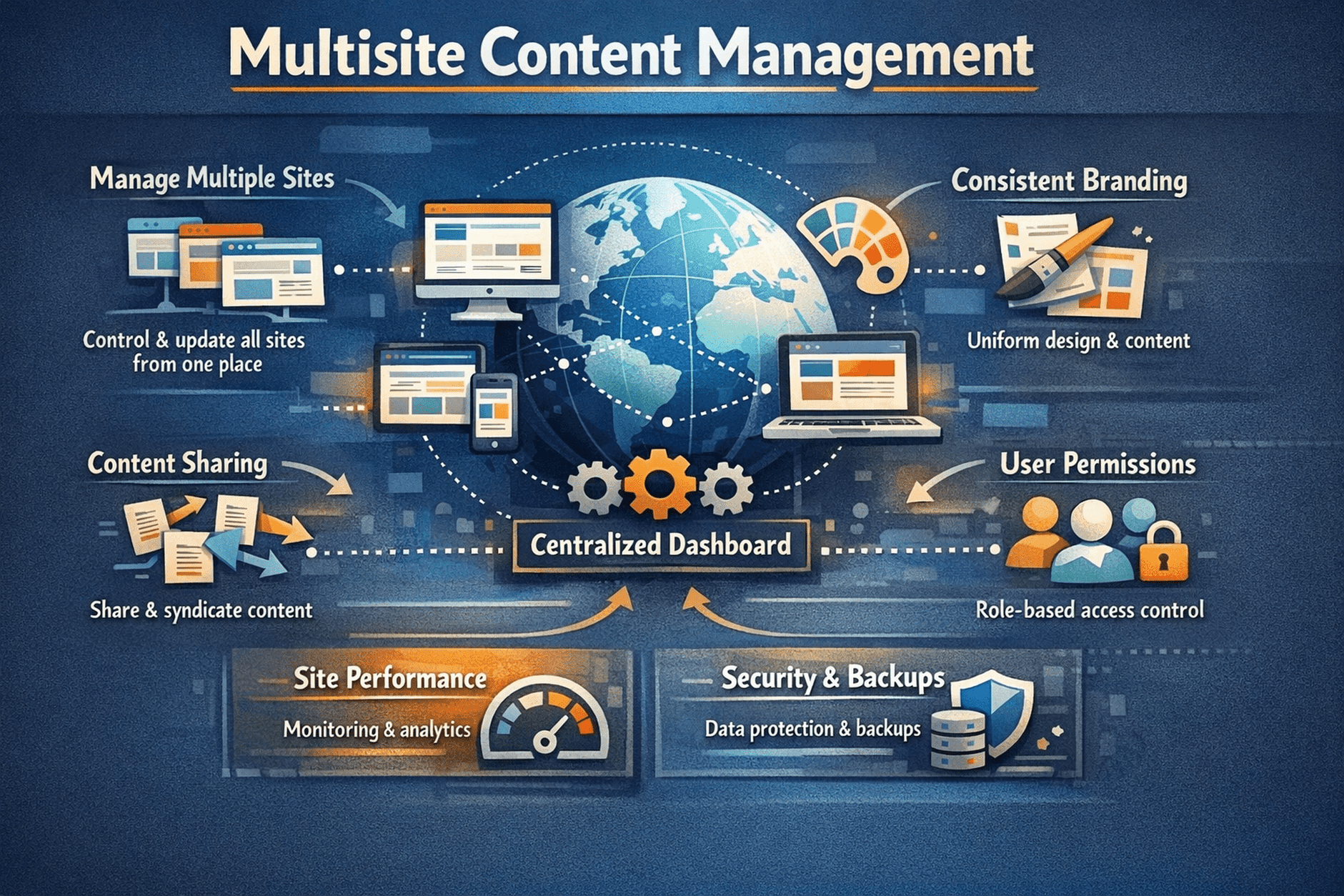
Multisite content management is the coordinated creation, governance, distribution, and maintenance of content across multiple digital properties from a centralized or semi-centralized system. Enterprises, universities, franchises, and media networks commonly adopt this approach to maintain consistency while supporting regional flexibility.
Without structure, digital ecosystems tend to expand chaotically. Content duplication increases, workflows fragment, and operational costs rise. Research from Gartner consistently highlights that weak governance models can significantly inflate content operations costs due to inefficiencies and rework.
A deliberate multisite strategy addresses these risks by aligning technology, processes, and decision-making.
Why Multisite Environments Drift Into Chaos
Disorder rarely stems from tooling alone. In most real-world implementations, instability appears when governance and workflows are undefined or inconsistently applied.
Common failure patterns include:
Governance Gaps
Absence of centralized content standards and approval rules.
Brand and Taxonomy Inconsistencies
Divergent tone, structure, and categorization across sites.
Duplication Instead of Reuse
Manual copying rather than structured content inheritance.
Fragmented Team Operations
Departments working in disconnected systems.
Scaling Without Automation
Performance, security, and maintenance handled reactively.
Insights from Harvard Business Review emphasize that digital sprawl is predominantly a governance and process issue, not merely a technology problem.
Governance Models That Support Scale
Governance defines who can create, modify, approve, publish, and retire content. Without clear decision rights, multisite systems inevitably degrade.
Three governance models typically emerge:
Centralized Governance
A single team controls content decisions and standards. Suitable for highly regulated environments requiring strict oversight.
Decentralized Governance
Individual sites operate independently. Effective where subsidiaries or franchises require high autonomy.
Hybrid Governance
Centralized standards combined with local execution flexibility. Most sustainable for large organizations balancing consistency with regional adaptation.
Hybrid governance frequently delivers the best outcomes. Centrally governed templates and taxonomies preserve structure, while local teams retain the ability to contextualize messaging.
Selecting the Right CMS Foundation
Technology choices should prioritize long-term scalability rather than short-term familiarity. A multisite-ready CMS must support both operational efficiency and governance enforcement.
Critical capabilities include:
Native Multisite or Multi-Tenant Support
Essential for centralized management and reuse.
Role-Based Access Control (RBAC)
Enables controlled permissions and accountability.
Shared Content Repositories
Facilitates structured reuse and synchronization.
API-First or Headless Architecture
Supports omnichannel delivery and edge customization.
Versioning and Audit Trails
Protects against errors and ensures traceability.
Industry analyses from Forrester and CMSWire frequently cite solutions like WordPress Multisite, Adobe Experience Manager, and Contentful for their enterprise multisite strengths, each suited to different operational contexts.
Designing Content Architecture for Reuse
Content architecture is the backbone of scalability. Poor structure forces duplication, while strong models enable efficiency.
Effective multisite architectures emphasize:
Structured Content Types
Replacing free-form pages with reusable components.
Shared Taxonomies and Metadata
Maintaining consistent classification and discoverability.
Content Inheritance Rules
Allowing global assets to cascade across sites.
Separation of Content Layers
Distinguishing global, regional, and local variations.
For example, a global product description may remain centrally governed, while pricing and legal disclaimers adapt regionally. This reduces redundancy while preserving compliance.
Workflow Automation as a Scaling Multiplier
Manual workflows cannot sustain multisite velocity. Automation reduces delays, errors, and coordination friction.
Scalable workflows typically incorporate:
Defined Editorial Stages
Draft, review, compliance, and publication checkpoints.
Automated Notifications
Ensuring stakeholders act without manual follow-ups.
Conditional Approvals
Applying rules based on content type or region.
Scheduled Publishing and Expiration
Maintaining content freshness automatically.
Studies from McKinsey indicate that organizations adopting workflow automation often achieve dramatic reductions in content cycle times, particularly within distributed teams.
Performance, Security, and Compliance at Scale
As multisite ecosystems expand, operational risks multiply. Performance degradation, security vulnerabilities, and regulatory exposure become systemic concerns rather than isolated incidents.
Preventive strategies include:
Global Performance Optimization
Using CDNs and edge delivery networks.
Centralized Security Policies
Standardizing updates, monitoring, and patch management.
Compliance Enforcement
Aligning with GDPR, accessibility standards, and regional laws.
Continuous Access Auditing
Reviewing plugins, integrations, and user permissions.
Structured governance combined with centralized monitoring frequently yields measurable reductions in vulnerabilities and maintenance overhead.
Measuring Multisite Effectiveness
Scalability must be evaluated continuously. Clear metrics reveal whether systems and workflows genuinely improve operations.
Key indicators include:
Content Reuse Ratio
Extent of shared assets across sites.
Time to Publish
Efficiency from creation to approval.
Compliance and Quality Scores
Adherence to standards and regulations.
Operational Cost per Site
True efficiency gains across the network.
Guidance from Nielsen Norman Group underscores that organizations regularly analyzing content performance data maintain higher consistency and usability across large digital ecosystems.
Practical Principles for Sustainable Multisite Growth
Successful multisite strategies consistently follow several foundational principles:
Start With Governance
Define roles, responsibilities, and decision rights before expanding tooling.
Design for Reuse
Structure content to propagate intelligently rather than duplicate manually.
Automate Intentionally
Remove repetitive human coordination tasks wherever feasible.
Invest Early in Infrastructure
Performance and security challenges scale exponentially.
Continuously Simplify
Regularly review workflows and eliminate unused complexity.
Small governance refinements often produce disproportionate operational improvements.
Conclusion
Multisite content management does not fail because organizations grow; it fails when decisions, standards, and workflows remain fragmented. Treating governance, content models, workflows, and technology as a unified system transforms scalability from a reactive struggle into a predictable process.
Automation and AI amplify human judgment rather than replace it. With the right structural foundations, multisite ecosystems become easier to control as they expand – a rare but achievable outcome.
Growth then becomes something teams guide deliberately, not something they chase under pressure.
More Articles
Cloud Content Strategy Versus Traditional Content Planning
7 Workflow Orchestration Tools That Simplify Collaboration
Ethical AI Marketing Checklist
A Practical Roadmap to Improve Visibility in AI Search Results
Essential Checklist to Optimize WordPress Performance

FAQs
What does a practical roadmap for multisite content management actually include?
It usually covers governance rules, content ownership, shared vs local content decisions, technology standards, workflows and metrics. The goal is to create clear guardrails so teams can move fast without creating duplicated, outdated, or conflicting content across sites.
Why do multisite setups become chaotic so quickly?
Chaos often comes from unclear ownership, inconsistent templates and teams solving the same problems in different ways. Without a shared framework, each site evolves independently, making updates, compliance and scaling much harder over time.
How do you balance global consistency with local flexibility?
A good approach is to standardize the structure and core components while allowing controlled customization. Global teams define what must stay consistent, such as branding and key messaging, while local teams adapt content for language, region, or audience needs.
What should be centralized versus managed locally?
Brand guidelines, design systems, shared content modules and core governance policies are best centralized. Local teams usually manage region-specific pages, translations and market-driven content, as long as they follow the shared standards.
Do you need the same workflow for every site?
Not necessarily. While the core workflow stages should be consistent, such as drafting, review and publishing, the roles and approval steps can vary based on team size, regulatory needs, or content volume at each site.
How can teams keep content aligned as the number of sites grows?
Regular audits, shared content libraries, clear documentation and ongoing communication are key. Scaling works best when alignment is treated as a continuous process, not a one-time setup.
What’s a common mistake to avoid when scaling multisite content management?
One major mistake is focusing only on tools and ignoring people and processes. Even the best system will fail if roles are unclear, governance is missing, or teams are not trained on how to work together effectively.