



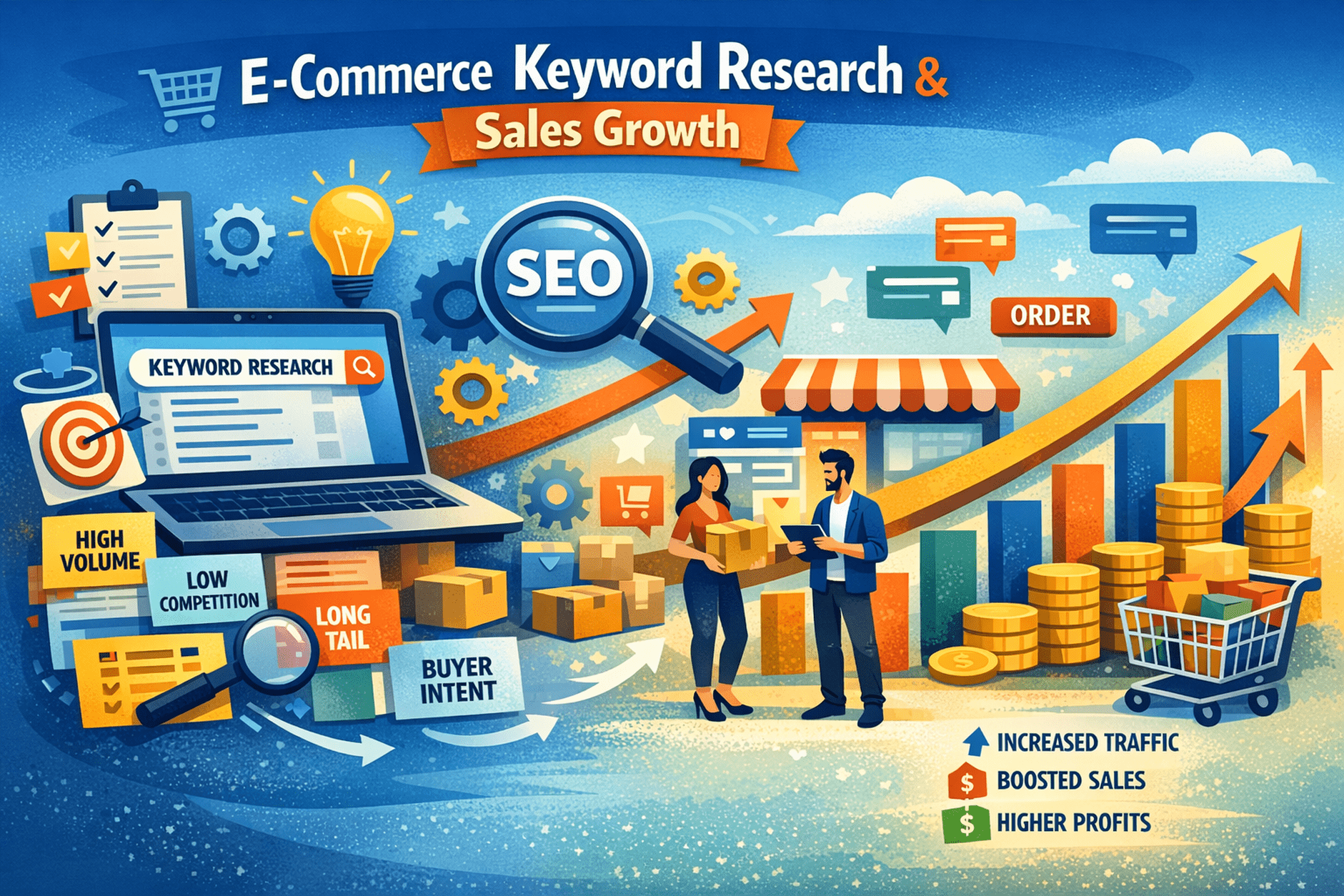
Navigating today’s digital commerce environment requires far more than basic keyword targeting. Advanced keyword research for e-commerce is now a central driver of sustainable revenue growth, shaping how online stores attract, convert, and retain customers. Modern SEO success depends on understanding user intent, semantic relationships, and search engine interpretation mechanisms rather than relying solely on search volume metrics. High-performing e-commerce brands treat keyword strategy as a data science discipline, aligning search behavior, site architecture, and conversion optimization into a unified growth system.
Beyond Basic Metrics: Why E-commerce Keyword Research Has Changed
Traditional keyword research emphasized search volume and competition scores. While still useful, these metrics alone no longer capture the complexity of modern search ecosystems. Search engines evaluate meaning, context, and relationships between concepts. As a result, ranking potential is strongly influenced by how well pages satisfy underlying intent and semantic expectations.
For e-commerce businesses, this shift means that keywords cannot be treated as isolated targets. They function as signals within broader topical frameworks. A product page optimized purely for keyword density but lacking informational relevance or structural clarity may struggle to perform, even if targeting high-volume terms. Sustainable visibility now emerges from aligning content purpose, search intent, and user experience.
Deconstructing Search Intent in E-commerce
Understanding search intent is foundational to effective optimization. Queries generally fall into categories such as informational, commercial investigation, navigational, and transactional. Each reflects a different stage of the buying journey and requires a distinct content approach.
A user searching “how to descale an espresso machine” exhibits informational intent, seeking guidance rather than a purchase. Conversely, a query like “best semi-automatic espresso maker” signals evaluation behavior, while “buy Breville Barista Express” indicates readiness to convert. Attempting to rank a product page for informational queries often leads to poor engagement because the page fails to meet user expectations.
Intent-aligned architecture resolves this issue. Educational queries are best served by guides or blog resources, while transactional queries require streamlined product pages with clear pricing, availability, and structured data. Proper mapping improves engagement metrics, click-through rates, and ultimately conversion performance.
Leveraging First-Party Data for Keyword Intelligence
While third-party SEO tools offer valuable insights, the most accurate keyword intelligence often resides within a company’s own analytics ecosystem. Platforms such as Google Search Console and Google Analytics 4 provide direct visibility into real user behavior and query patterns.
Search Console reveals the exact queries generating impressions and clicks, helping identify opportunities where rankings are strong but CTR remains weak. Small refinements to titles and meta descriptions can significantly improve traffic without altering rankings. Analytics 4 adds behavioral depth, allowing segmentation of sessions, conversions, and user pathways associated with specific keyword clusters.
Internal site search data is particularly powerful. Users searching within a store express explicit intent, often tied to high purchase probability. Repeated searches for terminology absent from product taxonomy may expose semantic mismatches or unmet demand. Aligning catalog language with user vocabulary can produce outsized gains in both visibility and conversion rates.
Competitive Analysis as Strategic Reverse Engineering
Advanced competitive analysis goes beyond copying competitor keywords. The objective is to decode structural patterns and semantic strategies that drive their visibility. Tools like SEMrush and Ahrefs enable identification of keyword gaps, revealing valuable queries where competitors rank strongly while your site does not.
Examining competitor page structures can highlight critical signals influencing rankings. These include title construction, semantic depth, internal linking patterns, and use of structured data. For instance, competitors may rank for highly specific long-tail searches due to detailed product attributes or well-organized informational support content.
Rather than blindly replicating strategies, effective analysis isolates transferable insights. Long-tail opportunities and content structure improvements typically offer higher ROI than direct competition for heavily contested head terms.
Long-Tail Keywords and Scalable Growth Mechanisms
Long-tail keywords represent a major growth vector in e-commerce SEO. Although individually low in search volume, they collectively account for the majority of searches and often exhibit stronger conversion intent. Highly specific queries such as “men’s waterproof trail running shoes size 10” reflect refined purchase intent, making them disproportionately valuable.
Programmatic SEO extends this advantage through automation. By leveraging structured product data, e-commerce platforms can generate large volumes of highly targeted pages based on combinations of attributes like brand, features, compatibility, and use cases. This approach allows stores with extensive catalogs to capture diverse search variations without manual page creation.
Careful technical governance is essential. Canonicalization, crawl efficiency, and index management must be monitored to avoid duplication issues or index bloat. When implemented correctly, programmatic expansion dramatically increases organic reach and search coverage.
Semantic Clustering and Entity-Driven Optimization
Modern SEO increasingly revolves around semantic authority rather than isolated keyword rankings. Search engines evaluate how comprehensively a site covers related concepts and entities within a topic. Semantic clustering organizes content into interconnected hubs that reinforce topical relevance.
An e-commerce store selling coffee equipment, for example, benefits from linking espresso machines, grinders, brewing methods, and maintenance guides into a coherent knowledge structure. This strengthens contextual signals and improves the probability of ranking across broader query sets.
Product descriptions also benefit from semantic enrichment. Incorporating related terminology, use cases, and feature context helps search engines interpret page relevance while simultaneously enhancing user comprehension.
Maximizing SERP Visibility Through Structured Data
Achieving high rankings is only part of the equation. Visibility and click-through performance depend heavily on SERP presentation. Structured data markup enables enhanced listings with ratings, pricing, and availability information, increasing user engagement.
Correct implementation of product and review schema can significantly improve CTR by making results more informative and visually compelling. Precision is critical, as invalid or inconsistent markup may be ignored or generate indexing issues. Regular validation ensures structured data functions as intended.
Continuous Optimization: The Feedback Loop Model
Keyword research is not a one-time process but an iterative cycle. Rankings, user behavior, and competitive dynamics constantly evolve. Monitoring performance metrics, identifying anomalies, and refining page elements form the core of long-term SEO success.
Testing plays a vital role. Platforms such as VWO and Optimizely allow controlled experimentation with titles, descriptions, and content variations. Even modest improvements in CTR or engagement metrics can translate into substantial traffic and revenue gains at scale.
International and Multilingual Keyword Considerations
Global expansion introduces additional complexity. Direct translation rarely captures local search behavior, as vocabulary and cultural context vary widely across regions. Effective international SEO requires localization, not mere translation.
Technical signals such as hreflang tags ensure correct language targeting and prevent duplication conflicts. Regional keyword research supported by tools like Google Trends helps identify locally relevant terminology and demand patterns, improving both visibility and conversion outcomes.
Conclusion
E-commerce keyword research has evolved into a multidimensional discipline combining search intent analysis, semantic modeling, technical architecture, and continuous experimentation. Success depends on building adaptive systems rather than static keyword lists. Businesses that embrace data-driven iteration, semantic authority, and user-centric optimization consistently outperform competitors in organic acquisition and revenue growth.
More Articles
7 Actionable Steps to Build Topical Authority for Better Search Rankings
Voice Search Versus Text Search Maximizing E-commerce Sales for Your Store
How to Attract More Customers Online with Simple Digital Marketing Tactics
Five Simple Steps to comprehend Keyword Difficulty for Better SEO Rankings

FAQs
So, what exactly is ‘The Ultimate Roadmap for E-commerce Keyword Research and Sales Growth’ all about?
It’s your complete guide to finding the exact words and phrases your customers are using to search for products online. We break down how to research these keywords, integrate them into your store. ultimately use them to skyrocket your sales and get more traffic.
Why bother with keyword research for my online store? Isn’t it just for bloggers?
Nope, it’s crucial for e-commerce! Good keyword research means you’re not just guessing what people want. It helps customers find your products when they search on Google, Amazon, or elsewhere, leading directly to more visibility, relevant traffic, and, yep, more sales.
What kind of keyword research techniques does this roadmap cover?
We dig into a bunch of techniques, from understanding customer intent and competitor analysis to finding long-tail keywords and even uncovering trending search terms. It’s about getting a full picture of what your audience is searching for.
How does finding keywords actually translate into more sales for my business?
By using the right keywords, your product pages, descriptions. ads become much more relevant to what potential customers are searching for. This means higher rankings in search results, more qualified visitors clicking through to your store. a much better chance of them making a purchase. It’s all about connecting demand with your supply.
I’m pretty new to e-commerce. Is this roadmap something I can actually follow?
Absolutely! This roadmap is designed for everyone, from complete beginners just starting their online store to seasoned pros looking to refine their strategy. We break down complex topics into easy-to-comprehend, actionable steps. No jargon overload here!
What’s a common mistake e-commerce businesses make when it comes to keywords?
A huge one is not updating their keyword strategy regularly or just guessing what people search for. The market, trends. even search algorithms change constantly. Relying on outdated or generic keywords means you’re missing out on tons of potential customers. This roadmap helps you stay on top of it!
How often should I revisit my keyword research with this roadmap?
It’s not a one-and-done deal! We recommend reviewing and updating your keyword strategy at least quarterly, or whenever you launch new products or notice significant changes in market trends. Regular check-ins ensure you’re always optimized for what customers are looking for right now.