



Automation ROI Calculation in Workflow Automations
Automation initiatives often promise efficiency, accuracy, and cost reduction, yet many organizations struggle to quantify their real impact. A credible automation ROI calculation requires more than optimistic projections – it demands structured measurement, realistic financial modeling, and continuous validation.
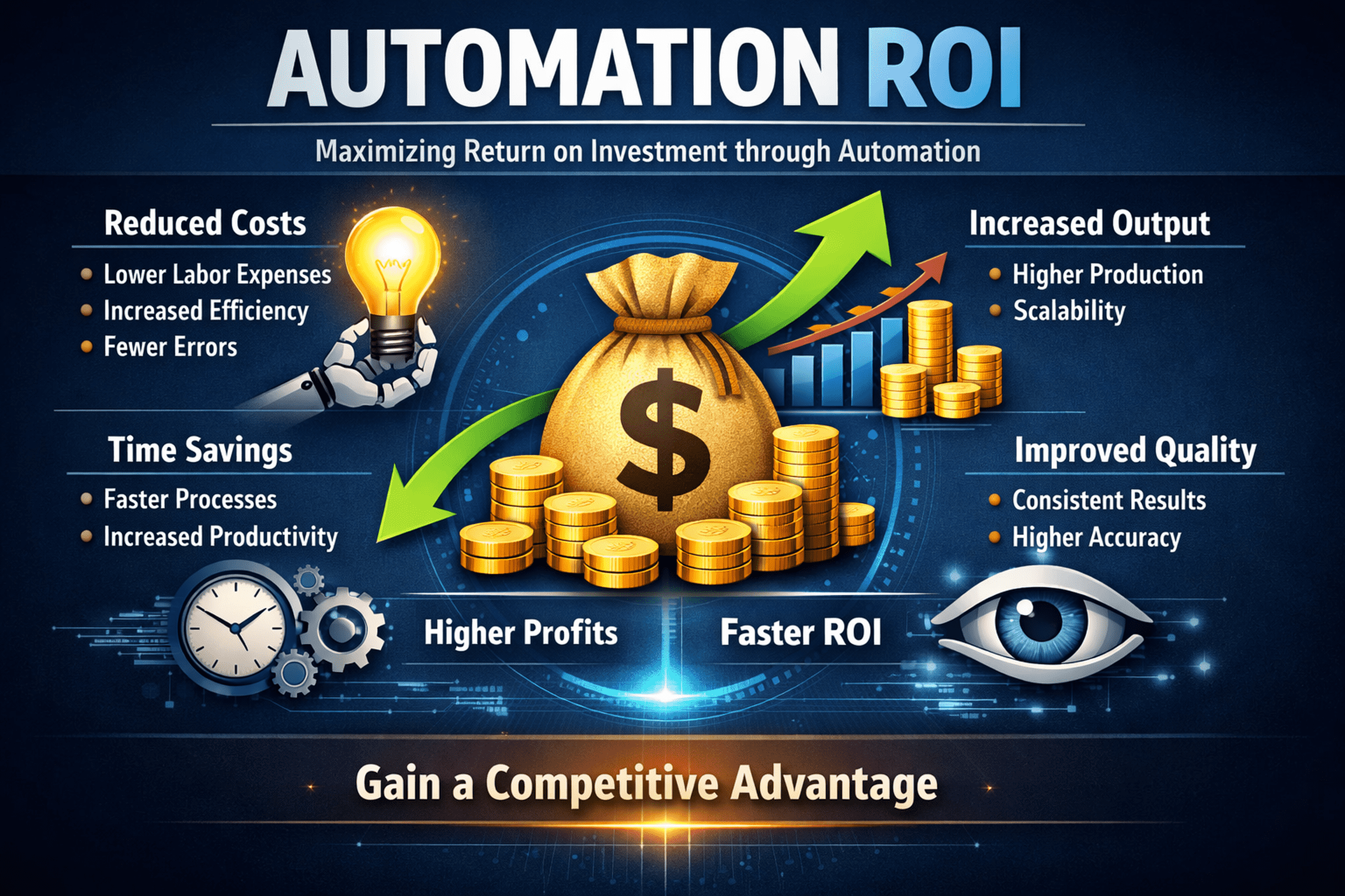
Establishing a Robust Baseline
A reliable ROI analysis begins with understanding the “as-is” state. Without baseline data, any post-automation improvement becomes guesswork.
Baseline measurement should capture how the workflow truly operates, not how it is assumed to function. This involves examining cycle times, manual effort, rework frequency, and error patterns. System logs, historical records, and process observation provide a clearer picture than anecdotal feedback alone.
Key metrics typically include:
Full-Time Equivalent (FTE) Cost
Calculate fully loaded employee costs, factoring in salary, benefits, overhead, and infrastructure. Automation savings often stem from capacity recovery rather than direct headcount elimination.
Process Cycle Time
Measure average completion times along with variability. Bottlenecks and approval delays often reveal the largest improvement opportunities.
Error Rate and Rework Costs
Human-driven workflows introduce inconsistencies. Even small error percentages can create substantial correction expenses.
Transaction Volume
Volume contextualizes savings. Efficiency gains at scale generate disproportionate value.
Accurate baselines prevent inflated ROI claims and create a defensible benchmark for future comparison.
Quantifying Direct Cost Savings
Direct savings are the most visible benefits but are frequently misunderstood. Automation does not always reduce staff numbers; instead, it reallocates human effort toward higher-value work.
Savings may arise from:
Recovered Employee Capacity
When repetitive tasks are automated, employees can focus on decision-making, customer engagement, or strategic work. The financial value lies in increased productivity, not necessarily workforce reduction.
Reduced Error Correction Costs
Automation executes rules consistently, minimizing rework, investigation, and downstream disruptions.
Lower Operational Overheads
Digitization reduces paper handling, storage needs, and manual coordination.
Elimination of Overtime and Penalties
Faster workflows reduce deadline pressures, late fees, and missed discount opportunities.
However, “phantom savings” occur when freed capacity is not effectively redeployed. Real ROI depends on operational changes, not theoretical efficiencies.
Measuring Indirect and Strategic Benefits
Indirect benefits often exceed direct savings in long-term value, though they are harder to monetize.
Automation commonly improves:
Compliance and Risk Reduction
Consistent execution reduces regulatory exposure and audit complexity.
Employee Experience and Retention
Removing monotonous work improves engagement and lowers turnover costs.
Customer Satisfaction and Loyalty
Faster response times and fewer errors enhance service quality.
Scalability and Agility
Automated workflows handle volume fluctuations without proportional staffing increases.
While precise attribution may be challenging, proxy metrics – such as churn reduction or satisfaction improvements – help demonstrate impact.
Understanding Total Cost of Ownership (TCO)
ROI calculations fail when costs are underestimated. Automation expenses extend beyond software licenses.
A realistic TCO includes:
Implementation and Integration Effort
Design, development, and testing often represent the largest initial investment.
Infrastructure and Hosting Costs
Cloud or on-premise environments introduce recurring expenses.
Maintenance and Support
Automations require updates as systems and business rules evolve.
Training and Change Management
User adoption and operational alignment are critical for value realization.
Security and Governance
Compliance, monitoring, and controls add necessary overhead.
Architectural shortcuts may accelerate deployment but often increase long-term maintenance costs.
Applying Advanced Financial Modeling
Sophisticated ROI analysis accounts for multi-year impacts and the time value of money.
Common techniques include:
Net Present Value (NPV)
Evaluates whether discounted future benefits exceed costs.
Internal Rate of Return (IRR)
Represents the effective return generated by the initiative.
Discounted Cash Flow (DCF)
Incorporates risk-adjusted assumptions and long-term projections.
Sensitivity analysis is essential. Minor assumption changes can significantly alter outcomes, making conservative modeling crucial.
Post-Implementation Verification
ROI calculation does not end at deployment. Continuous monitoring validates whether projected benefits materialize.
Effective verification involves:
Tracking Operational KPIs
Cycle times, error rates, and throughput confirm performance gains.
Reconciling Financial Outcomes
Compare expected versus realized savings.
Analyzing Exceptions and Failures
Identify causes of performance gaps.
Iterative Optimization
Refine workflows and automation logic based on real-world behavior.
Automation success depends on adaptation, not static implementation.
Addressing Edge Cases and Complexities
Not all processes are equally suited for automation. Highly variable workflows or exception-heavy tasks may require hybrid designs with human oversight.
Legacy systems introduce additional complexity, often increasing development effort and maintenance risk. Compliance-driven automations may deliver limited direct savings yet provide substantial strategic protection.
The goal is selective, high-impact automation rather than indiscriminate deployment.
The Strategic Imperative of Automation
Beyond financial metrics, automation strengthens organizational resilience, scalability, and innovation capacity. Faster operations, improved data reliability, and enhanced adaptability often define the true value of automation investments.
Short-term ROI may justify projects, but long-term competitive advantage sustains them.
Conclusion
A credible automation ROI calculation combines rigorous baselines, realistic cost modeling, strategic evaluation, and continuous validation. Organizations that treat ROI as an evolving measurement framework – rather than a one-time justification exercise – consistently achieve stronger outcomes and more sustainable value.
More Articles
A Practical Roadmap to Privacy Compliant Analytics Without Sacrificing Business Insights
What Is a Content Strategy Framework and How Does It Guide Better Decisions
A Practical Roadmap to Mastering SEO Ranking Factors That Drive Sustainable Traffic
How Can You Secure Your CMS Against Common Attacks and Data Breaches

FAQs
What exactly is this roadmap for?
This roadmap is your comprehensive guide to successfully calculating the Return on Investment (ROI) for any automation project. It breaks down a complex process into clear, manageable steps so you can confidently assess the financial benefits.
Why is calculating automation ROI so crucial, anyway?
Knowing your automation ROI is vital because it helps you justify investments, prioritize projects, allocate resources effectively and make data-driven decisions. It moves automation discussions beyond ‘it’s a good idea’ to ‘this will deliver tangible financial value’.
What kind of steps can I expect to follow in this roadmap?
You’ll go through stages like defining the scope of your automation, identifying relevant costs and benefits (both tangible and intangible), gathering necessary data, performing the actual calculations and finally, presenting your findings clearly to stakeholders.
Is this roadmap only useful for large enterprises, or can smaller businesses benefit too?
Absolutely not just for big companies! The principles and steps outlined in this roadmap are universally applicable. Whether you’re a small business automating a single task or a large enterprise deploying a complex system, the methodology will help you accurately measure ROI.
What if I don’t have all the perfect data readily available?
Don’t worry, that’s a common challenge. The roadmap addresses this by guiding you on how to make reasonable estimates, identify key data points and comprehend what level of accuracy is ‘good enough’ to make informed decisions without getting stuck.
How does this roadmap help me avoid common pitfalls when calculating ROI for automation?
It highlights common mistakes, such as overlooking hidden costs, ignoring intangible benefits, using inaccurate baseline data, or failing to account for change management. By being aware of these, you can preemptively address them and ensure a more realistic and robust ROI calculation.
After I’ve calculated the ROI, what should I do with the results?
Once you have your ROI figures, the roadmap will guide you on how to effectively communicate these results to decision-makers. This includes creating compelling business cases, presenting your findings clearly and using the data to secure project approval or make strategic adjustments.