Informational Versus Transactional Keyword Intent Which Drives More Sales
Effective keyword intent analysis goes far beyond measuring search volume. It forms the foundation of a strong SEO strategy by identifying what users actually want when they search. Whether a query reflects curiosity or a clear buying decision determines how content should be structured, optimized, and delivered. With modern search engines powered by AI and natural language processing, static keyword classification models are no longer sufficient. Today, aligning content precisely with user intent directly influences engagement, conversions, sales velocity, and overall ROI.
Below is a refined and structured version of your blog, organized with clear sub-headings and streamlined language.
Understanding Informational vs Transactional Intent
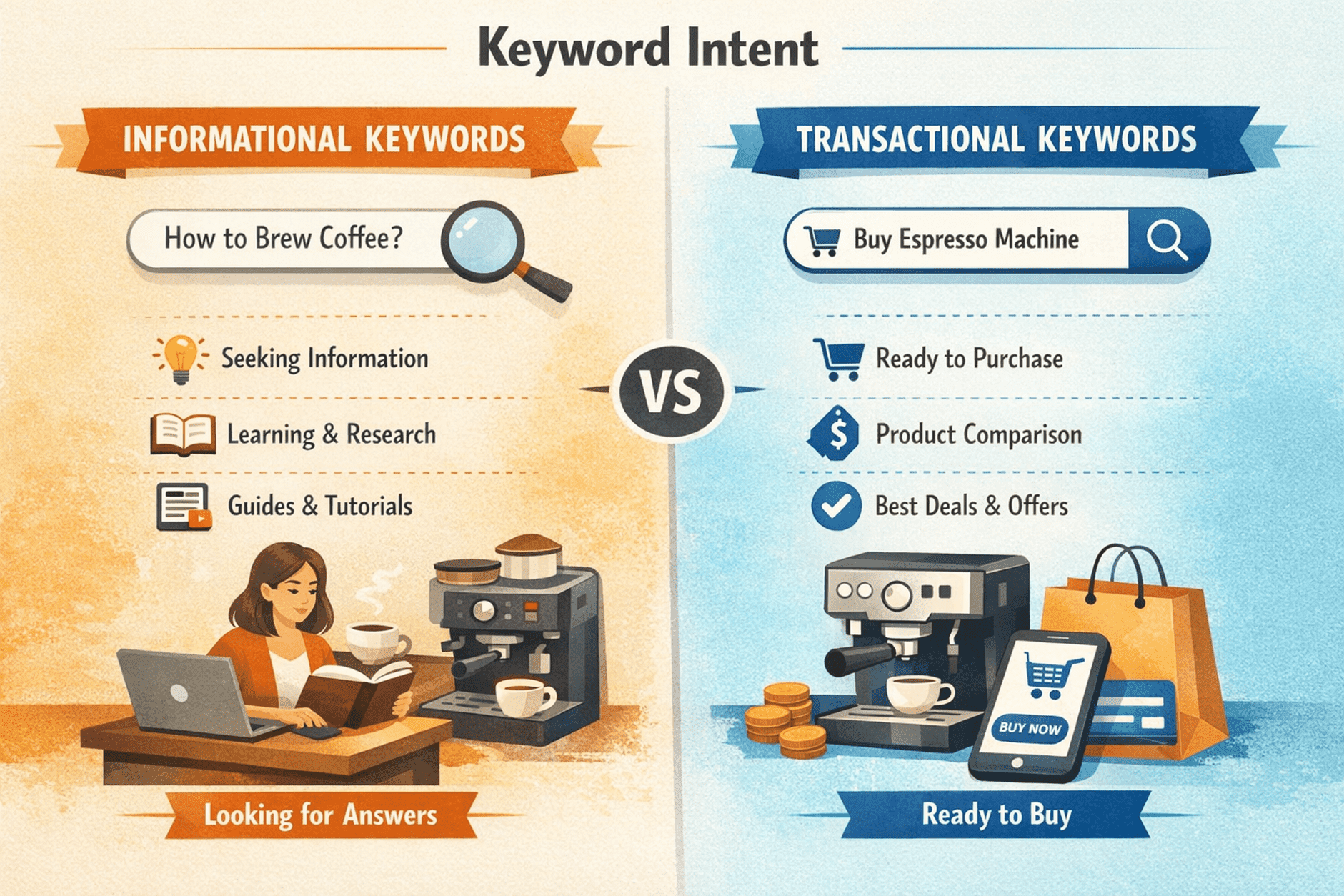
Keyword intent analysis identifies the purpose behind a search query. While intent can be categorized into multiple types, informational and transactional intent form the two primary drivers of SEO-led sales performance.
Informational intent reflects a desire to learn or understand something. Searches like “how to fix a leaky faucet” or “what is quantum computing” indicate exploration. The user is gathering knowledge rather than preparing to purchase. Search engines interpret these queries using advanced AI systems such as Google BERT and Google MUM. BERT analyzes contextual word relationships, while MUM processes complex, multi-layered queries across text, images, and video formats. Together, these technologies enhance semantic interpretation and deliver content aligned with learning-based searches.
Transactional intent, by contrast, signals readiness to act. Queries like “buy iPhone 15 Pro Max,” “CRM software pricing,” or “hire SEO consultant” demonstrate commercial motivation. Search engines respond by prioritizing product listings, pricing pages, reviews, and service landing pages. Structured data such as Product Schema helps search engines display pricing, availability, and ratings directly in search results, increasing click-through rates and accelerating conversions.
Misalignment between intent and content can significantly reduce performance. Serving an educational guide to someone searching for a specific product purchase often leads to immediate abandonment. Understanding intent ensures every page fulfills its intended role in the buyer journey.
The Indirect Sales Power of Informational Intent
Although informational keywords may not drive immediate purchases, they play a foundational role in long-term revenue growth. Users at the awareness and early consideration stages seek answers, guidance, and clarity. High-quality informational content builds trust, establishes authority, and positions a brand as a credible solution provider.
Search engines reward authoritative content through ranking signals aligned with E-E-A-T principles (Experience, Expertise, Authoritativeness, Trustworthiness). Well-researched blog posts, guides, and tutorials frequently serve as first-touch interactions in conversion journeys.
Direct conversion rates from informational pages may average between 0.5% and 1%. However, their true impact emerges through assisted conversions. A user might read an educational article, subscribe to a newsletter, download a guide, and eventually convert weeks later through a branded or transactional search.
Advanced analytics platforms such as Google Analytics 4 enable multi-touch attribution modeling, revealing how informational content contributes to 30–40% of overall conversion paths. These insights demonstrate that informational SEO supports pipeline development even when it does not directly close sales.
The trade-off lies in longer ROI cycles. Informational content demands consistent investment and strategic internal linking. Without clear pathways to product or service pages, its commercial value may remain unrealized. Effective content hubs connect educational material to solution-focused pages, guiding users progressively toward decision-making.
Transactional Intent and Direct Revenue Impact
Transactional keywords represent bottom-of-funnel demand. Users searching with high commercial intent expect frictionless pathways to purchase or sign-up.
Well-optimized transactional pages typically convert between 3% and 10%, depending on industry and product value. Branded transactional searches can convert at even higher rates due to established trust and purchase readiness.
Search engines evaluate multiple signals to rank transactional pages effectively:
- Clear calls-to-action
- Transparent pricing
- Secure checkout systems
- Positive user reviews
- Structured data implementation
Rich snippets displaying pricing and availability often increase click-through rates by 20–30% compared to standard listings.
However, transactional keywords often carry lower search volumes and higher competition. Paid advertising costs for these queries can be substantial. Long-tail transactional keywords, such as highly specific product variations, typically produce lower traffic but significantly higher conversion rates due to precision targeting.
The risk emerges when landing pages fail to match expectations. If a query includes price sensitivity or specific features and the page does not reflect those parameters, users disengage quickly.
Intent Mapping Across the Sales Funnel
Maximum sales impact occurs when informational and transactional strategies operate together. Each intent category supports a specific stage of the buyer journey.
At the awareness stage, users search informational queries such as “what is headless CMS.” In the consideration stage, queries evolve into “headless CMS benefits” or comparisons between platforms. At the decision stage, searches shift toward pricing, demos, and direct purchase options.
Organizations that align keyword intent with funnel stages often see measurable improvements:
- 20–30% increase in qualified leads
- 15–25% shorter B2B sales cycles
- Higher overall conversion efficiency
In complex B2B scenarios, multiple stakeholders may search for different informational angles before a transactional decision occurs. A comprehensive intent strategy ensures content exists for every stage and decision-maker, increasing overall deal closure probability.
Advanced Techniques for Keyword Intent Analysis
Effective intent analysis requires more than automated tagging. It involves detailed examination of search engine results pages (SERPs) and user behavior patterns.
Key SERP indicators include:
- Shopping results indicating transactional intent
- Featured snippets suggesting informational intent
- “People Also Ask” boxes highlighting related queries
- Video or image carousels implying visual informational needs
- Local packs signaling local transactional or navigational intent
SEO platforms such as SEMrush and Ahrefs provide automated intent classifications and SERP analysis tools. However, manual review remains essential for accuracy.
Advanced workflows combine keyword research, SERP feature analysis, competitor audits, and performance tracking through search console data. This layered approach prevents misalignment and improves overall content ROI.
Measuring ROI with Multi-Touch Attribution
Traditional last-click attribution models disproportionately favor transactional keywords. They overlook the influence of early-stage informational interactions.
Modern attribution models within Google Analytics 4 include:
- Linear attribution
- Time decay attribution
- Position-based attribution
- Data-driven attribution using machine learning
These models assign proportional value across all touchpoints, providing a more accurate representation of SEO performance.
Informational content ROI can be measured through micro-conversions such as:
- Email sign-ups
- Whitepaper downloads
- Increased dwell time
- Repeat visits
Assigning monetary value to these actions enables a more holistic calculation of SEO impact. In many cases, informational strategies generate significant long-term ROI when assisted conversions are considered.
Strategic Prioritization Based on Business Goals
The balance between informational and transactional focus depends on business maturity and objectives.
New brands or product launches should emphasize informational content to build awareness and authority. Established brands in competitive markets may prioritize transactional optimization to drive immediate revenue.
The most effective approach blends both strategies dynamically, adjusting emphasis according to campaign goals, market competition, and product lifecycle stage.
A structured content matrix helps align efforts:
Awareness Stage – Informational content focused on education and thought leadership
Consideration Stage – Comparison and commercial investigation content
Decision Stage – Transactional pages optimized for conversion
This ecosystem ensures continuous progression from discovery to purchase.
Conclusion
Keyword intent analysis is not a static classification exercise but an adaptive, data-driven discipline. Informational and transactional queries serve distinct yet interconnected roles in the revenue pipeline. While transactional keywords often produce higher immediate conversion rates, informational content fuels long-term growth, brand authority, and lead generation.
A closed-loop analytics system that tracks assisted conversions and multi-touch interactions reveals the true value of intent-based SEO. As AI-powered search environments continue evolving, static optimization strategies will become increasingly ineffective. Success lies in continuously analyzing user behavior, refining content alignment, and guiding intent toward measurable business outcomes.
When informational trust-building and transactional precision operate together, organizations unlock deeper engagement, stronger lead qualification, and sustained sales growth.
More Articles
The Ultimate Roadmap for E-commerce Keyword Research and Sales Growth
7 Actionable Steps to Build Topical Authority for Better Search Rankings
Voice Search Versus Text Search Maximizing E-commerce Sales for Your Store
Your Practical Checklist to Optimize Website Content for SGE Success
How Can I Effectively Run Shopify Ads to Boost My Sales

FAQs
What’s the main difference between informational and transactional keywords?
Informational keywords are what people use when they’re looking for answers, learning something new, or researching a topic (like ‘how to fix a leaky faucet’). Transactional keywords, on the other hand, are used by people who are ready to take action, usually to buy something or sign up for a service (like ‘buy new faucet online’).
Which type of keyword brings in more direct sales?
Transactional keywords generally lead to more direct sales. When someone uses a transactional keyword, they’re already in a buying mindset, making them closer to converting into a customer right away.
So, should I just focus on transactional keywords then?
Not necessarily! While transactional keywords drive direct sales, solely focusing on them means you miss out on a huge audience who are earlier in their buying journey. Informational keywords build awareness, trust. guide potential customers towards a purchase, often making them more loyal in the long run.
How do informational keywords actually lead to sales if they’re not about buying?
Informational keywords lead to sales by establishing your brand as an authority and a trusted resource. When you provide valuable details, you build rapport with potential customers. This trust can then influence their decision to buy from you when they are ready to make a purchase. It’s about nurturing leads.
Can you give me a few examples of both types of keywords?
Sure! For informational, think ‘best running shoes for flat feet,’ ‘how to choose a web host,’ or ‘benefits of organic coffee.’ For transactional, examples would be ‘buy Nike running shoes,’ ‘cheap web hosting plans,’ or ‘order organic coffee beans.’
What’s the best way to use both types of keywords in my marketing strategy?
The best approach is to use both! Create content around informational keywords (like blog posts, guides) to attract people at the research stage. Then, create product pages, service descriptions. landing pages optimized for transactional keywords to capture those ready to buy. It’s about guiding customers through their entire journey.
Are there any situations where one keyword type is clearly more essential than the other?
Yes, it depends on your immediate goal. If your primary objective is a quick sales boost or direct conversions, transactional keywords will be your focus. If you’re looking to build long-term brand authority, educate your audience. fill your sales funnel, informational keywords become extremely crucial. A balanced strategy is usually ideal for sustainable growth.