The Complete AI-Powered Technical SEO Audit Stack You Need in 2026
Most websites aren’t losing rankings because of bad content. They’re losing because something invisible is broken — a crawl error, a dead backlink, a missing schema tag, a server timeout nobody noticed.
In 2026, the SEO teams winning aren’t just publishing more. They’re auditing smarter. And the secret weapon? A tightly integrated stack of AI-driven SEO tools that catch problems before Google does.
This guide breaks down exactly which tools belong in your audit workflow — and how to use them together for maximum impact.
Why Traditional Site Audits Are No Longer Enough
SEO used to be forgiving. You could run a site audit once a quarter, fix a few broken links, and move on.
That era is over.
Google’s crawlers are faster. AI search engines like Perplexity and ChatGPT pull from the cleanest, most structured sources they can find. If your site has technical debt — slow response times, orphaned pages, thin schema, or toxic backlinks — you’re being passed over in both traditional and AI search results.
The solution isn’t more effort. It’s smarter tooling.
Building Your AI-Powered SEO Audit Stack
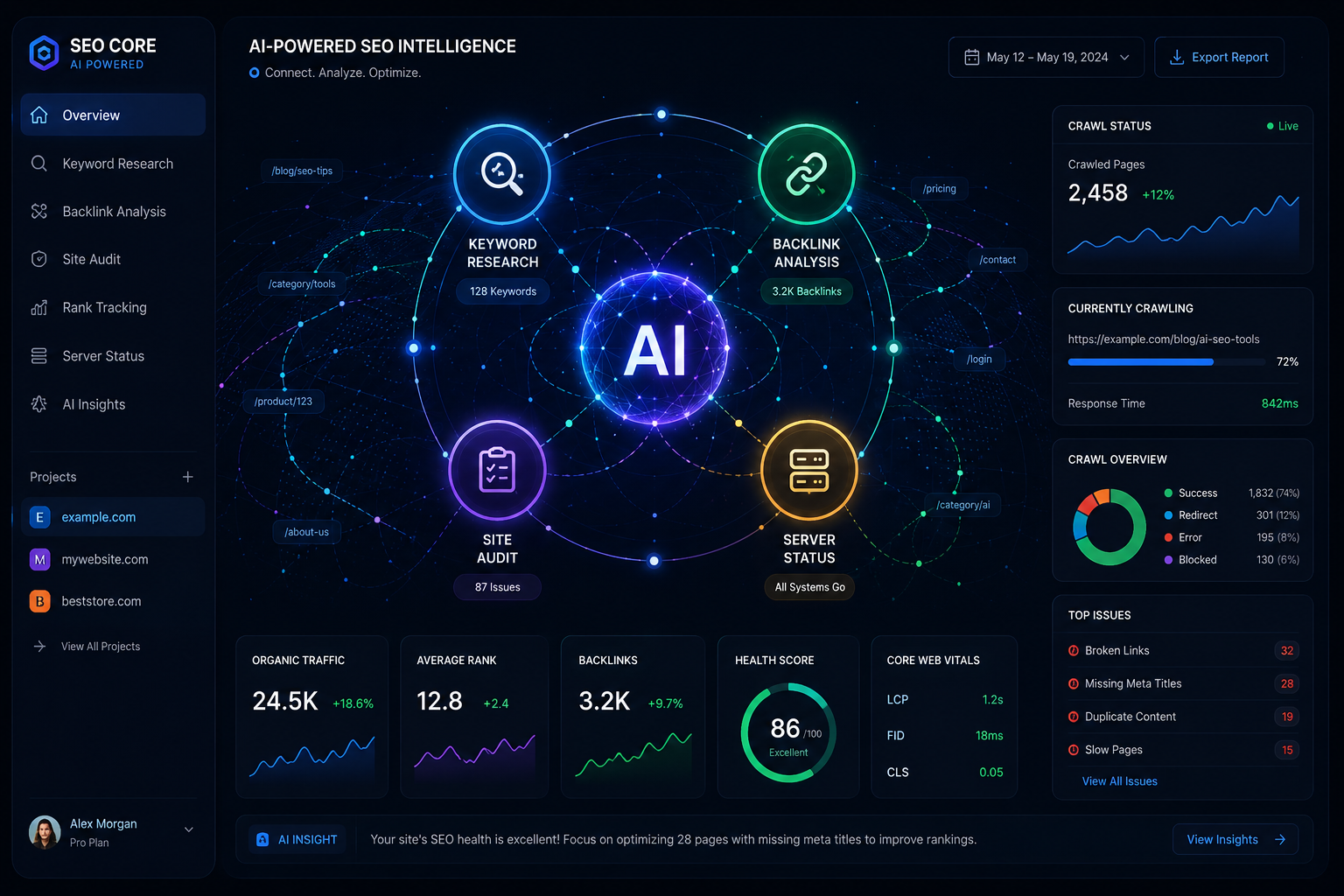
A modern technical SEO audit covers six core areas. Each needs a dedicated tool — and ideally, one that uses AI to surface insights you’d otherwise miss.
1. Keyword Density Checker — Stop Over-Optimizing
Keyword stuffing was killed by Panda. But under-optimization is just as damaging.
A keyword density checker helps you find the exact balance — ensuring your primary terms appear with enough frequency to signal relevance, without tripping spam filters.
In 2026, AI-assisted density analysis goes beyond raw counts. It maps your keyword usage against semantic clusters, helping you identify whether you’re covering a topic thoroughly or just repeating one phrase in circles.
Best practice: Aim for a natural 1–2% density for your focus keyphrase. Use semantic variants liberally throughout. Tools like Promoto AI’s keyword density checker give you instant visual feedback on how your page compares.
2. Keyword Research Tools — Intent First, Volume Second
The old game was chasing high-volume keywords. The new game is understanding intent at scale.
AI for keyword research now means understanding why someone is searching — not just what they’re searching for. Modern tools cluster keywords by intent (informational, commercial, transactional, navigational) and match them to the right content type.
For AI search visibility specifically, you want to target conversational, question-based phrases. These are the queries that AI answer engines like Google’s AI Overview and ChatGPT pull responses for.
Promoto AI’s Keyword Research tool and Keyword Position tracker work together to show not just where you should rank, but where you currently stand — and how far you are from a featured snippet or AI-pulled answer.
3. Link Analyzer Tool — Understand Your Link Profile Completely
Internal linking is one of the most underrated technical SEO levers available.
A link analyzer tool maps every internal and external link across your site — showing you which pages are well-connected, which are orphaned, and which outbound links are pointing to low-authority or dead destinations.
According to Google Search Central, crawlable internal links are essential for Googlebot to discover and index your content properly. If key pages aren’t receiving internal link equity, they simply won’t rank — no matter how good the content is.
Use a link analyzer to:
- Find orphaned pages with zero internal links
- Identify over-linked anchor text (anchor text diversity matters)
- Spot broken outbound links before Google flags them
- Build strategic link paths between high-authority and new pages
4. Broken Links Checker — Fix What’s Hurting Your Crawl Budget
Every broken link on your site wastes crawl budget and damages user trust.
Promoto AI’s Broken Links tool scans your entire domain and returns a prioritized list of 404 errors, redirect chains, and dead anchor links. Fix these and you immediately improve your crawl efficiency and user experience.
For larger sites with thousands of pages, broken link audits should run weekly. An undetected 404 loop on a high-authority page can silently drain the ranking power of your entire domain.
5. Backlink Maker Tool — Build Authority the Smart Way
Backlinks remain one of Google’s top three ranking factors — and that hasn’t changed in 2026.
But the strategy has. Low-quality directory submissions are worthless. What matters now is earning contextual, topically relevant backlinks from trusted domains.
Promoto AI’s Backlink Maker tool helps you submit your site to credible, relevant directories and platforms — building a baseline link profile that supports your broader authority-building strategy.
According to Ahrefs, the pages ranking #1 on Google have, on average, 3.8x more backlinks than positions 2–10. Starting with a clean, diverse base is the foundation — not the ceiling.
Pair backlink building with:
- Content designed for natural link acquisition (data studies, original research, how-to guides)
- A meta tag analyzer to ensure your landing pages are fully optimized before outreach
- Regular audits via your link analyzer to track new acquisitions
6. Server Status Checker — Because Downtime Kills Rankings
Here’s a technical SEO problem most content teams ignore: server reliability.
If Googlebot attempts to crawl your site during a period of downtime or slow server response, it doesn’t just fail that crawl — it can reduce your crawl frequency over time. This means new content gets indexed more slowly, and ranking momentum is lost.
Promoto AI’s Server Status Checker gives you an instant view of your server’s HTTP response health. A clean 200 OK response means your site is crawlable and healthy. Anything else is a red flag worth investigating immediately.
Also check:
- DNS configuration with the DNS Lookup tool — propagation issues can cause intermittent downtime that’s hard to catch manually
- Domain age with the Domain Age tool — newer domains may need extra authority signals to overcome sandbox effects
7. Schema Markup and Structured Data — Your AI Search Advantage
This is where most sites leave significant visibility on the table.
Schema markup tells search engines — and AI systems — exactly what your content is about. It powers rich results, knowledge panels, FAQ snippets, and increasingly, the structured answers pulled by AI search engines like Perplexity and Google’s AI Overview.
Schema.org defines hundreds of content types. At minimum, every blog post should include Article, FAQPage, and BreadcrumbList schema. E-commerce pages need Product and Review. Local businesses need LocalBusiness.
Promoto AI’s Schema Validator lets you test your structured data implementation instantly — catching errors before they prevent your rich results from appearing.
For a complete optimization foundation, pair schema validation with Promoto AI’s AI Content Generation to produce SERP-aware drafts with JSON-LD schema built in from the start.
Site Audit Best Practices for 2026
Running individual tools is useful. Running them as a coordinated system is what separates good SEO from great SEO.
Here’s a practical audit cadence that works:
Weekly:
- Broken links scan
- Server status check
- Keyword position tracking
Monthly:
- Full link analysis (internal + external)
- Keyword density review on top-performing pages
- Schema validation across key landing pages
Quarterly:
- Full technical site audit via Promoto AI’s Analytics Dashboard
- Backlink profile review and new submission round
- Sitemap refresh using the Sitemap Generator
- Robots.txt audit via the Robots.txt Generator
According to Semrush, websites that run regular technical audits and fix crawl issues see an average 15–30% improvement in indexed page counts within 90 days. That translates directly to organic traffic growth.
The Future of SEO Tools: What’s Coming Next
AI search is changing what “ranking” even means.
In 2025 and beyond, the goal isn’t just to appear in the top 10 blue links. It’s to be the source that AI systems quote, summarize, and recommend in answer boxes, AI Overviews, and conversational search responses.
To be that source, your site needs:
- Technical cleanliness — fast servers, clean crawl paths, no broken links
- Semantic depth — content that covers topics, not just keywords
- Structured data — schema that communicates meaning to machines
- Backlink authority — trustworthiness signals from reputable external sources
- AI visibility optimization — GEO and AIO strategies, not just traditional SEO
Platforms like Promoto AI’s Rank on AI Engine solution are specifically built for this new landscape — helping brands get cited by AI tools, not just ranked by traditional algorithms.
Key Takeaways
- A modern technical SEO audit covers keyword density, link health, backlink authority, server performance, and schema markup — not just content quality.
- AI-powered tools surface problems faster and with more context than manual audits or legacy crawlers.
- Internal linking and schema structured data are two of the highest-leverage, most underused SEO levers available in 2026.
- Server status and DNS health directly affect crawl frequency and indexation speed.
- Running SEO tools as a coordinated system — on a consistent cadence — compounds results over time.
Conclusion
Technical SEO isn’t glamorous. Nobody shares a tweet about fixing a broken internal link or updating their schema markup. But these are the moves that quietly determine whether your content ranks — or disappears.
In 2026, the sites that win search aren’t just producing better content. They’re maintaining cleaner foundations, smarter structures, and tighter technical health than their competitors.
The tools to do this are available right now. Promoto AI’s free SEO tool suite — from the keyword density checker and link analyzer to the schema validator and server status checker — gives you everything you need to run a professional-grade audit at no cost.
Start with one section of your site. Run the full stack. Fix what you find. Repeat.
That’s what separates teams that grow traffic from teams that wonder why they’re not.
Start your free AI-powered site audit with Promoto AI →
More Articles
How AI Search Snippet Optimization Boosts Organic Visibility
Automating SEO Workflows with PromotoAI: A Comprehensive Guide
How to Choose the Best AI Content Tool for Scalable Organic Growth
How AI Search Snippet Optimization Boosts Organic Growth Strategies
How AI Content Visibility Boosts Organic Growth Across Digital Platforms
Frequently Asked Questions
What is a technical SEO audit and why does it matter in 2026?
A technical SEO audit examines the non-content factors affecting your site’s search visibility — including crawlability, server health, internal linking, schema markup, and backlink profile. In 2026, it matters more than ever because AI search engines evaluate page structure and technical signals alongside content quality when deciding what to cite or rank.
How often should I run a site audit?
For most sites, a weekly check on server status and broken links, a monthly review of link structure and keyword density, and a full quarterly audit is an effective cadence. High-traffic or e-commerce sites benefit from more frequent automated monitoring.
What is keyword density and what’s the ideal percentage?
Keyword density is the percentage of times your focus keyphrase appears relative to the total word count. In 2026, a natural density of 1–2% for your primary keyword — combined with semantic variants — is generally considered optimal. Over-optimization above 3–4% can trigger spam signals.
Why does schema markup matter for AI search visibility?
Schema markup uses structured data (typically JSON-LD) to communicate page meaning to search engines and AI systems. Pages with proper schema are far more likely to appear in rich results, AI Overviews, and as cited sources in conversational AI tools like Perplexity and ChatGPT.
What’s the difference between a link analyzer and a backlink maker tool?
A link analyzer audits your existing internal and external link structure — identifying orphaned pages, broken links, and anchor text distribution. A backlink maker tool helps you actively build new inbound links by submitting your site to relevant, authoritative directories and platforms. Both are necessary parts of a complete link strategy.
How does server status affect SEO rankings?
If Googlebot encounters repeated server errors or slow response times when crawling your site, it reduces the frequency of future crawls. This means newly published or updated content gets indexed more slowly, and you lose ranking momentum. Monitoring server status proactively prevents this silent SEO leak.