What is GEO and Why Every Brand Needs It in 2026

Not long ago, ranking on Google’s first page was the finish line every digital marketer chased. Get that coveted spot, drive the clicks, grow the business. Simple enough — at least in theory. But search has changed in a way that no one fully anticipated. Today, millions of people don’t type queries into a search bar and scroll through blue links. Instead, they ask ChatGPT a direct question and get a direct answer. They open Perplexity AI and read a curated summary with sources. They ask their AI assistant for a vendor recommendation — and it gives one, without the user ever visiting a website. If your brand isn’t showing up in those AI-generated answers, you’re invisible to an enormous and rapidly growing segment of your audience. That’s exactly the problem Generative Engine Optimization (GEO) is designed to solve. In this guide, we’ll break down what GEO is, how it differs from traditional SEO and Answer Engine Optimization, and — most importantly — what your brand needs to do right now to stay visible in the age of AI-powered search.
What Is GEO (Generative Engine Optimization)?
Generative Engine Optimization (GEO) is the practice of optimizing your content so that AI-powered search tools — like ChatGPT, Perplexity AI, Google’s AI Overviews, Microsoft Copilot, and others — surface your brand, products, or expertise in their generated responses. Unlike traditional SEO, which focuses on ranking pages in a list of results, GEO focuses on becoming a source that AI models trust, reference, and cite when generating answers for users. Think of it this way: when someone asks an LLM (large language model) “What’s the best project management tool for remote teams?”, that LLM doesn’t run a fresh search. It draws on its training data, indexed web content, and real-time retrieval to compose an answer. GEO is about engineering your content to be part of that answer.
“In 2026, showing up in an AI answer is worth more than a page-one Google ranking. The question is: how do you get there?”
SEO, AEO, and GEO: What’s the Difference?
These three disciplines often get conflated, but they’re distinct — and all three matter in a comprehensive modern strategy.
SEO (Search Engine Optimization) Targets traditional search engine algorithms like Google and Bing. The goal is higher page rankings, measured by organic traffic and keyword positions. Format: keyword-optimized long-form pages.
AEO (Answer Engine Optimization) Targets voice assistants and featured snippets. The goal is to win the direct answer box at the top of search results. Format: concise Q&A content and structured data. A strong Answer Engine Optimization strategy is about being the clearest, most direct answer to a user’s question.
GEO (Generative Engine Optimization) Targets generative AI tools like ChatGPT, Perplexity AI, and Gemini. The goal is to be cited or referenced in AI-generated responses. Format: authoritative, well-sourced, conversational content built around topic depth and trust signals.
A sound Answer Engine Optimization strategy overlaps significantly with GEO — both prioritize structured, direct, trustworthy content. But GEO goes a layer deeper by also considering how LLMs ingest, weight, and reproduce information during generation.
How Do AI Search Engines (LLMs) Actually Work?
To optimize for something, you need to understand how it works. Here’s a simplified but accurate picture.
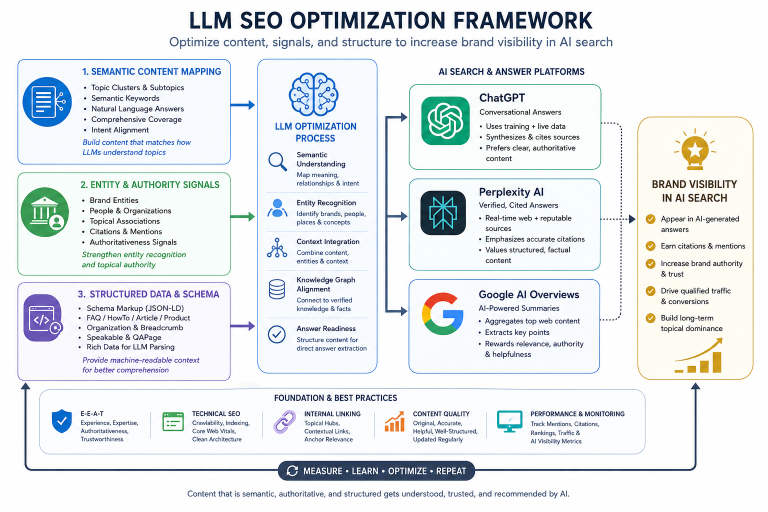
LLMs like ChatGPT are trained on enormous datasets scraped from the web. They learn language patterns, factual associations, and writing styles from billions of documents. When you ask a question, the model generates a statistically likely answer based on everything it has absorbed. Tools like Perplexity AI layer real-time web retrieval on top of this — they actively fetch current content and synthesize it into a response, citing their sources. Google’s AI Overviews do something similar, pulling from indexed content to compose a summary answer at the top of search results. What does this mean for brands? It means that:
Freshness counts. Retrieval-augmented tools like Perplexity actively prefer recent, updated content.
Clarity beats cleverness. AI tools favor content that states facts directly, not content designed to tease readers into clicking.
Authority matters. Domains with strong backlink profiles, consistent expertise, and real citations are more likely to be trusted sources.
Structure is signal. Content organized with clear headings, definitions, and Q&A formatting is far easier for an LLM to parse and reproduce.
Why GEO Matters for Brands in 2026
Here’s the uncomfortable truth: a brand that ranks #1 on Google for a competitive keyword but never appears in AI-generated answers is leaving an enormous opportunity on the table — and, worse, ceding that space to competitors who understood the shift earlier. Consumer behavior has moved. When someone is researching a SaaS tool, a local service, a financial product, or even which sneakers to buy, the first stop is increasingly an AI assistant rather than a traditional search engine. The brands that appear in those conversations gain disproportionate trust and purchase intent. AI-powered search visibility is not just a vanity metric — it’s a genuine revenue channel. And GEO is how you build it systematically.
Key Components of a Strong GEO Strategy
1. Semantic SEO Content Strategy
Traditional keyword optimization targets individual search terms. A semantic SEO content strategy goes further — it maps entire topic ecosystems so that AI tools recognize your brand as a comprehensive, trustworthy resource on a subject. This means building content clusters: a pillar page on a core topic, surrounded by supporting articles that answer every related question in depth. When an LLM has encountered dozens of your well-written pages on a topic, it is far more likely to treat you as an authority and surface your content when relevant questions come up.
2. Structured Data Implementation
Structured data implementation using Schema.org markup makes your content machine-readable. FAQ schema, HowTo schema, Article schema, and Product schema all help AI tools understand what your page is about and how to categorize it. For GEO, structured data is foundational — not optional. An LLM or retrieval engine parsing your page should be able to extract key facts and entities without ambiguity. Schema markup is how you make that easy.
3. AI Readability and Answer Formatting
Write content in a way that directly answers questions. Use clear definitions, numbered steps, comparison tables, and concise summaries at the top of sections. Avoid burying the answer in paragraphs of preamble. This also means using natural language that mirrors how people actually phrase questions to AI assistants — “How do I…”, “What is the best…”, “Why does…” — your content should reflect conversational intent, not just traditional search keyword patterns.
4. Authority and Trust Signals
Backlinks from reputable sources, author bios with demonstrated expertise, citations from industry publications, and consistent brand mentions across the web all contribute to what LLMs learn about your domain’s credibility. Think of it like academic citation: the more reliable sources reference your work, the more likely an AI is to treat your content as a go-to reference when composing answers in your category.
How to Optimize Content for AI Tools (ChatGPT, Perplexity AI, and Others)
If you want to understand how to rank in ChatGPT answers or optimize content for Perplexity AI, the playbook looks like this:
- Write definitively. State clear positions and definitions. AI tools favor content that takes a stance, not content padded with endless “it depends.”
- Use real data and cite sources. Content backed by statistics, studies, or expert quotes carries more weight in AI retrieval systems.
- Create original research. First-party data — surveys, case studies, proprietary benchmarks — is gold for GEO. AI tools love unique data they can’t find replicated everywhere else.
- Maintain a consistent brand voice across platforms. Social, editorial, PR — the more coherent and visible your brand presence, the stronger your entity recognition in AI systems.
- Get mentioned in niche publications. Industry blogs, podcasts, and forums that discuss your brand help LLMs build positive associations between your brand name and your category.
Step-by-Step Answer Engine Optimization Strategy for GEO
Step 1: Audit your existing content for AI readiness Run your top-performing pages through an AI readability lens. Are key questions answered directly? Is the content clearly structured? Would an LLM extract the right facts from it?
Step 2: Build your topic authority map Identify the core topics your brand owns. Create or expand pillar content and supporting articles to cover every angle of each topic comprehensively.
Step 3: Implement structured data across key pages Add FAQ, Article, Product, and HowTo schema wherever relevant. Test with Google’s Rich Results tool and validate with structured data validators.
Step 4: Optimize for conversational queries Research how users phrase questions to AI tools — not just to Google. Perplexity’s related questions, Reddit threads, and Quora are goldmines for natural language query patterns.
Step 5: Build authority through third-party mentions Pursue guest articles, podcast appearances, PR coverage, and industry citations that mention your brand name alongside your core topic keywords.
Step 6: Create content specifically for AI retrieval Write comprehensive “what is” and “how to” guides that serve as definitive resources. These are the pages most likely to be cited by retrieval-augmented AI tools like Perplexity AI.
Step 7: Monitor and measure AI brand visibility Use tools — including Promoto.ai — to track how often and in what context your brand appears in AI-generated outputs. Adjust your content strategy based on what is working.
Common Mistakes Brands Make with GEO
Even well-resourced marketing teams fall into these traps when they first approach GEO:
- Treating GEO like traditional SEO. Keyword stuffing and backlink volume alone won’t move the needle. AI tools assess semantic depth, not just keyword density.
- Ignoring structured data. Many brands skip schema markup thinking it’s optional. For GEO, it’s essential infrastructure — not a bonus.
- Publishing thin content at scale. Churning out hundreds of AI-generated articles without depth won’t build authority. LLMs recognize shallow content patterns and deprioritize them.
- Skipping entity building. Not investing in brand mentions, PR, and thought leadership means AI tools have little signal to associate your brand with your category.
- Measuring only traditional metrics. If your reporting still stops at organic traffic and rankings, you’re missing the most important new dimension: AI citation and brand mention frequency.
The Future of AI-Powered Search Visibility
We’re still in the early innings of generative search. The brands that invest in scalable organic growth through GEO today are building a durable competitive moat — not chasing a short-term tactic. In the next 12 to 24 months, expect AI search tools to become even more personalized, multimodal (text, image, voice), and commercially integrated. The distinction between “discovering a brand” and “being recommended a brand” will blur entirely. Your brand’s presence inside these AI systems will increasingly determine whether you grow or get left behind. The brands that will win are those that treat GEO as a core growth discipline — not an afterthought, and not something they’ll “get to eventually.” The window to build early authority in AI systems is open right now. It won’t stay open forever. A robust GEO and Answer Engine Optimization strategy — powered by deep semantic content, proper structured data, and deliberate authority building — is the most important investment a growth-focused brand can make in 2026 and beyond.
Conclusion: Your Brand Needs to Be in the Answer, Not Just the Results
The shift from search engines to answer engines is not coming. It’s already here. Every day that your brand isn’t visible in AI-generated responses is a day your competitors — who understand GEO — are getting recommended in your place. GEO is not about gaming an algorithm. It’s about building the kind of content, authority, and structure that AI tools genuinely trust and want to surface. That’s a durable advantage — and one that compounds over time, just like the best SEO optimization strategies always have. The question isn’t whether you need GEO. The question is how quickly you can build it.