Best AI Tools Compared (2026 Buyer’s Guide): Find the Right SEO Tool for Your Goals

The way SEO works has changed dramatically. What once required a team of analysts, hours of manual research, and expensive agency retainers can now be handled in minutes with the right AI-powered tools. In 2025–2026, the gap between businesses using the best SEO tools and those still working manually is wider than ever — and it keeps growing. But here’s the problem: there are hundreds of tools on the market, each claiming to be the best. Choosing the wrong one wastes time, money, and opportunity. This guide cuts through the noise. Whether you’re a freelancer just starting out, a digital marketer scaling campaigns, or a startup founder trying to get organic visibility without burning your budget, this buyer’s guide will help you make a confident, informed decision.
What Makes an AI SEO Tool “Best”?
Not every tool that slaps “AI” on its homepage actually delivers. Before you compare pricing or features, it’s worth understanding what genuinely separates a great AI SEO tool from a mediocre one.
Key features to look for:
- Accurate, real-time data — not recycled metrics from months ago
- Depth of keyword research tools, including intent classification and clustering
- Automation that actually saves time, not just dashboards that look impressive
- Content optimization suggestions grounded in actual SERP analysis
- Technical capabilities like a keyword density checker, backlink maker tool, and server status checker
- Transparent reporting that non-technical users can understand
The best tools strike a balance between automation and control. Full automation is great for speed, but experienced SEOs still want the ability to override, customize, and dig deeper when needed. The ideal tool gives you both.
Types of AI SEO Tools
Before comparing specific platforms, it helps to understand the categories. Most modern tools fall into one or more of these:
Keyword Research Tools These identify what your audience is searching for, how competitive those terms are, and where opportunity exists. The best ones now use AI to cluster keywords by topic and map them to buyer intent — not just show you a list of terms and their monthly volumes.
Content Optimization Tools These tools analyze top-ranking pages and tell you exactly what your content needs to compete — ideal word count, recommended topics, semantic coverage, and keyword density. They take the guesswork out of on-page SEO.
Site Audit Tools Site audits crawl your entire website and flag technical issues: broken links, slow pages, missing meta tags, duplicate content, crawl errors, and more. AI-powered audits can now prioritize issues by actual impact, not just severity level.
Backlink and Link Analyzer Tools Backlinks remain one of Google’s strongest ranking signals. Link analyzer tools help you monitor your backlink profile, identify toxic links, track competitor link-building strategies, and find opportunities for outreach. A backlink maker tool streamlines the entire link acquisition workflow.
Technical SEO Tools This includes server status checkers, crawl configuration tools, schema markup validators, and Core Web Vitals monitoring. These are often overlooked but matter enormously for large websites.
Best AI SEO Tools Compared (2026)
Here’s an honest comparison of the leading tools available right now. Pricing is categorized broadly since exact figures change frequently — always verify before purchasing.
1. Semrush
Best for: All-in-one SEO and competitive research
Key Features: Keyword research tools with AI clustering, site audit, backlink analysis, content marketing toolkit, position tracking, and competitor gap analysis.
Use Case: Mid-size to enterprise teams that want a single platform covering all SEO needs.
Pricing: Mid to high range; monthly and annual plans available.
Pros:
- Enormous keyword and backlink database
- Strong site audit with prioritized recommendations
- Excellent competitor intelligence tools
Cons:
- Can feel overwhelming for beginners
- Cost adds up quickly for small teams or solo users
2. Ahrefs
Best for: Backlink analysis and link strategy
Key Features: Industry-leading link analyzer tools, keyword explorer, content gap analysis, rank tracker, and site audit.
Use Case: SEOs and agencies focused heavily on link building and competitor backlink research.
Pricing: Mid to high range; per-seat pricing model.
Pros:
- Arguably the best backlink database available
- Intuitive interface with strong data accuracy
- Excellent keyword difficulty scoring
Cons:
- Limited content creation features
- No built-in AI writing assistance
3. Surfer SEO
Best for: AI-powered content optimization
Key Features: Real-time keyword density checker, SERP analysis, content editor with NLP scoring, keyword clustering, and AI-generated outlines.
Use Case: Content teams and bloggers focused on optimizing articles to rank faster.
Pricing: Mid range; scales by number of articles per month.
Pros:
- Extremely actionable on-page SEO recommendations
- Integrates with Google Docs and WordPress
- Easy to understand for non-technical users
Cons:
- Limited technical SEO and backlink features
- Better as a complement to other tools than a standalone solution
4. SE Ranking
Best for: Budget-conscious professionals who need solid all-around performance
Key Features: Keyword research, site audit, rank tracking, backlink checker, competitor analysis, and white-label reporting.
Use Case: Freelancers, small agencies, and growing startups.
Pricing: Budget to mid range; flexible pricing based on check frequency.
Pros:
- Strong feature set at a competitive price
- Clean, beginner-friendly interface
- Good keyword density and technical audit reporting
Cons:
- Backlink database smaller than Ahrefs or Semrush
- Some advanced features lag behind premium competitors
5. Screaming Frog SEO Spider
Best for: Deep technical SEO audits
Key Features: Full site crawl, server status checker, redirect chain analysis, duplicate content detection, structured data validation, and integration with Google Analytics and Search Console.
Use Case: Technical SEOs and developers who need granular crawl data.
Pricing: Free version available; low annual cost for the full version.
Pros:
- Unmatched depth for technical audits
- Highly customizable crawl settings
- One of the most trusted tools among senior SEOs
Cons:
- Desktop-based, not cloud-hosted
- Steep learning curve for beginners
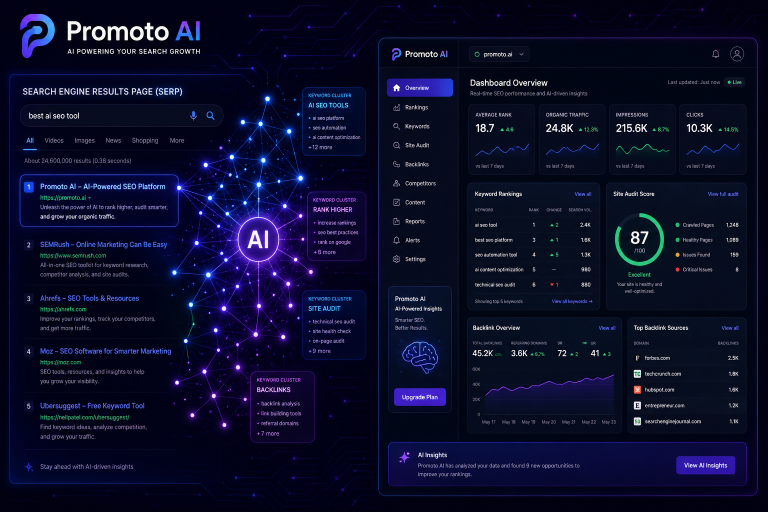
6. Promoto.ai
Best for: AI-driven SEO strategies for growing teams and solo users
Key Features: AI-powered content research, keyword clustering, keyword density checker, backlink maker tool, site audit tools, link analyzer, and server status checker — all in one streamlined dashboard.
Use Case: Marketers, bloggers, and founders who want actionable AI-driven insights without juggling five different platforms.
Pricing: Accessible and transparent; built for individual users and teams alike.
Pros:
- Purpose-built for AI-driven SEO workflows
- Covers technical, content, and link building in one place
- Clean interface without the bloat of enterprise-heavy platforms
Cons:
- Newer platform still expanding its database depth
- Some enterprise-scale features still in development
How to Choose the Right Tool for Your Needs
The “best” tool depends entirely on where you are and where you’re headed.
Beginners should prioritize ease of use and learning curve over feature depth. Tools like SE Ranking or Promoto.ai offer strong foundational capabilities without burying you in data you’re not ready to act on.
Experienced professionals and agencies typically need larger databases, more integrations, and deeper customization. Semrush or Ahrefs fit this profile well, though the cost reflects that.
Budget considerations matter. Paying for a $400/month platform when you’re managing one website doesn’t make sense. Start with what you’ll actually use, and upgrade as your needs grow.
Business vs. personal use. If you’re running a client-facing agency, white-label reporting and multi-account management matter. For personal projects or a single brand, you can skip those and invest in content and keyword tools instead.
How AI is Transforming SEO
This isn’t a trend — it’s a permanent shift. AI-driven SEO strategies are now the default for any competitive market.
Content research has been completely overhauled. AI-powered content research tools can now analyze thousands of top-ranking pages, identify content gaps, extract semantic relationships between topics, and produce structured content briefs in seconds. What used to take a skilled writer a full day now takes ten minutes.
Keyword clustering — grouping related search terms by intent rather than just similarity — is now handled automatically. This means fewer missed opportunities and more strategically structured site architecture.
Automated site audits don’t just flag issues anymore; they explain the impact, suggest fixes, and prioritize based on your specific traffic situation. That’s a massive leap from the PDF crawl reports of five years ago.
Must-Have Features in Modern SEO Tools
If a tool is missing any of these in 2026, think carefully before committing:
- Keyword density checker — to ensure content is optimized without over-stuffing
- Backlink maker tool — to systematically build and track link acquisition campaigns
- Link analyzer tools — to audit your profile, disavow toxic links, and study competitors
- Server status checker — to catch downtime, redirect issues, and server errors that hurt rankings
- Technical SEO integrations — with Google Search Console, Analytics, and CMS platforms
Site Audit Best Practices Using AI Tools
A site audit is only valuable if you act on the results. Here’s a simple workflow that works:
Step 1: Crawl your full website. Use your chosen tool’s audit feature and let it run a complete crawl. Don’t exclude any sections at first — you want the full picture.
Step 2: Prioritize critical errors first. Broken internal links, missing title tags, duplicate meta descriptions, and pages returning server errors hurt rankings directly. Fix these before anything else.
Step 3: Address page speed and Core Web Vitals. AI tools now flag exactly which elements are slowing down your pages and score them against competitors.
Step 4: Review structured data and schema markup. AI audits can validate your structured data and flag invalid schema that prevents rich results from appearing.
Step 5: Re-crawl after fixes. Always verify your fixes landed correctly with a follow-up audit.
Common issues to fix immediately:
- 4xx and 5xx server errors
- Redirect chains longer than two hops
- Pages with thin content (under 300 words with no clear purpose)
- Missing or duplicate H1 tags
- Uncompressed images above 200KB
Common Mistakes When Choosing SEO Tools
Overpaying for features you won’t use. Enterprise platforms are built for enterprise problems. If you’re running a 50-page website, you don’t need a tool that handles 10 million URLs.
Tool overload. Using six different tools that partially overlap leads to contradictory data, wasted hours, and confusion. Pick one or two that complement each other and master them.
Ignoring data accuracy. Some budget tools inflate metrics to look impressive. Always cross-reference keyword volumes and backlink counts against Google Search Console data before trusting a tool completely.
The Future of SEO Tools
The next two years will reshape this space significantly.
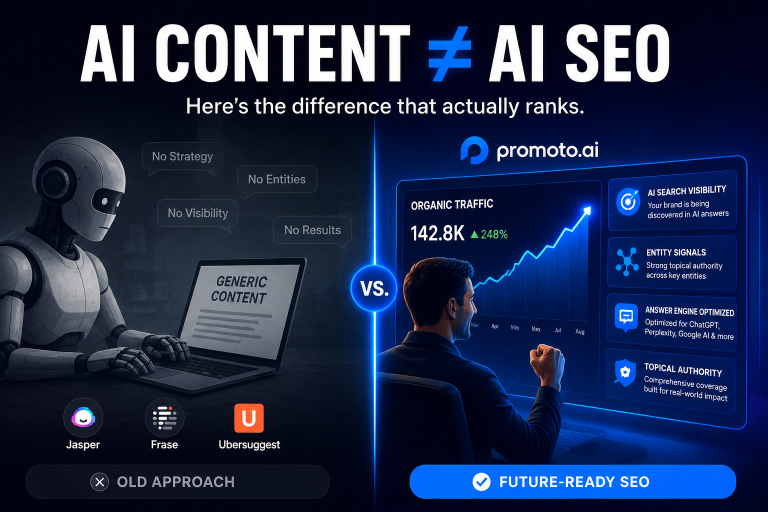
Large language models (LLMs) are already being integrated into SEO tools for content generation, intent analysis, and search behavior prediction. The tools that integrate these thoughtfully — rather than just bolting on a chatbot — will pull ahead.
Predictive SEO is emerging as a genuine capability. Rather than just reporting on what happened, tools are beginning to forecast keyword trends, estimate traffic impact of content decisions, and model ranking timelines based on historical data.
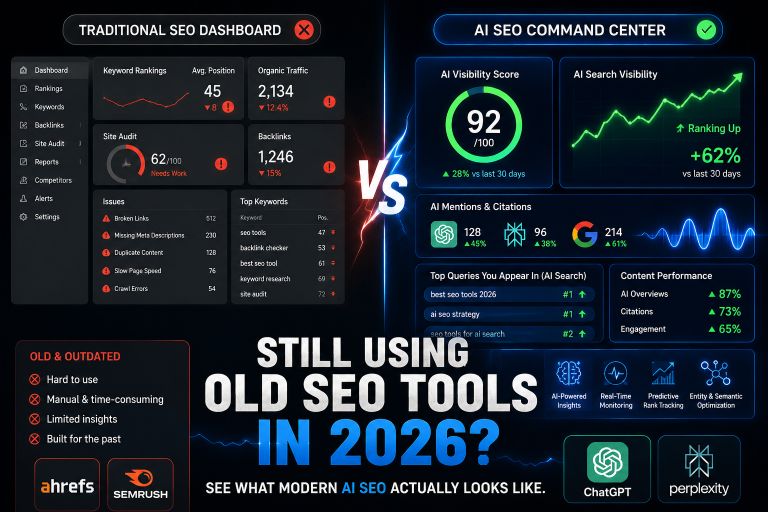
Answer engine optimization (AEO) is becoming as important as traditional SEO. As search evolves toward AI-generated answers and voice responses, tools will need to help marketers optimize for being cited as a source — not just ranking on page one. The future belongs to tools that think ahead, not just report backward.
Conclusion: Choose Smarter, Rank Better
The right AI SEO tool isn’t the most expensive one or the most feature-rich one — it’s the one you’ll actually use consistently and that gives you accurate, actionable data. Start by identifying your biggest gap: Is it content quality? Technical errors? Backlink strategy? Choose a tool that solves that problem first, then expand from there. If you’re looking for a platform that brings AI-driven SEO strategies, keyword research, site audits, backlink tools, and technical SEO checks into one focused experience, Promoto.ai is worth a serious look. It’s built for marketers who want results, not complexity. The best time to build your SEO foundation with the right tools was last year. The second best time is now.