What Most AI Writing Tools Still Get Wrong About SEO (And What Actually Works in 2026)
There’s a frustrating pattern playing out across content teams right now. A marketer fires up their favorite AI writing tool, generates a polished 1,500-word blog post in under three minutes, hits publish — and then watches it flatline on Google with zero organic traffic.
The article looks good. The sentences flow. The subheadings are clean. But it simply doesn’t rank.
This isn’t a fluke. It’s a structural problem with how most AI writing tools were built. They were designed to produce readable text — not to optimize for how search engines and AI-powered answer engines actually work in 2026.
And the gap between “AI-written content” and “AI-optimized content” is exactly where most tools fall short.
Why the “Write Fast, Rank Later” Approach Is Broken
For most of the last decade, the SEO playbook felt relatively stable. Research keywords, produce content, earn backlinks, track rankings. Add an AI writing tool to that process, and you could simply produce more content faster.
But search behavior has shifted dramatically. Google’s AI Overviews now appear at the top of results for hundreds of millions of queries, often absorbing the click before a user ever reaches organic listings. ChatGPT, Perplexity AI, Gemini, and Claude answer questions directly — frequently citing specific sources and ignoring others entirely.
Zero-click search behavior is no longer a trend to watch. It’s the baseline reality.
In this environment, producing content that merely “exists” on the web isn’t enough. The question isn’t whether your article is readable — it’s whether it’s structured, semantically rich, technically sound, and optimized for both traditional crawlers and LLM citation patterns. That’s an entirely different problem than what most AI writing tools were built to solve.
The Real Difference: Writing Tools vs. SEO Platforms
Here’s a distinction that most tool comparison articles skip over: there’s a fundamental difference between an AI writing tool and an AI SEO platform.
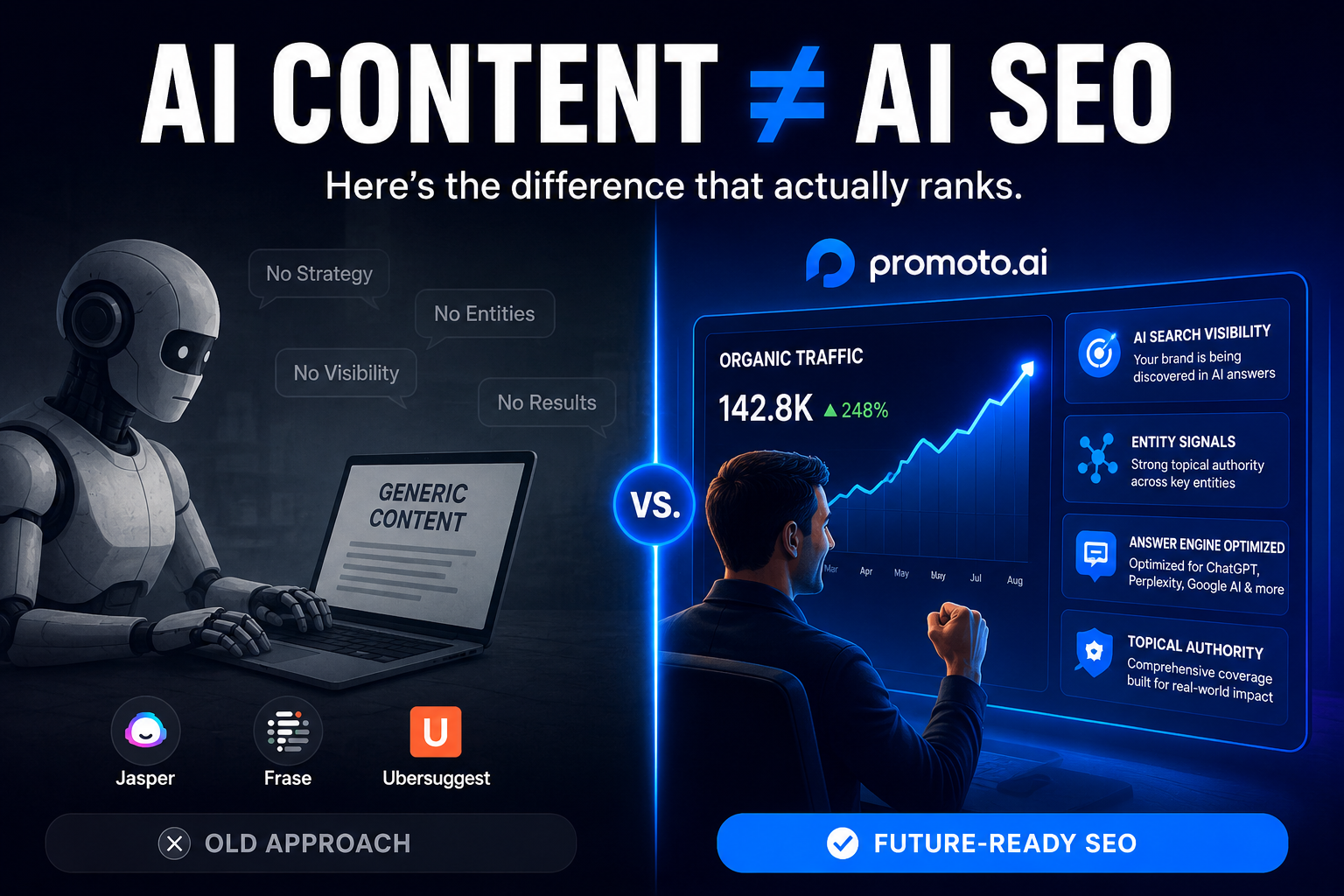
An AI writing tool helps you produce content faster. An AI SEO platform helps you produce content that ranks, gets cited, and drives compounding organic traffic over time.
Most tools in the market today are firmly in the first category — even the ones marketing themselves as “SEO tools.”
Let’s look at where the most popular platforms actually land.
Tool Comparison: What They Do Well — and Where They Fall Short
Jasper AI
Overview: Jasper is one of the most widely recognized AI writing platforms, popular among marketers for brand voice consistency and long-form content generation.
Best use case: Brand content, ad copy, email sequences, and social media assets.
Strengths: Excellent UI, wide template library, strong tone customization, and team collaboration features.
Weaknesses: Jasper’s core strength is writing, not SEO strategy. It lacks native keyword research, has no semantic SEO scoring, and offers no technical SEO integrations. Ranking guidance is minimal at best.
AI optimization capabilities: Limited. Jasper can write content, but it doesn’t analyze SERP structure, predict ranking potential, or optimize for AI visibility in tools like ChatGPT or Perplexity.
Best for: Content teams focused on brand voice, creative output, and volume — not teams with organic search as a primary growth channel.
Pricing category: Mid-to-high range. Starts around $49/month; enterprise plans scale significantly.
The honest take: If you’re searching for Jasper AI alternatives because your content isn’t ranking, the issue is that Jasper was never built to solve that problem.
Frase
Overview: Frase markets itself as an AI SEO content tool, with a focus on content briefs, SERP research, and question-based optimization.
Best use case: Content briefs and SERP-based content structuring.
Strengths: Good at pulling “People Also Ask” questions, competitor research, and content outline generation. Useful for freelance writers and small content teams.
Weaknesses: Frase’s AI writing quality has lagged behind newer models. It also lacks GEO optimization, AI visibility features, and the kind of full-stack automation that modern content operations need at scale.
AI optimization capabilities: Moderate. Frase covers on-page SEO signals but doesn’t extend to LLM optimization, entity-based SEO, or AI answer engine visibility.
Best for: Freelancers and small teams doing research-heavy content work without needing publishing automation or deep technical SEO.
Pricing category: Budget-to-mid range. Entry plans start around $15/month.
The honest take: Frase is a useful research layer, but it’s not a complete SEO platform. Teams looking for Frase alternatives typically need something that goes further — from research all the way through publishing and ranking analysis.
Ubersuggest
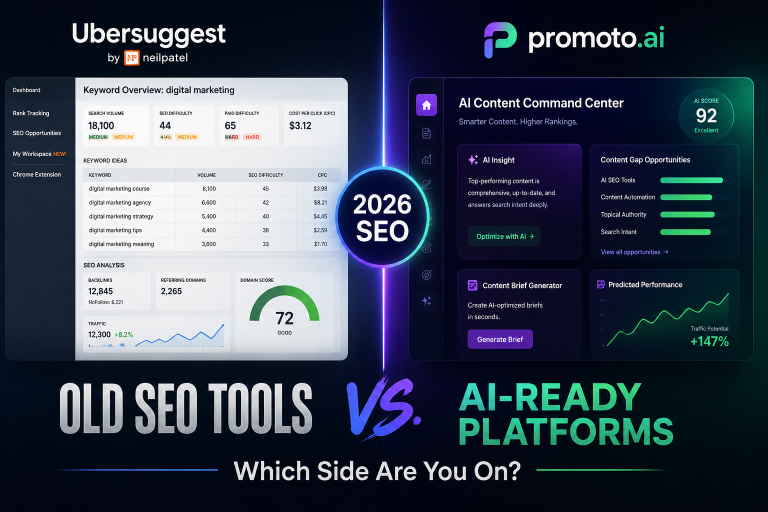
Overview: Neil Patel’s Ubersuggest is a keyword research and SEO audit tool that has added basic AI content features over time.
Best use case: Budget-conscious keyword research and basic site audits.
Strengths: Affordable, beginner-friendly, and decent for surface-level keyword discovery and backlink data.
Weaknesses: The AI content features feel bolted on rather than purpose-built. Ubersuggest doesn’t offer semantic SEO, content scoring, GEO optimization, or publishing integrations.
AI optimization capabilities: Basic. The platform handles keyword data reasonably well, but its content generation doesn’t match the optimization depth that professional SEO workflows require in 2026.
Best for: Beginners and solo bloggers doing initial keyword discovery on a tight budget.
Pricing category: Low range. Lifetime deals often available.
The honest take: Promoto AI vs Ubersuggest isn’t really a fair comparison — they’re solving different problems at different sophistication levels. Once a content operation scales, Ubersuggest’s limitations become apparent quickly.
SEMrush
Overview: SEMrush is the industry-standard SEO analytics platform — comprehensive, data-rich, and deeply trusted by agencies and enterprise teams.
Best use case: Technical SEO audits, competitor research, backlink analysis, and rank tracking at scale.
Strengths: Unrivaled data depth. SEMrush offers one of the most complete SEO toolsets available, from site crawling to traffic analytics to paid search insights.
Weaknesses: SEMrush is fundamentally an analytics and audit platform, not a content production platform. Its AI writing features (ContentShake AI) are secondary to its core purpose. For teams that need both content creation and GEO/AIO optimization in one workflow, SEMrush requires significant additional tooling.
AI optimization capabilities: Growing. SEMrush is investing in AI features, but its optimization guidance is still primarily focused on traditional search signals rather than LLM citation patterns or AI answer engine visibility.
Best for: Agencies, enterprise SEO teams, and technical SEO specialists who need deep analytics and can layer in separate content tools.
Pricing category: High. Plans typically start at $139/month, with agency plans running considerably higher.
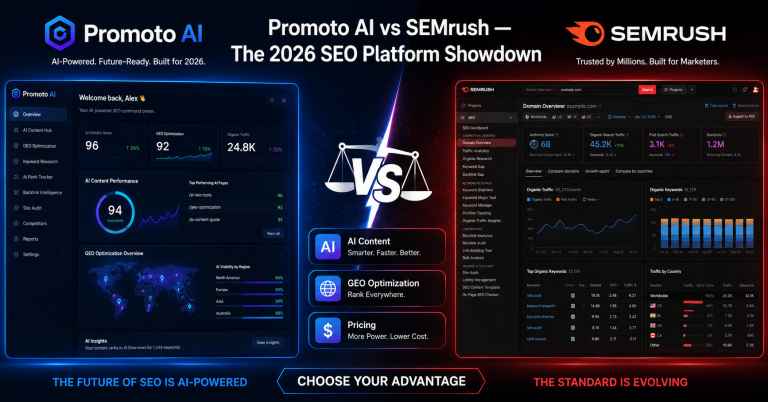
The honest take: Promoto AI vs SEMrush is less about one replacing the other and more about what your primary workflow is. SEMrush owns the analytics layer. But for content creation, AI optimization, and publishing automation in a single platform, it requires pairing with other tools.
Promoto.ai
Overview: Promoto.ai is a full-stack AI SEO platform built for the way search actually works in 2026 — covering SEO, AI Optimization (AIO), App Store Optimization (ASO), and Generative Engine Optimization (GEO) in a single workflow.
Best use case: Teams that need to research, create, optimize, publish, and track content across traditional search and AI-powered answer engines — without switching between tools.
Strengths: The platform combines AI content generation tuned for both SERP performance and LLM citation patterns, native publishing to WordPress and Shopify, Google Search Console and GA4 integration, keyword research and keyword density analysis, link analysis, backlink tools, server status monitoring, and an automation layer that handles scheduling, approvals, and team workflows.
AI optimization capabilities: Strong and purpose-built. Promoto.ai generates content optimized for schema markup, semantic SEO, AI answer engines, and topic clusters simultaneously — not as an afterthought.
SEO workflow features: End-to-end. From keyword position tracking to meta tag generation, sitemap creation, and schema validation, the platform covers the full technical surface area.
Best for: Digital marketers, agencies, SaaS companies, and content-heavy businesses that want unified SEO and AI search visibility without stitching together five different tools.
Pricing category: Free trial available; plans scale with usage. See current pricing →
The honest take: For teams asking “why isn’t our AI content ranking?”, Promoto.ai is built to answer that question structurally — not just produce more text.
Which Tool Is Best for Different Users?
Bloggers and solo content creators — If you’re managing your own blog and want content that actually builds organic traffic over time, a platform like Promoto.ai that handles both writing and SEO optimization gives you more leverage than a writing tool alone.
Agencies managing multiple clients — You need multi-tenant dashboards, bulk publishing, and scalable analytics. Promoto.ai’s agency architecture and platform integrations are built for this. SEMrush handles the analytics layer well if you already have it, but production-side automation is where Promoto.ai fills a gap.
Startups and SaaS founders — Speed and efficiency matter. A platform that can generate SEO and AIO-optimized content and push it live to your site without a large content team is exactly what early-stage growth looks like in 2026.
Freelancers — Frase is fine for brief creation, and Jasper is useful for clients who care about brand voice. But if your value proposition is helping clients rank, you need tools that actually move search metrics.
Content-heavy businesses (e-commerce, media, SaaS) — Scale and automation are non-negotiable. Promoto.ai’s Shopify solution and WordPress solution are particularly relevant here, enabling direct content publishing with SEO baked in.
Technical SEO specialists — SEMrush remains valuable for deep audits. Pairing it with Promoto.ai’s content and GEO optimization layer gives you a more complete stack than either tool alone.
Key Features Modern AI SEO Tools Must Have in 2026
Not all AI SEO tools are equal. Here’s what a genuinely complete platform should offer:
- AI-powered content research that factors in SERP structure, competitor analysis, and semantic intent — not just keyword frequency
- Keyword research tools with volume, difficulty, and opportunity signals informed by real-time data
- Semantic SEO optimization that builds topical authority across related entities, not just isolated keyword matches
- Keyword density checker to ensure natural keyword distribution without over-optimization
- Backlink maker tool and link analyzer for building and auditing link equity
- Server status checker and technical health monitoring
- Schema.org integration and structured data support for rich results eligibility
- Content scoring systems that measure optimization across both traditional SEO and AI visibility signals
- GEO and AIO optimization to appear in ChatGPT, Perplexity, Google AI Overviews, and other answer engines
- Publishing automation with direct integrations to CMS platforms
Promoto.ai offers free versions of many of these tools — including keyword density, link analyzer, backlink maker, server status, and meta tag analysis — making it accessible for teams at different budget levels while building toward a complete workflow.
Real SEO Problems AI Tools Are Solving (and Some Still Aren’t)
Content scaling without quality degradation is the most immediate problem AI tools address well. Producing consistent, topically relevant content at volume is no longer a bottleneck for teams using modern platforms.
Search intent optimization — matching content to what users actually want, not just what they searched — is improving across better platforms. Promoto.ai’s SERP-aware generation factors in intent signals at the content creation stage.
AI visibility and LLM citation patterns remain the least-addressed problem in the industry. Most tools still don’t optimize for the question: “Will ChatGPT cite my content?” Platforms focused on ranking on AI engines are ahead of this curve.
Internal linking and content architecture are still manual tasks in most platforms. Automated internal link recommendations based on topical clusters remain an emerging feature.
Predictive SEO analysis — anticipating which keywords are trending before competition increases — is where AI-powered platforms are starting to differentiate from traditional tools.
Common Mistakes When Choosing AI SEO Software
Buying based on hype alone. Jasper and several other tools have benefited enormously from marketing spend. That visibility doesn’t translate directly to SEO performance. Evaluate based on what actually moves rankings.
Ignoring workflow compatibility. A tool that doesn’t integrate with your CMS creates friction. Before committing to any platform, verify it connects with your publishing stack — WordPress, Shopify, or otherwise.
Overpaying for features you won’t use. SEMrush’s full feature set is impressive. It’s also expensive. If your primary need is content creation and AI optimization, paying for deep technical audit features you’ll rarely use isn’t efficient.
Publishing AI content without optimization review. AI-generated text that skips semantic optimization, internal linking, and schema markup is just filler content. Volume without quality signals actively damages topical authority.
Ignoring technical SEO entirely. Even the best AI-written article fails if the page has crawl issues, missing meta tags, or broken links. Technical and content SEO are not separate disciplines — they’re the same problem.
The Future of AI SEO Software: What’s Coming Next
The next 12–18 months will stress-test every platform in this space. Here’s what to pay attention to:
LLM optimization will become a formal discipline. Right now, appearing in ChatGPT or Perplexity responses is partially luck and partially structure. Dedicated GEO optimization features will become table stakes for any serious AI SEO platform.
Personalized search — where results adapt to individual user behavior, location, and history — will demand content that signals authority across a broader range of intent signals, not just a single keyword match.
ChatGPT SEO and Perplexity AI optimization will require content built for citation logic: clear authorship, structured data, entity associations, and verifiable claims. Generic content won’t cut it.
Predictive SEO systems that identify content opportunities before competitors do will give early-mover advantages to teams using platforms with real-time trend intelligence.
Multi-platform content engines — tools that simultaneously optimize for Google, AI answer engines, and app stores — will replace the fragmented five-tool stacks that most teams currently run.
Platforms like Promoto.ai that are already building across SEO, AIO, ASO, and GEO simultaneously are better positioned for this shift than tools designed around a single output format.
Conclusion: Stop Confusing “AI Content” With “AI SEO”
The insight most content teams eventually arrive at — sometimes after months of publishing AI-written articles that go nowhere — is that writing fast and ranking well are different skills that require different tools.
Jasper writes well. Frase researches well. Ubersuggest handles basic keyword data. SEMrush analyzes deeply. But for most teams building an organic growth engine in 2026, none of these tools alone closes the full loop from keyword research to AI-optimized content to published, tracked, and compounding rankings.
The platforms worth investing in are the ones that treat SEO and AI visibility as a single, unified problem.
If your current stack produces content but doesn’t move rankings — or if you’re planning for a world where AI search engines are as important as Google — it’s worth taking a closer look at what a genuinely full-stack platform like Promoto.ai offers.
You can start a free trial and run a free instant SEO audit without a credit card. Sometimes the fastest way to understand the gap is to just see it directly.
About promotoai
PromotoAI is a leading AI-powered platform specializing in SEO, AIO, ASO, and GEO solutions. With the ability to publish directly to platforms like WordPress and Shopify, and track performance through real-time analytics, PromotoAI simplifies complex workflows for agencies and enterprises. Trusted by teams across industries, PromotoAI leverages advanced AI models to deliver scalable, optimized content strategies that drive measurable results
More Articles to Read
- The Answer Engine Optimization Playbook: How to Make Your Brand Impossible to Ignore in AI Search
- Why Most Websites Are Invisible in ChatGPT Answers (And How to Fix That)
- The Death of Traditional SEO: How AI Search Tools Are Rewriting Digital Marketing in 2026
- How to Automate Your Entire SEO Workflow in 2026 (Best AI Tools Compared)
- Best AI Tools Compared (2026 Buyer’s Guide): Find the Right SEO Tool for Your Goals
FAQ Section
Q1: What is the difference between an AI writing tool and an AI SEO platform? An AI writing tool helps you produce content faster. An AI SEO platform — like Promoto.ai — optimizes that content for search engine rankings, semantic SEO, technical health, and AI answer engine visibility (GEO/AIO). The distinction matters because writing speed alone doesn’t move organic rankings.
Q2: Why isn’t my AI-generated content ranking on Google? Most AI writing tools skip the optimization layer: semantic keyword relationships, SERP-aware structure, schema markup, entity signals, and internal linking. Content produced without these elements often fails to rank regardless of its quality as readable text. Tools that combine generation with SEO optimization — like Promoto.ai’s AI content generation — address this gap.
Q3: Is Promoto.ai a good alternative to Jasper AI for SEO? Yes, if your primary goal is organic search performance rather than brand voice content alone. Jasper excels at creative and brand-aligned writing. Promoto.ai is built specifically around ranking, AI visibility, and publishing workflows — making it a stronger fit for teams with SEO as their primary growth channel.
Q4: What is GEO optimization and why does it matter in 2026? Generative Engine Optimization (GEO) is the practice of optimizing content to appear in AI-powered answer engines — ChatGPT, Perplexity AI, Google’s AI Overviews, and similar tools. As more users ask questions directly to AI assistants rather than searching Google, brands that aren’t optimized for GEO are increasingly invisible to a significant share of their audience. Promoto.ai covers GEO optimization as a core feature.
Q5: How does Promoto.ai compare to SEMrush for content teams? SEMrush is the industry leader for SEO analytics, technical audits, and backlink research. Promoto.ai focuses on content creation, AI optimization, and publishing automation. The two tools serve complementary roles — and for teams running content at scale, Promoto.ai’s unified workflow often reduces the need for multiple separate tools.

Piyush is a highly skilled Full Stack Software Engineer with a strong foundation in Java, TypeScript, Next.Js and cloud technologies such as AWS and GCP. He has mastered the art of end-to-end web application development, utilizing a versatile tech stack. His educational background from JNU and BHU and hands-on experience in software engineering have equipped him with expertise in problem-solving, data analysis, and cutting-edge technology. As an agile performer with a passion for delivering results, he thrives in dynamic and challenging environments.