The AI SEO Tools Marketers Are Actually Using in 2026 (And Why Promoto.ai Is Winning)

Here’s something most SEO blogs won’t tell you: the tool you used to rank in 2022 probably isn’t enough to rank in 2026 — and using the wrong one might actually be costing you visibility.
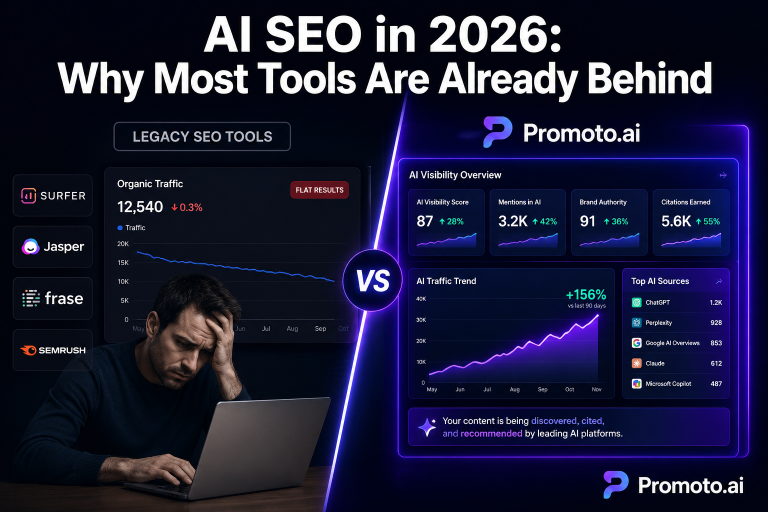
The landscape has shifted dramatically. Google’s AI Overviews now answer millions of queries before a user ever clicks a result. ChatGPT, Perplexity AI, and Gemini are recommending brands, comparing vendors, and shaping buying decisions in ways that traditional backlink profiles and keyword density scores were never designed to address. If your content strategy still revolves around chasing an on-page score inside a single-purpose tool, you’re playing an old game in a new arena.
That’s the conversation this guide is here to have. We’re comparing Promoto AI vs Surfer SEO, Jasper AI, Frase, and SEMrush — not to declare one a “winner” in some absolute sense, but to give you the honest, practical breakdown you need to choose the right tool for your workflow, your budget, and where search is actually going.
Why Traditional SEO Tools Are Changing — Fast
Two years ago, ranking on page one meant optimizing for a list of blue links. Today, that’s necessary but no longer sufficient.
Zero-click searches are growing. A significant portion of users now get their answers directly from AI-generated summaries at the top of search results — no click required. If your content isn’t structured in a way that AI systems can extract, cite, and surface, you’re invisible to a growing segment of your audience.
AI search engines are a new distribution layer. ChatGPT, Gemini, Perplexity AI, and Google AI Overviews collectively field hundreds of millions of queries every day. These platforms don’t just crawl — they cite, summarize, and recommend. Brands that appear in LLM answers are earning awareness before a competitor’s webpage even loads.
Search intent has become multi-layered. It’s no longer enough to match a keyword. Modern search engines — and the AI systems trained on them — reward content that fully satisfies the user’s underlying goal, anticipates follow-up questions, and demonstrates genuine subject authority. Tools that only tell you how many times to use a phrase are dangerously incomplete.
Workflows have merged. The old way — use one tool for keyword research, another for content briefs, a third for publishing — creates friction, inconsistency, and a lot of tab-switching. In 2026, the teams moving fastest are those using unified platforms that connect research to creation to publishing to performance tracking in a single environment.
That’s the context. Now let’s look at the tools.
Tool-by-Tool Comparison: Promoto.ai vs. the Major Players
Promoto.ai
Overview: Promoto.ai is an AI-powered platform built specifically for the era of unified search visibility. It combines SEO optimization, AI Optimization (AIO), Generative Engine Optimization (GEO), and App Store Optimization (ASO) in a single dashboard — with direct publishing integrations for WordPress and Shopify.
Best Use Case: Businesses and agencies that need content strategy, creation, optimization, and publishing to live in one place — and that want their content to rank in both Google and AI-powered search engines like ChatGPT and Gemini.
Strengths:
- Covers the full content lifecycle: keyword research → AI content creation → SEO optimization → direct publishing
- Built-in GEO and AIO optimization — rare features that most competitors either lack entirely or charge extra for
- Single dashboard for managing 20+ client websites
- Integrates with Google Search Console and GA4 for data-driven content decisions
- Designed to improve visibility not just in Google, but across AI answer engines
Weaknesses:
- Newer platform, so it lacks the years-long user community that older tools have built
- Some advanced technical SEO workflows may still require supplemental tools for highly specialized needs
AI Optimization Capabilities: Strong — content is optimized for both traditional search ranking signals and AI search visibility from the outset, which is a meaningful differentiator.
Best For: Agencies managing multiple clients, startups that want compounding organic growth without stitching together a messy tool stack, Shopify and WordPress users who want seamless publishing.
Pricing Category: Flexible, with a free trial and scalable plans — no credit card required to start.
Unique Advantage: It’s one of the few platforms explicitly built for GEO optimization and LLM visibility alongside traditional SEO — giving users a head start on where search is heading, not just where it’s been.
Surfer SEO
Overview: Surfer SEO has been a content optimization staple for years. It analyzes top-ranking SERP pages and generates real-time scoring based on keyword usage, structure, entity coverage, and NLP signals. Its Content Editor is genuinely useful for writers who want guidance while drafting.
Best Use Case: Writers and SEO teams who primarily need on-page content optimization scoring during the editing process.
Strengths:
- Best-in-class content scoring with deep NLP integration
- Surfer AI for generating SEO-structured long-form drafts
- Clear, visual content scores that non-technical users can act on
- Strong SERP analyzer for competitive benchmarking
Weaknesses:
- Primarily a content optimization tool — keyword research and technical SEO require additional platforms
- No native AI visibility tracking for LLMs or AI answer engines
- Publishing integrations are limited compared to all-in-one platforms
- Pricing scales quickly for agencies managing large content volumes
AI Optimization Capabilities: Good for traditional search — but lacks native GEO, AIO, or LLM visibility optimization.
Best For: Content writers and mid-size SEO teams focused on Google content rankings.
Pricing Category: Mid-to-high range; most useful features sit in paid tiers.
Unique Advantage: Its content scoring system is among the most established and respected in the industry — particularly useful as a quality benchmark.
Promoto AI vs Surfer SEO — Bottom Line: Surfer excels at scoring content you’re already writing. Promoto.ai starts earlier in the process and extends further — from research to AI-engine visibility — making it the more complete solution for teams thinking beyond Google’s blue links.
Jasper AI
Overview: Jasper AI is primarily an AI writing assistant — one of the first to achieve mainstream adoption among content marketers. It’s excellent at generating marketing copy, blog drafts, and creative content quickly. In recent years, it has added brand voice customization and autonomous marketing agents.
Best Use Case: Marketing teams that need high-volume content drafting across multiple formats — blog posts, ad copy, emails, social media — with consistent brand tone.
Strengths:
- Exceptional brand voice consistency across content types
- Broad template library for marketing workflows
- Autonomous agents that can handle campaign-level copy production
- Familiar, low-learning-curve interface for marketers
Weaknesses:
- Not built around SEO-first workflows — SEO signals are layered on, not core to the experience
- Limited keyword research capabilities
- No GEO or LLM visibility optimization
- Can produce generic output that requires significant human editing to rank competitively
AI Optimization Capabilities: Moderate — Jasper can follow SEO guidelines if prompted correctly, but it doesn’t natively optimize for search intent or AI answer visibility.
Best For: Brand content teams, copywriters, and marketing departments that prioritize voice consistency over search performance.
Pricing Category: Mid-to-high range for teams requiring advanced features.
Unique Advantage: Best-in-class brand voice application across large content teams.
Promoto AI vs Jasper AI — Bottom Line: Jasper is a writing tool that can be guided toward SEO. Promoto.ai is an SEO tool with built-in writing capabilities — a meaningful distinction if rankings are the primary goal.
Frase
Overview: Frase is a content research and briefing tool that accelerates the SERP analysis process. It helps teams understand what top-ranking content covers, generates outlines, and scores content against competitor pages.
Best Use Case: SEO teams that want faster content briefs and SERP research without fully automating content creation.
Strengths:
- Extremely fast SERP research and competitive content analysis
- Clean, actionable content outlines based on real SERP data
- Affordable entry-level pricing
- Good for agencies that produce many content briefs at scale
Weaknesses:
- Content generation quality is functional but less polished than dedicated AI writers
- No AI visibility tracking for LLMs or answer engines
- Limited publishing integration options
- Analytics and performance tracking are minimal
AI Optimization Capabilities: Solid for content brief creation and on-page optimization; weaker on AI search visibility.
Best For: Content strategists and editorial teams that want to accelerate research without going fully automated.
Pricing Category: Lower range — accessible for freelancers and small teams.
Unique Advantage: Speed of SERP research is genuinely impressive, especially for teams producing briefs at high volume.
Promoto AI vs Frase — Bottom Line: Frase does one important job well. Promoto.ai does that job plus several others — including publishing, GEO optimization, and multi-site management — for teams that need a broader solution.
SEMrush
Overview: SEMrush is a full-scale SEO and digital marketing intelligence platform. It’s the go-to choice for enterprise teams, agencies, and anyone who needs comprehensive keyword data, backlink analysis, competitive intelligence, and technical audit capabilities.
Best Use Case: Large SEO teams and agencies that need deep competitive intelligence, technical SEO auditing, and broad marketing analytics.
Strengths:
- Unmatched depth in keyword research, backlink analysis, and competitive data
- Topic clustering and content planning at scale
- Technical SEO auditing across large sites
- AI-powered content briefs and optimization suggestions
- AI visibility and citation reporting is a growing feature set
Weaknesses:
- Complex interface with a steep learning curve for beginners
- Expensive — meaningful features often require higher-tier plans
- Content creation workflow is not as streamlined as purpose-built AI tools
- Overkill for smaller businesses, solopreneurs, or early-stage startups
AI Optimization Capabilities: Growing — SEMrush has invested in AI visibility features, but its primary strength remains traditional SEO intelligence.
Best For: Enterprise SEO teams, large agencies, and technically sophisticated marketers.
Pricing Category: High range; enterprise pricing for full access.
Unique Advantage: The depth and breadth of its keyword and backlink database remains unmatched.
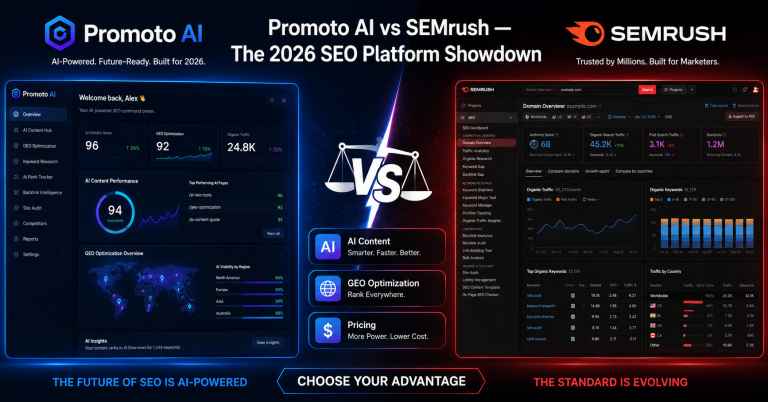
Promoto AI vs SEMrush — Bottom Line: SEMrush gives you the most complete picture of the competitive SEO landscape. Promoto.ai gives you a faster, more integrated path from insight to published, AI-optimized content — particularly for teams that don’t need enterprise-level complexity.
Which Tool Is Best for Different Users?
Bloggers and Content Creators: Promoto.ai offers a clear path from keyword research to published content without requiring SEO expertise at every step. Frase is a solid budget alternative for briefing, and Surfer SEO works well for optimizing individual posts.
SEO Agencies Managing Multiple Clients: Promoto.ai’s multi-site dashboard and publishing integrations make it a natural fit. SEMrush remains the strongest choice for agencies that prioritize competitive intelligence and client reporting depth.
Startups and Solopreneurs: Promoto.ai hits the right balance of capability and accessibility. You’re not paying for enterprise features you don’t need, and the learning curve is manageable.
Freelancers: Frase and Promoto.ai both offer accessible pricing. Promoto.ai has the edge if you’re offering full content strategy services to clients; Frase wins if briefing is your primary deliverable.
Content-Heavy Businesses (eCommerce, Media, SaaS): Promoto.ai’s Shopify and WordPress integrations, combined with AI-driven content scaling, make it well-suited for businesses publishing at volume. Surfer SEO and SEMrush can complement it for deep competitive analysis.
Technical SEO Users: SEMrush remains the gold standard. Promoto.ai handles technical foundations well, but if technical SEO is your primary focus, SEMrush or Screaming Frog should still be in your stack.
Key Features Modern AI SEO Tools Must Have in 2026
Choosing the wrong platform is expensive — not just in subscription costs, but in time and missed opportunity. Here are the features that actually matter now:
AI-Powered Content Research — The tool should understand what top-ranking content covers, not just which keywords appear most often. Topic modeling, semantic clustering, and entity recognition are baseline requirements.
Keyword Research with Intent Mapping — Raw keyword data isn’t enough. Modern tools need to surface search intent, question-based queries, and long-tail patterns that align with how AI systems interpret user needs.
Semantic SEO Optimization — Content should be optimized for topic coverage and entity relationships, not just keyword frequency. This is how Google’s AI systems and LLMs assess content authority.
Content Scoring Systems — Quantitative feedback on how well a piece of content covers a topic relative to the competition — ideally updated in real time as you write.
GEO and LLM Optimization — This is the feature that separates 2026-ready tools from 2022-era platforms. If your tool can’t tell you how to improve visibility in ChatGPT, Perplexity, or Google AI Overviews, it’s missing a significant portion of where search has moved.
Publishing Integrations — Direct connections to WordPress and Shopify eliminate the copy-paste workflow that costs teams hours every week.
Technical SEO Foundations — Server status monitoring, internal link analysis, and site health auditing should be part of the picture, even if they’re not the primary focus.
Multi-Site Management — For agencies and growing businesses, managing everything from one dashboard isn’t a nice-to-have — it’s a practical necessity.
Real SEO Problems That AI Tools Actually Solve
Let’s be specific about where AI SEO tools create real value — because the use cases matter more than the feature lists.
Content Scaling Without Quality Drops: A team of two can now produce the research-backed, intent-aligned content that used to require a full editorial department. AI tools handle the heavy data lifting; humans handle judgment and refinement.
Search Intent Optimization at Scale: Manually analyzing SERPs for every target keyword is impractical for most teams. AI tools do this automatically, surfacing what users actually want to find — not just what they typed.
AI Search Visibility: This is the genuinely new problem. Your content might rank well in Google and be completely invisible to users asking ChatGPT the same question. Tools that address GEO and LLM optimization are filling a gap that didn’t exist two years ago.
Internal Linking at Scale: Poorly linked content leaves both rankings and user experience on the table. AI tools can identify internal linking opportunities across hundreds of pages in minutes.
Workflow Automation: Keyword clustering, content scheduling, meta tag generation, and performance reporting — the administrative layer of SEO is increasingly automated, freeing strategists to focus on decisions that require actual judgment.
Predictive SEO Analysis: The best platforms can now identify content gaps before traffic data reveals them, helping teams stay ahead of emerging keyword opportunities rather than reacting to competitors.
Common Mistakes When Choosing an AI SEO Platform
A lot of teams regret their tool choices — not because the tools are bad, but because the selection process was rushed. Here’s what goes wrong:
Buying on hype. A tool with impressive marketing doesn’t guarantee impressive results. Evaluate based on workflow fit, not feature announcements.
Ignoring workflow compatibility. If the tool doesn’t connect to your CMS, your analytics stack, or your team’s existing process, the adoption friction will quietly kill ROI.
Overpaying for features you don’t use. Enterprise plans with 200 features sound compelling. In practice, most teams use 15. Start with what you need now and upgrade based on real usage.
Publishing AI content without editing. AI-generated drafts are a starting point, not a finished product. Content that lacks genuine expertise, original perspective, and human editing tends to underperform against well-crafted competitors — and Google’s helpful content signals are increasingly good at detecting it.
Treating technical SEO as optional. Content quality is important, but a site with fundamental technical problems — slow load times, broken internal links, poor crawl architecture — won’t get the full benefit of content optimization. The best AI content tools include at least basic technical health monitoring.
The Future of AI SEO Software in 2026 and Beyond
The direction is clear, even if the exact roadmap isn’t.
LLM optimization will become standard. Right now, GEO and AIO features are differentiators. Within 18 months, they’ll be table stakes. Platforms that haven’t built them by then will be playing catch-up.
Personalized search will require richer content signals. As AI search engines learn individual user preferences, generic content will lose ground to content with specific, authoritative, experience-backed depth. The pressure to demonstrate genuine expertise — E-E-A-T — will only increase.
AI citation tracking will matter as much as rank tracking. In the same way teams obsess over keyword positions today, they’ll track brand citations in ChatGPT, Gemini, and Perplexity tomorrow. Platforms with robust citation monitoring will have a significant advantage.
Predictive SEO will move from experimental to operational. The tools that combine search trend data, content gap analysis, and competitive signals will allow forward-thinking teams to build topical authority ahead of demand — a compounding advantage that grows over time.
Integrated platforms will win. The era of stitching together six tools to cover one workflow is ending. Teams that operate from unified platforms will move faster, make better decisions, and produce more consistent output than those managing fragmented stacks.
Conclusion: Choosing the Tool That Fits Where Search Is Going
Every tool in this comparison has genuine strengths. Surfer SEO remains excellent for content scoring. SEMrush is still the most comprehensive competitive intelligence platform available. Frase accelerates briefing workflows at an accessible price point. Jasper is unmatched for brand voice consistency across high-volume content teams.
But if you’re building a content strategy for 2026 and beyond — one that needs to perform in Google search and in the AI-generated answers that are increasingly shaping what your audience discovers — you need a platform that was designed with both in mind from the start.
That’s exactly where Promoto.ai was built to operate. From keyword research and AI content creation through GEO optimization and direct publishing to WordPress and Shopify, it brings the core of a modern SEO workflow into a single environment — without the enterprise price tag or the complexity that comes with it.
If you’ve been thinking about upgrading your AI SEO stack, the platform you choose now will shape your search visibility for the next two to three years. It’s worth being deliberate about.
Start your free Promoto.ai trial — no credit card required — and see what unified AI SEO actually looks like in practice.
About promotoai
PromotoAI is a leading AI-powered platform specializing in SEO, AIO, ASO, and GEO solutions. With the ability to publish directly to platforms like WordPress and Shopify, and track performance through real-time analytics, PromotoAI simplifies complex workflows for agencies and enterprises. Trusted by teams across industries, PromotoAI leverages advanced AI models to deliver scalable, optimized content strategies that drive measurable results
More Articles
PromotoAI vs Jasper AI: Which Tool Best Powers Scalable Organic Growth?
Automating SEO Workflows with PromotoAI: A Comprehensive Guide
Getting Started with PromotoAI Content Scheduling
PromotoAI vs SurferSEO: Which AI Tool Drives Scalable Organic Growth?
PromotoAI vs SEMrush: Choosing the Best AI Tool for Organic Growth
Frequently Asked Questions
Q1: What is the main difference between Promoto.ai and Surfer SEO?
Surfer SEO focuses primarily on content scoring and on-page optimization for Google search. Promoto.ai covers the full content workflow — from keyword research to AI-generated content, direct publishing, and GEO/LLM optimization — making it more suitable for teams that need search visibility across both traditional and AI-powered search engines.
Q2: Is Promoto.ai better than Jasper AI for SEO?
They serve different primary purposes. Jasper AI is an AI writing tool with SEO features added on top. Promoto.ai is an SEO platform with AI content generation built in. If your primary goal is improving search rankings and AI visibility, Promoto.ai’s SEO-first architecture gives it a meaningful edge over Jasper.
Q3: Can Promoto.ai optimize content for ChatGPT and Perplexity AI?
Yes — Promoto.ai includes GEO (Generative Engine Optimization) and AIO (AI Optimization) capabilities specifically designed to improve brand and content visibility in AI-powered answer engines, including ChatGPT, Gemini, and Perplexity AI.
Q4: What does GEO optimization mean, and why does it matter in 2026?
GEO optimization (Generative Engine Optimization) refers to structuring and optimizing content so that AI answer engines like ChatGPT, Google AI Overviews, and Perplexity AI are more likely to cite it in their responses. As a growing share of search queries are now answered by AI-generated summaries rather than traditional blue links, GEO optimization has become a critical component of any modern SEO strategy.
Q5: Who should use Promoto.ai versus SEMrush?
SEMrush is best suited for large agencies and enterprise SEO teams that need deep competitive intelligence, extensive backlink analysis, and broad campaign management capabilities. Promoto.ai is a stronger fit for startups, growing businesses, content-heavy websites, and agencies that want an integrated, workflow-friendly platform with built-in AI content generation and AI search visibility features.
Q6: Is Promoto.ai suitable for beginners?
Yes — Promoto.ai is designed to be accessible without a steep learning curve, while still offering the depth that experienced SEO professionals need. Its dashboard provides clear insights and guided workflows, making it practical for users who are new to AI SEO tools as well as for seasoned practitioners.

Disharth Thakran is a rising star in digital marketing, bringing two years of hands‑on expertise in SEO, performance ads, and growth hacking to B2B and B2C brands. His data‑driven approach and technical know‑how have already delivered standout results: 200% boost in organic traffic for Free Culture in just three months, and 10,000‑reach milestone achieved within the first 28 days ₹10,000 Facebook ad spend for Shri Vrinda Group that directly generated over ₹6 million in real‑estate sales 4× LinkedIn page growth in six months through targeted content, connection strategies, and on‑page optimizations Deep expertise in technical SEO, on‑page SEO, and comprehensive site audits ensuring fast indexation, crawl efficiency, and maximum visibility Combining a relentless focus on metrics with hands‑on execution, Disharth crafts end‑to‑end campaigns that not only drive traffic but turn visitors into measurable revenue. Whether unraveling crawl‑budget issues, fine‑tuning meta‑structures, or scaling paid channels, he delivers rapid, scalable growth and ensures every marketing rupee works harder.