Promoto AI vs Ubersuggest: Which Tool Actually Moves the Needle in 2026?
There’s a question quietly spreading through marketing Slack channels, agency group chats, and SaaS founder communities right now: “Is Ubersuggest still worth it?”
It’s a fair question. Ubersuggest helped an entire generation of marketers understand keyword research without breaking the bank. But in 2026, the SEO landscape doesn’t look anything like it did when Neil Patel launched it. Google’s AI Overviews now absorb millions of clicks before users ever land on your site. Perplexity AI, ChatGPT, and Gemini are reshaping what “ranking” even means. And the tools that helped content teams win in 2020 are struggling to keep pace with what winning looks like today.
So this comparison isn’t about tearing down a legacy tool. It’s about asking an honest question — if you’re building a content strategy in 2026, which platform is actually built for the way search works now?
Why the SEO Playbook Has Changed — Fast
Not long ago, SEO was a relatively linear discipline. You found keywords, optimized on-page elements, built backlinks, and tracked positions. That workflow still matters, but it’s no longer the whole game.
AI-generated answers now appear at the top of Google for an enormous range of queries. Zero-click searches have been rising steadily — meaning users get their answers directly from AI summaries without ever clicking through. For content teams running traditional SEO workflows, this represents a structural problem, not just a trend.
The platforms that were built before this shift — even well-loved ones like Ubersuggest — weren’t designed to solve it. They can tell you what people are searching for. They’re far less equipped to help you appear inside AI-generated answers, optimize content for semantic relevance, or publish at the velocity modern SEO demands.
That’s the gap tools like Promoto AI were built to fill.
Tool Overview: Understanding What You’re Comparing
Before diving into the head-to-head, it helps to be clear about what each platform is actually designed to do.
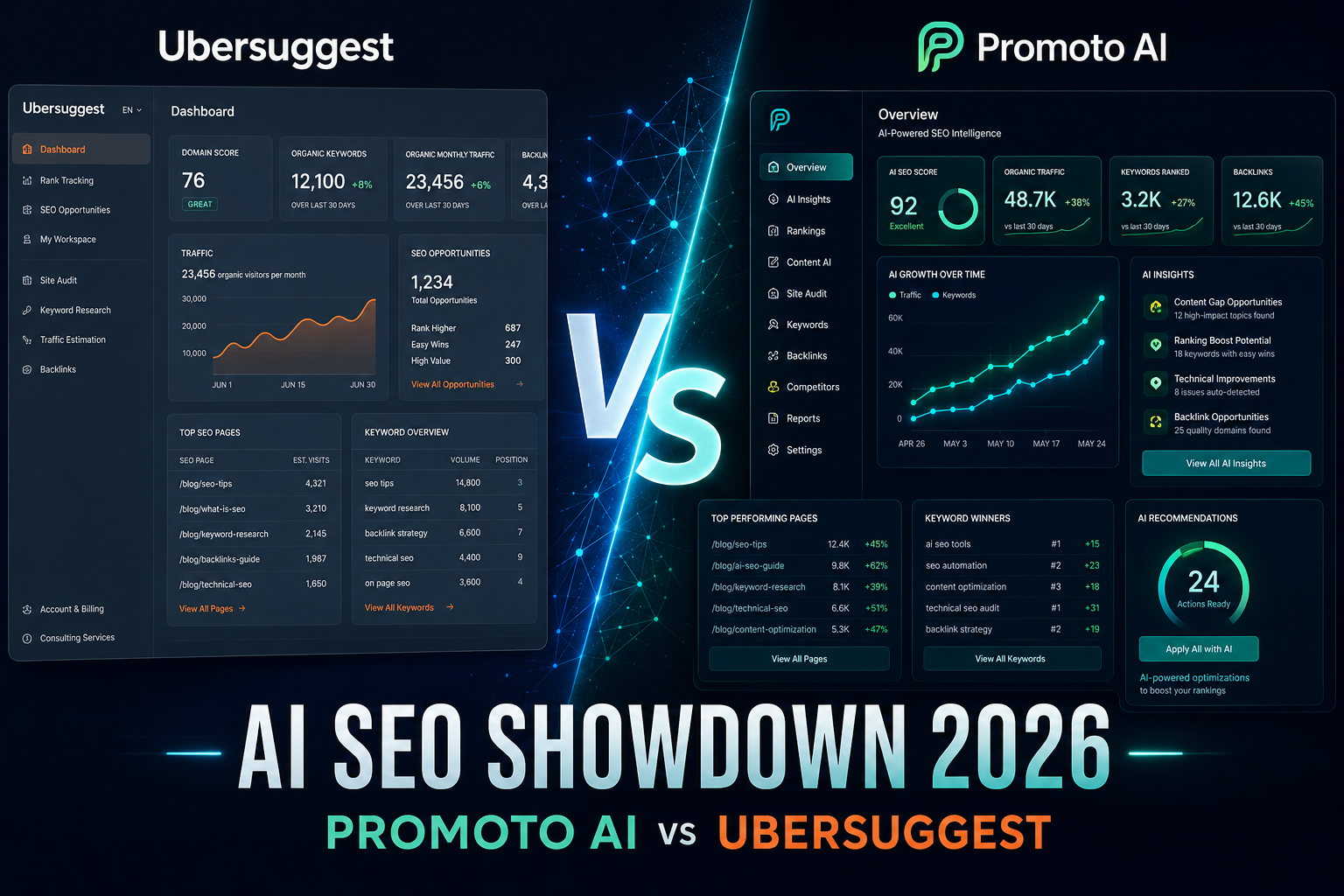
Ubersuggest is a keyword research and basic SEO audit tool launched by Neil Patel Digital. It offers keyword suggestions, domain-level traffic estimates, backlink data, content ideas, and a site audit feature. It’s positioned as an affordable, beginner-friendly alternative to enterprise SEO platforms.
Promoto AI is a full-stack AI SEO, AIO (AI Optimization), ASO (App Store Optimization), and GEO optimization platform. It handles everything from AI-powered content generation and keyword analysis to one-click publishing on WordPress and Shopify, SERP tracking, and visibility across AI search engines like ChatGPT, Gemini, and Perplexity AI.
These are not really competing in the same category anymore. But that difference is exactly what makes this comparison useful.
Feature-by-Feature Comparison
Keyword Research
Ubersuggest delivers solid keyword volume data, CPC estimates, keyword difficulty scores, and related keyword suggestions. For basic keyword discovery, it works well. The free tier is generous enough for solo bloggers, and the paid plans stay affordable.
Promoto AI’s keyword analysis goes further. It maps keyword opportunities to content gaps, surfaces rising queries directly from Google Search Console data, and prioritizes topics by actual ranking potential — not just volume. For teams that need research connected to action, that end-to-end workflow is a meaningful difference.
Winner for keyword depth: Promoto AI. Winner for budget simplicity: Ubersuggest.
Content Creation & AI Optimization
This is where the comparison becomes stark.
Ubersuggest doesn’t generate content. It can suggest content ideas and show you what competitor articles look like, but creating the actual piece still falls entirely on the writer. There’s no AI content engine, no SERP-aware drafting, and no semantic SEO optimization built in.
Promoto AI’s content generation engine uses a multi-model AI stack — GPT-4, Gemini, Bedrock — to produce SERP-aware drafts that are optimized for SEO, AIO, and GEO from the first draft. It builds in Schema.org structured data, adjusts brand voice, and produces content ready for publishing, not just outline-level suggestions. For teams managing 20, 50, or 100 articles per month, that difference is significant.
Winner: Promoto AI — by a wide margin.
Technical SEO
Ubersuggest includes a basic site audit tool that flags crawl errors, slow pages, broken links, and missing meta tags. For a small site, it’s serviceable.
Promoto AI’s free tools suite covers broken link checking, server status monitoring, meta tag analysis, schema validation, sitemap generation, and DNS lookup — all available without a paid subscription. These tools are integrated into the platform workflow rather than existing as bolt-on afterthoughts.
Winner: Promoto AI on breadth and depth. Ubersuggest on simplicity for total beginners.
GEO & AI Search Visibility
Ubersuggest has no meaningful answer to this. The platform was designed for traditional Google search. It has no features for optimizing content to appear in ChatGPT responses, Google AI Overviews, Perplexity AI summaries, or Gemini answers.
Promoto AI’s Rank on AI Engine capability is specifically designed for this use case — helping brands achieve visibility across generative AI tools, not just blue-link Google results. In 2026, with over 100 million people using AI search every day, this isn’t a nice-to-have. It’s a core part of any sustainable content strategy.
Winner: Promoto AI — Ubersuggest simply doesn’t compete here.
Publishing & Workflow Automation
Ubersuggest doesn’t publish content. Full stop.
Promoto AI connects natively to WordPress, Shopify, Webflow, Strapi, and more — with bulk publishing, approval workflows, version history, and auto-scheduling built in. Teams can move from keyword research to published, optimized content without leaving the platform.
Winner: Promoto AI.
Analytics & Reporting
Ubersuggest provides domain-level traffic estimates and basic ranking data, but its analytics rely heavily on third-party estimates rather than verified first-party data.
Promoto AI’s analytics dashboard integrates directly with Google Search Console and Google Analytics 4, giving teams verified clicks, impressions, CTR, and position data — plus content performance alerts and refresh suggestions based on real traffic signals.
Winner: Promoto AI on data accuracy. Ubersuggest for simpler reporting needs.
Pricing & Accessibility
Ubersuggest is genuinely affordable. Individual plans start at low monthly rates, and the one-time lifetime plan has made it popular among bootstrapped founders. For someone who just needs basic keyword research and a site health check, the price point is hard to argue with.
Promoto AI is priced for teams that need real output — content creation, publishing automation, AI optimization, and analytics in one place. If your workflow only requires occasional keyword lookups, Ubersuggest may still serve you. But if you’re building content at scale, the ROI math changes quickly.
Which Tool Is Right for You?
Solo bloggers and hobbyists who need basic keyword research on a tight budget may still find Ubersuggest useful as a starting point.
Freelance SEO consultants who want to deliver better content and reporting to clients will hit Ubersuggest’s ceiling fast. Promoto AI offers the kind of workflow depth that justifies a professional rate.
Startups scaling content as a growth channel need both speed and optimization. Promoto AI’s one-click publishing and AI content engine directly support that goal in ways Ubersuggest was never designed to.
Agencies managing multiple client properties need multi-tenant workflows, bulk operations, and verified analytics. Promoto AI was built with exactly that in mind.
E-commerce teams on Shopify or WordPress will find Promoto AI’s native integrations far more useful than anything Ubersuggest can offer in that pipeline.
Key Features Modern AI SEO Platforms Must Offer in 2026
Not every platform deserves the “AI SEO” label it claims. The features that actually matter in today’s landscape include:
AI-powered content generation that produces SERP-aware, semantically rich drafts — not generic text. Keyword research tools tied to real performance data from GSC, not just third-party estimates. Semantic SEO optimization that maps topical relevance across an entire content cluster, not just individual pages. A reliable keyword density checker and keyword position tracker. A backlink maker and link analyzer for ongoing technical health. GEO optimization to capture AI search visibility. Publishing automation that connects research to live content. And a schema validator to ensure structured data stays accurate.
Ubersuggest covers a handful of these. Promoto AI covers all of them.
Common Mistakes Teams Make When Choosing SEO Software
Many teams choose tools based on brand recognition rather than workflow fit. Ubersuggest benefits from Neil Patel’s massive personal brand — which is legitimate — but brand recognition isn’t the same as capability.
Another common mistake is overpaying for features you don’t use, or underpaying for tools that don’t cover your actual needs. The cheapest option isn’t always the most cost-effective one when you factor in the time spent working around its limitations.
Teams also frequently underestimate how much technical SEO and AI visibility matter in 2026. A tool that helps you write content but ignores structured data, server health, and AI search optimization is leaving serious ranking opportunity on the table.
What SEO Looks Like in 2026 and Beyond
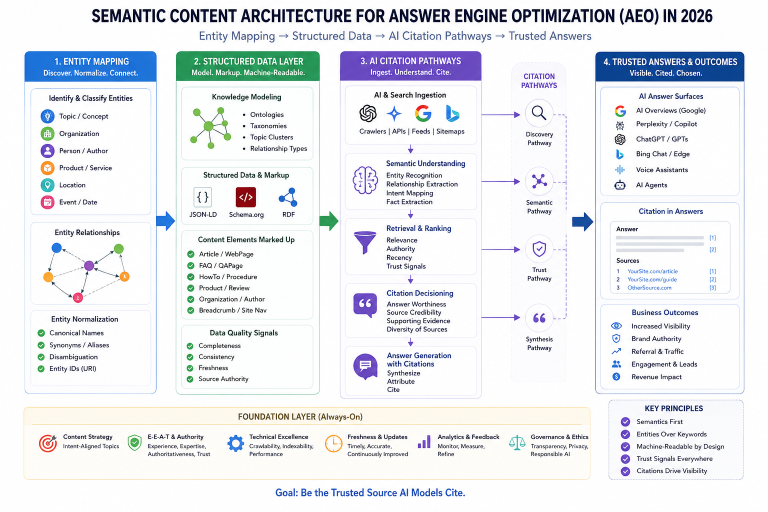
The next wave of SEO is being shaped by LLM optimization — the practice of making your brand and content the preferred answer inside AI language models. This includes structured data, entity optimization, topical authority signals, and the kind of semantic depth that AI systems use to evaluate content quality.
Traditional SEO tools were not designed for this. Platforms like Promoto AI that were built from the ground up with AIO, GEO, and AI search visibility as core functions are far better positioned to help brands stay visible as search continues to evolve.
The teams winning in 2026 aren’t the ones with the most backlinks or the highest content scores. They’re the ones whose content appears in AI answers, earns trust from search engines and AI models, and publishes consistently enough to build compounding topical authority.
Conclusion
Ubersuggest served its purpose well — and for very basic keyword research, it still does. But the SEO landscape it was built for no longer exists.
Promoto AI isn’t just a better version of Ubersuggest. It’s a different category of tool altogether — one designed for the realities of AI-driven search, content at scale, and multi-platform visibility.
If you’re evaluating your SEO stack heading into the second half of 2026, the question isn’t really “which is better.” It’s “which one is built for where search is going.” On that question, the answer is clear.
Explore what Promoto AI can do for your content strategy — start your free trial today.
More Articles to Read
- Surfer SEO Alternatives Marketers Are Actually Switching To in 2026
- Surfer SEO vs Promoto AI: Why Content Teams Are Rethinking Their SEO Stack in 2026
- The Semantic Content Blueprint: How to Build AI-Powered Search Visibility That Outlasts Every Algorithm Update
- The Hidden SEO Stack: How AI-Driven Keyword Research and Technical Tools Are Quietly Rewriting Rankings in 2026
FAQ Section
Q1: Is Promoto AI better than Ubersuggest for content teams?
Yes — significantly, if your team is actively producing content. Ubersuggest offers keyword research and basic auditing, but it has no AI content generation, no publishing automation, and no GEO optimization. Promoto AI handles the full content lifecycle from research to publishing.
Q2: Can Ubersuggest optimize content for ChatGPT or Google AI Overviews?
No. Ubersuggest was built for traditional Google search and has no features for AI search visibility or GEO optimization. If appearing in AI-generated answers matters to your strategy, you’ll need a platform like Promoto AI that was specifically built for that.
Q3: What makes Promoto AI different from other AI SEO tools?
Promoto AI combines AI content generation, keyword research, GEO and AIO optimization, native CMS publishing (WordPress, Shopify, and more), and a verified analytics dashboard in a single platform. Most tools do one or two of these things — Promoto AI does all of them.
Q4: Is Ubersuggest good for beginners?
Ubersuggest is one of the more beginner-friendly SEO tools available, with a clean UI and affordable pricing. For someone just learning keyword research or running a personal blog, it’s a reasonable starting point. But as your content strategy grows, you’ll likely outgrow its capabilities quickly.
Q5: Does Promoto AI offer free SEO tools?
Yes. Promoto AI offers a range of free tools including a keyword density checker, keyword position tracker, broken link checker, meta tag analyzer, schema validator, sitemap generator, server status checker, and more — no subscription required.
Q6: Which AI SEO tool is best for agencies in 2026?
Agencies managing multiple client properties need multi-tenant workflows, bulk publishing, role-based access, and verified analytics. Promoto AI was built with agency-scale use cases in mind, making it a much stronger fit than Ubersuggest for professional service teams.