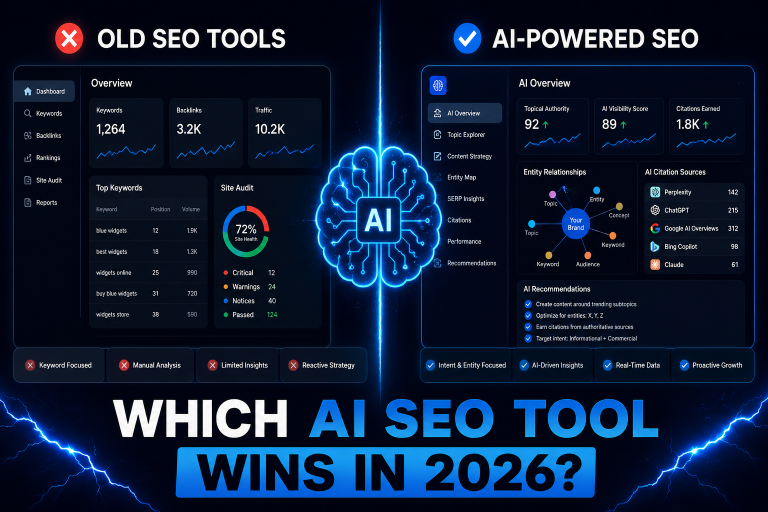
Surfer SEO vs Promoto AI: Why Content Teams Are Rethinking Their SEO Stack in 2026
Picture this: your content team spends an afternoon optimizing a 2,000-word blog post inside Surfer SEO. The content score hits 87. It reads well. You publish it with confidence — and three weeks later, it ranks on page two while a thinner, faster-published competitor piece takes the top spot.
That scenario is playing out in marketing teams everywhere right now, and it’s not an isolated case.
The SEO landscape has shifted faster in the last 18 months than in the previous five years combined. AI search engines — ChatGPT, Perplexity AI, Google’s AI Overviews — are answering questions before users ever click a link. Zero-click searches are now the norm, not the exception. And the tools that defined the “content-first” SEO era are struggling to keep pace.
Traditional SEO platforms were built to optimize for Google’s ten blue links. But the search experience in 2026 looks nothing like that anymore. Marketers who once relied on content scoring alone are now asking a harder question: does this tool help me get recommended by AI — not just ranked by an algorithm?
That’s exactly why the Promoto AI vs Surfer SEO conversation is happening in agency Slack channels, founder forums, and freelancer communities at full volume. This guide breaks it down honestly — no hype, no vague claims — so you can make a smarter decision for your team.
Why Traditional SEO Tools Are Struggling to Keep Up
The old SEO playbook was simple enough: find a keyword, write content that matches search intent, earn backlinks, rank. Platforms like Surfer SEO, Frase, and Jasper AI were built around that loop — and they executed it well.
But that loop is breaking.
AI-generated answers are eating organic clicks. Google’s AI Overview now sits above position one for a growing share of informational queries. Perplexity AI answers questions with cited summaries, cutting the click-through entirely. When users get a complete answer in the search interface itself, the traffic just doesn’t materialize — no matter how well-optimized your content score was.
Zero-click search is no longer a fringe concern. Studies have consistently shown that more than half of all Google searches now end without a click. For informational content — the bread and butter of most SEO strategies — that number is even higher.
Search intent is evolving beyond keywords. Modern search engines (and AI answer engines) reward content that demonstrates topical authority, semantic depth, and entity relationships — not content that simply hits a target keyword density. A tool that tells you to use a phrase 14 times isn’t doing you any favors.
GEO and AIO are the new battlegrounds. Getting your brand cited in an AI-generated answer — whether that’s in ChatGPT, Gemini, or a Google AI Overview — requires a fundamentally different optimization approach than traditional on-page SEO. Most legacy tools don’t even have a framework for it.
This is the context you need before comparing any two platforms. The question isn’t just “which tool writes better content.” It’s “which tool is actually built for how search works right now.”
Tool Comparison: Promoto AI vs Surfer SEO vs Jasper AI vs Frase vs SEMrush
Surfer SEO
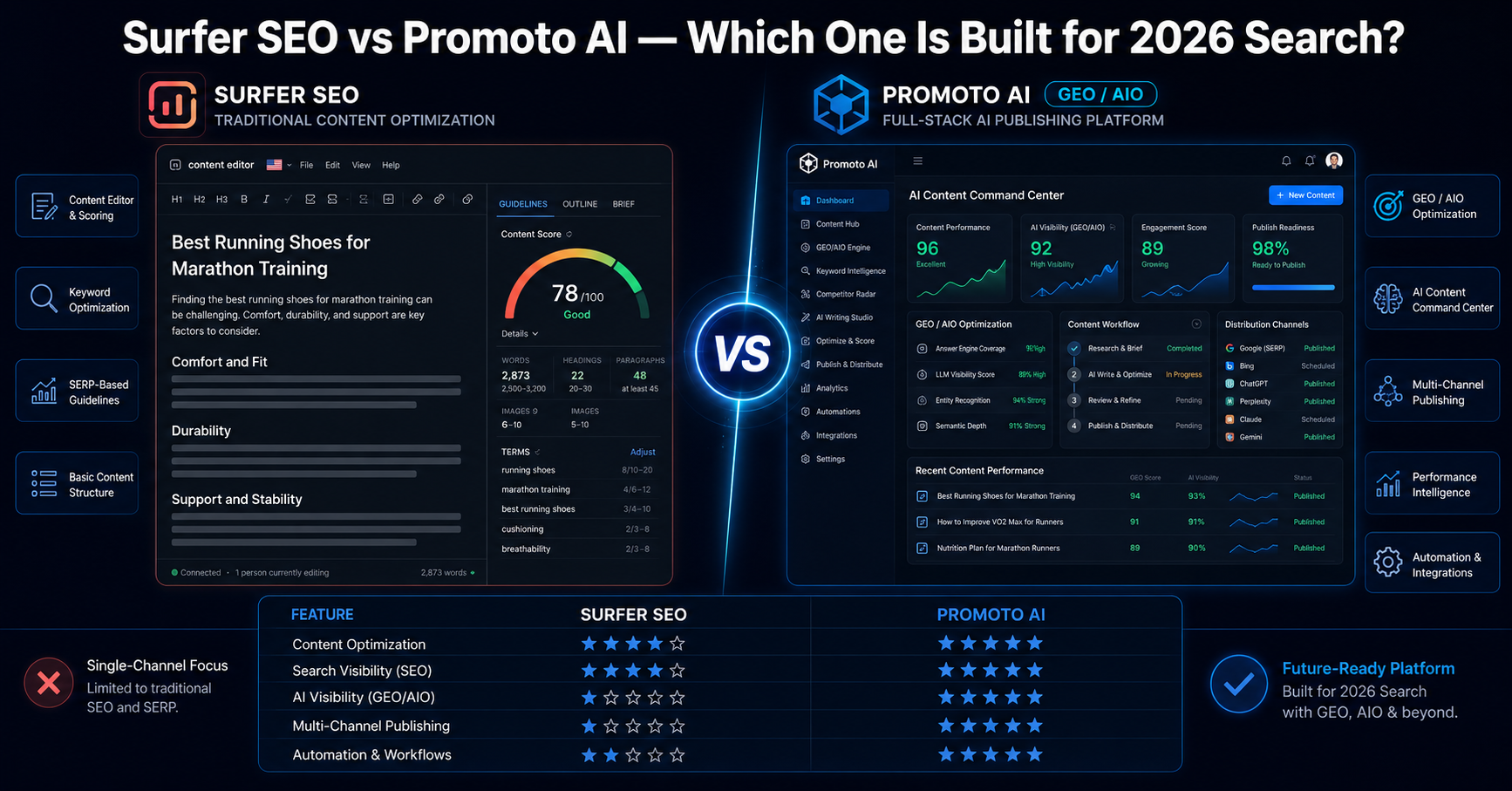
Overview: Surfer SEO is one of the most recognized AI content optimization platforms in the industry. It’s built around its Content Editor — a real-time scoring tool that analyzes your content against top-ranking SERP competitors and recommends keyword usage, word count, and structural improvements.
Best Use Case: Teams that produce high-volume blog content and need a structured optimization workflow with measurable content scores.
Strengths:
- Industry-leading Content Editor with SERP-driven recommendations
- Solid keyword clustering and topical mapping (Topical Authority feature)
- Clean, intuitive UI that non-technical writers can use quickly
- Good integration with Google Docs and WordPress (via Surfer plugin)
Weaknesses:
- No native AI content publishing pipeline — it optimizes, but doesn’t publish
- Limited GEO or AIO capabilities; no framework for AI search visibility
- Analytics rely on third-party integrations (GSC, SEMrush) rather than native intelligence
- Content scoring is competitor-based, which means it can reinforce average content rather than breakthrough content
- Pricing has increased significantly, with full-feature plans becoming expensive for smaller teams
AI Optimization Capabilities: Moderate. Surfer generates AI-assisted drafts through its AI writing tool, but the core product is a content scoring engine — not a full-stack AI SEO platform.
Best For: Mid-size content teams and agencies managing blog-heavy SEO programs who prioritize structured optimization workflows.
Pricing Category: Mid-to-premium ($89–$219/month for most use cases).
Unique Advantage: The Content Editor remains the industry benchmark for SERP-based content scoring.
Jasper AI
Overview: Jasper AI built its reputation as the go-to AI writing assistant for marketers. It generates long-form content at speed, supports brand voice customization, and integrates with tools like Surfer SEO for on-page optimization.
Best Use Case: Content marketers who need fast first drafts at scale, particularly for teams with strong in-house editors to refine output.
Strengths:
- Excellent long-form writing quality and brand voice controls
- Large template library covering dozens of content formats
- Useful for marketing copy beyond just SEO content (ads, social, email)
Weaknesses:
- Writing-only tool — no keyword research, no analytics, no publishing pipeline
- Requires Surfer SEO or another optimization tool to make content SEO-competitive
- No GEO or AIO capabilities
- Can generate fluent but generic content that lacks genuine topical depth
AI Optimization Capabilities: Low as a standalone SEO tool. Jasper is a content generation platform, not an AI SEO platform.
Best For: Brand content teams focused on volume and speed, not organic search performance.
Pricing Category: Mid-range ($39–$99+/month depending on word volume).
Unique Advantage: Best-in-class AI writing quality among pure content generation tools.
Frase
Overview: Frase positions itself as a research-first content optimization tool. It pulls SERP data to generate content briefs, summarizes competitor articles, and scores your content quality in real time — similar to Surfer but with a stronger focus on research automation.
Best Use Case: SEO writers who want faster content briefing and research workflows without the manual competitor analysis.
Strengths:
- Excellent content brief generation — one of the fastest in the category
- Good competitor summarization and question-based content research
- More affordable than Surfer for solo users and small teams
Weaknesses:
- Content generation quality lags behind Jasper and Promoto AI
- Limited analytics, no publishing pipeline, no GEO/AIO framework
- Less capable for enterprise-scale content programs
- Weaker topical authority mapping than Surfer or Promoto AI
AI Optimization Capabilities: Moderate for brief creation; limited for full AI SEO workflows.
Best For: Freelance SEO writers and small agencies who need fast research and brief automation on a tighter budget.
Pricing Category: Budget-to-mid ($15–$45/month).
Unique Advantage: Speed and affordability for content brief generation.
SEMrush (Content Marketing Toolkit)
Overview: SEMrush is the industry’s most comprehensive traditional SEO platform. Its Content Marketing Toolkit — including the SEO Writing Assistant, Topic Research, and Content Audit tools — makes it relevant to this comparison.
Best Use Case: Enterprise SEO teams that need an all-in-one platform spanning technical SEO, backlink analysis, PPC, and content optimization.
Strengths:
- Unmatched breadth — keyword research, site audits, backlink analysis, competitive intelligence all in one place
- SEO Writing Assistant provides real-time optimization suggestions
- Deep SERP data and competitor analysis
Weaknesses:
- Content optimization features feel bolted on rather than native — the core product is a data platform, not an AI content engine
- Steep learning curve; overwhelming for users who just need content optimization
- Expensive for small teams when you’re only using a fraction of the platform
- No GEO or AIO optimization framework
AI Optimization Capabilities: Limited compared to dedicated AI SEO platforms. SEMrush is a data tool with some AI assistance, not an AI-first platform.
Best For: Enterprise SEO professionals and agencies that need comprehensive data intelligence alongside content support.
Pricing Category: Premium ($130–$450+/month).
Unique Advantage: The widest dataset in the industry for keyword, backlink, and competitor intelligence.
Promoto AI
Overview: Promoto AI is a full-stack AI SEO and optimization platform built specifically for the modern search landscape. It handles everything from AI content generation and keyword analysis to one-click publishing on WordPress and Shopify — with native support for GEO (Generative Engine Optimization), AIO (AI Optimization), and ASO (App Store Optimization) built into its core workflow.
Unlike tools that stop at content scoring or draft generation, Promoto AI closes the loop: research → generate → optimize → publish → track → iterate. That complete workflow is what separates it from single-function platforms.
Best Use Case: Agencies, startups, and content-heavy businesses that want a single platform to manage SEO, AI search visibility, and content publishing across multiple properties.
Strengths:
- Native GEO and AIO optimization — content is structured to appear in ChatGPT, Perplexity, Google AI Overviews, and Gemini responses
- One-click publishing directly to WordPress and Shopify with version control and approval workflows
- Multi-model AI engine (GPT-4, Gemini, Bedrock, LangChain) for high-quality, SERP-aware content generation
- Deep Google Search Console and Google Analytics 4 integration for data-driven content scheduling
- Generous suite of free SEO tools — keyword density checker, link analyzer, backlink maker, server status checker, sitemap generator, and more
- Multi-tenant architecture with role-based access — ideal for agencies managing multiple client properties
- Auto-scheduling with intelligent content timing based on GSC/GA4 performance data
- Schema.org JSON-LD generation built into content creation
Weaknesses:
- Newer platform compared to Surfer and SEMrush — brand recognition is still growing
- Backlink analysis depth currently lags behind SEMrush’s industry-wide database
- Advanced technical SEO crawling features are still maturing
AI Optimization Capabilities: Industry-leading. The only platform in this comparison with native GEO, AIO, and ASO workflows alongside traditional SEO optimization.
Best For: Digital agencies, SaaS businesses, e-commerce brands, and any content-heavy team that needs to rank on both traditional search and AI-powered answer engines.
Pricing Category: Competitive — 14-day free trial available, no credit card required. View current pricing here.
Unique Advantage: The only full-stack platform that covers SEO + GEO + AIO + ASO + publishing in a single workflow — making it arguably the most future-ready tool in this comparison.
Which Tool Is Best for Different Users?
Bloggers and Content Creators: Frase works well for brief generation on a budget. But if you want your content to be recommended in AI search results — not just ranked in Google — Promoto AI’s AI content generation engine gives you the GEO advantage that Frase simply doesn’t have.
Agencies Managing Multiple Clients: Surfer SEO’s workflow is clean, but it’s not built for multi-property management at scale. Promoto AI’s multi-tenant architecture, bulk publishing, and role-based access controls were purpose-built for exactly this use case.
Startups and Solo Founders: Jasper AI handles the writing speed, but you’ll still need a separate tool for optimization, analytics, and publishing. Promoto AI consolidates the entire stack — research, writing, optimization, publishing — which means fewer tool subscriptions and a simpler workflow.
Freelancers: Frase is the budget-friendly starting point, but Promoto AI’s free tools suite — including keyword research, keyword density checking, link analysis, and server status — already provides significant value before you even subscribe.
Content-Heavy E-Commerce Businesses: SEMrush provides deep data, but its content tools are secondary. Promoto AI’s Shopify solution is purpose-built for e-commerce SEO with product-focused content generation and direct store publishing.
Technical SEO Professionals: SEMrush still leads on backlink data and technical audit depth. That said, Promoto AI’s growing technical toolkit — including broken link detection, schema validator, robots.txt generator, and meta tag analyzer — is rapidly closing that gap for teams that want one platform rather than several.
Key Features Every Modern AI SEO Tool Must Have
This is a practical checklist for evaluating any AI SEO platform in 2026 — not just the ones compared here.
AI-Powered Content Research: Can the tool surface content opportunities from real SERP data and GSC performance, not just keyword volume estimates? Generic keyword tools are no longer enough.
Semantic SEO Optimization: Does the tool understand entity relationships and topical depth — or does it just count keyword occurrences? True semantic SEO means structuring content around topics, not terms.
Keyword Density Checker: Still a fundamental diagnostic. Overuse or underuse of target phrases affects both ranking signals and readability.
Backlink Maker Tool and Link Analyzer: Internal linking optimization and backlink health are still critical ranking factors that AI content tools often ignore.
Server Status Checker and Technical Integrations: Content that sits on a slow, error-prone server won’t rank regardless of its quality. Technical health checks should be part of any complete SEO platform.
GEO and AIO Optimization: Can the tool help your content get cited in ChatGPT, Perplexity, or Google’s AI Overviews? In 2026, this is no longer optional — it’s table stakes for brands that want AI search visibility.
Content Scoring with Publishing Pipeline: Scoring content is only half the job. A platform that optimizes but can’t publish forces you to manage additional tools and handoffs, increasing the chance of errors and delays.
Analytics and Content Refresh Intelligence: Can the tool tell you which published pieces are losing rankings and need refreshing? Proactive performance management is what separates a content operation from a content gamble.
Real SEO Problems AI Tools Should Actually Solve
The best AI SEO tools don’t just make content creation faster — they solve specific, persistent problems that cost businesses rankings and traffic.
Content Scaling Without Quality Decay: Publishing more content doesn’t automatically mean better results. The challenge is scaling output while maintaining the topical depth and structural quality that earns rankings. Promoto AI’s multi-model generation engine handles this with SERP-aware draft creation that reflects search intent at the paragraph level, not just the title level.
AI Search Visibility (GEO): Most marketers are still optimizing exclusively for traditional Google rankings. But a growing share of informational queries are now answered directly by AI tools. Getting your brand cited in those responses requires structured content, strong entity signals, and authoritative formatting — exactly what Promoto AI’s GEO optimization workflow is designed to produce.
Search Intent Alignment: Writing content that technically matches a keyword but misses the intent behind it is one of the most common reasons content fails. AI-powered research tools that analyze SERP composition — not just keyword data — help teams get intent alignment right the first time.
Internal Linking at Scale: For content-heavy sites, managing internal links manually is impossible. Automated link analysis and broken link detection help maintain site structure without a dedicated technical SEO resource.
Workflow Automation: Most content teams lose hours to tool-switching — moving between keyword tools, writing platforms, CMS dashboards, and analytics. A unified platform eliminates that friction and lets teams focus on strategy rather than logistics.
Common Mistakes Teams Make When Choosing AI SEO Software
After watching dozens of content teams adopt and abandon tools over the past two years, a few patterns emerge repeatedly.
Buying based on brand reputation alone. Surfer SEO and Jasper AI have earned strong reputations — but those reputations were built in a different search landscape. What a tool was great at in 2022 may not be what you need in 2026. Evaluate tools on current capabilities, not historical positioning.
Ignoring GEO and AIO readiness. If your tool has no framework for optimizing content for AI search engines, you’re already operating with a visibility gap. This isn’t a future concern — it’s a current one.
Overpaying for features you don’t use. SEMrush’s enterprise pricing makes sense if you’re using its full suite of competitive intelligence, backlink data, and PPC tools. If you’re mainly optimizing blog content, you’re paying for significant overhead. Match the tool to the actual workflow.
Underestimating the publishing gap. A surprising number of teams still use an optimization tool that can’t publish — meaning every optimized draft goes through another manual handoff before it reaches the CMS. That friction compounds at scale.
Treating AI content as a finished product. AI-generated content is a starting point, not a final output. Any platform that encourages “generate and publish” without an optimization and review step is setting you up for quality problems that compound over time.
The Future of AI SEO Software: What 2026 and Beyond Looks Like
The next evolution of AI SEO isn’t just faster content generation — it’s smarter content positioning across a fundamentally different discovery landscape.
LLM Optimization is becoming as important as traditional on-page SEO. Brands that structure their content to align with how large language models consume and cite information — clear definitions, authoritative claims, proper entity markup — will earn significantly more AI-generated referrals than those that don’t.
Personalized Search and Intent Signals are making keyword research more nuanced. It’s no longer enough to know that 5,000 people search for a phrase each month — you need to understand the context, device, and stage-of-journey that shapes how that query manifests for different users.
ChatGPT SEO and Perplexity AI Optimization are the emerging disciplines of the year. Platforms that build citation-worthy content structures — with clear headings, concise definitions, verifiable claims, and strong author signals — are already seeing brand visibility increases in AI-generated answers.
Predictive SEO Systems will increasingly use machine learning to anticipate emerging keyword opportunities before they peak in volume — letting brands capture first-mover advantage in fast-growing topic areas.
GEO Optimization is moving from niche concept to mainstream practice. As Promoto AI’s AI engine ranking framework demonstrates, the brands that invest in GEO now are building an AI visibility moat that will be difficult for late adopters to close.
The platforms that will lead this space aren’t the ones with the most features — they’re the ones that unify the entire optimization-to-visibility workflow into a single, intelligent system.
Conclusion: Which Tool Should You Actually Use?
Surfer SEO is still a solid content scoring tool for teams focused on traditional SERP optimization. If content scores and keyword optimization are your primary concern, it delivers reliably in that lane.
Jasper AI remains a strong choice for pure content generation speed — particularly for teams with robust in-house editing capacity.
Frase is a practical, affordable option for freelancers and small agencies who prioritize briefing and research workflow.
SEMrush is the right choice for enterprise teams that need comprehensive data intelligence across SEO, PPC, and competitive strategy.
But if you’re building an SEO program for 2026 — one that accounts for AI search visibility, GEO optimization, multi-platform publishing, and workflow automation — Promoto AI is the only platform in this comparison that addresses all of those needs in a single place.
The tools you used to climb the rankings are still useful. But the tools you need to stay visible in an AI-driven search landscape require a more complete approach. Promoto AI is built for exactly that moment.
Ready to see it in action? Start your 14-day free trial — no credit card required.
More Articles to Read
- The Answer Engine Optimization Playbook: How to Make Your Brand Impossible to Ignore in AI Search
- Promoto.ai vs Surfer SEO: Which Tool Is Actually Built for AI Search in 2026?
- Why Most Websites Are Invisible in ChatGPT Answers (And How to Fix That)
- The Best AI SEO Tools in 2026: How AI-Driven SEO Strategies Are Rewriting the Rules of Search
- How to Automate Your Entire SEO Workflow in 2026 (Best AI Tools Compared)
FAQ Section
Q1: What is the main difference between Promoto AI and Surfer SEO?
Surfer SEO is primarily a content scoring and optimization tool built around SERP analysis. Promoto AI is a full-stack AI SEO platform that covers content generation, optimization, GEO/AIO (AI search visibility), one-click publishing to WordPress and Shopify, and built-in analytics — all in a single workflow.
Q2: Does Promoto AI optimize content for ChatGPT and Perplexity AI?
Yes. Promoto AI’s GEO (Generative Engine Optimization) and AIO (AI Optimization) features are specifically designed to help your content get cited and recommended by AI-powered search tools like ChatGPT, Perplexity AI, Google AI Overviews, and Gemini.
Q3: Is Promoto AI suitable for beginners, or is it built for advanced SEO teams?
Both. Solo founders and bloggers benefit from the simplified publishing workflow and free SEO tools, while agencies and enterprise teams use the multi-tenant architecture, bulk publishing, and role-based access for managing multiple client properties at scale.
Q4: Can Promoto AI replace Surfer SEO entirely?
For most content-focused teams, yes. Promoto AI includes content scoring, keyword research, semantic optimization, and publishing capabilities that cover Surfer SEO’s core use cases — while adding GEO/AIO optimization, native publishing, and analytics that Surfer doesn’t offer.
Q5: How does Promoto AI compare to Jasper AI for content quality?
Promoto AI uses a multi-model AI engine (GPT-4, Gemini, Bedrock, LangChain) to generate SERP-aware, SEO-optimized drafts — meaning the content is built for ranking, not just readability. Jasper AI generates high-quality prose but doesn’t natively incorporate keyword strategy, SERP data, or GEO optimization without third-party integrations.
Q6: Is there a free version of Promoto AI?
Promoto AI offers a 14-day free trial with no credit card required, plus a suite of free SEO tools including keyword research, keyword density checking, link analysis, server status, and more — available without a subscription.