AI SEO Tools Compared: What Promoto.ai Does That Others Still Can’t
The way people search online has fundamentally shifted — and most SEO teams haven’t caught up yet.
In 2026, a growing share of search journeys no longer end with a click on a blue link. Instead, users get answers directly from AI Overviews on Google, from ChatGPT Search, from Perplexity, or from Gemini. For content marketers, this is a wake-up call.
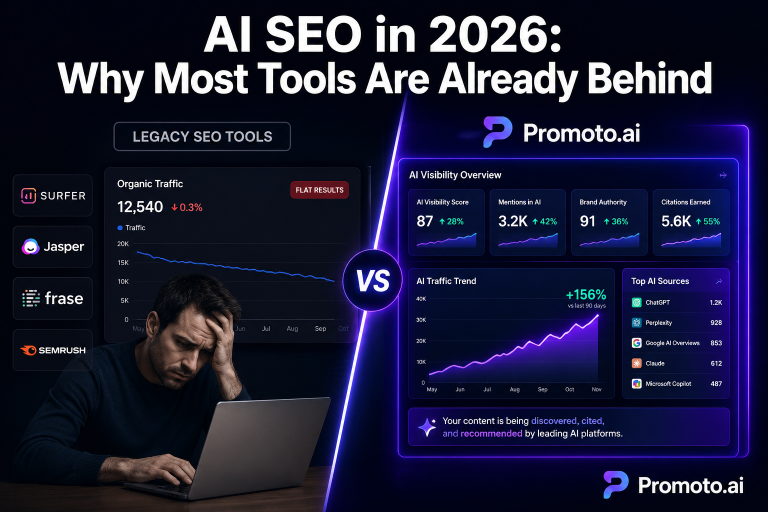
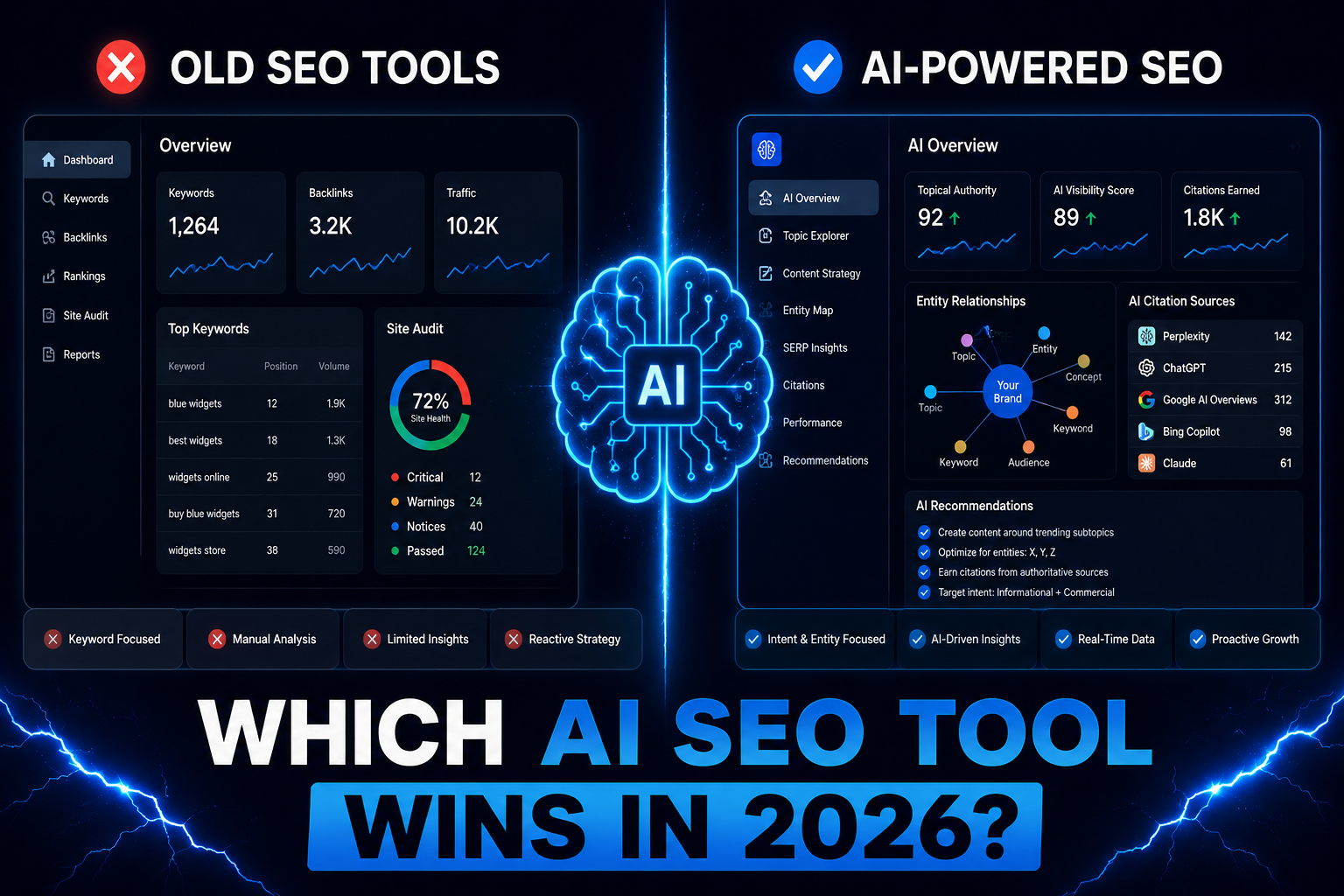
Traditional SEO tools were built for a different internet. They were designed to chase keyword rankings in a world where Google served ten blue links. That world is rapidly shrinking.
The new question isn’t just “Can I rank for this keyword?” It’s “Will AI engines cite my content as a trusted source?”
That’s exactly where AI-driven SEO strategies diverge from old-school approaches — and where platforms like Promoto.ai are built for what comes next.
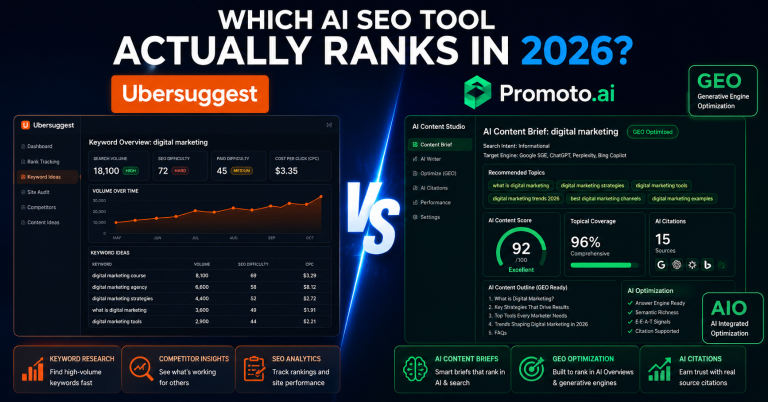
In this guide, we compare Promoto.ai with Surfer SEO, Jasper AI, Frase, and SEMrush to help you make a smart, informed choice in 2026.
Why Traditional SEO Tools Are Losing Ground
Let’s be honest: many SEO tools still marketed as “AI-powered” are just keyword databases with a chatbot layer slapped on top.
The real disruption isn’t in keyword research alone. It’s in how users interact with search at all.
Here’s what’s changed:
- Zero-click searches now account for more than 60% of Google queries. Users get their answers directly on the SERP.
- AI Overviews pull synthesized responses from high-authority content — not necessarily the highest-ranking page.
- AI search engines like Perplexity and ChatGPT Search prioritize structured, citation-worthy content over keyword-dense pages.
- Search intent is more nuanced than any keyword volume tool can capture alone.
The result? A blog ranking #2 for a keyword may generate almost no traffic — because AI already answered the question above the fold.
SEO software that doesn’t account for GEO optimization, LLM citation signals, and semantic content depth is already behind.
Tool-by-Tool Comparison: How Promoto.ai Stacks Up
Promoto.ai
Overview: Promoto.ai is built around a core idea — visibility in the AI era requires more than rankings. It covers SEO, AIO (AI Optimization), ASO, and GEO in one platform.
Best Use Case: Teams and agencies that need AI-optimized content at scale, with built-in technical SEO and LLM visibility features.
Strengths:
- Multi-model AI that handles both content creation and optimization
- Native GEO and LLM optimization support — rare in competing tools
- Integrated backlink maker, link analyzer, and server status checker
- AI-powered content research paired with semantic SEO scoring
- Designed for AI search visibility, not just Google rankings
Weaknesses:
- Newer to the market compared to legacy tools like SEMrush
- Smaller third-party integration library (growing rapidly)
Best For: Content-heavy businesses, agencies, startups, and teams optimizing for AI search alongside traditional SEO.
Pricing Category: Mid-range, with scalable plans for freelancers to enterprise teams.
Unique Advantage: One of the few platforms combining SEO + AIO + GEO + LLM optimization under one roof — rather than requiring multiple tool subscriptions.
Surfer SEO
Overview: Surfer SEO is a widely used content optimization tool that analyzes on-page SEO signals and provides a content score based on top-ranking pages.
Best Use Case: Writers who want real-time content scoring during drafting.
Strengths:
- Clean, intuitive content editor
- Strong NLP-based keyword suggestions
- Good for content teams focused on on-page optimization
Weaknesses:
- Limited AI search visibility features (no native GEO or LLM optimization)
- Requires third-party tools for technical SEO, backlink analysis, and keyword research
- No built-in AI content generation that’s search-intent aware
- Pricing has increased significantly without proportional feature upgrades
Best For: Writers who already have a separate keyword research and technical SEO stack.
Pricing Category: Mid-to-high range; add-ons increase total cost quickly.
Promoto AI vs Surfer SEO Verdict: For teams optimizing purely for traditional Google rankings, Surfer is a solid content editor. But for AI search visibility and GEO optimization, it falls short. Promoto.ai covers both worlds.
Jasper AI
Overview: Jasper is primarily a long-form AI writing assistant, used heavily for ad copy, blog posts, and marketing content.
Best Use Case: Fast content production at scale, especially for marketing teams with separate SEO workflows.
Strengths:
- Fast, high-volume content generation
- Strong brand voice customization
- Wide template library for various content types
Weaknesses:
- Not built as an SEO tool — no keyword research, semantic analysis, or ranking features
- Content often needs heavy SEO optimization post-generation
- No GEO optimization, LLM citation signals, or AI visibility features
- Can produce generic, low-differentiation content without careful prompting
Best For: Marketing copywriters who need volume, not SEO professionals focused on rankings.
Pricing Category: Premium; priced for content teams, not solo SEO practitioners.
Promoto AI vs Jasper AI Verdict: Jasper writes fast. Promoto.ai writes strategically. If rankings and AI visibility are the goal, Jasper requires multiple complementary tools that Promoto.ai already includes natively.
Frase
Overview: Frase is an AI content research and optimization tool that helps create content briefs and optimize articles for search intent.
Best Use Case: Content brief creation and research-led SEO writing.
Strengths:
- Excellent at generating content outlines from SERP analysis
- Research-focused workflow that helps writers understand topic depth
- Clean UI suitable for freelancers and small teams
Weaknesses:
- Content generation quality is inconsistent for complex topics
- No AI search optimization (GEO, AIO, or LLM citation features)
- Limited technical SEO capabilities
- Backlink analysis, internal linking, and server tools not included
Best For: Freelancers and small content teams building research-heavy blog strategies.
Pricing Category: Budget-to-mid range, accessible for solo operators.
Promoto AI vs Frase Verdict: Frase does research well. But in 2026, content research alone isn’t enough — you also need to optimize for how AI engines interpret and cite your content. That’s where Promoto.ai extends the workflow significantly.
SEMrush
Overview: SEMrush is an all-in-one SEO platform covering keyword research, backlink analytics, site audits, and competitive intelligence.
Best Use Case: Enterprise SEO teams needing a comprehensive data suite.
Strengths:
- Industry-leading backlink database
- Deep competitive analysis and keyword gap tools
- Robust site audit for technical SEO issues
- Recently added AI visibility tracking features
Weaknesses:
- Expensive, especially at team-level plans
- AI content creation tools are basic compared to dedicated platforms
- Steep learning curve for new users
- AI search optimization is an add-on, not a core workflow
Best For: Established SEO teams with large budgets and complex competitive needs.
Pricing Category: Premium to enterprise — starts at $139/month and scales quickly.
Promoto AI vs SEMrush Verdict: SEMrush wins on raw data depth. But for teams who need AI-optimized content creation, GEO visibility, and LLM optimization built into their workflow — not bolted on — Promoto.ai offers a more integrated, cost-effective path.
Which Tool Is Right for You?
Bloggers and solo content creators — If you want an all-in-one platform that helps you research, write, optimize, and make content AI-search-visible without juggling five tools, Promoto.ai is the cleaner choice. Frase and Surfer cover pieces of this, but not the full picture.
Agencies — SEMrush offers the deepest data, but at significant cost per seat. Promoto.ai’s multi-tool integration means agencies can run SEO, AIO, and GEO workflows from one dashboard without separate subscriptions.
Startups and SaaS businesses — You need fast output and efficient spending. Jasper writes quickly but doesn’t rank. Promoto.ai is designed for lean teams that need content to perform, not just exist.
Freelancers — Frase is budget-friendly and research-forward. But if clients are asking about AI search visibility (and they will be), Promoto.ai prepares you for that conversation.
Technical SEO professionals — SEMrush remains strong for site audits and backlink analysis. That said, Promoto.ai’s built-in technical SEO tools, including server status checker and link analyzer, handle the fundamentals without premium pricing.
Key Features Every AI SEO Platform Should Have in 2026
Not all tools are equal. When evaluating any AI SEO software, look for these capabilities before committing:
AI-Powered Content Research — The tool should go beyond keyword suggestions. It should analyze search intent, topic clusters, and content gaps.
Semantic SEO Optimization — Keywords matter less than context in 2026. Your tool needs to understand entity relationships and topical depth.
Keyword Density Checker — Still useful, but should be combined with semantic scoring — not used in isolation.
Backlink Maker and Link Analyzer — Internal and external link health directly affects both traditional rankings and AI citation likelihood.
Server Status Checker — Technical accessibility is foundational. Broken servers mean missed crawling, missed citations, and missed rankings.
GEO and LLM Optimization — This is non-negotiable now. If your tool doesn’t help your content appear in AI-generated answers, it’s not built for today’s search landscape.
Content Scoring System — A real-time quality signal that reflects both on-page SEO and AI readability standards.
Promoto.ai is built around all of the above. That’s not a promotional claim — it’s a direct response to what the AI search era actually demands.
Real SEO Problems AI Tools Should Be Solving
Here’s where a lot of AI blog writing tools fall short in practice.
Content scaling without quality loss is still a genuine challenge. Publishing 50 thin AI articles is worse than publishing five authoritative ones. The best AI SEO tools enforce quality standards, not just speed.
Search intent alignment — Writing for the right query isn’t about keyword matching anymore. It’s about understanding what a user actually wants to know, and structuring your content to answer that question better than any AI overview already does.
Internal linking at scale — Most tools ignore this entirely. A weak internal link structure hurts both crawlability and semantic authority. Promoto.ai’s link analyzer tool addresses this directly.
AI visibility — Getting cited by ChatGPT, Perplexity, or Google AI Overviews requires content that is structured, factual, and authoritative. Random keyword-rich articles don’t make that cut.
Workflow automation — The best platforms reduce the number of tools, not multiply them.
Common Mistakes When Choosing AI SEO Software
Buying based on hype. A tool with 200,000 Twitter followers isn’t automatically the best for your workflow. Test it against your actual content production needs.
Ignoring workflow compatibility. A great keyword research tool that doesn’t connect to your content editor creates friction. The best platforms reduce handoffs.
Overpaying for unused features. Enterprise SEO platforms are full of features that solo operators and small agencies will never use. Match the tool to your actual team size.
Publishing low-quality AI content. Using AI to generate bulk content without optimization and human review is still one of the fastest ways to damage domain authority.
Ignoring technical SEO. Great content on a broken website gets nowhere. Server health, crawlability, and site speed remain foundational — regardless of how good your content AI is.
The Future of AI SEO Software: What’s Coming Next
The next 12 months will accelerate the shift toward AI-first search in ways most SEO teams aren’t prepared for.
LLM Optimization will become a standard service offering, not a niche specialty. Brands that can’t appear in AI-generated answers will lose meaningful discovery volume.
Personalized search powered by AI will mean the same query returns different results for different users. Content that signals clear expertise and authority will maintain visibility across these variations.
ChatGPT SEO and Perplexity AI optimization are already real disciplines. Platforms that track brand mentions and citations across these engines — not just Google — will have a significant competitive edge.
GEO optimization will become as standard as meta descriptions are today. Structured, answer-ready content formats will be table stakes.
Predictive SEO systems will shift from reactive (analyzing what’s already ranked) to proactive (predicting what will be searched next quarter). Promoto.ai is building in this direction.
The tools that survive this transition are the ones treating AI visibility as a first-class feature — not an afterthought.
Conclusion: Which AI SEO Tool Should You Choose?
There’s no single answer that fits every team. But the honest assessment in 2026 is this:
If you need raw data and backlink analysis at scale, SEMrush remains the industry standard. If you need fast-turnaround content production for non-SEO campaigns, Jasper works. Surfer and Frase are solid for specific on-page and research workflows.
But if you’re looking for a platform that bridges traditional SEO and the AI search era — handling content creation, semantic optimization, GEO, LLM visibility, and technical SEO without stitching together five separate tools — Promoto.ai is designed for exactly that.
The SEO landscape is shifting faster than most tool vendors are adapting. Choosing a platform that’s built for where search is going, not just where it’s been, is the most practical decision you can make in 2026.
Explore what Promoto.ai can do for your content and AI search strategy →
More Articles to Read
- PromotoAI vs SEMrush: Which Tool Drives Better Organic Growth?
- PromotoAI vs. Jasper AI: Which is Better for Content Marketing?
- PromotoAI vs SurferSEO: Which AI Tool Drives Scalable Organic Growth?
- Best AI Content Platforms for Marketing Agencies Managing Multiple Client Properties
FAQ Section
Q1: What is the main difference between Promoto.ai and Surfer SEO? Surfer SEO focuses on on-page content scoring for traditional Google rankings. Promoto.ai covers that — and extends into GEO optimization, LLM visibility, AI-powered content research, and technical SEO features. It’s a more complete platform for 2026 search.
Q2: Is Jasper AI a good SEO tool? Jasper is a powerful content writing tool but is not built for SEO as a primary function. It has no keyword research, semantic optimization, or AI search visibility features. For content that actually ranks, you’d need additional tools alongside Jasper — tools that Promoto.ai includes natively.
Q3: What is GEO optimization and why does it matter? GEO (Generative Engine Optimization) refers to strategies that help your content appear in AI-generated answers from platforms like ChatGPT, Google AI Overviews, and Perplexity. As zero-click searches increase, appearing in AI responses is becoming as important as traditional Google rankings.
Q4: How does Promoto.ai compare to SEMrush for agencies? SEMrush offers deeper backlink data and a more established competitive intelligence suite, but at a significantly higher price per seat. Promoto.ai offers a more integrated content + SEO + AI visibility workflow that works better for agencies producing high volumes of optimized content.
Q5: What features should I look for in an AI SEO tool in 2026? Prioritize: AI content research, semantic SEO optimization, LLM and GEO optimization capabilities, internal link analysis, technical SEO tools (server checker, site audit), and content scoring systems. A tool that covers all of these removes the need for multiple subscriptions.