The Death of Traditional SEO: How AI Search Tools Are Rewriting Digital Marketing in 2026

Not long ago, SEO was a familiar game. Find a keyword. Write a blog post. Build some backlinks. Wait. Rank. Repeat. That system worked — until AI didn’t just enter the room but rearranged every piece of furniture in it. In 2026, more than half of Google searches end without a single click. AI Overviews serve instant answers before users even glance at the blue links below. ChatGPT, Perplexity AI, Gemini, and Claude are increasingly the first stop — not just for research, but for purchasing decisions, product comparisons, and brand discovery. If your content isn’t being surfaced by these AI systems, you’re invisible to a growing chunk of your audience. This isn’t a warning about the future. It’s already happening. And the brands winning traffic right now are the ones who’ve rethought their SEO from the ground up with AI-driven SEO strategies at the center.
Why traditional SEO alone is no longer enough
Classic SEO metrics — domain authority, keyword rankings, page-one positions — haven’t vanished. But their relationship to actual traffic has become dangerously unreliable.
The core problem is zero-click searches. When Google’s AI Overview answers a question directly on the results page, there’s simply no incentive for a user to click through. Click-through rates for informational queries have dropped sharply across categories in early 2026.
Meanwhile, AI search engines operate on entirely different logic. Perplexity AI doesn’t care about your domain authority — it cares whether your content is structured, citable, and semantically clear enough for its models to extract value. ChatGPT prioritizes content that answers questions directly and concisely. These systems reward entity clarity, topical depth, and structured information over keyword frequency.
Ranking #1 on Google is still valuable. It’s just no longer sufficient on its own.
What makes modern AI SEO tools genuinely powerful
The first generation of SEO tools was built to reverse-engineer algorithms. The new generation is built to align your content with how AI systems actually read, interpret, and cite information.
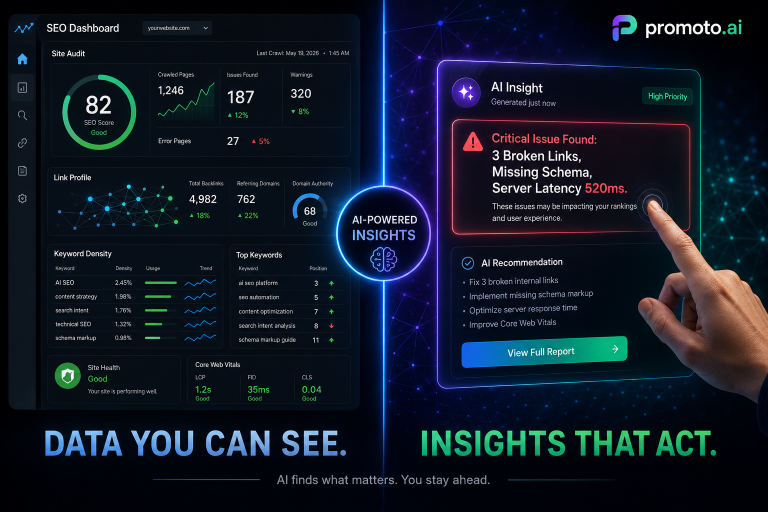
Modern AI SEO software does several things legacy tools simply can’t. NLP-based intent analysis helps you understand not just what users type, but what they actually mean — surfacing content gaps your competitors are missing. AI-powered content research generates semantic topic clusters and maps content to real search intent before a word is written. Predictive SEO uses historical data and trend signals to surface keyword opportunities before they peak. Automated technical auditing catches crawlability gaps, broken internal links, and server response issues in minutes rather than hours. Scalable content scoring evaluates drafts in real time against semantic SEO benchmarks rather than crude keyword density.
The result is a workflow that’s faster, more consistent, and better calibrated to how both Google and generative AI systems evaluate content quality.
Types of AI SEO tools you need in your stack
A complete AI SEO toolkit covers the full content lifecycle. Here’s how to think about each category:
Keyword research tools are no longer about finding high-volume terms in isolation. The goal is mapping semantic clusters — groups of related terms that together signal topical authority to AI ranking systems. Look for tools that surface entity relationships and question-based query patterns alongside traditional volume data.
AI content optimization platforms analyze top-ranking content, extract the semantic signals AI systems use to evaluate relevance, and score your drafts accordingly. They function like editors who’ve read the entire search index and know exactly what’s missing from your article.
Site audit systems and technical SEO tools in 2026 go well beyond fixing 404s. Following solid site audit best practices now means evaluating Core Web Vitals, crawl budget efficiency, structured data completeness, and mobile rendering — all factors that affect both traditional rankings and AI citation likelihood.
Link analyzer tools and backlink maker tool systems help you build a link profile that’s evaluated not just on authority but on topical relevance and anchor text diversity — signals that both traditional algorithms and AI systems weigh when assessing source credibility.
Server status checker tools are often the most overlooked piece. A slow or intermittently unavailable site gets deprioritized by crawlers and loses citation opportunities when AI search engines can’t reliably retrieve its content.
How to build an AI SEO content strategy from scratch
Most brands don’t fail at AI SEO because they lack tools. They fail because they deploy tools without a coherent strategy underneath them.
Start with topical authority, not individual keywords. AI search systems don’t evaluate pages in isolation — they evaluate whether a website comprehensively covers a topic. Before touching any tool, map out the core topics your brand should own. Every piece of content should fit into that map, building cumulative authority rather than chasing scattered rankings.
Next, define your audience’s search intent at every funnel stage. Informational content earns citations in AI answer engines. Comparison content captures mid-funnel decision makers. Solution-focused content converts. Mapping your content to these stages deliberately produces a library that works at every step of the buyer journey, not just one.
Then, run an AI-powered content gap analysis. Identify topics your competitors cover that you don’t, questions your audience asks that you haven’t answered directly, and semantic entities that appear frequently in well-cited content but are absent from yours. These gaps are your content priorities — fill them systematically, not randomly.
Structure every piece for AI citability from the first draft. Before writing begins, define the specific questions each article will answer directly. Structure the piece so those answers appear in short, scannable paragraphs — not buried in dense prose blocks. Use H2 and H3 headings that mirror the questions your audience actually searches. AI answer engines pull from content that makes extraction easy. If a model has to parse five paragraphs to find one answer, it will find a better-structured source instead.
Finally, track visibility across both traditional and AI search. Tools like Promoto.ai are surfacing AI citation data alongside conventional ranking metrics — giving brands a fuller picture of where their content is actually being discovered. A strategy that ignores AI search is like running a campaign with half the attribution data.
Must-have features in modern SEO software
When evaluating any SEO platform in 2026, these capabilities separate genuinely useful tools from expensive noise:
A keyword density checker with semantic weighting — not raw frequency — ensures your content covers a topic deeply rather than simply repeating terms. Link analyzer tools with topical relevance scoring reflect how both algorithms and AI systems weigh backlink context. A server status checker with ongoing monitoring gives you alerts when response times degrade before rankings are affected. AI content recommendations grounded in actual SERP patterns are far more useful than generic best-practice checklists. And content scoring calibrated for AI search — not just on-page SEO — helps you evaluate whether your articles are structured in ways that AI answer engines can reliably cite.
Common mistakes brands make with AI SEO
Tool overload without strategy is the most common. Subscribing to multiple AI SEO platforms creates workflow fragmentation, not compounding value. A lean stack used consistently outperforms an expensive one used sporadically. Over-automation of content is the second. AI-generated content published without human editing is increasingly penalized by both Google and AI search systems trained to detect low-effort output. Use AI to accelerate research and structure — keep human judgment in the writing layer.
Ignoring technical SEO remains a persistent problem. Technical foundations determine whether AI systems can even access and process your pages. A technically broken site cannot rank regardless of content quality. Crawlability and structured data are prerequisites, not optional extras. Publishing without an AEO strategy is perhaps the most costly mistake for brands targeting AI visibility. Walls of dense prose don’t get cited. Clear definitions, direct answers, and well-structured FAQ sections dramatically improve your citation frequency in AI-generated responses.
More Articles
How AI Search Snippet Optimization Boosts Organic Visibility
Automating SEO Workflows with PromotoAI: A Comprehensive Guide
How to Choose the Best AI Content Tool for Scalable Organic Growth
How AI Search Snippet Optimization Boosts Organic Growth Strategies
How AI Content Visibility Boosts Organic Growth Across Digital Platforms
Conclusion
Traditional SEO isn’t dead — but relying on it alone is a fast path to declining organic traffic. The shift to AI-generated answers, zero-click searches, and LLM-powered discovery is already reshaping how audiences find content and brands.
The good news is the tools and strategies to adapt already exist. Platforms like Promoto.ai are purpose-built for this transition — combining AI-powered content research, semantic SEO, and AI search visibility optimization in a single workflow designed for how search works in 2026. The strategies generating organic growth today look fundamentally different from those that worked two years ago. The question isn’t whether to update your approach — it’s how quickly you can make the shift before your competitors do.
Ready to take your SEO strategy to the next level? Start optimizing with PromotoAI today and experience the transformative power of AI for your agency or enterprise.
About promotoai
PromotoAI is a leading AI-powered platform specializing in SEO, AIO, ASO, and GEO solutions. With the ability to publish directly to platforms like WordPress and Shopify, and track performance through real-time analytics, PromotoAI simplifies complex workflows for agencies and enterprises. Trusted by teams across industries, PromotoAI leverages advanced AI models to deliver scalable, optimized content strategies that drive measurable results.
More Articles
Automating SEO Workflows with PromotoAI: A Comprehensive Guide
PromotoAI vs SEMrush: Choosing the Best AI Tool for Organic Growth
Maximizing ROI with PromotoAI Analytics and Insights
FAQs
What are AI-driven SEO strategies?
AI-driven SEO strategies use machine learning and NLP to research keywords, analyze search intent, optimize content, and monitor technical health — improving visibility across both traditional search engines and AI answer engines like ChatGPT, Gemini, and Perplexity AI.
Is traditional SEO still relevant in 2026?
Yes, but it’s no longer sufficient alone. Brands need to layer in GEO, AEO, and AI search optimization alongside conventional practices to maintain and grow organic visibility.
How do I build a content strategy for AI search?
Map the topics your brand should comprehensively own, identify content gaps using AI-powered research tools, structure every piece to answer questions directly, and track visibility across both traditional and AI search channels.
What is a keyword density checker and why does it matter?
A keyword density checker measures how frequently target terms appear in your content. Modern AI-powered versions evaluate semantic richness and NLP relevance — ensuring topical depth rather than keyword repetition.

Disharth Thakran is a rising star in digital marketing, bringing two years of hands‑on expertise in SEO, performance ads, and growth hacking to B2B and B2C brands. His data‑driven approach and technical know‑how have already delivered standout results: 200% boost in organic traffic for Free Culture in just three months, and 10,000‑reach milestone achieved within the first 28 days ₹10,000 Facebook ad spend for Shri Vrinda Group that directly generated over ₹6 million in real‑estate sales 4× LinkedIn page growth in six months through targeted content, connection strategies, and on‑page optimizations Deep expertise in technical SEO, on‑page SEO, and comprehensive site audits ensuring fast indexation, crawl efficiency, and maximum visibility Combining a relentless focus on metrics with hands‑on execution, Disharth crafts end‑to‑end campaigns that not only drive traffic but turn visitors into measurable revenue. Whether unraveling crawl‑budget issues, fine‑tuning meta‑structures, or scaling paid channels, he delivers rapid, scalable growth and ensures every marketing rupee works harder.