How to Get Your Brand Cited by ChatGPT, Perplexity, and Google’s AI: The Answer Engine Optimization Strategy Most Businesses Are Missing
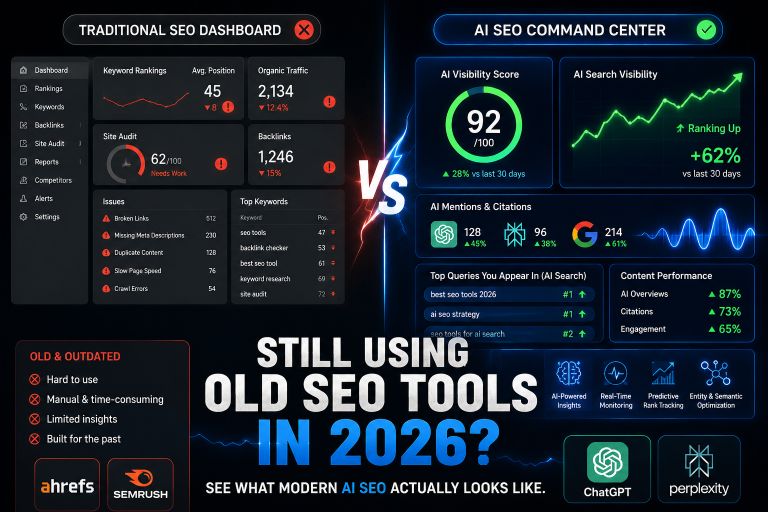
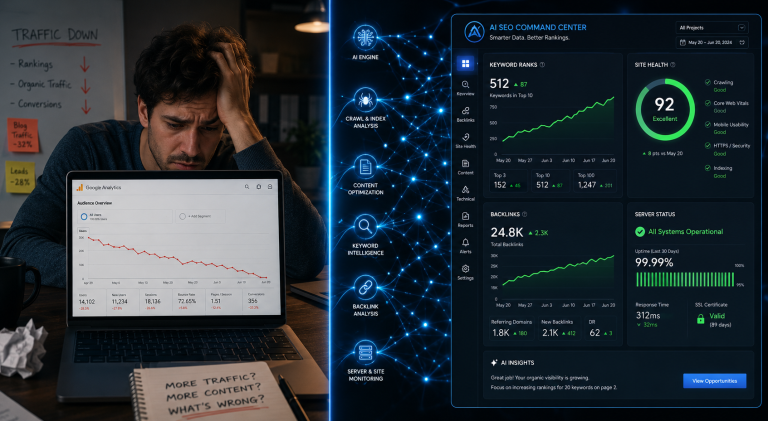
There’s a version of your competitor’s brand showing up inside every ChatGPT answer, every Perplexity summary, every Google AI Overview — while yours doesn’t. The gap isn’t content quality. It’s strategy.
Over 100 million people now use AI-powered search every single day. They’re not clicking through ten blue links. They’re reading a synthesized answer, trusting the source the AI chose for them, and moving on.
If your brand isn’t one of those chosen sources, you’re invisible to a rapidly growing segment of your audience — regardless of where you rank on Google.
This is the new reality of answer engine optimization (AEO), and most businesses haven’t started building for it yet. This guide changes that.
What Answer Engine Optimization Actually Means
Answer engine optimization is the discipline of structuring your content, authority signals, and technical architecture so that AI language models — ChatGPT, Perplexity, Google’s AI Overviews, Gemini — surface your brand as a trusted source when generating responses.
It’s related to GEO (Generative Engine Optimization) and LLM SEO optimization, but it isn’t the same as traditional SEO. Google’s algorithm weighs backlinks and on-page signals. LLMs weigh something different: factual density, source credibility, semantic clarity, and entity associations.
Understanding that distinction is the first thing separating brands that get cited from brands that get ignored.
Why Great Content Still Gets Overlooked by AI
You might publish excellent, well-researched content and still never appear in a ChatGPT answer or Perplexity summary. This happens for reasons most SEO guides never address.
AI models don’t crawl your site the way Googlebot does. They’re trained on large datasets and supplemented by real-time retrieval systems. For your content to be consistently cited, it needs to pass multiple evaluation layers — factual trustworthiness, entity clarity, and structured signal strength — at once.
Thin topical authority gets filtered out fast. When an LLM responds to “the best SEO tools for SaaS companies,” it doesn’t just look for keyword matches. It looks for sources with deep, interconnected knowledge about SEO, SaaS, and tools as related entities.
Ambiguous brand identity confuses AI retrieval. If your website doesn’t clearly communicate what you do, who you serve, and what you’re expert in, AI systems struggle to associate you with relevant queries — even when your content directly answers them.
Fixing all three requires an answer engine optimization strategy, not just better writing.
The Four-Layer AEO Framework That Gets Brands Cited
Building AI-powered search visibility isn’t a single tactic. It’s a layered system. Here’s the exact framework we use at Promoto AI to help brands rank in both traditional search and AI-generated answers.
Layer 1 — Topical Authority Architecture
AI models trust sources with comprehensive, interconnected topical coverage far more than sites with isolated, keyword-targeted posts. This is why semantic SEO content strategies have become the backbone of any serious answer engine optimization strategy.
Map your core topic domain into a cluster structure: one pillar page that establishes your primary expertise, surrounded by supporting articles covering every meaningful sub-question. This signals depth of knowledge to LLMs that use retrieval-augmented generation.
A SaaS company selling project management software shouldn’t just publish “best project management tools.” They should build a cluster covering task automation, team collaboration, productivity benchmarks, and integration comparisons — all internally linked and semantically aligned.
Promoto AI’s AI Content Generation engine builds these cluster architectures automatically, generating content that covers topic depth rather than just individual keyword targets.
Layer 2 — Entity Clarity and Brand Signal Strength
One of the most overlooked drivers of AI discoverability is entity SEO — making sure AI models can clearly identify your brand as a distinct, trustworthy entity associated with specific topics.
Your About page, homepage, author bios, and schema markup should all reinforce the same entity narrative. When AI systems repeatedly encounter your content framed through consistent entity signals, your brand gets associated with those topics in the model’s internal knowledge graph.
Think of it this way: Wikipedia doesn’t just rank because it has good content. It ranks because every page clearly establishes its entities — people, places, organizations, concepts — with precision. Your content needs that same level of entity discipline.
Layer 3 — Structured Data Implementation and AI-Readable Signals
Structured data implementation is the single most underused lever in answer engine optimization, and it’s directly correlated with how consistently AI systems can parse and cite your content.
Schema markup — particularly Article, FAQPage, HowTo, Organization, and Breadcrumb schemas — gives AI crawlers a machine-readable layer of context that supplements your prose. When Perplexity or Google’s AI Overview retrieves content to generate an answer, structured data acts as a confidence signal.
Promoto AI automatically embeds JSON-LD schema in every article it generates, meaning your content ships with AI-readable signals built in from day one — not bolted on as an afterthought.
At minimum, every page targeting informational queries should have FAQPage schema on its FAQ section and Article schema with author, datePublished, and organization fields populated. You can validate your existing schema anytime using Promoto AI’s Schema Validator.
Layer 4 — Optimized Content for Perplexity AI and Retrieval-Based Systems
Perplexity AI works differently from ChatGPT in one critical way: it performs live retrieval of web content before generating answers. This means optimizing content for Perplexity AI follows principles closer to traditional SEO — but with key AEO-specific differences.
Perplexity favors content that leads with direct, declarative answers in the first 100 words, then expands with supporting evidence. Clear H2s and H3s, short paragraphs, and bulleted lists for multi-part answers all improve retrieval probability.
For how to rank in ChatGPT answers, the logic is different. Brands that appear consistently across authoritative third-party sources — press features, industry databases, expert-authored citations — get woven into the model’s knowledge base at a deeper level than self-published content alone.
This is why brand visibility in AI tools isn’t just an on-site problem. It’s a digital PR and authority-building challenge that requires consistent off-site presence across trusted publications in your niche.
The Content Format Signals That AI Models Reward
Beyond strategy layers, specific formatting decisions directly improve your content’s performance in AI-generated answers. These aren’t about style — they’re about NLP content optimization and how language models parse information.
Direct definitional statements improve citation probability significantly. When your content opens a section with a clear, standalone definition, LLMs can extract it as a high-confidence factual snippet.
Short, information-dense paragraphs — two to three sentences maximum — are easier for AI retrieval systems to chunk and attribute. Long, flowing prose often gets passed over in favor of content organized into discrete, citable units.
Comparative and benchmark data gets cited disproportionately often. If your content includes specific statistics, comparisons, or original benchmarks, AI models will reach for those over generic explanations.
Question-and-answer formatting at the end of articles, especially for long-tail conversational queries, is the single highest-ROI tactic in answer engine optimization. A well-structured FAQ section doesn’t just serve users — it directly feeds the FAQPage schema that AI systems love to surface.
How Scalable Organic Growth Fits Into an AEO-First Strategy
Here’s something nobody talks about enough: scalable organic growth in 2026 requires you to optimize for two audiences simultaneously — human readers and AI retrieval systems.
The brands winning at this aren’t producing more content. They’re producing smarter content, with a semantic architecture that compounds over time. Each new article reinforces topical authority. Each internal link strengthens entity associations. Each structured data block adds another machine-readable signal layer.
When you use Promoto AI’s keyword analysis alongside its content generation engine, you’re not just targeting keywords — you’re building the semantic web that makes your brand increasingly difficult for AI systems to ignore.
The goal isn’t to write one article that ranks. It’s to build a topical ecosystem so thorough that when any AI model is asked about your domain, the probability of it citing you keeps increasing with every piece you publish.
The LLM SEO Optimization Mistakes to Stop Making Now
Even well-intentioned teams make structural errors that actively hurt their AI-powered search visibility. These are the most common ones.
Over-relying on keyword density instead of semantic depth. LLMs don’t count keyword occurrences — they evaluate conceptual completeness. A page that mentions “answer engine optimization” fifteen times but never addresses entity relationships or content architecture will lose to a page that covers the topic comprehensively, even if it uses the phrase less.
Ignoring author and brand entity signals. Anonymous content gets filtered out by AI systems trained to associate trustworthy information with identifiable human or organizational expertise. Every piece of content should have a named author with a bio that establishes relevant credentials.
Treating AI optimization as separate from content strategy. The brands succeeding at LLM SEO optimization integrate AEO signals — schema, entity clarity, topical clusters, direct answers — into their standard content production process from the start.
Promoto AI’s GEO optimization features handle this integration automatically, so teams don’t have to choose between writing for humans and optimizing for AI retrieval systems. The platform does both simultaneously.
Building a Long-Term Answer Engine Optimization Strategy
Getting cited once by an AI tool is a signal. Getting cited consistently is a brand visibility in AI tools strategy — and it requires a long-term system, not a one-time campaign.
The most effective approach combines four ongoing practices: publishing topically deep content clusters consistently, building off-site authority through guest contributions and press features, maintaining clean structured data across every indexed page, and monitoring AI-generated responses to identify gaps and refresh opportunities.
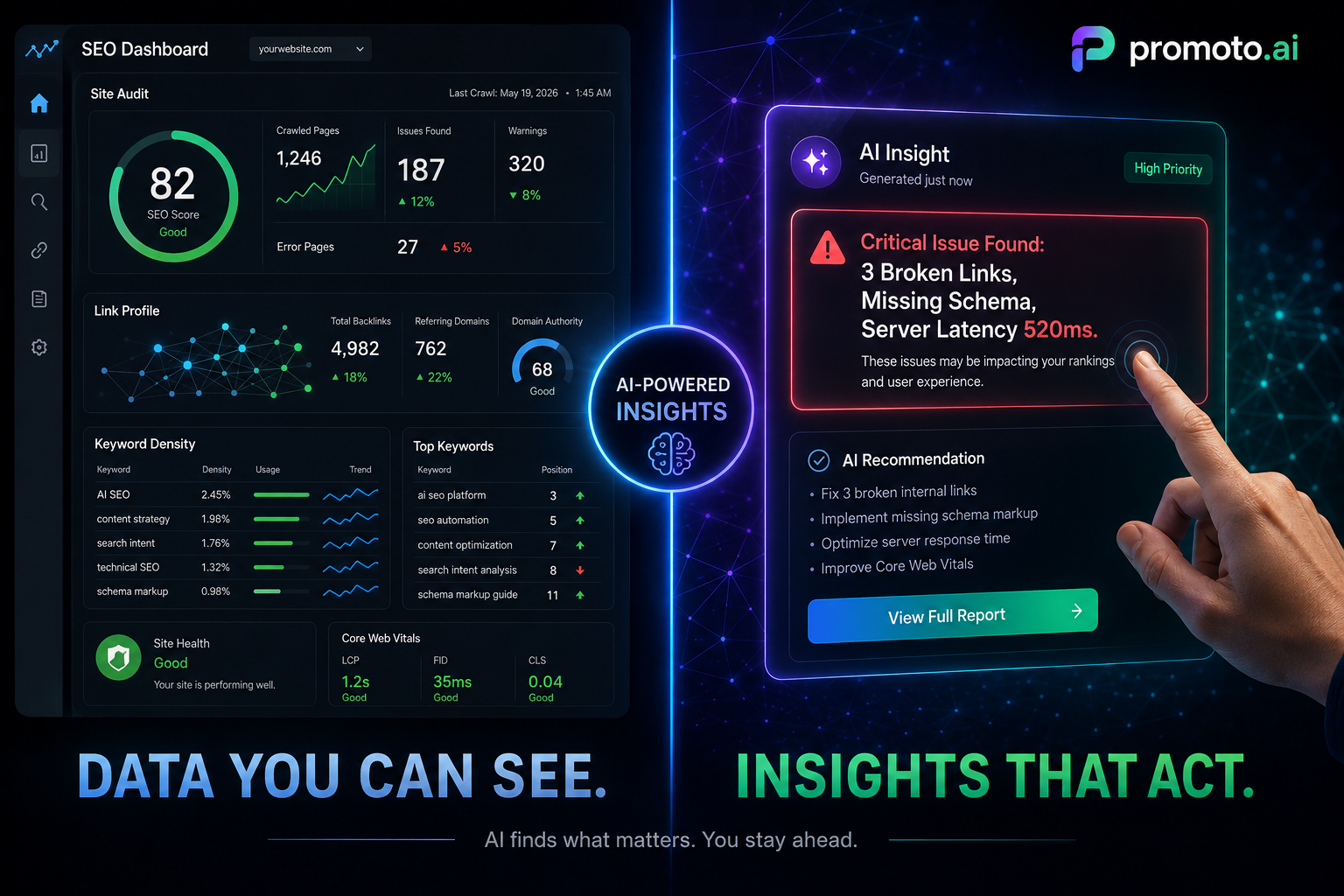
The Promoto AI analytics dashboard integrates GSC and GA4 data to surface rising queries and traffic signals — making it easy to identify which topics need deeper coverage and which articles need refreshing.
Answer engine optimization isn’t a sprint. It’s the long game that fewer brands are willing to play — which is exactly why the ones who commit to it now will own their categories in AI search before most competitors have even started.
KEY TAKEAWAYS
- Answer engine optimization (AEO) is the practice of structuring content and authority signals so AI tools like ChatGPT, Perplexity, and Google AI Overviews cite your brand in generated responses.
- AI models evaluate topical depth, entity clarity, structured data signals, and source credibility — not just keyword relevance.
- A four-layer AEO framework — topical authority architecture, entity signal strength, structured data implementation, and Perplexity-optimized formatting — covers the full spectrum of AI-powered search visibility.
- Structured data implementation (particularly FAQPage, Article, and HowTo schema) is the most underused but highest-impact technical lever for AI citation probability.
- Optimizing for Perplexity AI requires direct, declarative answers in the first 100 words; optimizing for ChatGPT requires consistent brand presence across authoritative third-party sources.
- Scalable organic growth in an AI-first search world means building semantic content ecosystems, not isolated keyword pages.
- Platforms like Promoto AI integrate AEO signals — schema, GEO optimization, semantic architecture — directly into content production, removing the need for parallel workflows.
Conclusion
Your Competitors Are Already Being Cited by AI. Are You?
Every day you publish content without an answer engine optimization strategy, you’re handing AI-powered search visibility to the brands that have figured this out. That gap compounds fast.
Promoto AI is built specifically for this new era of search. From semantic content architecture and auto-embedded JSON-LD schema to GEO optimization and real-time analytics — everything you need to rank in both Google and AI-generated answers is in one platform.
Start your free 14-day trial — no credit card required →
Or, if you want to see how your current content scores against AEO benchmarks, run your free instant SEO audit and get a prioritized action plan in minutes.
MORE ARTICLES TO READ
- Your Brand Is Invisible to AI Search — Here’s How Answer Engine Optimization Changes That
- The LLM SEO Playbook: How to Engineer Your Brand Into Every AI Answer
- The Technical SEO Audit Playbook for 2026: How AI-Driven Tools Are Closing the Gaps Agencies Still Miss
- The Smart SEO Stack: How to Use AI-Driven SEO Strategies and the Best SEO Tools in 2026
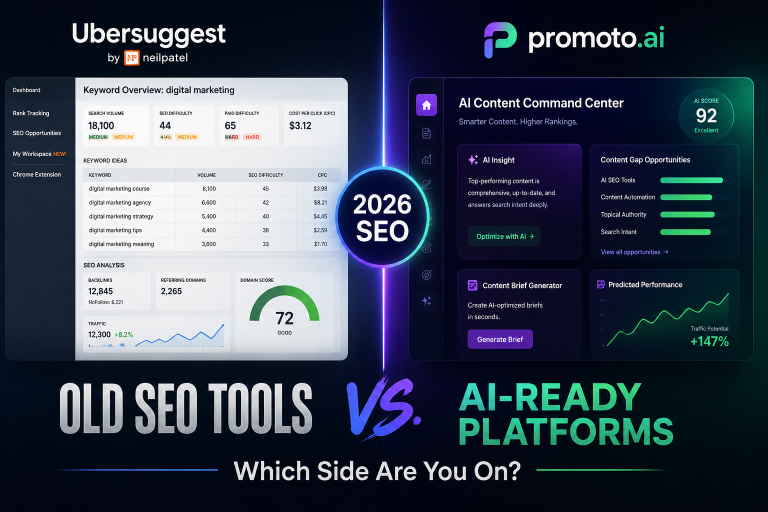
- Why Ubersuggest Is Losing Ground to Smarter AI SEO Platforms in 2026
FAQ SECTION
Q1: What is answer engine optimization and how is it different from traditional SEO?
Answer engine optimization (AEO) is the practice of structuring content, technical signals, and brand authority so that AI-powered answer engines — including ChatGPT, Perplexity, and Google AI Overviews — cite your brand in generated responses. Unlike traditional SEO, which optimizes for ranking positions, AEO optimizes for being chosen as a trusted source within a synthesized AI answer. AI systems weigh topical depth, entity clarity, and structured data signals rather than backlink counts or keyword density alone.
Q2: How do I get my website to appear in ChatGPT answers?
Getting cited in ChatGPT answers requires both off-site and on-site strategies. Off-site, your brand needs consistent presence across authoritative third-party publications and expert-attributed sources — this builds the brand entity into the model’s training knowledge base. On-site, your content needs deep topical coverage, clear entity signals, and structured data markup. For real-time browsing-enabled ChatGPT, fast-loading pages with direct, declarative answers in the opening section improve citation probability significantly.
Q3: What is the best content format for Perplexity AI optimization?
Perplexity AI uses live retrieval to pull content before generating answers. It favors pages that lead with a direct answer in the first 100 words, use clear H2 and H3 heading structures, feature short information-dense paragraphs, and include structured comparisons for multi-part queries. FAQPage and Article schema with full metadata — author, datePublished, organization — further increase the reliability with which Perplexity retrieves and cites your content.
Q4: How does structured data implementation help with AI search visibility?
Structured data — particularly JSON-LD schema markup — gives AI crawlers a machine-readable layer of context that supplements your prose. FAQPage schema turns Q&A sections into directly extractable answer units. Article schema establishes authorship and publication credibility. HowTo schema organizes step-by-step content in a format AI systems can confidently cite. Together, these signal that your content is well-organized and trustworthy — improving citation frequency across AI answer engines.
Q5: What is LLM SEO optimization and why does it matter?
LLM SEO optimization refers to strategies specifically designed to improve a brand’s visibility within large language model-generated responses. As more users shift from keyword searches to conversational AI queries, brands that appear in LLM answers gain a significant trust and awareness advantage — often without the user ever visiting a website. For businesses in competitive niches, LLM SEO optimization is the differentiator between brands that get discovered and those that get commoditized.