
The Smart SEO Stack: How to Use AI-Driven SEO Strategies and the Best SEO Tools in 2026 to Actually Rank
What if the SEO strategy you’ve been running for the past two years is already outdated — not by months, but by an entirely different era of search?
AI is no longer just augmenting SEO. It’s rewriting the rules entirely.
The brands winning in 2026 aren’t using more tools. They’re using smarter ones, assembled the right way. This guide breaks down which tools actually matter, how AI-driven workflows change execution, and what technical foundations you need before your competitors build them first.
Why Your Old SEO Stack Is Holding You Back
Most SEO teams are still using tools built for a search world that no longer exists. They rely on keyword tools that ignore semantic intent. They run site audits without AI diagnosis. They build backlinks without understanding topical authority signals.
The gap between traditional SEO and AI-driven SEO strategies isn’t a gap anymore. It’s a canyon.
Google has evolved. ChatGPT, Perplexity, and Google’s AI Overviews are reshaping how users find answers. If your site isn’t optimized for both traditional search and AI answer engines, you’re losing visibility on two fronts at once.
What Makes an SEO Tool “AI-Driven” in 2026?
Not every tool that slaps “AI” on its homepage earns the label. Genuinely AI-driven tools share specific traits that separate them from rebranded legacy software.
They use natural language processing to map semantic topic relationships — not just keyword frequency. They surface predictive insights, not just historical reports. They synthesize signals from search console data, competitor analysis, and entity recognition into real guidance.
Here’s what to look for in 2026:
- Semantic keyword clustering — not just volume-based lists
- AI-generated content briefs tied to real SERP intent
- Automated site audit scoring with prioritized fix recommendations
- Entity-aware optimization for AI search indexing
- Real-time rank monitoring connected to live analytics data
If your current tools can’t do at least three of these, it’s time to rethink your stack.
The Essential SEO Tools Stack for 2026
1. AI Keyword Research Tools
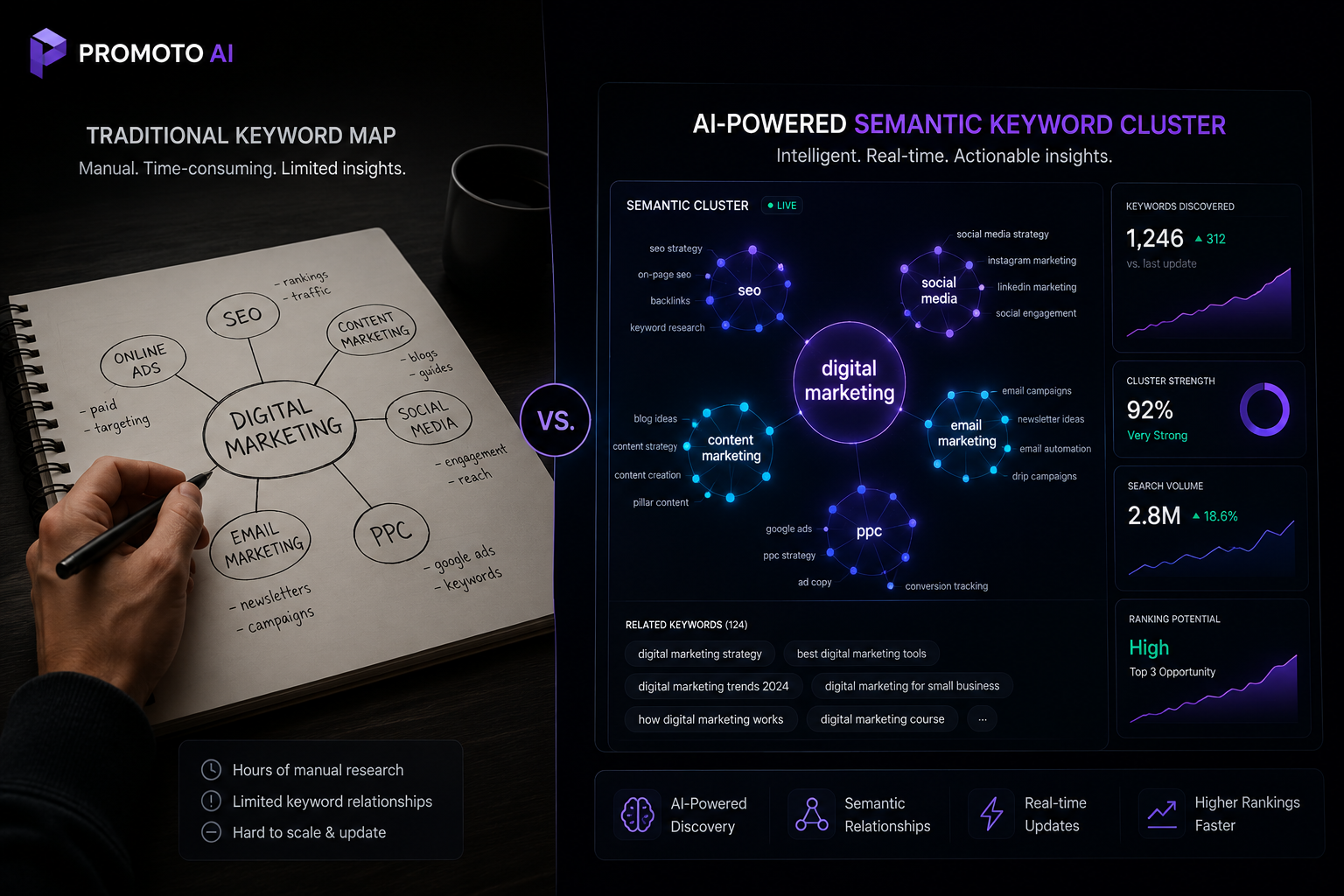
Keyword research has fundamentally changed. In 2026, it’s not about finding isolated high-volume terms. It’s about mapping semantic clusters — groups of related topics that prove topical depth to both search engines and AI systems.
Promoto AI’s Keyword Research tool and Keyword Position Tracker let you surface primary and latent semantic keywords in one unified workflow.
Pair them with Semrush’s Keyword Magic Tool or Ahrefs’ Keywords Explorer for competitive layer intelligence. The real power comes from combining AI-generated clusters with established volume data.
Pro tip: For AI answer engines like Perplexity and ChatGPT, prioritize question-based clusters — “how to,” “why does,” and “what is” formats consistently appear in AI-generated responses.
2. Keyword Density Checker
Keyword stuffing killed rankings in 2012. Under-using keywords weakens semantic relevance in 2026. The goal is precise, natural balance.
A Keyword Density Checker audits your content for over-optimization risks while confirming that primary and secondary keywords appear with enough frequency to signal topical relevance clearly.
Think of it less as hitting a percentage target and more as matching the natural writing pattern of an expert in your subject — varied, specific, and contextually rich.
3. Site Audit Tools and Best Practices
A site audit is the health check your website needs quarterly — not once a year. Technical issues compound silently. Crawl errors, slow load times, broken links, missing schema — each one slowly erodes your ranking potential.
Google Search Central defines what Google requires technically. For actionable, scaled diagnostics, automated audit tools are essential to catch what manual reviews miss.
Site audit best practices for 2026:
- Audit Core Web Vitals on both mobile and desktop
- Identify orphaned pages with zero internal links
- Validate structured data with Promoto AI’s Schema Validator
- Monitor crawl budget on large e-commerce or multi-category sites
- Consolidate thin content and flag duplicate meta tags immediately
A clean technical foundation isn’t a bonus — it’s the baseline. AI search systems depend on structured, crawlable content to generate accurate answers from your pages.
4. Link Analyzer Tool and Backlink Strategy
Backlinks still carry enormous weight. But what defines link quality has changed. In 2026, AI systems assess backlink profiles for topical relevance and entity association — not just raw domain authority numbers.
A Link Analyzer Tool helps you audit your current profile — catching toxic links, reviewing anchor text distribution, and identifying topical authority gaps worth addressing.
The Backlink Maker supports pipeline building by surfacing relevant directories, citation sources, and niche partnership opportunities aligned to your content strategy.
For competitive analysis, Ahrefs Site Explorer and Moz Link Explorer remain gold-standard references. Cross-compare your profile with top-ranking competitors to isolate the specific link types actually moving rankings.
Backlink signals that matter in 2026:
- Topical relevance of referring domains
- Editorial in-content placement over footer or sidebar links
- Entity co-occurrence on the linking page
- Freshness and consistent growth of new referring domains
5. Broken Links and Internal Link Health
Broken links silently damage user experience and crawl efficiency at the same time. A single 404 on a high-authority internal page bleeds PageRank that should be flowing to your key conversion pages.
The Broken Links Checker automates detection — surfacing broken internal and external links with page-level context so you can triage fixes by priority, not guesswork.
Pair this with a deliberate internal linking strategy. Every new piece of content you publish should receive inbound internal links from at least three relevant existing pages. This reinforces topical clusters and distributes authority across your site architecture in a way search engines reward.
6. Schema Markup and Structured Data
If there’s one technical area separating 2026 SEO leaders from everyone else, it’s structured data implementation. Schema markup tells search engines — and AI systems — what your content means, not just what it says.
FAQ schema, Article schema, HowTo schema, Product schema — each type provides machine-readable context that directly improves your chances of appearing in featured snippets and AI-generated answer summaries.
Schema.org is the canonical reference for all structured data formats. Always verify implementation accuracy with Promoto AI’s Schema Validator. Broken schema sends conflicting signals — often worse than having none at all.
Structured data implementation checklist:
- Article or BlogPosting schema on all editorial content
- FAQ schema on pages targeting question-based queries
- BreadcrumbList schema to clarify site hierarchy
- SiteLinksSearchBox for brand authority reinforcement
- Organization schema with verified social profile links
7. Server Status Checker
This one gets overlooked constantly — and it costs rankings quietly.
A site that goes down during peak crawl windows can lose indexed pages, miss ranking opportunities, and lose users who never return. The Server Status Checker gives you real-time uptime visibility so outages are caught before they become ranking liabilities.
For competitive niches, even 30 minutes of unexpected downtime at the wrong moment can shift positions noticeably. Monitoring this isn’t paranoia — it’s basic competitive hygiene.
AI-Driven Workflows That Separate Top SEO Teams
The best SEO teams in 2026 aren’t just using better tools — they’ve rebuilt their workflows around AI from the ground up.
A mature AI-driven SEO workflow looks like this end-to-end: Research → Brief → Create → Optimize → Publish → Track → Iterate. Every step connects to the next, with data flowing automatically between stages.
Promoto AI supports the entire workflow — from AI-powered keyword analysis and content generation to one-click publishing on WordPress and Shopify, tracked through a unified analytics dashboard.
What used to require a team of five — research, briefing, writing, optimization, publishing — can now run leaner and faster with the right AI infrastructure in place.
Optimizing for AI Search — The New SEO Frontier
Traditional Google SEO and AI search optimization are converging, but they’re not identical. You need to understand both to win in both environments.
For AI answer engines — ChatGPT, Perplexity, Google AI Overviews — the signals that matter most are:
- Entity clarity: Does your content definitively establish who, what, and why?
- Structured formatting: Short paragraphs, headers, and bullets are more easily extractable
- Source authority: Cross-web brand mentions, citations, and consistent presence
- Freshness: AI systems strongly favor recently updated, accurate information
Promoto AI’s Rank on AI Engine solution is purpose-built for this layer — helping brands appear in generative AI answers, not just traditional blue-link results.
For deeper background, these related guides cover the full picture: why websites become invisible in ChatGPT answers and the Answer Engine Optimization playbook.
The Future of SEO Tools — What’s Coming Next
The trajectory is clear. Tomorrow’s SEO tools will focus less on reporting what already happened and more on predicting what to do next.
Real-time SERP shifts will trigger automated content refresh suggestions. Competitor moves will generate strategic alerts. AI agents will handle routine optimization tasks without human input.
The platforms that win won’t be the ones with the most features. They’ll be the ones that reduce the distance between insight and action — delivering usable data at the speed the algorithm demands.
Build your stack today for that future. Prioritize tools with AI-native architectures, strong API connectivity, and active roadmaps. Today’s best SEO tools 2026 can carry you further than you think — if you choose them intentionally.
Key Takeaways
- AI-driven SEO requires semantic clustering — not isolated keyword targeting
- Run site audits quarterly and prioritize Core Web Vitals, schema, and crawlability
- Backlink quality in 2026 means topical relevance and entity association, not just DA scores
- Schema markup directly improves eligibility for featured snippets and AI answer citations
- Broken links and server downtime create silent ranking losses — monitor both consistently
- AI search engines like ChatGPT require optimization beyond traditional on-page SEO
- Integrated platforms like Promoto AI reduce complexity across every layer of the workflow
Conclusion
SEO in 2026 isn’t harder. It’s different — and the teams that recognize the shift early are the ones building durable, compounding organic growth.
The tools exist. The workflows are proven. The data is available.
Start with your technical foundation — audit your site, validate your schema, clean your backlink profile, and keep your server reliable. Then layer in AI-driven keyword research and content workflows built for both traditional search and AI-powered discovery.
If you want a single platform that connects all of those layers — from keyword research and site auditing to AI content generation, publishing, and analytics — Promoto AI was built for exactly this moment.
Start your free trial and see how much your SEO workflow can improve in the first 30 days.
About promotoai
PromotoAI is a leading AI-powered platform specializing in SEO, AIO, ASO, and GEO solutions. With the ability to publish directly to platforms like WordPress and Shopify, and track performance through real-time analytics, PromotoAI simplifies complex workflows for agencies and enterprises. Trusted by teams across industries, PromotoAI leverages advanced AI models to deliver scalable, optimized content strategies that drive measurable results.
More Articles
Promoto AI Dashboard and Analytics Overview
Promoto AI: Streamline Content Scheduling and Automated Publishing Workflows
Mastering AI Overview Optimization: Boost Your Google Visibility with Intelligent Strategies
AI Bulk Blog Post Generator for Agencies: Scale Content Production & Boost SEO
PromotoAI vs SEMrush: Which AI-Powered SEO Tool Delivers Better Organic Growth?
Frequently Asked Questions
Q1: What are the best SEO tools to use in 2026? The best SEO tools in 2026 combine AI-powered keyword research, site auditing, structured data validation, and backlink analysis in connected workflows. Platforms like Promoto AI, Semrush, and Ahrefs lead in comprehensive coverage, with specialized tools like schema validators and server monitors rounding out a complete stack.
Q2: How does AI change keyword research? AI shifts keyword research from targeting single high-volume terms to building semantic topic clusters. AI-driven tools surface related concepts, search intent patterns, and entity relationships that traditional tools miss — enabling content strategies that rank for hundreds of related queries, not just one primary keyword.
Q3: What is a keyword density checker and why does it matter? A keyword density checker measures how frequently your target keywords appear relative to total word count. It helps writers avoid over-optimization penalties while ensuring sufficient semantic frequency for search engine relevance — striking the balance between natural readability and clear topical signaling.
Q4: Why is schema markup important for SEO? Schema markup gives search engines and AI systems machine-readable context about your content’s meaning. It significantly increases eligibility for featured snippets, rich results, and AI-generated answer citations — making structured data one of the highest-ROI technical SEO investments in 2026.
Q5: How does a link analyzer tool improve SEO performance? A link analyzer audits your backlink profile for quality signals — topical relevance, anchor text diversity, toxic link risks, and authority gaps. Regular analysis protects against algorithmic penalties and continuously surfaces new link-building opportunities within your niche.