Why Most Websites Are Invisible in ChatGPT Answers (And How to Fix That)
Here’s something that should concern every marketer and business owner right now. A potential customer opens ChatGPT or Perplexity AI and asks which project management tool is best for remote teams. A direct, confident answer comes back — listing three or four specific brands, explaining their strengths, maybe even recommending one over the others. Your brand isn’t mentioned. Not because your product is inferior. Not because your content is bad. But because AI search engines simply cannot find a reason to cite you. This is the quiet crisis unfolding across search right now. Millions of websites that rank perfectly well on Google are completely absent from AI-generated answers. And as more users shift toward conversational AI tools for research and recommendations, that invisibility is starting to cost real traffic, real leads, and real revenue. Answer Engine Optimization isn’t a buzzword. It’s the practical response to a search environment that has fundamentally changed how information gets discovered and trusted.
Why AI Search Engines Work Differently Than Google
Google’s algorithm has always rewarded links, authority, and technical signals. You build backlinks, optimize your on-page elements, fix your Core Web Vitals, and Google gradually rewards you with ranking positions. AI search engines like ChatGPT, Perplexity AI, Gemini, and Claude operate on different logic. They aren’t scanning an index and returning a list — they’re synthesizing information, building answers, and deciding which sources are credible enough to cite. That distinction matters enormously.
Perplexity AI actively retrieves and cites web sources in real time. When a user asks a question, Perplexity evaluates which pages give the clearest, most structured, and most relevant answer — then references them. Being cited there isn’t about domain authority in the traditional sense. It’s about whether your content is formatted in a way that an AI can read, understand, and confidently reference. ChatGPT with browsing enabled works similarly. Its model draws on content that is semantically rich, well-structured, and topically authoritative. Thin pages, vague writing, and content that lacks clear definitions or specific insights rarely make the cut.
The practical implication? SEO optimization alone is no longer enough. You need your content to be AI-readable, AI-trustworthy, and AI-citable — three things most websites have never been designed for.
What Makes a Website Visible to AI Search
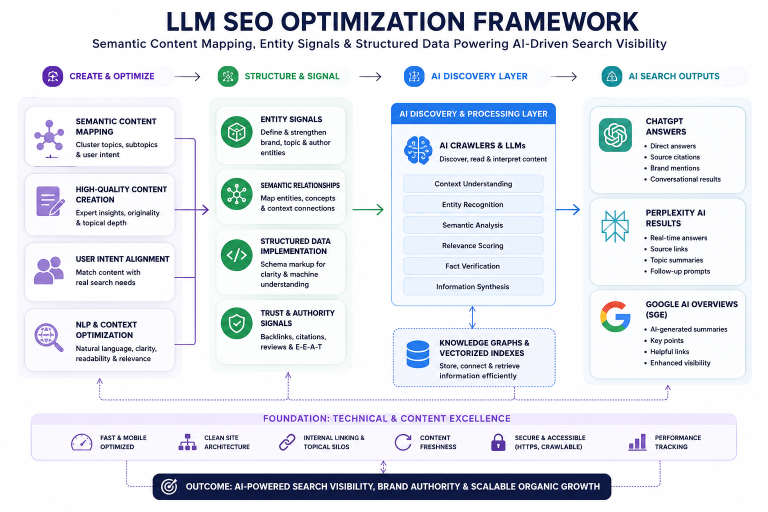
AI powered search visibility comes down to a few core principles that most content teams aren’t actively thinking about yet.
Clarity of expertise. AI models favor sources that clearly demonstrate knowledge on a specific topic. This doesn’t mean writing longer articles. It means writing more precise ones. If your page on email marketing covers everything vaguely, it will lose to a focused page that answers one question with exceptional depth.
Structured, scannable content. AI systems process text in ways that reward clear structure. Headers that reflect actual questions. Paragraphs that lead with the main point. Definitions that appear early. Lists that organize information without burying it in prose. This isn’t just good UX — it’s how you make your content legible to a machine trying to synthesize an answer.
Semantic SEO content strategy. AI tools don’t just match keywords — they understand topics, relationships, and context. A strong semantic SEO content strategy means covering a topic thoroughly enough that AI systems recognize you as a topical authority, not just a page that mentions the right words.
Structured data implementation. Adding schema markup — FAQ schema, How-To schema, Article schema — helps AI systems understand what your content is about and how it’s organized. It’s not a guarantee of visibility, but structured data implementation gives AI search tools more signals to work with, and that matters when they’re deciding what to cite.
Genuine brand signals. AI models pick up on whether a brand is mentioned and referenced across the web. If your brand only exists on your own website, you’re essentially invisible to the broader AI retrieval ecosystem. Mentions in industry publications, forums, podcasts, and credible third-party sources build the kind of brand visibility in AI tools that self-published content alone can’t create.
Practical Strategies to Start Showing Up in AI Answers
Getting visible in AI-generated answers isn’t a single tactic. It’s a content infrastructure shift. Here’s how to approach it:
Rewrite your core pages for conversational search. Most product and service pages are written for selling, not answering. AI search pulls from content that directly addresses questions. Audit your top pages and rewrite them to answer the specific questions your audience is actually asking. Think less “about us” copy, more “here’s exactly what you need to know.”
Create dedicated FAQ and definition content. Pages that clearly define terms, answer common questions, and explain concepts in plain language are consistently among the most cited in AI answers. Build these intentionally — not as afterthoughts at the bottom of a page, but as standalone, well-optimized content assets.
Build topical depth, not breadth. One well-structured content cluster on a specific topic will outperform ten loosely related articles every time in AI search. If you want to rank in ChatGPT answers about email deliverability, you need multiple quality pieces covering that topic from different angles — not a single broad overview post.
Earn third-party mentions. Guest articles, podcast appearances, product reviews, and forum participation all generate the kind of unstructured brand mentions that AI models pick up on during training and retrieval. This is a long game, but it’s one of the highest-leverage investments for AI discoverability.
Optimize content specifically for how to rank in ChatGPT answers. This means making sure your content appears in formats ChatGPT can retrieve and reference — clear attribution, factual accuracy, citable data points, and content that directly answers questions without excessive preamble or filler.
Implement structured data consistently. At minimum, add FAQ schema to any page with question-and-answer content. Add How-To schema for instructional content. Add Article schema with author and publication date. These signals are low-effort to implement and meaningfully improve how AI tools interpret your pages.
Mistakes That Keep Brands Out of AI Search Results
A few patterns consistently hurt AI search visibility across industries. Thin AI-generated content that covers topics superficially. Ironically, the wave of AI-written articles flooding the internet has made it harder for AI search tools to find genuinely useful content. If your articles are vague and undifferentiated, they won’t get cited — by humans or machines.
Ignoring conversational search intent. Most content is still written for keyword-based queries. Conversational AI search operates on natural language questions. If your content doesn’t reflect how people actually ask questions out loud or in chat interfaces, it’s going to miss. Weak topical authority. Publishing one or two pieces on a topic doesn’t signal expertise to AI systems. Sustained, deep coverage of a subject area does. AI models look for patterns of credibility, not isolated pages.
No structured data. Skipping schema markup is a missed opportunity that costs nothing but a few hours of implementation time. It directly impacts how AI tools categorize and surface your content. Writing for keyword density instead of semantic coverage. Stuffing a target phrase into your content doesn’t help with AI search optimization. Covering the full semantic range of a topic — related concepts, questions, entities, and practical applications — does.
Where This Is All Heading
Zero-click search isn’t coming — it’s already the norm for millions of queries. Users get answers directly inside AI tools without ever visiting a website. That doesn’t mean web traffic is dying, but it does mean the bar for earning a click, a citation, or even a mention has risen sharply.
The brands building AI discoverability now — through semantic content depth, structured data, topical authority, and genuine third-party presence — are building a compounding advantage. Scalable organic growth in 2026 and beyond will belong to whoever shows up where answers are generated, not just where links are listed.
Perplexity AI, ChatGPT, Gemini, and Claude are where an increasing number of purchase decisions, research processes, and brand comparisons are happening. Being present in those answers is no longer optional for businesses that rely on organic discovery.
Conclusion
Most websites are invisible in AI search not because they lack quality, but because they were never built for how AI engines read and evaluate content. The fix isn’t starting over — it’s adapting. Restructuring how your content is written, organized, and marked up. Building genuine topical authority. Earning the kind of third-party presence that makes AI tools confident enough to cite you. This is exactly what Promoto.ai is designed to help with. From AI search visibility tracking to Answer Engine Optimization tools and content recommendations built around how AI platforms actually work, it gives your brand the infrastructure to show up where search is heading — not just where it’s been. The brands adapting now will be the ones getting cited tomorrow. That window is open, but it won’t stay that way.
More Articles to Read
- How to Optimize for AI Engines and Boost Digital Visibility
- AI Overview Optimization: How to Maximize Digital Visibility Using Scalable Strategies
- How AI Content Visibility Drives Scalable Organic Growth Strategies
- Benefits of Using PromotoAI for Organic Traffic Growth
- How AI Content Visibility Can Transform Your Organic Growth Strategy
Frequently asked questions
Q1: How do websites appear in ChatGPT answers?
ChatGPT with browsing enabled retrieves content from websites that are clearly structured, topically authoritative, and semantically rich. Pages with direct answers, proper formatting, and factual accuracy are more likely to be retrieved and cited. Building strong brand signals across the web and implementing structured data also improves your chances of appearing in ChatGPT-generated responses.
Q2: What is Answer Engine Optimization?
Answer Engine Optimization (AEO) is the practice of structuring and writing content so that AI-powered search engines like ChatGPT, Perplexity, and Gemini can easily find, understand, and cite it. It focuses on clarity, semantic depth, conversational formatting, and structured data — going beyond traditional SEO to optimize for how AI systems generate answers.
Q3: Does Perplexity AI cite websites?
Yes. Perplexity AI actively retrieves and cites web pages in real time. It favors sources that directly answer the user’s question, are clearly structured, and demonstrate topical credibility. Pages with FAQ schema, clear headings, and precise answers consistently perform better in Perplexity citations than dense or vague content.
Q4: Why is semantic SEO important for AI search?
AI search engines understand topics, relationships, and context — not just keywords. A strong semantic SEO content strategy ensures your content covers a topic with enough depth that AI tools recognize you as a credible authority. This increases the likelihood of your content being retrieved and referenced in AI-generated answers across platforms.
Q5: What content formats work best for AI search engines?
AI search engines favor content with clear question-and-answer formatting, concise definitions, structured lists, and step-by-step explanations. FAQ pages, how-to guides, comparison articles, and definition-led content perform well. Adding structured data like FAQ schema and How-To schema further improves how AI platforms interpret and surface your content

Awanish Kumar Singh is a trailblazing cloud and infrastructure leader with more than 15 years of experience architecting, optimizing, and scaling high‑impact digital platforms across healthtech, fintech, media, and loyalty domains. As CTO at Amar Ujala, and in key senior roles at Brevo (formerly SendinBlue), Times Internet, and Redcliffe Labs, he’s built a reputation for marrying strategic vision with hands‑on execution to drive both performance and efficiency at massive scale. Over his career, Awanish has delivered transformative cost savings and performance gains, including: 30% reduction in cloud spending for an online health‑lab platform through deep architecture audits and database optimizations 60% cut in infrastructure costs for a loyalty‑program provider by migrating core APIs to AWS API Gateway and right‑sizing compute resources 500% traffic growth absorbed on mission‑critical systems while simultaneously reducing infrastructure expenses by 40% 99.999% system uptime achieved via resilient, multi‑AZ cloud architectures and automated failover strategies 25% faster release velocity thanks to end‑to‑end DevOps pipelines, containerization, and IaC best practices Beyond FinOps and cloud optimization, Awanish has spearheaded the adoption of CI/CD frameworks, container orchestration with Kubernetes, and real‑time monitoring solutions—enabling engineering teams to move rapidly without sacrificing reliability. His leadership extends into analytics‑driven decision‑making, where he leverages cost and usage data to continuously tune environments, ensuring every rupee invested in infrastructure delivers maximum ROI. Whether guiding startups through their first cloud migrations or re‑architecting legacy systems for global enterprises, Awanish combines deep technical mastery with a relentless focus on metrics. His track record of slashing costs, accelerating delivery, and boosting resilience makes him the go‑to expert for organizations that demand both bulletproof reliability and explosive growth.