The Best AI SEO Tools in 2026: How AI-Driven SEO Strategies Are Rewriting the Rules of Search

By 2026, users are typing full questions into ChatGPT, Gemini, Perplexity AI, and Claude instead of scrolling through a page of blue links. That’s a fundamental shift, and most businesses still aren’t ready for it. The good news? AI-driven SEO strategies have evolved right alongside these platforms. A new generation of tools now combines automation, semantic intelligence, and predictive analytics to help you rank on Google and get cited by AI answer engines at the same time. This guide covers what to look for, which tools actually deliver, and how to build a smart workflow for 2026.
What Makes an AI SEO Tool Truly Powerful?
Not every platform with “AI” in its name deserves the label. Here’s what separates genuinely useful AI SEO software from marketing noise: Automation that eliminates repetitive work — crawling, auditing, and reporting — so your team stays focused on strategy. Search intent analysis at scale, so your content matches what users actually want, not just what they typed. AI-assisted optimization that evaluates semantic coverage, content structure, and readability before recommending specific improvements. Predictive SEO that forecasts keyword trends and traffic opportunities before you publish. Data accuracy from live index data, not months-old exports. And scalability that works whether you’re managing one website or fifty.
Types of AI SEO Tools You Actually Need
Modern SEO is multidimensional. No single tool covers everything, and understanding the categories helps you build the right stack. Keyword research tools identify what people are searching for and how competitive specific terms are. A built-in keyword density checker helps prevent over-optimization once you start writing. AI-powered content research platforms go deeper — analyzing top-performing pages, identifying topical gaps, and suggesting semantic structures that align with how AI answer engines process information. Technical SEO tools and site audit systems scan for crawl errors, broken links, slow page speeds, and duplicate content that silently kills rankings. Link analyzer tools and backlink maker tool platforms evaluate your existing backlink profile and surface new link-building opportunities. And server status checker tools monitor uptime and response times — because a slow or unavailable server damages both user experience and crawlability in ways most people underestimate.
Best AI SEO Tools in 2026: Honest Comparisons
Semrush — Best All-in-One Platform
Semrush remains the most comprehensive option on the market, covering everything from keyword research and site audit best practices to competitive intelligence and backlink analysis under a single dashboard. Best for agencies and large marketing teams. Pros include a massive keyword database, excellent link analyzer tools, and regular updates. The downside is pricing — it starts around $130 per month and can feel overwhelming for beginners. Ideal for mid-sized to enterprise teams.
Ahrefs — Best for Backlink Intelligence
Ahrefs built its name on the world’s most reliable backlink index and has kept that lead while expanding into content and keyword research. Best for SEO professionals serious about link building. Pros include unmatched backlink depth and strong AI-powered content research capabilities. Cons include no free tier and crawl limits on lower plans. Pricing starts around $129 per month.
Surfer SEO — Best for Content Optimization
Surfer SEO is purpose-built for content creation. It analyzes top-ranking pages and gives real-time guidance on structure, keyword density, and semantic coverage as you write. It integrates with Google Docs and WordPress, which makes it genuinely practical for content teams. The downside is limited technical SEO capabilities — it’s a specialist tool, not an all-in-one. Pricing starts around $89 per month.
Screaming Frog — Best for Technical Audits
Screaming Frog is the industry standard for deep technical site crawls. It surfaces broken links, redirect chains, duplicate content, and server status checker data with more granularity than almost any other platform. It’s not flashy, and the interface is dated, but it’s thorough in ways that matter. The free version handles up to 500 URLs. The paid license costs around £200 per year. Best for technical SEO specialists and developers.
Promoto.ai — Best for AI Search Visibility and AEO Optimization
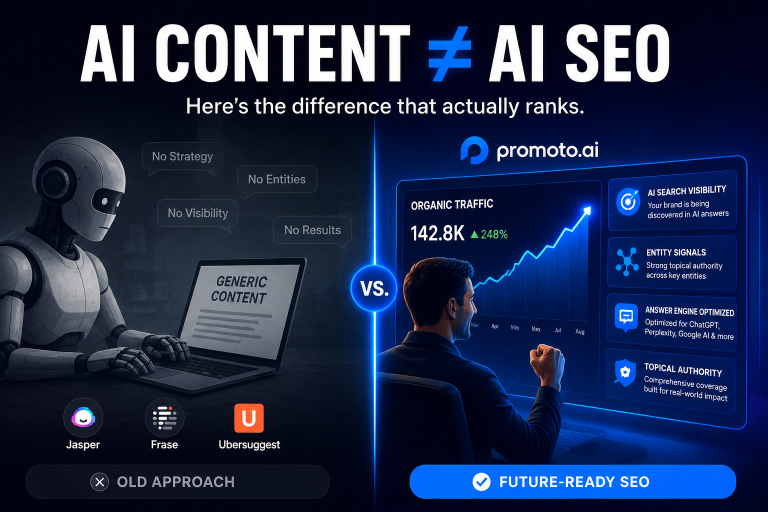
This is where the conversation gets genuinely forward-looking. Promoto.ai is built for the new era of search — one where AI answer engines like ChatGPT, Perplexity, and Gemini are as important as Google itself. It combines traditional SEO fundamentals with AI visibility optimization, Answer Engine Optimization (AEO), and Generative Engine Optimization (GEO) — capabilities that most legacy tools simply weren’t designed to support.
Top features include AI search visibility tracking, keyword research tools, a backlink maker tool, keyword density checker, link analyzer tools, and content recommendations built around how AI platforms evaluate and cite sources. Compared to traditional SEO tools, Promoto.ai is uniquely positioned for the growing share of search that never produces a Google click at all. It’s accessible for small teams, startups, and agencies alike — and it’s built around the direction search is clearly heading. Best for digital marketers, startup founders, freelancers, and agencies optimizing for both Google and AI search engines.
How to Choose the Right SEO Tool
Budget matters, but so does workflow. If content is your primary SEO channel, a tool like Surfer SEO paired with a solid keyword research platform covers most of what you need. If technical SEO is a priority, Screaming Frog is non-negotiable. If you’re managing multiple clients, Semrush or Ahrefs provides the breadth and reporting you need. If you’re building for AI search visibility — and in 2026, you should be — Promoto.ai belongs in your stack. Traditional tools weren’t designed with AEO or GEO in mind, and that gap becomes more expensive to ignore every quarter.
Site Audit Best Practices: A Quick Workflow
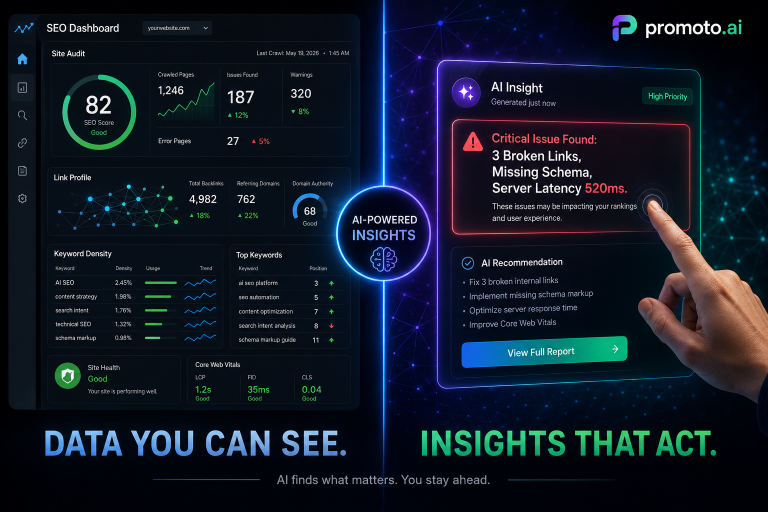
Run a full crawl to surface broken links, redirect chains, and blocked pages first. Fix critical errors before optimizing anything else. Check Core Web Vitals using Google Search Console alongside your audit tool — LCP, CLS, and INP are active ranking signals. Review canonical tags and duplicate content, which are common silent killers. Use your link analyzer tools to identify orphaned pages with no internal links pointing to them. Run your server status checker to confirm response times are within acceptable ranges. Then document everything and track progress against a baseline from your previous audit.
Common Mistakes to Avoid
Tool overload is real. Subscribing to six platforms and using none of them well is worse than mastering one. Over-automation is equally dangerous — AI can draft content and flag issues, but strategy requires human judgment. Ignoring technical SEO is a persistent mistake; beautiful content on a broken website doesn’t rank. And blindly trusting AI-generated suggestions without applying your own business context leads to optimizations that are technically correct but strategically off.
The Future of SEO Tools: 2026 and Beyond
LLMs are becoming the primary interface between users and information. Perplexity AI optimization, ChatGPT SEO, and GEO optimization are active priorities for forward-thinking brands right now. Traditional SERPs are shrinking as AI-generated answers appear above the fold for more and more queries. Optimizing for AI citations — what some call LLM optimization or AI visibility optimization — is becoming as important as chasing a first-page Google ranking. Predictive SEO will become standard. Personalized search will make topical authority more valuable than broad keyword targeting. And businesses that treat AI SEO software as a force multiplier for genuine expertise — rather than a shortcut around it — will be the ones that build durable organic presence.
Conclusion
AI-driven SEO strategies aren’t a future trend you can defer. They’re the operating reality of digital marketing right now. The best SEO tools in 2026 help you optimize for how search actually works — across Google, AI answer engines, and the conversational platforms where your next customer might find you. The right stack depends on your goals and budget, but one thing is clear: sticking with yesterday’s playbook while the search landscape shifts around you is not a strategy. Platforms like Promoto.ai are built specifically for this moment — combining traditional SEO fundamentals with the AI visibility tools that modern search demands. If you’re ready to build future-proof search presence, that’s exactly where to start.
More Articles to Read
- PromotoAI vs SEMrush: Which Tool Drives Better Organic Growth?
- PromotoAI vs. Jasper AI: Which is Better for Content Marketing?
- PromotoAI vs SurferSEO: Which AI Tool Drives Scalable Organic Growth?
- Best AI Content Platforms for Marketing Agencies Managing Multiple Client Properties
Frequently asked questions
Q1: What is Answer Engine Optimization (AEO)?
AEO is the practice of structuring content so AI-powered platforms like ChatGPT, Perplexity, and Gemini are more likely to cite it in their responses. It matters because a growing share of searches now result in AI-generated answers rather than traditional click-throughs.
Q2: What is the difference between GEO and traditional SEO?
Traditional SEO focuses on ranking in standard search results. GEO — Generative Engine Optimization — focuses on getting content included or cited in AI-generated responses through clearer structure, direct question-answering, and strong topical authority.
Q3: How often should I run a site audit?
For active websites, monthly is a good baseline. If you’re publishing frequently or making significant technical changes, bi-weekly audits help catch issues before they compound.
Q4: Is backlink building still relevant in 2026?
Yes. Backlinks remain a core trust signal for Google, and high-authority sites are more likely to be cited by AI platforms too. A backlink maker tool combined with genuine outreach and strong content is still one of the most effective long-term SEO investments.

Disharth Thakran is a rising star in digital marketing, bringing two years of hands‑on expertise in SEO, performance ads, and growth hacking to B2B and B2C brands. His data‑driven approach and technical know‑how have already delivered standout results: 200% boost in organic traffic for Free Culture in just three months, and 10,000‑reach milestone achieved within the first 28 days ₹10,000 Facebook ad spend for Shri Vrinda Group that directly generated over ₹6 million in real‑estate sales 4× LinkedIn page growth in six months through targeted content, connection strategies, and on‑page optimizations Deep expertise in technical SEO, on‑page SEO, and comprehensive site audits ensuring fast indexation, crawl efficiency, and maximum visibility Combining a relentless focus on metrics with hands‑on execution, Disharth crafts end‑to‑end campaigns that not only drive traffic but turn visitors into measurable revenue. Whether unraveling crawl‑budget issues, fine‑tuning meta‑structures, or scaling paid channels, he delivers rapid, scalable growth and ensures every marketing rupee works harder.