How to Build a Complete AI SEO Strategy in 2026

Most businesses approach SEO the same way they did five years ago. They hire writers, brief them on keywords, wait three weeks for drafts, run them through edits, and finally push something live — hoping it ranks before a faster competitor beats them to it.
That process isn’t just slow. In 2026, it’s a structural disadvantage.
The teams gaining ground in search right now aren’t bigger. They’re better organised. They’ve replaced fragmented tool stacks with connected workflows, and they’ve stopped treating AI as a writing shortcut and started treating it as a strategic system. This guide walks through exactly how to build that system — step by step — even if you’re running a one-person operation or a lean agency team.
Step 1: Stop Thinking in Keywords. Start Thinking in Topical Authority.
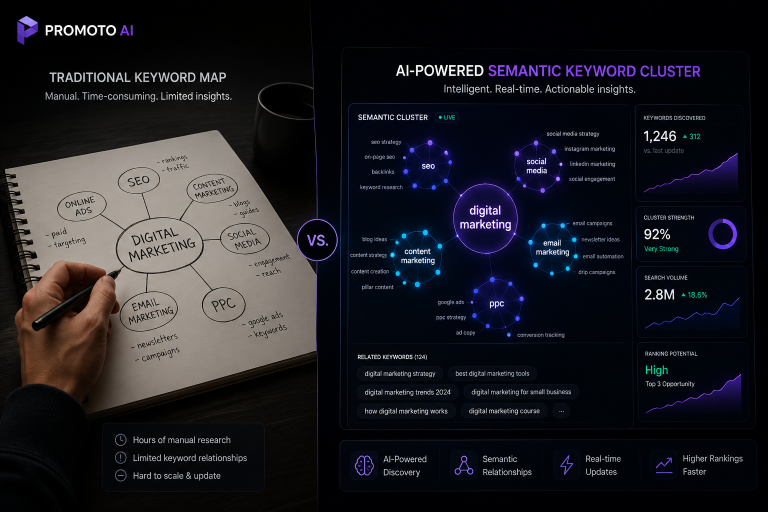
The single biggest mindset shift in modern SEO is moving from individual keyword targeting to building topical authority across clusters of related content. Google and AI search engines like ChatGPT and Perplexity don’t evaluate pages in isolation anymore — they evaluate your site’s depth and credibility across an entire subject area.
What this means practically: instead of writing one article about “best SEO tools,” you need a cluster of content that covers the topic from every angle — comparisons, use cases, how-to guides, platform-specific breakdowns, and trend analysis. Each piece reinforces the others and signals to search engines that your site is a genuine authority on the subject.
This is where Promoto.ai’s keyword analysis becomes genuinely useful beyond simple keyword research. The platform helps you identify not just individual keywords but the full topical landscape around your core subject — surface the questions your audience is asking, find the subtopics your competitors have left uncovered, and map out a content cluster that builds real authority over time.
Step 2: Understand the New Search Landscape — SEO Is Now Four Channels, Not One
Here is something a lot of SEO guides still gloss over: ranking on Google is no longer the complete goal. In 2026, your content needs to be visible across at least four distinct search surfaces simultaneously.
Google’s organic results remain important and aren’t going anywhere. But they now compete for attention with Google’s AI Overview, which appears above organic results for a growing percentage of queries and synthesises answers directly from indexed content.
ChatGPT Search now handles over 100 million queries per day. Users ask it product questions, comparison questions, and research questions — the exact queries that used to drive high-intent traffic to your site. If your brand isn’t being cited in ChatGPT’s answers, you’re invisible to a significant and growing portion of your potential audience.
Perplexity AI is particularly popular among researchers, founders, and technical buyers — high-value audiences for most SaaS and B2B brands. It surfaces sources directly and rewards content that answers questions clearly, cites evidence, and structures information logically.
Google Gemini is increasingly integrated into Google’s core search interface, especially on mobile, meaning AI-generated answers are now part of the default search experience for a large percentage of users.
Optimising for all four of these simultaneously requires a fundamentally different approach to content creation than traditional SEO. Promoto.ai’s AI engine ranking solution was built specifically for this multi-channel reality — generating content that performs across both traditional SERP rankings and AI-generated answer surfaces at the same time.
Step 3: Build Your Keyword Foundation Before You Write a Single Word
Most content teams make a consistent mistake at this stage: they pick keywords based on volume and difficulty alone, ignoring search intent, topical fit, and the competitive reality of their domain’s current authority.
A keyword with 10,000 monthly searches that your domain has no realistic chance of ranking for in the next six months is a wasted investment. A cluster of 20 lower-volume keywords that your domain can realistically rank for — and that collectively cover a topic your audience cares deeply about — is a strategic asset.
Here’s the research process that works:
Start with your core topic. What is the single subject your business has the strongest claim to expertise on? Every piece of content you create should connect back to this.
Map the question landscape. What is your audience actually asking? Look at “people also ask” results, forum discussions, competitor content that ranks well, and the autocomplete suggestions that appear when you type your core topic into Google, ChatGPT, and Perplexity. These aren’t just content ideas — they’re evidence of genuine search demand.
Identify gaps your competitors have missed. The best content opportunities in any niche are the questions that have real search volume but haven’t been answered well yet. These are the topics where a single well-researched, clearly written article can rank quickly even without a strong backlink profile.
Prioritise for realistic impact. Not everything is worth writing about equally. Focus first on keywords where your domain can rank within three months, topics that map directly to your product or service, and content that serves readers across multiple stages of their decision journey.
Use Promoto.ai’s free keyword research tool to start this process without spending anything — it gives you a practical foundation to build your content cluster from.
Step 4: Create Content That Earns Trust From Both Humans and AI Systems
Here is the distinction that separates content that ranks in 2026 from content that doesn’t: trustworthiness signals that work simultaneously for human readers and AI evaluation systems.
For human readers, trust comes from specificity, clarity, and genuine expertise. Articles that make vague claims, pad word count with filler, or fail to actually answer the question they promise to answer don’t get read, shared, or linked to. They also don’t generate the engagement signals that search engines use to validate quality.
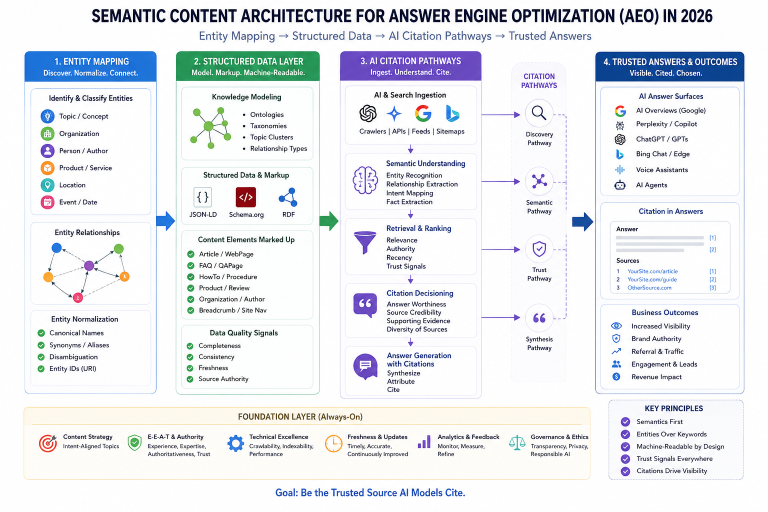
For AI systems, trust comes from a different but overlapping set of signals. Entities need to be clearly defined — AI engines need to understand who and what you’re talking about. Claims should be specific and verifiable rather than vague. Content should be structured so that key answers are findable without reading the entire piece. And schema markup — the machine-readable metadata that tells search engines what your content is about — needs to be accurate and present.
This is a significantly higher bar than what many content teams are currently clearing. The good news is that Promoto.ai’s AI content generation handles the technical layer of this automatically — schema markup, entity clarity, and AI-optimised structure are built into every piece of content the platform generates, not added manually after the fact.
Step 5: Optimise for GEO and AIO — Not Just Traditional On-Page SEO
Generative Engine Optimisation (GEO) and AI Optimisation (AIO) are the two disciplines that most SEO teams are still significantly underinvesting in — and they represent the biggest untapped opportunity in search right now.
GEO is the practice of structuring your content so that AI-powered search engines and answer engines will surface, cite, and recommend your brand when relevant queries are asked. It’s different from traditional SEO in important ways. Keyword density matters less than semantic clarity. Backlinks still matter but entity authority matters more. And the structure of your content — how clearly it answers specific questions, how logically it organises information, how accurately it represents your brand’s expertise — carries significant weight.
AIO focuses specifically on ensuring your content appears in AI-generated answers within tools like ChatGPT, Gemini, and Perplexity. This means writing in a way that AI systems can accurately summarise and quote, building brand authority signals that AI systems pick up through citation patterns and entity recognition, and ensuring your technical setup — schema, structured data, canonical tags — gives AI crawlers the information they need to understand your content accurately.
Both of these are core capabilities within Promoto.ai’s platform, not afterthought features. Every piece of content generated goes through GEO and AIO optimisation as part of the standard workflow.
Step 6: Publish Consistently — and Automate What You Can
Consistency is the variable that most content strategies underestimate and most content teams struggle to maintain. A single excellent article published in January and nothing else until April is not a content strategy. It’s a content event. And search engines — both traditional and AI-powered — reward sustained topical engagement, not occasional brilliance.
The challenge is that consistent publishing at quality is genuinely hard without the right infrastructure. Briefing, writing, editing, uploading, scheduling — each step creates friction, and friction compounds into delay.
The most effective solution for lean teams is selective automation. Not automating the thinking or the strategy — those need human judgment — but automating the execution steps that don’t require it. Content scheduling, CMS publishing, metadata generation, and structural formatting are all tasks that a platform can handle reliably at scale.
Promoto.ai’s Auto Schedule feature lets you define your publishing rules once — which days, which properties, which audiences — and then the platform generates and queues content that follows those rules automatically. For WordPress users and Shopify store owners especially, this means a consistent content cadence without the constant manual overhead that usually kills consistency in the long run.
Step 7: Measure What Actually Matters — Then Double Down
Most analytics setups track the wrong things. Page views and sessions are vanity metrics unless they’re connected to the outcomes your business actually cares about — leads, revenue, customer acquisition, and brand visibility.
The metrics worth tracking for an AI SEO strategy in 2026:
Keyword position trends — not just whether you rank, but whether you’re moving in the right direction across your target cluster over time.
Organic click-through rate — a strong ranking that generates no clicks is a sign your title and meta description need work, not that your content does.
AI search citation frequency — are you appearing in ChatGPT, Perplexity, and Google AI Overview answers for your target topics? This is increasingly measurable and increasingly important.
Content-to-conversion rate — which pieces of content are actually generating the leads or sales that justify the investment? Double down on the formats and topics that convert, not just the ones that rank.
Topical authority growth — are you ranking for a growing number of keywords within your core topic cluster over time? This is the compounding return that makes content SEO genuinely sustainable.
Promoto.ai’s analytics dashboard integrates directly with Google Search Console and Google Analytics 4, so you’re working with your actual performance data rather than estimates. The platform surfaces the insights that matter — rising keywords, underperforming pages, content refresh opportunities — rather than burying you in raw numbers.
The Strategy That Actually Compounds
Here is the honest summary of what a working AI SEO strategy looks like in 2026:
It starts with deep keyword and topical research — understanding not just what people search for but why, and where your domain can realistically compete. It continues with content that earns trust from both human readers and AI evaluation systems, structured for visibility across Google’s SERP, AI Overview, ChatGPT, and Perplexity simultaneously. It’s sustained by consistent publishing cadence, supported by automation that removes friction without removing judgment. And it’s measured against outcomes that actually matter to your business.
This isn’t a complicated formula. But it does require the right infrastructure — a platform that connects keyword research, content generation, GEO/AIO optimisation, CMS publishing, and analytics in a single workflow rather than stitching together five different tools and hoping they talk to each other.
That’s exactly what Promoto.ai was built to do. If you’re ready to move from occasional content publishing to a genuine compounding SEO system, the 14-day free trial is the lowest-friction place to start — no credit card required, and your first AI-optimised article can be live within the hour.
About promotoai
PromotoAI is a leading AI-powered platform specializing in SEO, AIO, ASO, and GEO solutions. With the ability to publish directly to platforms like WordPress and Shopify, and track performance through real-time analytics, PromotoAI simplifies complex workflows for agencies and enterprises. Trusted by teams across industries, PromotoAI leverages advanced AI models to deliver scalable, optimized content strategies that drive measurable results.
More Articles
Promoto AI Dashboard and Analytics Overview
Promoto AI: Streamline Content Scheduling and Automated Publishing Workflows
Mastering AI Overview Optimization: Boost Your Google Visibility with Intelligent Strategies
AI Bulk Blog Post Generator for Agencies: Scale Content Production & Boost SEO
PromotoAI vs SEMrush: Which AI-Powered SEO Tool Delivers Better Organic Growth?
Frequently Asked Questions
Q1. What is an AI SEO strategy and how is it different from traditional SEO?
A traditional SEO strategy focuses primarily on keyword research, on-page optimisation, and backlink building to rank in Google’s organic search results. An AI SEO strategy does all of that — but also optimises content for AI-powered search surfaces like ChatGPT, Google’s AI Overview, Perplexity, and Gemini. It uses AI tools to speed up content creation, automate publishing workflows, and structure content in ways that both human readers and AI evaluation systems recognise as authoritative and trustworthy. In 2026, a strategy that ignores AI search channels is leaving a significant portion of potential visibility on the table.
Q2. Do I need a large content team to execute an AI SEO strategy?
No — and that’s precisely the point. The reason AI SEO platforms like Promoto.ai exist is to give solo founders, lean marketing teams, and small agencies the same content output and optimisation capability that previously required a full content department. With the right platform handling keyword research, content generation, schema markup, and CMS publishing in a single connected workflow, a one or two-person team can produce and publish high-quality, AI-optimised content at a scale that would have been impossible without significant headcount just three years ago.
Q3. How long does it take to see results from an AI SEO strategy?
It depends on your domain authority, the competitiveness of your target keywords, and how consistently you publish. For newer domains targeting lower-competition keyword clusters, meaningful ranking movement typically appears within six to twelve weeks of consistent publishing. For established domains with existing authority, well-optimised content can begin ranking within two to four weeks. AI search visibility — appearing in ChatGPT and Perplexity answers — can happen faster than traditional Google rankings, often within weeks of a piece being indexed, because AI engines weight content quality and entity clarity heavily. The key variable in all cases is consistency: sporadic publishing rarely compounds the way a sustained cadence does.
Q4. What is Generative Engine Optimisation (GEO) and why does it matter?
Generative Engine Optimisation (GEO) is the practice of structuring and writing content so that AI-powered answer engines — like ChatGPT, Perplexity, Google’s AI Overview, and Gemini — surface, summarise, and cite your brand when relevant questions are asked. It differs from traditional SEO in that keyword density matters less than semantic clarity, entity accuracy, and the logical structure of your answers. GEO matters because these AI channels now handle hundreds of millions of queries per day, and brands that aren’t optimised for them are effectively invisible to a growing share of their potential audience. Promoto.ai’s rank-on-AI-engine features are built specifically to close this gap.
Q5. What is topical authority and how do I build it?
Topical authority is the measure of how comprehensively and credibly your website covers a particular subject area. Search engines — both traditional and AI-powered — evaluate your site not just on individual pages but on the depth and breadth of your coverage across a topic. Building topical authority means creating a cluster of interconnected content that covers your core subject from multiple angles: how-to guides, comparisons, definitions, use cases, trend analysis, and platform-specific content. Each piece reinforces the others, and together they signal to search engines that your site is a reliable, expert source on that subject. Promoto.ai’s keyword analysis tool helps you map the full topical landscape before you write a single word.

Piyush is a highly skilled Full Stack Software Engineer with a strong foundation in Java, TypeScript, Next.Js and cloud technologies such as AWS and GCP. He has mastered the art of end-to-end web application development, utilizing a versatile tech stack. His educational background from JNU and BHU and hands-on experience in software engineering have equipped him with expertise in problem-solving, data analysis, and cutting-edge technology. As an agile performer with a passion for delivering results, he thrives in dynamic and challenging environments.