The Silent SEO Revolution: How AI-Driven SEO Strategies Are Rewriting the Rules in 2026
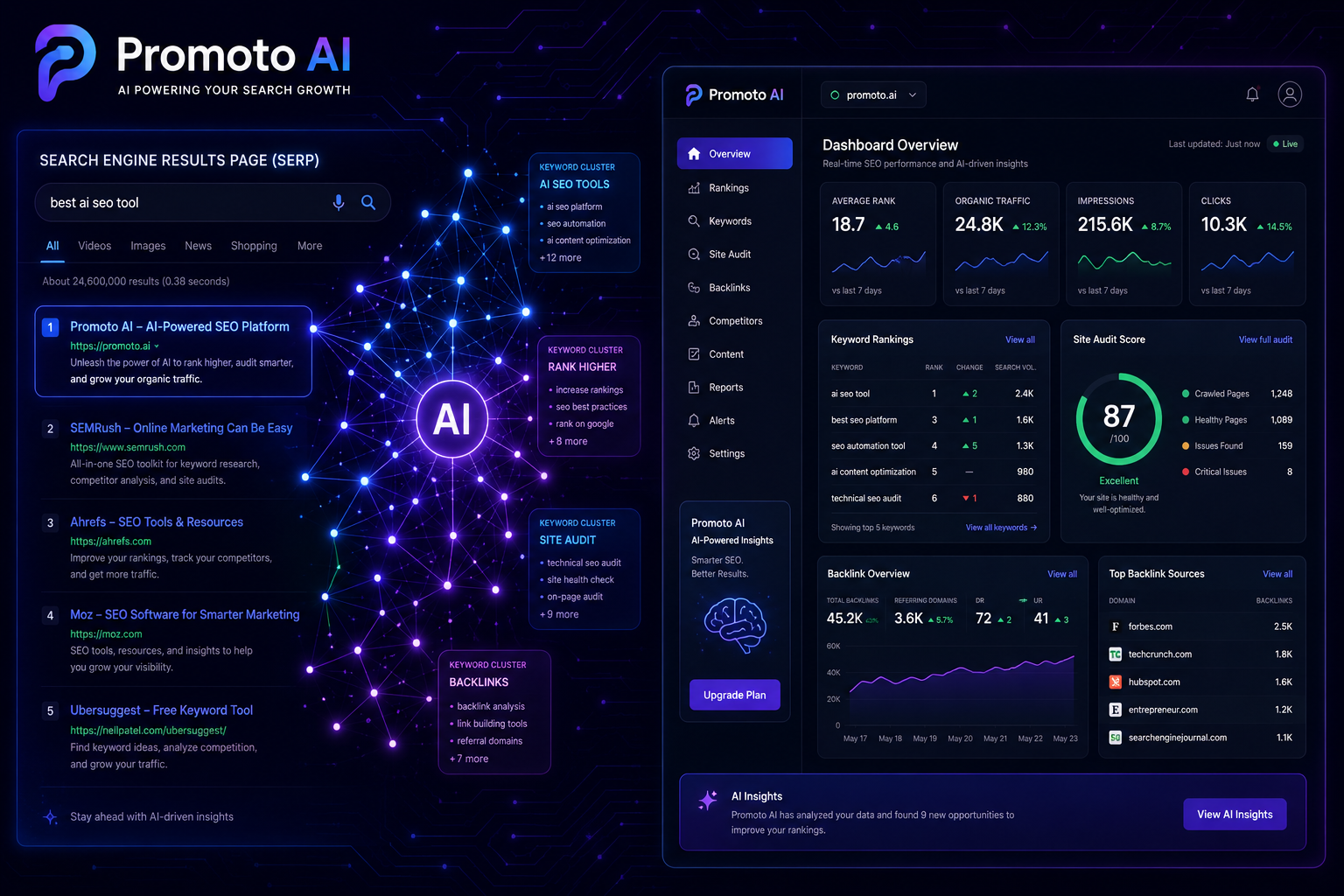
What if everything you knew about SEO became outdated — quietly, without warning? That’s not a hypothetical anymore. In 2026, AI hasn’t just entered the SEO world; it has taken the wheel. Search engines are smarter. AI answer engines are replacing blue links. And the brands that understand this shift are pulling ahead — fast.
If you’re still relying on manual keyword research, one-size-fits-all audits, or guesswork-based link building, you’re not just behind. You’re invisible. This guide breaks down exactly what’s changed, which tools are winning, and how to build an AI-driven SEO strategy that actually works — right now.
Why 2026 Is the Year SEO Gets Unrecognizable
SEO has always evolved. But 2026 is different.
For the first time, AI systems — not just algorithms — are actively deciding what content gets seen. Google’s AI Overviews, ChatGPT’s Browse feature, Perplexity’s answer engine, and Gemini-powered search are reshaping how search results are formed.
Users now get direct answers without clicking. That means your content must be structured not just to rank, but to be quoted by AI systems.
The rules have shifted. And your SEO toolkit needs to shift with them.
What “AI-Driven SEO Strategies” Actually Means in Practice
This phrase gets thrown around a lot. But what does it actually look like in real workflows?
AI-driven SEO strategies combine:
- Machine learning-powered keyword research that predicts search demand before it peaks
- Automated on-page optimization that adjusts content structure in real time
- AI content generation aligned to semantic keyword clusters
- Technical SEO monitoring that flags issues before they cost you rankings
- Structured data and schema markup deployed at scale
It’s the difference between reacting to Google updates and anticipating them.
The Best SEO Tools of 2026 — What to Actually Look For
Not all SEO tools are built equal. In 2026, the ones that matter share a common thread: they use AI to reduce guesswork and surface insights faster.
Here’s what separates great SEO tools from outdated ones:
- Real-time data processing — Not weekly crawls. Live monitoring.
- Semantic understanding — Going beyond keywords to topic relevance
- AI-assisted recommendations — Actionable, not just analytical
- Integration capability — Connecting with your CMS, analytics, and search console
- Generative Engine Optimization (GEO) support — Content visibility in AI answer systems
If your current tools don’t hit most of these benchmarks, you’re flying blind.
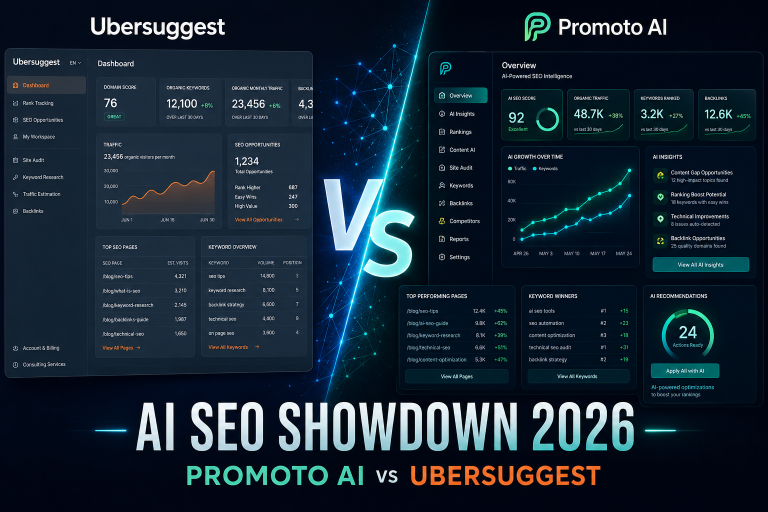
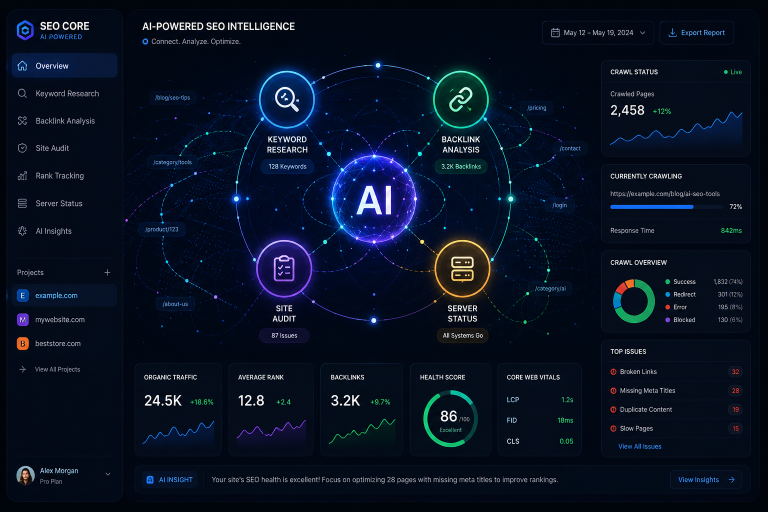
Promoto AI’s Analytics Dashboard brings all of this into one place — combining GSC data, GA4 insights, and AI-powered recommendations in real time.
AI for Keyword Research — Smarter Than You Think
Traditional keyword research was about search volume and competition scores. That era is fading.
Modern AI for keyword research identifies:
- Intent clusters — Grouping keywords by what users actually want to achieve
- Rising semantic variations — Terms that haven’t peaked yet but are gaining traction
- Question-based queries — Ideal for featured snippets and AI answer boxes
- Competitor content gaps — Keywords your competitors rank for that you’re missing
The best platforms now use NLP (Natural Language Processing) to understand why someone searches, not just what they type.
Promoto AI’s Keyword Research Tool and Keyword Analysis product are built around this exact methodology — surfacing high-impact opportunities that basic tools miss entirely.
For further depth on modern keyword methodology, Ahrefs’ Keyword Explorer remains a trusted reference for understanding keyword difficulty and SERP intent.
Keyword Density — Still Relevant, But Not the Way You Think
Keyword density was once the go-to metric for on-page SEO. Stuff a page with your target phrase and watch it rank. That approach is dead.
In 2026, keyword density matters only as a quality signal. Google’s systems now detect both under-optimization and over-optimization.
The smart approach is balance:
- Use your focus keyword naturally in the title, first paragraph, and a few headers
- Distribute semantic variations and related terms throughout the body
- Avoid forced repetition — it signals low-quality content to both AI systems and human readers
Use a Keyword Density Checker to audit your existing content and catch optimization imbalances before they hurt your rankings.
Technical SEO in 2026 — Where AI Makes the Biggest Difference
Technical SEO has always been the backbone of organic performance. But manually auditing crawl errors, broken links, redirect chains, and Core Web Vitals is incredibly time-consuming.
This is where AI tools shine brightest.
Site Audit Best Practices for AI-Powered Workflows
A modern site audit should include:
- Crawlability analysis — Ensuring all key pages are indexed correctly
- Core Web Vitals monitoring — LCP, INP, and CLS scores that affect ranking directly
- Broken link detection — Internal and external links that return 4xx or 5xx errors
- Duplicate content flags — Canonical issues and thin content warnings
- Mobile usability checks — Especially critical as mobile-first indexing is now standard
- Server response monitoring — Catching downtime and slow response times early
Google Search Central’s technical SEO documentation is the authoritative baseline for understanding what Google evaluates during a crawl.
For real-time server health monitoring, Promoto AI’s Server Status Checker helps you catch downtime and slow server responses before they damage your crawl budget or user experience.
Link Analysis — The Hidden Power of Internal and External Link Audits
Your link profile tells search engines a story about your authority and trustworthiness.
A link analyzer tool helps you understand:
- Which pages are receiving the most internal link equity
- Which external links are pointing to your site (and their quality)
- Orphaned pages with no internal links — invisible to both users and crawlers
- Broken internal links causing user frustration and crawl waste
Promoto AI’s Link Analyzer gives you a clear picture of your site’s link health, while the Broken Links Checker catches problems that silently erode your SEO performance.
According to Moz’s guide on internal linking, a strong internal linking structure directly improves crawlability and distributes page authority effectively.
Backlink Building in the AI Era — Quality Over Volume, Always
Backlinks remain one of Google’s top three ranking signals. But the strategies that once worked — mass directory submissions, low-quality guest posts, paid link schemes — now actively harm your site.
In 2026, backlink building is about:
- Earning editorial links through genuinely useful, citable content
- Digital PR — Creating data-driven studies and reports that journalists reference
- Relationship-based outreach — Building real connections with relevant publishers
- Broken link building — Finding dead links on authority sites and offering your content as a replacement
Promoto AI’s Backlink Maker Tool helps identify high-quality backlink opportunities relevant to your niche.
Semrush’s Backlink Analytics is an excellent external resource for competitive backlink research and gap analysis.
Schema Markup and Structured Data — Your Shortcut to AI Visibility
This is the most underused strategy in modern SEO — and one of the highest-leverage ones.
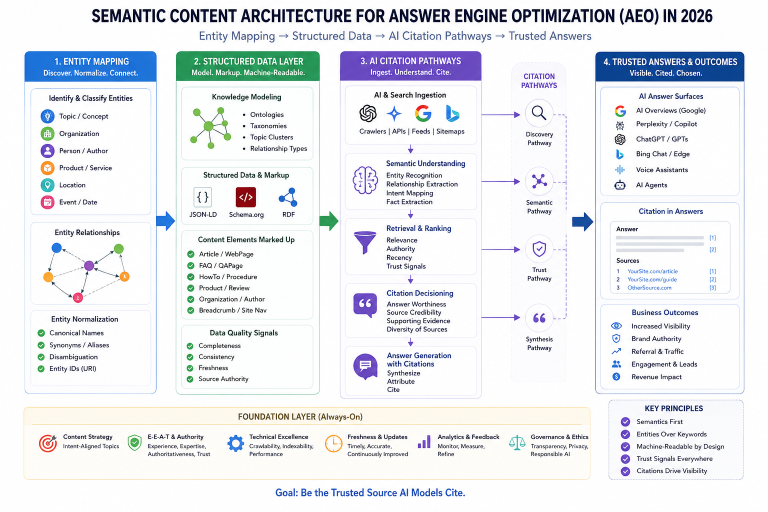
Schema markup is code that tells search engines exactly what your content means. It’s not just for rich results anymore. In 2026, structured data is how AI answer engines understand and cite your content.
The most impactful schema types to implement:
- Article schema — Marks content as editorial and authoritative
- FAQ schema — Directly feeds into featured snippets and AI answer boxes
- Product schema — Boosts e-commerce visibility in both traditional and AI-powered search
- HowTo schema — Captures instructional queries with step-by-step rich results
- Organization and Author schema — Strengthens EEAT signals (Experience, Expertise, Authority, Trust)
The Schema.org vocabulary is the definitive reference for structured data types and correct implementation.
Use Promoto AI’s Schema Validator to ensure your structured data is error-free and correctly parsed by search engines before going
Optimizing for AI Search Systems — The GEO Advantage
This is the frontier that most SEO guides haven’t caught up to yet.
Generative Engine Optimization (GEO) is the practice of making your content visible inside AI-powered answer systems — ChatGPT, Perplexity, Google AI Overviews, and Gemini.
The core principles of GEO include:
- Write with clear, declarative statements that AI systems can extract and quote
- Use structured headers that mirror likely AI query patterns
- Include statistics, definitions, and expert positions that answer engines favor
- Deploy schema markup to signal content authority to machine readers
- Build brand mentions and entity associations across authoritative sources
Promoto AI’s Rank on AI Engine solution is specifically built to optimize content for visibility inside these AI-powered ecosystems — giving your brand presence where millions of users now search every day.
Putting It Together — A Practical AI-Driven SEO Workflow
Here’s a simplified workflow for implementing AI-driven SEO strategies in 2026:
- Audit your technical foundation — Use a site audit tool to fix crawl errors, broken links, and Core Web Vitals issues first
- Research with intent — Use AI keyword research to identify semantic clusters and question-based queries, not just volume metrics
- Create semantically rich content — Write content that covers a topic comprehensively, naturally integrating keywords and related terms
- Deploy structured data — Implement schema markup relevant to your content type for AI and rich result visibility
- Build authority systematically — Pursue quality backlinks through editorial outreach and digital PR
- Monitor and iterate — Track rankings, traffic, and AI mention frequency; refresh content quarterly based on data
This loop, powered by the right tools, compounds over time. Each cycle makes your site stronger.
Key Takeaways
- AI has fundamentally changed SEO — content must now be optimized for both traditional search and AI answer engines simultaneously
- The best SEO tools in 2026 combine real-time monitoring, semantic understanding, and AI-powered recommendations
- Keyword density is a quality signal, not a stuffing strategy — balance and semantic variation matter far more
- Technical SEO remains the foundation — site audits, server monitoring, and link analysis must be ongoing, not one-time tasks
- Schema markup is your AI visibility shortcut — structured data is how AI systems understand, trust, and cite your content
- GEO (Generative Engine Optimization) is the next frontier — brands not visible in AI answer engines are losing a massive share of attention
Conclusion
The SEO landscape in 2026 is simultaneously the most complex and most opportunity-rich it has ever been.
Brands that adapt — that move from manual processes to AI-driven workflows, from keyword stuffing to semantic relevance, from basic site checks to comprehensive technical audits — will dominate. Those that don’t will watch their traffic quietly disappear into AI-generated answer boxes that never mention their name.
The good news? You don’t need an enterprise budget to compete at this level.
Promoto AI gives you the full stack — AI content generation, keyword analysis, schema validation, link auditing, backlink tools, and GEO optimization — built for founders, agencies, marketers, and SEO professionals who are serious about growing in the era of AI-powered search.
The revolution is already happening. The only question is which side of it you’ll be on.
Start your free trial at Promoto AI and build your AI-driven SEO strategy today.
About promotoai
PromotoAI is a leading AI-powered platform specializing in SEO, AIO, ASO, and GEO solutions. With the ability to publish directly to platforms like WordPress and Shopify, and track performance through real-time analytics, PromotoAI simplifies complex workflows for agencies and enterprises. Trusted by teams across industries, PromotoAI leverages advanced AI models to deliver scalable, optimized content strategies that drive measurable results.
More Articles
Automating SEO Workflows with PromotoAI: A Comprehensive Guide
PromotoAI vs SEMrush: Choosing the Best AI Tool for Organic Growth
Maximizing ROI with PromotoAI Analytics and Insights
FAQ Section
1. What are AI-driven SEO strategies?
AI-driven SEO strategies use machine learning, natural language processing, and automation to optimize websites for search engines. They go beyond manual keyword research and content updates — analyzing search intent, automating technical audits, generating structured content, and optimizing for AI answer engines like ChatGPT, Perplexity, and Google AI Overviews. The result is faster, smarter SEO that scales with your business.
2. What are the best SEO tools in 2026?
The best SEO tools in 2026 combine AI-powered keyword research, real-time site auditing, schema validation, backlink analysis, and GEO (Generative Engine Optimization) capabilities. Platforms like Promoto AI offer an all-in-one solution covering everything from keyword density checking and link analysis to AI content generation and analytics dashboards.
3. How does AI improve keyword research?
AI keyword research tools go beyond search volume metrics. They analyze search intent, identify semantic keyword clusters, surface rising long-tail queries, and map question-based searches that feed directly into featured snippets and AI answer boxes. This means your content strategy targets why users search, not just what they type, leading to higher engagement and better rankings.
4. Why is schema markup important for SEO in 2026?
Schema markup (structured data) tells search engines and AI systems exactly what your content means. In 2026, it’s critical for two reasons: it enables rich results in traditional search (featured snippets, FAQs, product ratings) and it signals content authority to AI answer engines, increasing the chance your content is cited in AI-generated responses. Use a Schema Validator to ensure your markup is error-free.

Disharth Thakran is a rising star in digital marketing, bringing two years of hands‑on expertise in SEO, performance ads, and growth hacking to B2B and B2C brands. His data‑driven approach and technical know‑how have already delivered standout results: 200% boost in organic traffic for Free Culture in just three months, and 10,000‑reach milestone achieved within the first 28 days ₹10,000 Facebook ad spend for Shri Vrinda Group that directly generated over ₹6 million in real‑estate sales 4× LinkedIn page growth in six months through targeted content, connection strategies, and on‑page optimizations Deep expertise in technical SEO, on‑page SEO, and comprehensive site audits ensuring fast indexation, crawl efficiency, and maximum visibility Combining a relentless focus on metrics with hands‑on execution.
Disharth crafts end‑to‑end campaigns that not only drive traffic but turn visitors into measurable revenue. Whether unraveling crawl‑budget issues, fine‑tuning meta‑structures, or scaling paid channels, he delivers rapid, scalable growth and ensures every marketing rupee works harder.