When Ubersuggest Isn’t Enough Anymore: Why Growing Teams Are Making the Switch to Smarter AI SEO

Here’s a conversation happening in marketing teams everywhere right now.
Someone brings up Ubersuggest in a strategy meeting. “We’ve been using it for two years — it’s affordable, it works for keyword research, what’s the problem?”
Then someone else opens ChatGPT, types in a question relevant to their industry, and their brand is nowhere in the answer. Not even mentioned. A competitor is cited three times.
That’s the problem.
The SEO landscape in 2026 looks almost nothing like it did in 2022. AI-generated answers have reshaped how people interact with search results. Google’s AI Overviews now handle a growing share of queries before a user ever clicks a blue link.
Tools like Perplexity AI, ChatGPT, and Gemini are becoming the first stop for research — not Google itself. If your SEO platform was built for the old world, it’s optimizing for a game that’s quietly changing its rules.
This is precisely why so many content teams, agency owners, and startup founders are rethinking their tool stack. It’s also why Promoto AI vs Ubersuggest has become one of the more relevant comparisons in AI SEO software right now.
This guide breaks both platforms down honestly. No hype, no fluff — just practical insight to help you decide what fits your workflow in 2026.
Why Traditional SEO Tools Are Changing — Fast
Let’s be direct about what’s happening.
Organic click-through rates have been declining for years. But 2025 and 2026 accelerated that trend dramatically.
Zero-click searches — where the answer appears directly on the results page — now account for a significant portion of queries. When AI Overviews populate above the fold, even a #1 ranking gets fewer clicks than it used to.
At the same time, AI search engines have changed what “visibility” even means.
Ranking on page one of Google still matters. But being cited in a ChatGPT response or an AI Overview matters too — sometimes more, depending on your audience.
This new layer of visibility is what marketers now call AIO (AI Optimization), GEO (Generative Engine Optimization), or LLM optimization.
Traditional SEO tools weren’t designed for this. They were built to help you rank on a SERP that looked the same for 15 years. Keyword density. Backlink analysis. Meta tag suggestions.
These things still matter — but they’re the floor, not the ceiling.
Modern AI SEO workflows need to account for semantic relevance, entity signals, structured data, and AI answer-friendliness. That’s a different discipline. And it requires different software.
Promoto AI vs Ubersuggest: A Practical Comparison
Both platforms serve the SEO space. Both have real users.
But they’re solving for fundamentally different problems — and understanding that gap is what helps you choose the right one.
Ubersuggest
Overview: Ubersuggest, developed by Neil Patel Digital, started as a free keyword tool and evolved into a broader SEO platform.
It covers keyword research, competitor analysis, backlink tracking, site audits, and some content ideas. It’s become a popular entry point for solo bloggers, small businesses, and marketers who want basic SEO data without a large budget.
Best use case: Budget-friendly keyword research and basic site health monitoring for small websites or individual creators.
Strengths:
- Very low cost (often free or near-free at the basic tier)
- Simple, approachable interface for SEO beginners
- Decent keyword difficulty and search volume data
- Basic competitor domain comparison
- Mobile app available
Weaknesses:
- Content generation is limited and not natively AI-optimized for search
- No AIO, GEO, or LLM optimization features
- No publishing integration — you research here, then write and publish elsewhere
- Analytics are surface-level compared to GSC/GA4 native integration
- Not built for AI search visibility or answer engine optimization
- Struggles to scale for agencies managing multiple client properties
User experience: Clean and accessible. Great for beginners who need a starting point.
However, power users bump into the platform’s ceiling quickly. When you’re ready to move beyond keyword lists into full content strategy, the workflow gaps start to show.
AI optimization capabilities: Minimal. Ubersuggest has added some AI writing features, but they’re primarily suggestions rather than true AI search optimization.
There’s no mechanism for optimizing content to appear in ChatGPT responses, AI Overviews, or Perplexity AI answers.
Pricing category: Free tier available; paid plans start affordably. Positioned as a budget tool.
Best for: Beginner bloggers, solo creators, and small businesses just starting with SEO who need basic keyword data and site audits.
Unique advantage: Accessibility. It’s one of the easiest tools to start with, and the low price point removes the barrier to entry for those new to SEO.
Promoto.ai
Overview: Promoto.ai is a full-stack AI SEO, AIO, ASO, and GEO platform built for the modern search landscape.
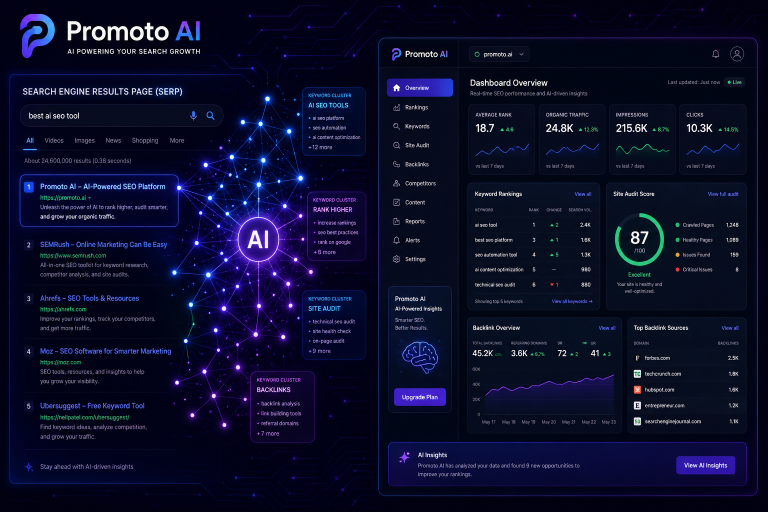
It combines AI content generation, keyword research, semantic SEO optimization, multi-platform publishing, and real-time analytics into a unified workflow. Unlike tools that stop at research, Promoto.ai connects the dots from keyword discovery all the way through content creation, publishing, and performance tracking.
Best use case: Teams, agencies, and growing businesses that need to create, publish, and track SEO-optimized content at scale — while also optimizing for AI search visibility.
Strengths:
- Generates SERP-aware, AI-optimized content drafts directly inside the platform
- Covers SEO + AIO (AI Optimization) + GEO (Generative Engine Optimization) in a single workflow
- Native one-click publishing to WordPress and Shopify
- Multi-model AI engine (GPT-4, Gemini, Bedrock, LangChain) for content generation
- GSC and GA4 integration for data-informed content decisions
- Auto-scheduling, approval workflows, and bulk publishing for teams and agencies
- Built-in free tools: keyword density checker, link analyzer, backlink maker, server status checker, sitemap generator, schema validator, and more
- Multi-tenant architecture for agencies managing multiple client sites
- Content optimized for ChatGPT, Perplexity AI, Google AI Overviews, and Gemini
Weaknesses:
- Steeper learning curve for users who only need basic keyword lookups
- Overkill for a solo blogger posting once a week with no publishing automation needs
- Newer platform, so the brand trust curve is still building
User experience: Dashboard-forward and designed for strategic workflows.
The initial setup — connecting GSC, GA4, and your publishing platforms — takes a few minutes. But it unlocks a meaningfully more powerful experience than research-only tools.
AI optimization capabilities: This is where Promoto.ai differentiates most clearly.
The platform is purpose-built for AI search visibility. Content drafts are optimized for both traditional SERP ranking and for appearing in AI-generated answers. Schema.org JSON-LD is built in, and topic clusters are structured to establish topical authority that AI models recognize.
Pricing category: 14-day free trial; subscription-based. Positioned as a professional and agency-grade tool.
Best for: In-house marketing teams, content agencies, SaaS companies, e-commerce brands, and any organization that needs to scale content output while staying visible in AI search results.
Unique advantage: It’s one of the few platforms that treats AIO and GEO as first-class SEO priorities — not afterthoughts.
Promoto.ai vs Jasper AI, Frase, and SEMrush: Where Does It Fit?
The comparison doesn’t stop at Ubersuggest. It’s worth briefly mapping where Promoto.ai sits relative to other tools marketers typically consider.
Promoto AI vs Jasper AI: Jasper is primarily an AI writing tool. It generates content and helps with copy, but it doesn’t publish, doesn’t track rankings, and doesn’t connect to your GSC or GA4 data.
It’s a writing assistant — not an SEO platform. If you need a full-circle SEO workflow, Jasper leaves significant gaps.
Promoto AI vs Frase: Frase is strong at content briefs and optimizing existing articles against SERP competitors. It’s a useful research layer.
But it doesn’t handle publishing, doesn’t natively optimize for AI search visibility, and doesn’t cover GEO or AIO workflows. Teams using Frase often need several other tools stitched together.
Promoto AI vs SEMrush: SEMrush is the heavyweight — comprehensive data, deep backlink analysis, competitive intelligence. But it’s expensive, complex, and primarily a data and audit platform.
It doesn’t generate content, doesn’t publish it, and its AI content features are bolt-ons rather than core functionality. Many users pay for SEMrush and still need a separate content tool alongside it.
What makes the Promoto.ai comparison interesting is that it’s not trying to be any of these tools specifically. It’s connecting research, creation, publishing, and AI visibility optimization into a single platform — which is a meaningfully different proposition than any individual Surfer SEO alternative or Jasper AI alternative on its own.
Which Tool Is Actually Right for You?
If you’re a blogger just starting out: Ubersuggest’s free tier is a legitimate place to begin. Learn the keyword research fundamentals, run a basic site audit, get comfortable with the concepts.
When you start producing more than a few posts a month and need content to actually perform, that’s when you hit the ceiling.
If you’re a freelance SEO consultant: You likely need something with more depth. Promoto.ai’s agency features — multi-property management, role-based access, bulk publishing — make it worth the investment once you’re managing more than two or three client sites.
If you’re a startup or SaaS company: Content velocity matters. So does AI search visibility.
If a potential customer asks ChatGPT which tool to use for your category, you want to be in that answer. Promoto.ai’s AIO and GEO optimization is directly relevant here.
If you’re an agency: Multi-tenant architecture, approval workflows, and one-click publishing across WordPress and Shopify properties make Promoto.ai genuinely useful at scale. Ubersuggest simply wasn’t built for this.
If you’re a content-heavy e-commerce business: Shopify integration plus keyword-informed content generation plus schema markup is a real competitive advantage. That combination exists in Promoto.ai; it doesn’t in Ubersuggest.
Key Features Modern AI SEO Tools Must Have
Not every platform earns the label “AI SEO tool” equally. Here’s what actually matters in 2026:
AI-powered content research and generation — not just keyword lists, but content briefs with semantic structure and search intent built in.
Semantic SEO optimization — understanding topic clusters, entity relationships, and how AI models interpret content authority.
Keyword density checker — still relevant for on-page quality control without over-optimization.
Backlink maker and link analyzer tools — to understand and build the authority signals that both Google and AI models use as quality indicators.
Technical SEO integrations — server status checker, schema validator, robots.txt generator, sitemap tools. These are the foundation, and any serious platform should include them.
Content scoring systems — real-time feedback on whether a draft meets the bar for both traditional ranking and AI answer inclusion.
Publishing integration — research without publishing creates workflow friction. The best tools close the loop.
GSC and GA4 native integration — data-informed decisions, not guesswork.
Real Problems AI SEO Tools Actually Solve
Here’s what separates a useful AI SEO tool from an expensive keyword spreadsheet.
Content scaling without quality loss. Manual content production has a ceiling. AI-assisted generation with SEO optimization built in lets teams publish more without sacrificing relevance or accuracy.
Search intent alignment. Getting the keyword right but the intent wrong is a common failure mode.
Good AI SEO tools analyze SERP composition to understand whether a query is informational, commercial, navigational, or transactional — and help you match that intent before you write a single word.
AI search visibility. This is the new frontier. Being present in ChatGPT responses, AI Overviews, and Perplexity AI answers requires a different content strategy than traditional SERP ranking.
Platforms built for this — like Promoto.ai — give you a structural advantage over teams using tools that haven’t caught up.
Internal linking at scale. As content libraries grow, internal linking becomes complex and often neglected. AI-assisted tools can surface linking opportunities automatically, saving hours of manual review.
Predictive SEO analysis. Instead of reacting to ranking drops, modern tools help you anticipate content gaps and refresh opportunities before performance degrades.
Common Mistakes When Choosing AI SEO Software
A few patterns come up repeatedly when teams end up with the wrong tool.
Choosing based on brand name alone. A well-marketed tool isn’t necessarily the right tool. Ubersuggest has excellent brand recognition thanks to Neil Patel’s presence — but that doesn’t mean it fits a scaling agency’s workflow.
Ignoring workflow compatibility. If your team publishes to WordPress and the tool you’re evaluating requires three export steps to get there, you’ll lose hours every week. Publishing integration matters more than most buyers realize.
Overpaying for features you won’t use. An enterprise SEMrush subscription makes sense for large organizations with dedicated SEO analysts. It’s overkill for a five-person startup team that mainly needs content and keyword support.
Publishing low-quality AI content. AI generation speeds up production — but it doesn’t replace editorial judgment.
The platforms that produce the best results generate optimized drafts and let humans refine them. Pure automation without review leads to thin content that hurts more than it helps.
Ignoring technical SEO entirely. Content tools get all the attention, but server status, schema markup, broken link detection, and page speed fundamentals still matter. The best AI SEO platforms cover both layers.
The Future of AI SEO Software in 2026 and Beyond
The direction is clear, even if the details are still evolving.
LLM optimization is becoming a standard consideration alongside traditional keyword ranking.
How does your content appear when a language model processes it? What entity signals do you have? These questions are moving from advanced to essential.
GEO optimization — structuring content specifically to appear in generative AI answers — is gaining its own playbook.
Schema markup, authoritative sourcing, structured answers, and entity clarity all contribute. Brands that invest in this now will have a significant head start.
ChatGPT SEO and Perplexity AI optimization are no longer niche concerns.
With hundreds of millions of users asking questions through these platforms daily, the traffic opportunity for brands that appear in AI answers is real and growing fast.
Personalized search is adding another layer.
AI models increasingly tailor answers based on context, previous interactions, and user signals. Content that demonstrates genuine expertise and specific utility will have structural advantages over thin, generic coverage.
Predictive SEO systems — tools that surface emerging topics before they peak, refresh opportunities before rankings drop, and competitive gaps before they close — represent where the best platforms are heading.
Promoto.ai is already building in this direction. Its AIO, ASO, and GEO capabilities aren’t marketing language — they represent a genuine architectural decision to build for the search landscape that’s actually arriving, not the one that existed five years ago.
Wrapping Up: What This Comparison Actually Tells You
Ubersuggest is a legitimate tool. For someone just starting with SEO, it’s accessible, affordable, and teaches the fundamentals. There’s nothing wrong with using it at that stage.
But “enough for right now” and “built for where search is going” are two very different things.
If you’re producing content at any meaningful volume, managing multiple sites, or trying to show up in AI-generated answers — not just Google page one — you need a platform designed with those realities in mind.
The Promoto AI vs Ubersuggest question essentially answers itself once you get specific about your goals.
If your goal is to learn keyword basics cheaply, Ubersuggest works. If your goal is to build organic visibility across both traditional search and AI answer engines at scale, Promoto.ai is built for that problem.
It’s worth exploring with their 14-day free trial before you commit. Connect your GSC and see what surfaces. That exercise alone tends to make the decision fairly obvious.
More Articles to Read
- PromotoAI vs SEMrush: Which Tool Drives Better Organic Growth?
- PromotoAI vs. Jasper AI: Which is Better for Content Marketing?
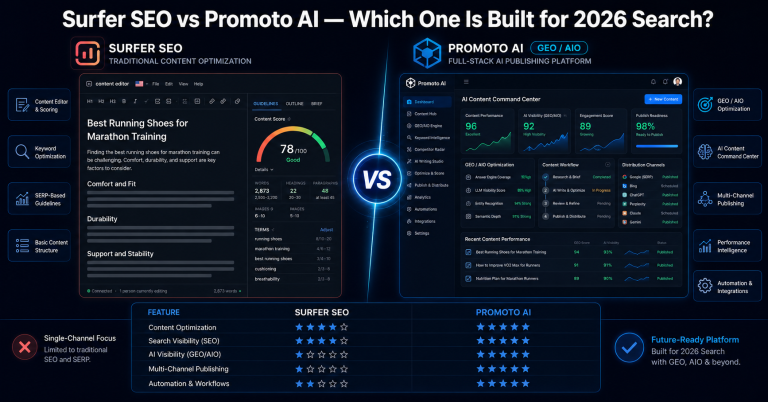
- PromotoAI vs SurferSEO: Which AI Tool Drives Scalable Organic Growth?
- Best AI Content Platforms for Marketing Agencies Managing Multiple Client Properties
FAQ SECTION
Q1: What is the main difference between Promoto AI and Ubersuggest? Ubersuggest is primarily a keyword research and basic site audit tool. Promoto.ai is a full-stack AI SEO platform that covers content generation, keyword research, semantic SEO optimization, multi-platform publishing (WordPress and Shopify), GEO/AIO optimization, and real-time analytics — all in one workflow.
Q2: Can Promoto.ai help my content appear in ChatGPT and AI search answers? Yes. Promoto.ai is specifically built to optimize for AI search visibility, including ChatGPT responses, Google AI Overviews, Perplexity AI, and Gemini. Its AIO (AI Optimization) and GEO (Generative Engine Optimization) features help structure your content for AI answer inclusion — something Ubersuggest and most traditional SEO tools don’t address.
Q3: Is Promoto.ai suitable for beginners, or is it only for advanced SEO users? Promoto.ai is designed for teams and growing businesses, so it has more depth than beginner-focused tools. That said, the dashboard is built for clarity, and the 14-day free trial lets you test the workflow before committing. If you’re a beginner creating content at scale or managing multiple sites, it’s worth the learning curve.
Q4: Does Ubersuggest offer AI content generation? Ubersuggest has added some AI writing features, but they’re supplementary to its core keyword research function. Unlike Promoto.ai, Ubersuggest doesn’t generate SERP-aware content drafts, doesn’t optimize for AI search visibility, and doesn’t connect content generation with direct publishing integrations.
Q5: How does Promoto.ai compare to other Surfer SEO alternatives and Jasper AI alternatives? Promoto.ai differentiates from Surfer SEO by combining content generation and publishing with optimization — Surfer focuses on content scoring but doesn’t generate or publish. Compared to Jasper AI, Promoto.ai adds keyword research, SEO analytics, GSC/GA4 integration, and GEO optimization that Jasper doesn’t offer. It’s a more complete workflow tool rather than a single-function writing assistant.
Q6: What free SEO tools does Promoto.ai include? Promoto.ai includes a suite of free tools: keyword position tracker, keyword density checker, keyword research tool, domain age checker, DNS lookup, link analyzer, broken links checker, backlink maker, meta tag analyzer, server status checker, sitemap generator, robots.txt generator, meta tag generator, and schema validator — covering both content and technical SEO needs.
Q7: What types of businesses benefit most from switching to Promoto.ai? Content-heavy businesses, SEO agencies managing multiple client properties, SaaS companies focused on organic growth, e-commerce brands on WordPress or Shopify, and any team that wants to stay visible in both traditional and AI search engines will find the platform’s feature set most relevant to their goals.

Piyush is a highly skilled Full Stack Software Engineer with a strong foundation in Java, TypeScript, Next.Js and cloud technologies such as AWS and GCP. He has mastered the art of end-to-end web application development, utilizing a versatile tech stack. His educational background from JNU and BHU and hands-on experience in software engineering have equipped him with expertise in problem-solving, data analysis, and cutting-edge technology. As an agile performer with a passion for delivering results, he thrives in dynamic and challenging environments.