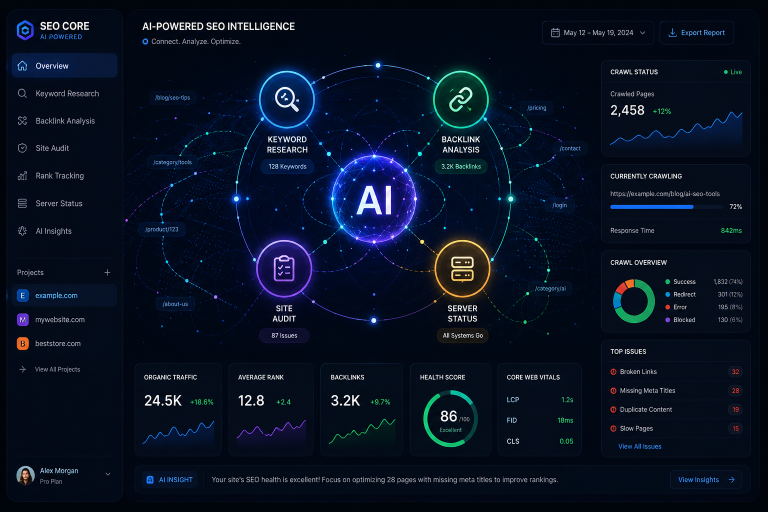
Why Your Site Audit Is Lying to You — And the AI-Powered Tools That Tell the Truth

You did everything right. You published content. You chased backlinks. You optimized your titles. And yet — your competitors are outranking you. Your site is invisible in AI search summaries. And you’re not even sure why.
Here’s the uncomfortable truth: most SEO strategies in 2026 are failing not because of bad content, but because of invisible technical problems that no one is checking. A broken link here. A misconfigured server response there. A keyword density issue that’s quietly cannibalizing your rankings.
The good news? A new generation of AI-driven SEO tools is making these issues impossible to ignore — if you know where to look.
Why Technical SEO Has Become the Real Ranking Factor in 2026
Everyone talks about content. Fewer people talk about the infrastructure that makes content rankable.
Google’s algorithms have evolved dramatically. So has AI-powered search. Systems like Google’s AI Overviews, ChatGPT search, and Perplexity AI don’t just read your words — they evaluate the structural credibility of your entire domain before deciding whether to surface your content.
That means a site with clean architecture, healthy links, valid schema markup, and fast server response times will consistently outperform a site with better writing but messy technical bones.
Technical SEO is no longer a “set it and forget it” task. It’s a living, ongoing process — and AI tools are making it faster, smarter, and more actionable than ever before.
The Core Technical SEO Stack You Need Right Now
1. Site Audit: Finding What’s Actually Breaking Your Rankings
A proper website audit is the foundation of every successful SEO strategy. Most marketers run an audit once and move on. That’s a mistake.
Your site is dynamic. Pages are added, redirects break, crawl budgets get wasted, and Core Web Vitals shift with every design update. Running audits consistently — ideally with AI-assisted tools — gives you a live picture of your site’s health.
What a strong site audit should flag:
- Broken internal and external links
- Missing or duplicate meta tags
- Pages blocked by robots.txt incorrectly
- Slow-loading resources affecting Core Web Vitals
- Missing or invalid schema markup
- Redirect chains and orphaned pages
The difference between a basic audit and an AI-powered one is intent detection. Modern tools don’t just list errors — they prioritize them by ranking impact and suggest fixes in plain language.
2. Keyword Density Checker: Stop Guessing, Start Measuring
Keyword stuffing killed rankings in 2015. But the opposite problem — under-optimizing — is quietly hurting thousands of pages in 2026.
A keyword density checker helps you find that balance. It tells you how often your focus keyphrase appears relative to total word count, whether your semantic variations are distributed naturally, and where you might be diluting your topical authority.
The ideal keyword density isn’t a fixed number. It varies by topic, content length, and competitor benchmarks. AI-powered density tools now benchmark your content against top-ranking pages in real time, so you’re not guessing anymore.
Key things to check:
- Primary keyword frequency and placement (title, H1, first 100 words)
- LSI and semantic keyword coverage
- Keyword cannibalization across multiple pages
- Natural language variation versus forced repetition
3. Link Analyzer Tool: Your Backlink Profile Is Your Reputation
In AI-powered search, your link profile isn’t just a ranking signal — it’s a trust signal. AI search engines use authority and citation patterns to decide which sources to surface in answer engines.
A link analyzer tool gives you a clear picture of your inbound and outbound link health. Are you linking to credible, authoritative sourceshttps://ahrefs.com/blog/backlinks/? Are toxic backlinks dragging your domain authority down? Which pages on your site have the strongest link equity — and are you using it strategically?
Critical link metrics to monitor:
- Domain Authority and Trust Flow of linking sites
- Anchor text distribution (branded vs. exact match vs. generic)
- Toxic or spammy backlink patterns
- Internal link equity distribution across key pages
- Broken inbound links that are losing you referral traffic
4. Backlink Maker Tool: Building Authority Intentionally
The era of mass link building is over. What works in 2026 is strategic, editorial link acquisition — and a smart backlink maker tool helps you identify the right opportunities systematically.
This doesn’t mean automated spam submissions. It means using AI-assisted prospecting to find relevant directories, niche citations, and content syndication opportunities that align with your domain’s topical authority.
A well-used backlink maker workflow includes industry-specific directories, structured citations, and resource page outreach — all calibrated to your existing domain strength.
5. Server Status Checker: The SEO Problem No One Talks About
Here’s a scenario that happens more often than you think. A site redesign goes live. A server configuration changes. And suddenly — without any content change — key pages start returning 5xx errors or intermittent 404s that search engine crawlers silently record.
A server status checker monitors your site’s HTTP response codes in real time. It catches server downtime, misconfigured redirects, and response delays before they compound into ranking drops.
For AI search visibility specifically, server reliability matters. If Googlebot or AI crawler agents repeatedly encounter server errors, your pages may be deprioritized in future crawl cycles.
What to monitor:
- HTTP status codes (200, 301, 302, 404, 500, 503)
- Server response time (aim for under 200ms for crawl efficiency)
- SSL certificate validity and HTTPS redirect chains
- Crawl anomalies across different user agents
Schema Markup and Structured Data: The AI Search Advantage
If there’s one technical SEO element that directly impacts AI search visibility in 2026, it’s structured data.
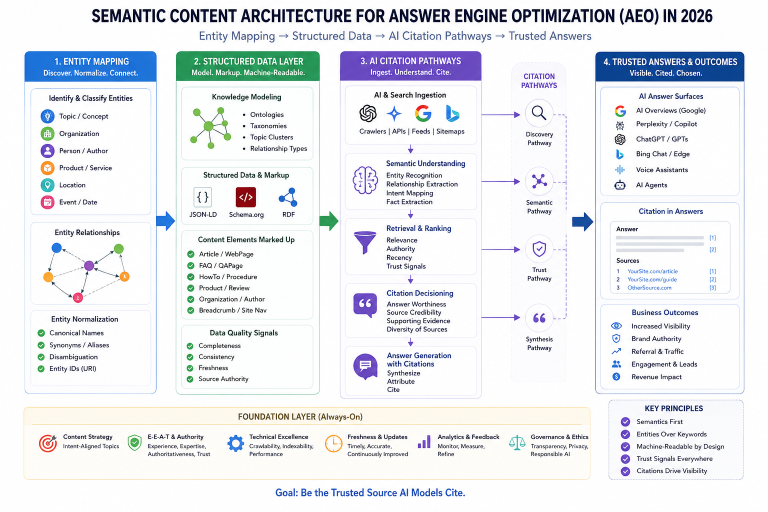
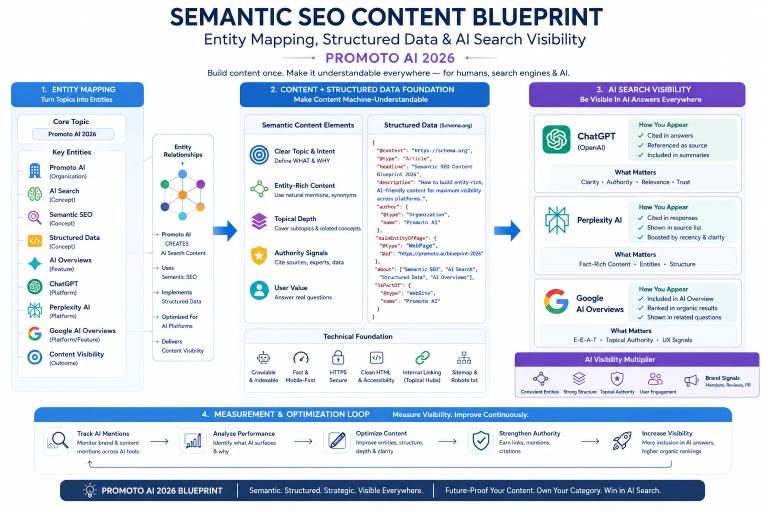
Schema markup tells search engines — and AI answer engines — exactly what your content is about. Product schema, FAQ schema, HowTo schema, Article schema — each one gives AI systems structured signals they can extract, verify, and surface in rich results or AI-generated answers.
Without schema, your content is still interpretable. But with schema, you’re handing AI systems a pre-packaged, machine-readable summary of your page’s value. That’s a significant competitive advantage in a world where AI Overviews and featured snippets often replace traditional blue-link results.
Priority schema types for 2026:
- FAQ Schema — feeds directly into AI answer engines and featured snippets
- Article Schema — signals publishing authority and freshness
- Product Schema — critical for e-commerce AI search visibility
- HowTo Schema — captures procedural search queries in AI summaries
- BreadcrumbList Schema — improves crawlability and SERP display
Tools like Promoto AI’s Schema Validator let you test and verify structured data instantly — catching errors before Google does.
AI Keyword Research: Moving Beyond Volume to Search Intent
Traditional keyword research optimizes for volume. AI-driven keyword research optimizes for intent, context, and entity relationships — which is exactly how modern search algorithms evaluate relevance.
In 2026, the best keyword research tools don’t just show you monthly search volume. They map intent clusters, suggest semantic variations, identify content gaps relative to competitors, and predict which queries are gaining traction in AI-powered search ecosystems.
What AI keyword research unlocks:
- Intent-aligned content planning (informational, navigational, transactional, commercial)
- Long-tail opportunity clusters with low competition and high conversion potential
- Entity-based topic mapping for semantic SEO
- Trend prediction for emerging search queries
Platforms like Promoto AI’s Keyword Research tool and Keyword Position tracker combine these capabilities in a unified workflow — so you can research, validate, and track without switching between five different tabs.
On-Page SEO Signals That Still Matter (And the Tools That Check Them)
Even as AI transforms search, foundational on-page SEO signals remain important. The difference is that they now need to be executed more precisely — because AI algorithms are better at detecting surface-level optimization versus genuine relevance.
On-page elements to audit regularly:
- Meta Title and Description: Unique, intent-aligned, under character limits, and click-optimized
- H1/H2/H3 Hierarchy: Clear semantic structure that helps both users and crawlers
- Internal Linking: Distributing link equity strategically to your most important pages
- Image Optimization: Descriptive alt text, compressed file sizes, and proper file naming
- Content Freshness Signals: Updated timestamps, recent statistics, and current references
Promoto AI’s Meta Tag Analyzer and Meta Tag Generator automate much of this audit process — flagging issues and suggesting improvements without requiring manual line-by-line checks.
The Future of SEO Tools: What’s Coming Next
The next wave of SEO tools won’t just analyze your site. They’ll actively manage it. AI agents are already beginning to monitor rankings, detect content decay, suggest refresh priorities, and even draft update briefs — all autonomously. The shift from “SEO tools you use” to “AI agents that work for you” is happening faster than most marketers realize.
For brands that want to be visible not just on Google, but inside AI-generated answers on ChatGPT, Perplexity, and Gemini — the technical foundation described in this article isn’t optional. It’s the baseline.
The brands winning in AI search aren’t necessarily publishing more. They’re publishing better-structured content, with cleaner technical architecture and more intentional schema signals.
Conclusion
Technical SEO isn’t glamorous. It doesn’t get the attention that viral content or influencer links do. But in 2026, it’s what separates sites that consistently rank from sites that perpetually wonder why they don’t. The tools exist. The AI capabilities are here. The strategies are proven.
What’s missing for most brands is a systematic approach — one that connects site audits, link analysis, schema implementation, keyword research, and server monitoring into a single, intelligent workflow.
That’s exactly what Promoto AI is built to do. If you haven’t run a full technical audit of your site recently, there’s no better time than now.
Start your free site audit with Promoto AI →
More Articles
How AI Search Snippet Optimization Boosts Organic Visibility
Automating SEO Workflows with PromotoAI: A Comprehensive Guide
How to Choose the Best AI Content Tool for Scalable Organic Growth
How AI Search Snippet Optimization Boosts Organic Growth Strategies
How AI Content Visibility Boosts Organic Growth Across Digital Platforms
Frequently Asked Questions
Q1: What is the most important technical SEO factor in 2026?
There’s no single answer, but structured data, Core Web Vitals, and clean crawl architecture consistently top the list. AI search engines rely heavily on schema markup to understand and surface content — making it one of the highest-impact technical improvements you can make right now.
Q2: How often should I run a website audit?
For most sites, a full audit once a month is a minimum. High-traffic or e-commerce sites benefit from weekly or even continuous automated monitoring. Significant site changes — redesigns, migrations, CMS updates — should always trigger an immediate audit.
Q3: What does a keyword density checker actually do?
A keyword density checker calculates how often your target keyword appears relative to total word count on a page. It also helps identify semantic keyword gaps, over-optimization risks, and keyword cannibalization issues across multiple pages of your site.
Q4: Why is schema markup important for AI search?
Schema markup provides machine-readable context that AI search systems use to extract, validate, and present information. Pages with correct FAQ, Article, or HowTo schema are significantly more likely to appear in AI Overviews, featured snippets, and AI-generated answer summaries.
Q5: What should I look for in a link analyzer tool?
A strong link analyzer should show you inbound backlink quality (domain authority, trust flow, anchor text), toxic link flags, internal link equity distribution, and broken link detection — all in one dashboard. Prioritize tools that give you actionable recommendations, not just raw data.
Q6: How does server status affect SEO?
Search engine crawlers and AI agents record server response codes every time they visit your site. Repeated 5xx errors or slow response times signal unreliability — reducing crawl frequency and potentially deprioritizing your pages in index updates. Monitoring server status in real time prevents these invisible ranking losses.
Q7: What’s the difference between traditional keyword research and AI keyword research?
Traditional keyword research focuses on volume and competition scores. AI keyword research maps search intent, semantic relationships, entity connections, and emerging query trends — helping you build content that aligns with how modern search algorithms evaluate topical relevance, not just keyword frequency.

Disharth Thakran is a rising star in digital marketing, bringing two years of hands‑on expertise in SEO, performance ads, and growth hacking to B2B and B2C brands. His data‑driven approach and technical know‑how have already delivered standout results: 200% boost in organic traffic for Free Culture in just three months, and 10,000‑reach milestone achieved within the first 28 days ₹10,000 Facebook ad spend for Shri Vrinda Group that directly generated over ₹6 million in real‑estate sales 4× LinkedIn page growth in six months through targeted content, connection strategies, and on‑page optimizations Deep expertise in technical SEO, on‑page SEO, and comprehensive site audits ensuring fast indexation, crawl efficiency, and maximum visibility Combining a relentless focus on metrics with hands‑on execution