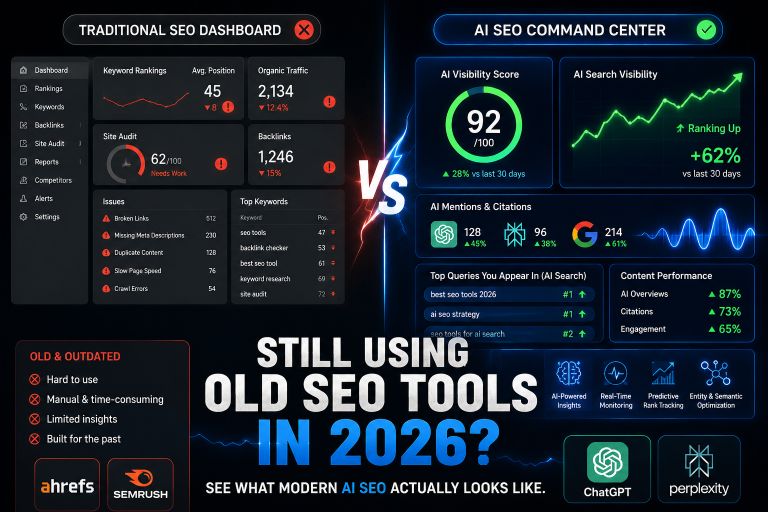
The Semantic Content Blueprint: How to Build AI-Powered Search Visibility That Outlasts Every Algorithm Update
Here’s a hard truth most marketing teams aren’t ready for:
Your perfectly optimized blog post — the one with the right keyword density, the solid backlink profile, the clean meta tags — may never reach your next customer. Not because Google ignored it. But because your customer never asked Google.
They asked ChatGPT. Or Perplexity. Or they got a direct answer inside Google’s AI Overview before they ever scrolled to your result.
This is the new search reality. And the brands winning inside it aren’t the ones with the most content. They’re the ones with the most trustworthy, structured, semantically coherent content.
This guide is the blueprint for building exactly that.
Why Keyword SEO Alone Is No Longer Enough
For two decades, SEO meant one thing: rank for the right keywords. Create a page, stuff in some search terms, build a few links, and wait for traffic to arrive.
That model isn’t dead. But it’s losing ground fast.
AI answer engines — ChatGPT, Perplexity AI, Google’s AI Overviews, and similar tools — don’t rank pages the way traditional search engines do. They synthesize answers from the content they trust most. They look for signals of authority, entity clarity, semantic depth, and structural credibility.
In other words, they reward brands that mean something in their domain — not just brands that targeted the right phrase.
A study by BrightEdge found that AI Overviews now appear in over 42% of U.S. search queries. If your content isn’t being selected as a source, you’re invisible to nearly half of searches in your category.
The fix isn’t more content. It’s smarter, more semantically structured content.
What Is Semantic SEO — And Why Does It Power AI Discoverability?
Semantic SEO is the practice of building content around meanings, relationships, and topics — not just individual keywords. Instead of writing a page that targets “best CRM software,” semantic SEO asks: what concept cluster does this page belong to? What entities does it reference? What questions does it answer at a depth that proves genuine expertise?
Large language models (LLMs) like GPT-4 and Gemini were trained on the internet’s most coherent, well-connected content. They learned to recognize which sources consistently answer related questions with authority. That training shapes which brands they cite.
This means semantic SEO content strategies aren’t just about ranking on Google anymore. They’re about being recognized as a reliable knowledge source by the AI systems billions of people now consult daily.
The practical implication: every piece of content you publish should be part of a deliberate semantic architecture — not a standalone page chasing a single keyword.
The Three Pillars of AI-Powered Search Visibility
Building visibility inside AI answer engines rests on three interconnected pillars. Ignore any one of them and the whole structure weakens.
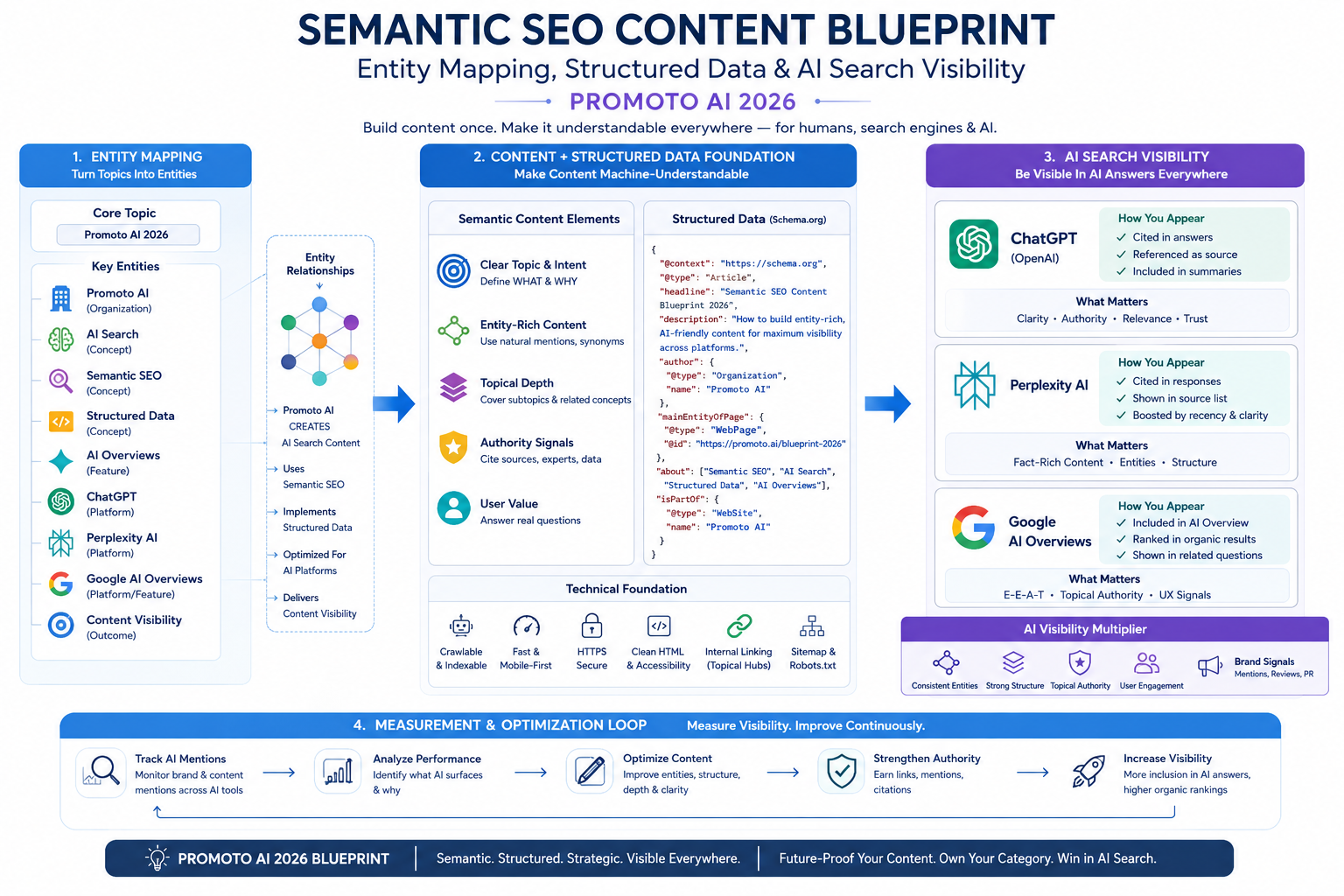
Pillar 1: Entity SEO and Topical Authority
An entity, in SEO terms, is a clearly defined concept — a brand, a person, a product, a topic — that search engines and LLMs can recognize and map to a knowledge graph.
When Perplexity AI answers a question about “AI SEO tools,” it doesn’t just crawl the latest articles. It draws on patterns established across hundreds of pages that consistently associate your brand with that topic space.
This is why topical authority matters more than ever. A brand that publishes 20 deeply connected articles on AI content optimization signals to every ranking system — Google and LLMs alike — that it owns that space. Scattered content with no semantic thread does the opposite.
What to do: Build topic clusters. Every pillar page should link to and from supporting content that deepens the same subject. Promoto AI’s AI Content Generation engine is built to create SERP-aware content within these clusters — so every article you publish reinforces your entity authority rather than diluting it.
Pillar 2: Structured Data Implementation
Structured data is how you speak to machines in their native language. When you add Schema.org JSON-LD markup to your pages — Article schema, FAQ schema, HowTo schema, Organization schema — you give AI crawlers an unambiguous map of who you are, what you do, and what a given piece of content covers.
This matters enormously for answer engine optimization. When Google or an LLM needs to quickly assess whether your content is a credible source for a specific answer, structured data removes all ambiguity.
Brands using FAQ and HowTo schema consistently see higher inclusion rates in featured snippets and AI-generated overviews. It’s not a guarantee — but it’s one of the clearest signals you can send.
What to do: Audit every key page on your site for missing or broken schema. Promoto AI’s Schema Validator tool lets you check implementation accuracy instantly — no developer required. Promoto AI also auto-embeds JSON-LD into AI-generated articles at publish time, removing one of the most commonly skipped steps in content workflows.
Pillar 3: NLP Content Optimization
Natural Language Processing (NLP) is the technology powering both modern search engines and large language models. And NLP doesn’t just look for keywords — it evaluates how naturally and comprehensively a piece of content addresses a subject.
This means content that reads in a fragmented, keyword-dense, or shallow way actively undermines your AI discoverability. NLP systems reward content that:
- Answers questions directly and completely
- Uses natural language variation (synonyms, related terms)
- Groups related concepts logically within sections
- Maintains a clear semantic flow from introduction to conclusion
Think of it less like writing for a search engine and more like writing the definitive chapter on a subject for a textbook. Comprehensive, structured, authoritative.
How to Rank in ChatGPT Answers: A Practical Breakdown
One of the most searched questions among marketers right now is: how to rank in ChatGPT answers? It’s the right question — but most answers stop at surface-level advice.
Here’s what actually drives LLM citation and inclusion:
Corroboration signals. LLMs favor sources whose claims appear consistently across multiple trusted domains. If your blog is the only place a fact appears, it gets less weight. Build a PR and digital PR presence that distributes your brand’s key insights across authoritative external sites.
Direct, question-shaped answers. ChatGPT is trained to retrieve concise, confident answers to direct questions. If your content buries the answer in the fifth paragraph, an LLM may skip it in favor of a competitor whose structure surfaces the answer immediately. Open your sections with the answer, then support it.
Semantic freshness. Stale content with no recent updates signals declining relevance to both Google and AI training pipelines. Promoto AI’s Analytics Dashboard tracks keyword position decay and surfaces refresh recommendations — so your highest-value content stays competitive.
Brand entity consistency. Your brand name, product names, and domain should appear consistently and correctly across your website, social profiles, and external citations. Inconsistency confuses knowledge graphs and reduces entity recognition.
Optimizing Content for Perplexity AI: What’s Different
Perplexity AI operates on a different retrieval model than ChatGPT. It performs live web searches and cites sources in real time — which means indexability and crawlability matter enormously for Perplexity AI optimization.
Pages that Perplexity cites most consistently share these characteristics:
- Fast load times and clean HTML structure — Perplexity’s crawler prioritizes content it can extract quickly and cleanly
- Clear authorship signals — Author bios, publication dates, and organization schema all increase perceived trustworthiness
- Concise, extractable answer blocks — Short paragraphs (2–3 sentences) that answer a specific question are more likely to be excerpted
- Internal link depth — Pages embedded in a well-linked site architecture are crawled more thoroughly
The underlying principle for all of these? Make it easier for an AI crawler to understand exactly what your content is and why it should be trusted. Remove every point of ambiguity.
Scalable Organic Growth Through Semantic Content Architecture
Here’s where strategy becomes operations.
The brands that win AI-powered search visibility at scale aren’t publishing more. They’re publishing smarter — with content that compounds over time because every new piece reinforces the same semantic network.
A scalable semantic content architecture looks like this:
- Define your entity space. What 5–10 core topics define your brand’s expertise? These become your pillar pages.
- Build topic clusters. For each pillar, create 8–15 supporting articles that go deeper on specific subtopics, questions, and use cases.
- Connect deliberately. Internal links should follow semantic logic — each supporting article links back to its pillar and to related cluster articles.
- Implement schema at every level. Pillar pages get BreadcrumbList and Article schema. FAQ-heavy posts get FAQPage schema. How-to guides get HowTo schema.
- Measure and refresh. Use Google Search Console data integrated into Promoto AI to identify which cluster articles are gaining impressions and which need refreshing.
This architecture does something keyword-first strategies can’t: it tells every AI system — Google, ChatGPT, Perplexity — who you are and what you own in your category.
The Role of Structured Data in Winning AI Overviews
Google’s AI Overview (formerly Search Generative Experience) pulls answers from a small set of sources it deems most credible for a given query. Research from Authoritas and Search Engine Land suggests that pages with complete structured data markup appear in AI Overviews at nearly twice the rate of unstructured pages.
The most impactful schema types for AI search visibility right now:
Implementation doesn’t have to be manual. Promoto AI auto-generates Schema.org JSON-LD within published articles — embedding the exact markup that AI crawlers prioritize, without adding developer overhead to your workflow.
Why EEAT Is the Foundation of Everything
Google’s EEAT framework — Experience, Expertise, Authoritativeness, and Trustworthiness — was designed for traditional search. But it maps almost perfectly to the trust signals LLMs use when deciding which sources to cite.
Content that demonstrates real experience (case studies, specific examples, first-person insight), genuine expertise (depth, accuracy, nuance), clear authoritativeness (consistent publishing, external citations, entity signals), and structural trustworthiness (HTTPS, schema, authorship) earns more citations from AI systems.
This means the brands investing in quality, attributed, deeply researched content are building a compounding advantage — not just for Google rankings today, but for AI visibility across every platform that emerges next.
Putting It All Together: Your Answer Engine Optimization Action Plan
You don’t need to rebuild your entire content strategy overnight. Here’s where to start:
- Audit your entity presence. Search your brand name in ChatGPT and Perplexity. What comes up? What’s missing or incorrect? That gap is your first priority.
- Pick one pillar topic and build a cluster. One well-structured topic cluster does more for AI visibility than twenty disconnected posts.
- Add FAQ schema to your top 10 pages. This single change can meaningfully increase your inclusion in featured snippets and AI Overviews.
- Refresh your highest-traffic content. Update dates, deepen answers, add structured data, and strengthen internal links.
- Use a platform built for this. Promoto AI’s GEO and AIO-optimized content engine executes all of the above — from semantic content generation to schema embedding to GSC-informed refresh recommendations — in one workflow.
Key Takeaways
- Keyword SEO is necessary but no longer sufficient. AI answer engines rank sources, not just pages.
- Semantic SEO content strategies — entity mapping, topical authority, NLP-aligned writing — are the new foundation of search visibility.
- Structured data implementation directly increases your inclusion rate in AI Overviews, featured snippets, and LLM citations.
- Optimizing content for Perplexity AI requires crawlability, authorship signals, and extractable answer blocks.
- How to rank in ChatGPT answers starts with corroboration signals, direct answer structures, and consistent entity presence.
- Scalable organic growth comes from semantic architecture — interconnected topic clusters, not isolated content.
- EEAT signals are the trust currency of both traditional and AI-powered ranking systems.
CTA Section
Ready to Make Your Brand Visible Where Your Buyers Are Actually Searching?
The search landscape has shifted. Your customers are getting answers from AI tools — and right now, most brands aren’t in those answers.
Promoto AI is built specifically for this moment. Our platform generates semantically structured, schema-embedded, GEO-optimized content that earns your brand visibility across Google, ChatGPT, Perplexity, and every AI answer engine your audience uses.
Start Your Free 14-Day Trial → No credit card required. See results in your first week.
Or explore how Promoto AI helps brands rank on AI engines — and why over 10,000 businesses trust it to drive compounding organic growth.
About promotoai
PromotoAI is a leading AI-powered platform specializing in SEO, AIO, ASO, and GEO solutions. With the ability to publish directly to platforms like WordPress and Shopify, and track performance through real-time analytics, PromotoAI simplifies complex workflows for agencies and enterprises. Trusted by teams across industries, PromotoAI leverages advanced AI models to deliver scalable, optimized content strategies that drive measurable results.
More Articles
Promoto AI Dashboard and Analytics Overview
Promoto AI: Streamline Content Scheduling and Automated Publishing Workflows
Mastering AI Overview Optimization: Boost Your Google Visibility with Intelligent Strategies
AI Bulk Blog Post Generator for Agencies: Scale Content Production & Boost SEO
PromotoAI vs SEMrush: Which AI-Powered SEO Tool Delivers Better Organic Growth?
FAQ Section
Q1: What is answer engine optimization and how is it different from traditional SEO? Answer engine optimization (AEO) is the practice of structuring and optimizing content so that AI-powered tools — ChatGPT, Perplexity AI, Google’s AI Overviews — select your content as a source when generating answers. Unlike traditional SEO, which prioritizes ranking a URL on a results page, AEO focuses on being cited inside the answer itself. It requires semantic depth, structured data, entity clarity, and direct answer formatting rather than just keyword targeting.
Q2: How do I get my brand mentioned in ChatGPT responses? To increase the likelihood of ChatGPT citing your brand, focus on three areas: (1) Build topical authority through deeply interconnected content clusters on your core subject areas. (2) Ensure your brand appears consistently across trusted external sources — press mentions, industry directories, authoritative backlinks. (3) Structure your content so that direct, concise answers appear prominently in each section, making it easy for LLMs to extract and attribute your content.
Q3: What structured data types are most important for AI search visibility? The highest-impact schema types for AI search visibility are FAQPage (for featured snippet inclusion), HowTo (for AI Overview selection), Article (for authorship and content-type signals), Organization (for knowledge graph entity strength), and BreadcrumbList (for architectural depth signaling). Implementing all five across your key pages creates a comprehensive machine-readable signal layer that AI crawlers can process with confidence.
Q4: Is Perplexity AI optimization different from Google SEO? Yes, meaningfully so. Google’s crawling and ranking is a relatively slow, periodic process. Perplexity performs live web retrieval — meaning your page needs to be indexable, fast, structurally clean, and recently updated to be competitive. Perplexity also weighs authorship signals and concise answer blocks more heavily than Google’s traditional ranking factors. That said, the foundation is the same: authoritative, well-structured, semantically rich content performs well in both systems.
Q5: What is LLM SEO optimization and why does it matter now? LLM SEO optimization refers to the practice of making your content more likely to be used as a training reference or real-time retrieval source by large language models. It matters because AI assistants now handle hundreds of millions of queries daily. Brands that aren’t optimized for LLM inclusion are invisible to a growing segment of their potential audience — one that skips traditional search results entirely and relies on AI-generated answers for discovery and decision-making.