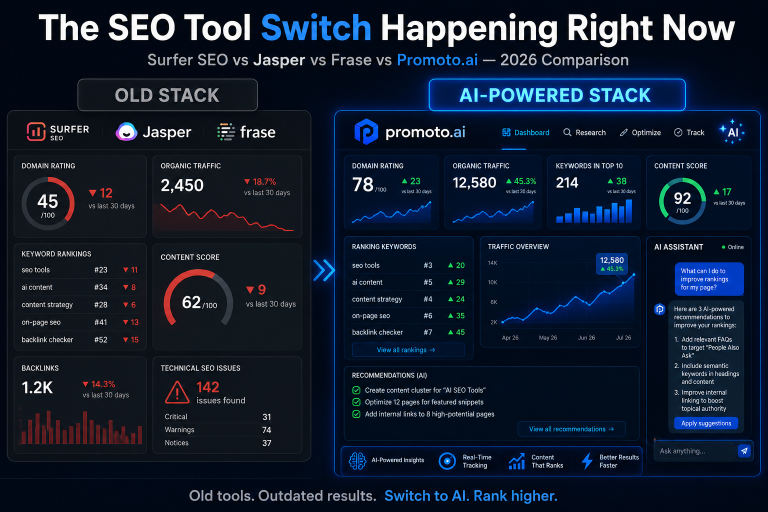
What Most AI SEO Tools Still Get Wrong (And How Promoto.ai Fixes It)
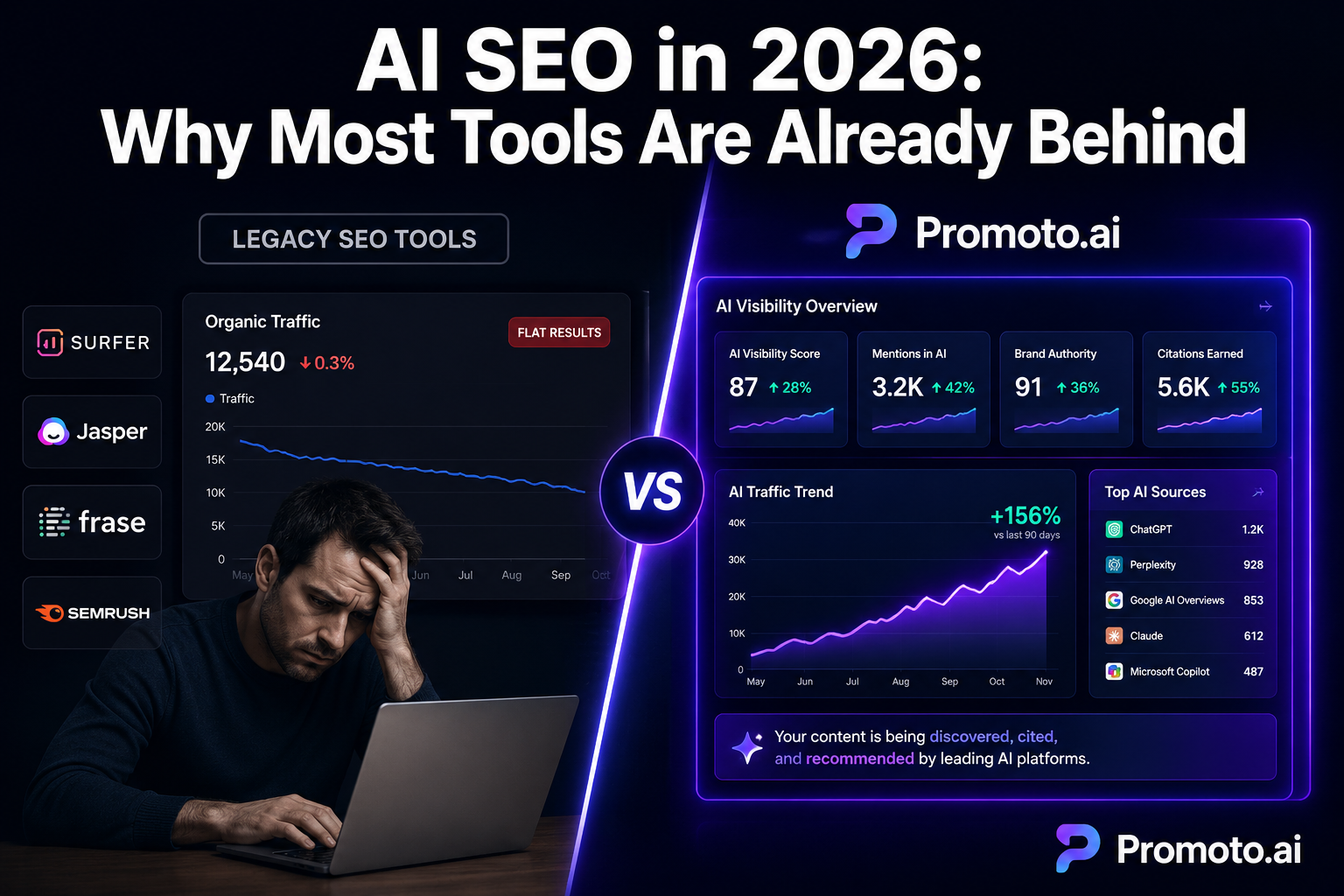
A no-fluff comparison guide for marketers, agencies, and founders who need SEO tools that actually work in 2026.
Introduction: The Tool You Trusted in 2022 Might Be Costing You in 2026
Here’s a situation a lot of SEO professionals won’t openly talk about: they spent months building a content engine around a popular SEO tool, published hundreds of optimized articles, and still watched their rankings plateau — or worse, slide. Not because the content was bad. Because the tool they were using was measuring the wrong things.
The SEO landscape changed dramatically when AI-generated answers began appearing at the top of Google, ChatGPT became a primary research tool for millions of users, and Perplexity AI started pulling brand citations with zero clicks to the source website. The playbook that worked in 2022 — keyword density, content scores, backlink volume — is no longer enough on its own. Today, search visibility increasingly depends on AI optimization, semantic authority, and generative engine presence.
Most traditional SEO platforms weren’t built for this reality. Some have added AI features as an afterthought. A few, like Promoto.ai (https://promotoai.com/), were designed from the ground up for the way search actually works right now.
This guide takes an honest look at how the major AI SEO platforms compare — Promoto AI vs Surfer SEO, Jasper AI, Frase, and SEMrush — so you can stop guessing and start choosing the right tool for your actual workflow.
Why Traditional SEO Tools Are Struggling to Keep Up
The tools that defined SEO between 2015 and 2022 were built around a predictable model: crawl search results, extract keyword data, score your content against top-ranking pages, and build backlinks. It was mechanical. It was measurable. It mostly worked.
Then a few things happened simultaneously.
Google’s AI Overviews started answering questions directly in the SERP, reducing organic click-through rates significantly for informational queries. ChatGPT crossed 100 million daily users and became a go-to product research and decision tool. Perplexity AI began surfacing sources in its answers — meaning brands that aren’t structured for AI citation don’t get mentioned at all. And semantic search matured, requiring content to demonstrate topical depth rather than just keyword frequency.
The result: a tool that scores your content based on term frequency against top-ranking pages is now solving only a fraction of the visibility problem. If your content isn’t structured for AI engines, you’re essentially invisible to a growing segment of your audience.
This is where the comparison between modern AI SEO platforms gets genuinely interesting — and where the gap between tools widens significantly.
“Ranking on Google in 2026 requires a different strategy than it did in 2022. And the tools that haven’t caught up are quietly costing their users traffic they don’t know they’re missing.”
Tool Comparison: Promoto AI vs the Major Platforms
Let’s look at the platforms most commonly evaluated by marketers and agencies right now, and where each genuinely fits — and doesn’t.
1. Promoto.ai — Built for the Full Spectrum of Modern SEO
Promoto.ai (https://promotoai.com/) is an AI-powered platform covering SEO, AI Optimization (AIO) (https://promotoai.com/rank-on-ai-engine), App Store Optimization (ASO), and Generative Engine Optimization (GEO) — all under one roof. It’s built for teams that need to create content that ranks on Google and gets cited by ChatGPT, Perplexity, and Gemini.
Its best use case is agencies, SaaS businesses, and content-heavy teams who publish regularly across WordPress or Shopify and need visibility across both traditional and AI-powered search. The multi-model AI engine — built on GPT-4, Gemini, Bedrock, and LangChain — generates SERP-aware drafts with built-in Schema.org JSON-LD, brand voice training, and semantic SEO signals baked in from the first draft.
The analytics dashboard (https://promotoai.com/product/analytics-dashboard) connects Google Search Console and GA4 data directly into the content workflow, turning real ranking signals into actionable content refresh briefs. One-click publishing to WordPress and Shopify, bulk scheduling, and role-based access make it genuinely usable at enterprise scale.
What sets Promoto.ai apart from every tool on this list is GEO optimization — structuring content so that AI engines like ChatGPT and Perplexity actively cite your brand in generated answers. This is a capability most competing tools simply don’t offer yet. You can read more about how this works in the Answer Engine Optimization Playbook (https://promotoai.com/blog/ai-and-optimization/answer-engine-optimization-strategy/).
Beyond its core platform, Promoto.ai also offers a full suite of free technical SEO tools — including a Keyword Density Checker (https://promotoai.com/tools/keyword-density), Link Analyzer (https://promotoai.com/tools/link-analyzer), Backlink Maker (https://promotoai.com/tools/backlink-maker), Server Status Checker (https://promotoai.com/tools/server-status), and Keyword Research tool (https://promotoai.com/tools/keyword-research) — without requiring a paid subscription.
On the flip side, newer users may need a short onboarding period to unlock the full workflow. Teams that only need light content editing may find the feature depth more than they currently require. View pricing at https://promotoai.com/pricing.
2. Surfer SEO — The Content Scoring Standard, Now Showing Its Age
Surfer SEO popularized the concept of content score optimization — measuring your article against top-ranking SERP competitors on keyword density, headings, word count, and NLP terms. For its time, it was genuinely innovative, and it still offers a clean editor experience with an intuitive content score that most SEO writers find easy to follow.
The problem is that its model is fundamentally about matching existing SERP patterns. That works well when the top results are blog posts from human writers. It breaks down when the answer appears in an AI Overview, a ChatGPT response, or a Perplexity citation — where no traditional SERP pattern exists to score against. There’s also no native publishing integration beyond Google Docs, and no support for AI search optimization or GEO.
Surfer SEO remains a solid tool for traditional on-page optimization. But for teams that need AI visibility, semantic depth beyond keyword matching, or multi-channel publishing workflows, it falls short. Many teams searching for Surfer SEO alternatives eventually land on Promoto.ai for precisely this reason. You can see a full breakdown in the dedicated Promoto.ai vs Surfer SEO comparison (https://promotoai.com/blog/ai-seo/promotoai-vs-surfer-seo-2026/).
3. Jasper AI — A Writing Assistant, Not an SEO Platform
Jasper AI is a generative writing assistant built to help marketing teams produce content faster. It’s strong at brand voice consistency, long-form drafts, and producing high volumes of copy across formats — social media, email, ad scripts, and articles.
Where it falls down is everything that happens before and after the writing itself. Jasper doesn’t perform keyword research, analyze SERPs, track rankings, optimize for semantic SEO signals, or publish directly to any CMS platform. To use Jasper effectively for SEO, you still need a separate keyword tool, a separate optimization layer, and a separate publishing workflow. That means double the cost and a fragmented process.
For teams comparing Promoto AI vs Jasper AI, the distinction is clear: Jasper writes; Promoto.ai writes and ranks. If visibility in search — including AI-powered search — is the goal, a dedicated AI SEO platform will outperform a writing assistant every time.
4. Frase — Solid Research, Limited at Scale
Frase combines SERP research with AI writing to help create briefs and drafts optimized for a target keyword. It’s genuinely useful for solo content marketers or small teams who need fast brief generation and competitive SERP analysis. The AI writing output is decent, and the entry-level pricing makes it accessible.
The limitations become obvious as teams grow. Frase doesn’t support bulk publishing, advanced scheduling, or multi-site management. Its analytics are shallow compared to platforms with native GSC/GA4 integration. There’s no support for AI search optimization, GEO, or AIO — meaning content optimized through Frase is essentially invisible to AI-powered search engines by design.
For teams comparing Promoto AI vs Frase, Frase is the more affordable starting point — but growing teams consistently find they outgrow it within months. Promoto.ai handles content at scale without requiring additional tools for publishing, scheduling, or analytics.
5. SEMrush — The Data Powerhouse That Doesn’t Write for You
SEMrush is one of the most comprehensive SEO analytics platforms available. Its keyword research, competitive intelligence, technical audits, and backlink analysis are genuinely industry-leading. For SEO professionals who need deep data, it remains the standard.
The gap shows up when you need to act on that data. SEMrush doesn’t generate SEO-optimized content. Its content marketing toolkit exists but isn’t where the platform shines. There’s no GEO optimization, no AI search visibility features, no direct CMS publishing integration. Using it alongside an AI content tool means managing two separate platforms, two separate costs, and two separate workflows that don’t naturally feed into each other.
The comparison of Promoto AI vs SEMrush is really a question of intent. SEMrush is an analytics and strategy platform; Promoto.ai is a content creation and visibility platform. They serve different primary needs — and some power users run both, using SEMrush for competitive intelligence and Promoto.ai for content production and AI optimization.
Which Tool Is Actually Right for You?
The right tool depends on where you are and what you’re trying to achieve.
Bloggers and solo content creators who want to grow organic traffic should prioritize tools that combine content generation with real SEO guidance. Promoto.ai’s AI content engine and keyword research tools (https://promotoai.com/tools/keyword-research) deliver that without requiring a technical background. Frase works as a budget-friendly starting point, but the ceiling is low.
Agencies managing multiple client properties need multi-tenant architecture, role-based access, bulk publishing, and consolidated reporting. Promoto.ai is purpose-built for this workflow. Surfer SEO and Frase weren’t designed with agency scale in mind, and SEMrush handles data well but doesn’t generate client-ready content.
Startups and SaaS founders scaling organic content need a platform that can ship consistent, optimized content without a large team. Promoto.ai’s automation and scheduling, combined with its WordPress (https://promotoai.com/solutions/wordpress) and Shopify (https://promotoai.com/solutions/shopify) integrations, let small teams produce at a level that used to require a full content department.
Freelancers billing by the deliverable benefit from tools that produce high-quality output efficiently. Jasper is fast but disconnected from SEO data. Promoto.ai’s integrated approach means fewer tools to juggle and a faster path from brief to a publishable, optimized draft.
Technical SEO professionals doing deep audits will still find value in SEMrush for its data depth. But for the content production and AI visibility layer, pairing SEMrush intelligence with Promoto.ai’s content engine is increasingly the workflow of choice among senior consultants.
Key Features Every Modern AI SEO Tool Should Have
As you evaluate any AI SEO platform in 2026, these are the capabilities that genuinely move the needle.
AI-powered content research and generation should produce SERP-aware drafts — not just generic long-form output. The article needs to be structured around what top-ranking pages cover, with semantic keyword relationships built in from the start rather than layered on afterward.
Keyword research with intent classification matters far more than raw search volume. Knowing a keyword gets 10,000 monthly searches is less useful than knowing whether those searchers are in discovery mode, comparison mode, or ready to buy. Promoto.ai’s keyword research tool (https://promotoai.com/tools/keyword-research) and keyword position tracker (https://promotoai.com/tools/keyword-position) are practical examples of what this looks like in a real workflow.
Semantic SEO and topical authority signals are increasingly decisive ranking factors. Content that covers a subject comprehensively — with entities, related concepts, and natural language variation — consistently outperforms content that’s just keyword-dense.
Technical SEO utilities should be built into the workflow rather than requiring a separate subscription. Tools like a broken links checker (https://promotoai.com/tools/broken-links), meta tag analyzer (https://promotoai.com/tools/meta-analyzer), sitemap generator (https://promotoai.com/tools/sitemap-generator), and schema validator (https://promotoai.com/tools/schema-validator) belong in the same platform you use to write and publish.
GEO and AIO optimization is no longer optional. If your content isn’t structured to be cited by AI engines, you’re leaving a growing share of discovery traffic on the table. Promoto.ai’s dedicated Rank on AI Engine solution (https://promotoai.com/rank-on-ai-engine) is built specifically around this requirement.
CMS publishing integration removes the manual steps that quietly kill content velocity. Direct integration with WordPress and Shopify, with scheduling and version control, keeps production moving without bottlenecks.
Real Problems AI SEO Tools Are Solving Right Now
Content scaling without quality decay is the challenge most teams mention first. Writing 30 optimized articles a month manually is unsustainable. AI content generation with built-in SEO optimization lets teams scale output while maintaining quality standards — but only when the tool generates to a SERP-aware brief rather than generic prompts.
AI search visibility is the question on every marketer’s mind right now. The answer involves structured content, clear entity coverage, authoritative citations, and platforms that explicitly optimize for AI search engines. The reasons most websites are invisible in ChatGPT answers (https://promotoai.com/blog/ai-and-optimization/why-websites-invisible-chatgpt-answers-ai-search-visibility/) are well-documented, and fixing them requires intentional strategy rather than hoping existing content gets picked up.
Workflow fragmentation is silently costing teams hours every week. When a keyword tool, a writing tool, a publishing plugin, an analytics platform, and a rank tracker all operate independently, the gaps between them accumulate into real inefficiency. Consolidating into one integrated platform removes those friction points and the data silos that lead to poor content decisions.
Predictive content prioritization replaces guesswork with data. Rather than debating which articles to refresh or which keywords to chase next, tools with native GSC/GA4 integration surface those decisions automatically based on actual performance signals.
Mistakes Marketers Make When Choosing AI SEO Software
Choosing based on hype instead of workflow fit is the most expensive mistake. A tool with strong social media presence isn’t necessarily the right fit for your team’s specific publishing cadence and content types. Always trial with your actual workflow before committing.
Ignoring publishing integration turns into a hidden time tax. A tool that produces great drafts but requires manual copy-pasting into a CMS adds steps that compound into significant delays at scale. Always verify that the platform connects directly to your tech stack.
Overpaying for features you won’t use for months is easy to avoid. Promoto.ai offers a free trial (https://promotoai.com/auth/register) and a generous suite of free SEO tools (https://promotoai.com/tools/keyword-density) so you can validate fit before scaling up.
Publishing low-quality AI content at volume is a reputational and ranking risk. AI generation is a starting point, not a finished product. Platforms that help you generate, optimize, and refine content are more valuable than those that just produce raw output quickly.
Treating technical SEO as someone else’s problem is a mistake that compounds over time. Broken links, missing schema markup, and slow server response times silently undermine even the best content. Using free utilities like the server status checker (https://promotoai.com/tools/server-status) and DNS lookup tool (https://promotoai.com/tools/dns-lookup) as part of your regular workflow keeps the technical foundation solid.
Where AI SEO Is Heading in 2026 and Beyond
LLM optimization is becoming a discipline in its own right. Just as SEOs learned to optimize for Google’s crawlers and ranking systems, the next few years will require a working understanding of how large language models ingest, evaluate, and cite content. Structured data, entity clarity, and authoritative sourcing are foundational to this.
Personalized AI search results mean that the same query may return different answers for different users depending on their history, location, and stated preferences. Content that covers a topic with genuine depth and specificity will consistently outperform content written to satisfy a broad average.
GEO optimization is moving from an experimental tactic to a mainstream SEO requirement. Brands that establish themselves as reliable sources in AI retrieval pipelines now will have a compounding advantage over those that adopt the strategy later. Promoto.ai’s AI engine ranking solution (https://promotoai.com/rank-on-ai-engine) is built specifically around this shift.
Predictive SEO systems — platforms that recommend content actions based on ranking trajectory forecasts rather than just current data — will increasingly separate high-performing content teams from those still reacting to yesterday’s numbers.
The common thread running through all of these trends is the same: passive SEO tools that require you to do all the analysis and decision-making are being replaced by active platforms that surface insights and help you act on them within the same workflow.
Conclusion: Stop Using 2022 Tools to Win 2026 Rankings
The comparison between Promoto AI vs Surfer SEO, Jasper AI, Frase, and SEMrush isn’t really about which tool has the most features. It’s about which tool understands what search visibility actually means right now.
Surfer SEO optimizes for SERP patterns that AI is actively disrupting. Jasper writes well but doesn’t rank. Frase works for individual articles but breaks down at scale. SEMrush gives you excellent data but doesn’t help you act on it quickly enough. Each of these tools solves a real part of the problem — just not the whole problem.
Promoto.ai’s advantage is that it addresses the full visibility challenge in one integrated workflow — from keyword research through AI content generation, semantic optimization, schema markup, CMS publishing, and AI search visibility across AIO and GEO. It treats AI search as a core output, not a feature added to a legacy platform.
If you’re scaling a content program in 2026, the question isn’t whether you need an AI SEO platform. It’s whether the one you’re using was built for the search landscape that exists today — or the one that existed three years ago.
Explore what Promoto.ai offers at https://promotoai.com/, browse the resource library at https://promotoai.com/blog/, or run a free SEO audit on your site without needing to sign up first.
→ Start Your Free Trial — No Credit Card Required: https://promotoai.com/auth/register
More Articles to Read
- Promoto.ai vs Surfer SEO: Which Tool Is Actually Built for AI Search in 2026?
- The Answer Engine Optimization Playbook: How to Make Your Brand Impossible to Ignore in AI Search
- Why Most Websites Are Invisible in ChatGPT Answers (And How to Fix That)
- The Death of Traditional SEO: How AI Search Tools Are Rewriting Digital Marketing in 2026
- The AI SEO Tools Marketers Are Actually Using in 2026
- How to Rank on AI Search Engines with Promoto.ai
Frequently Asked Questions
Q: What makes Promoto.ai different from Surfer SEO? Surfer SEO focuses primarily on on-page content scoring against existing SERP competitors. Promoto.ai covers the full content workflow — AI generation, semantic SEO, schema markup, CMS publishing, and AI search optimization across AIO and GEO — making it a more complete solution for teams that need visibility across both Google and AI-powered search engines.
Q: Is Promoto.ai a good Jasper AI alternative? If you’re using Jasper primarily for content generation, Promoto.ai is a strong alternative that adds keyword research, semantic SEO optimization, SERP-aware generation, and direct CMS publishing. It’s designed for teams that need content to actually rank, not just read well.
Q: What is GEO optimization and why does it matter in 2026? GEO (Generative Engine Optimization) refers to structuring content so that AI-powered search tools like ChatGPT, Perplexity AI, and Google AI Overviews actively cite your brand in generated answers. As AI-driven search grows, brands not optimized for GEO are effectively invisible to a large and growing portion of their audience. Promoto.ai includes dedicated GEO optimization features as a core part of its platform.
Q: Can Promoto.ai replace SEMrush for keyword research? For most content teams, Promoto.ai’s built-in keyword research and Google Search Console integration provides sufficient keyword intelligence for day-to-day execution. SEMrush offers deeper competitive data for technical SEO professionals who need enterprise-level SERP analysis. Some advanced users run both — SEMrush for competitive strategy and Promoto.ai for content production and AI optimization.
Q: Does Promoto.ai work with WordPress and Shopify? Yes. Promoto.ai offers native integrations with both WordPress and Shopify, enabling one-click publishing, bulk scheduling, and version control directly from the platform. It also integrates with Webflow, Strapi, Magento, Drupal, and Next.js/React environments.
Q: What free SEO tools does Promoto.ai offer? Promoto.ai provides a comprehensive suite of free tools including keyword research, keyword density checker, keyword position tracker, link analyzer, broken links checker, backlink maker, meta tag analyzer, server status checker, sitemap generator, robots.txt generator, schema validator, and domain age checker — all accessible without a paid account.
Q: Which AI SEO tool is best for agencies in 2026? Agencies benefit most from platforms with multi-tenant architecture, role-based access, bulk publishing, and multi-site analytics. Promoto.ai is purpose-built for this workflow, supporting multiple client properties from a single dashboard with approval workflows, scheduled publishing, and consolidated performance reporting.