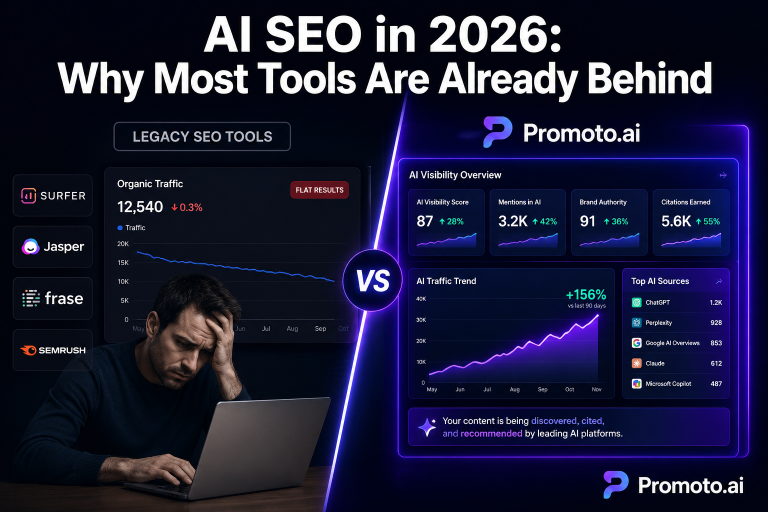
AI SEO Tools in 2026: Why Smart Marketers Are Moving Beyond Surfer, Jasper & Frase
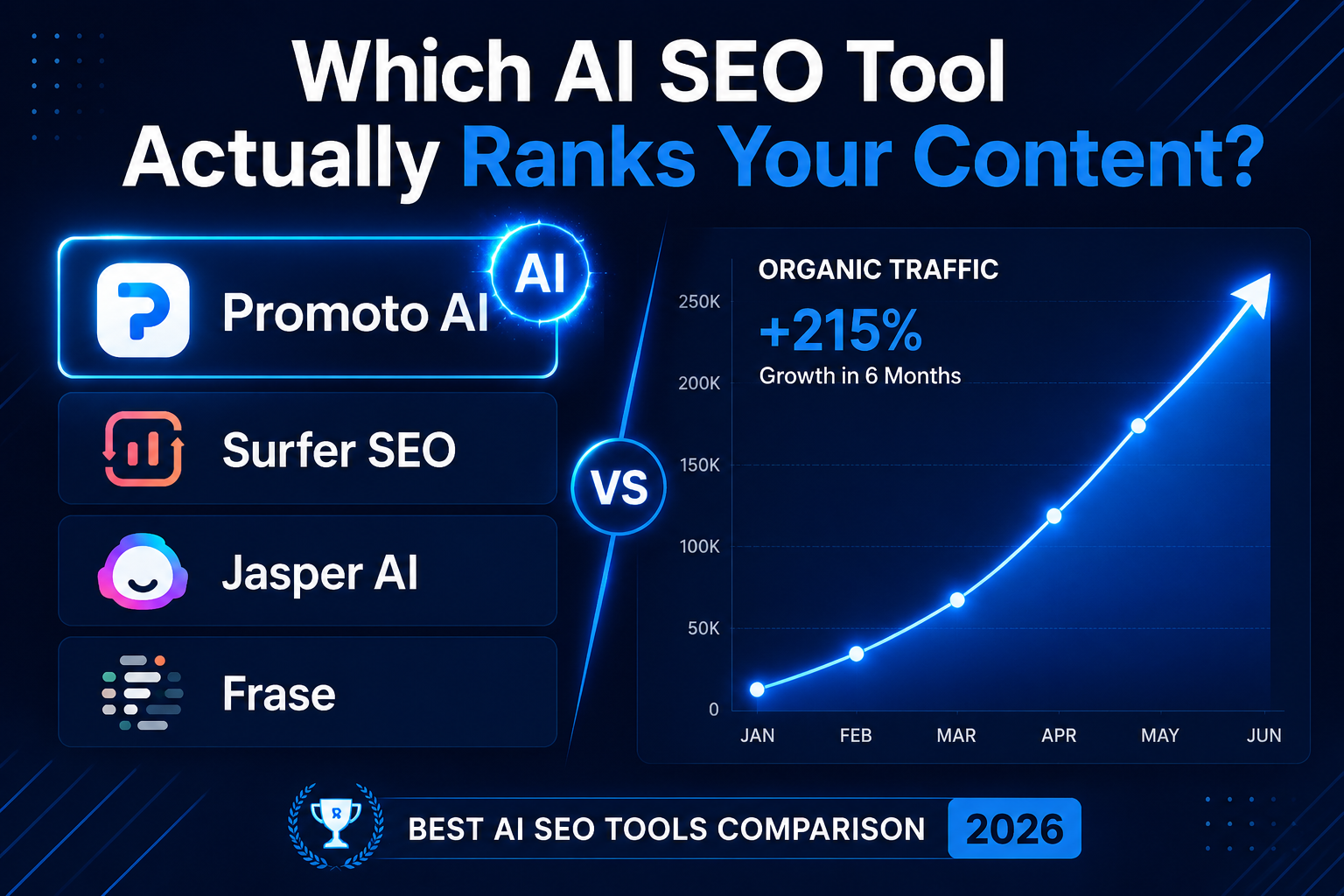
Here’s something worth thinking about: you can have the most advanced AI writing tool on your dashboard and still watch your content disappear on page four of Google. That’s the uncomfortable reality many content teams face in 2026.
SEO has changed its rules again. AI-generated answers now occupy prime SERP real estate. Zero-click behavior is reshaping how audiences interact with organic results. Search engines like ChatGPT, Perplexity AI, and Google’s AI Overviews pull answers from trusted, well-structured sources — bypassing traditional blue links entirely.
The tools that helped marketers scale content in 2022 and 2023 were not designed for this environment. Surfer SEO remains a solid on-page optimizer. Jasper AI is a capable writing assistant. Frase does decent content research. But none of them were built to address AI-driven SEO strategies, LLM optimization, or the kind of GEO optimization that modern search visibility demands.
That’s exactly the gap platforms like Promoto AI are stepping into. In this comparison, we break down how these tools stack up across real SEO workflows — and help you figure out which one belongs in your tech stack in 2026.
Why Traditional SEO Tools Are Struggling to Keep Up
The SEO tool market evolved around a Google-centric world. Keyword tracking, backlink monitoring, content scoring against top-ranking pages — these were the pillars. They worked well enough, right up until the ground shifted.
AI Overviews now appear in roughly 44% of all Google queries, according to BrightEdge data from 2025. Nearly half of your target searches get answered before a user ever sees your page. Zero-click behaviour is the default for informational queries now — not a trend.
What AI Search Engines Actually Reward
AI search engines reward content built for machine comprehension. Entities, semantic relationships, and direct question-answer formatting — these signals matter now. If your tool still optimizes purely for keyword density and word count, it is solving a 2019 problem.
The SEO landscape in 2026 demands a completely different kind of intelligence. This is why marketers actively search for Surfer SEO alternatives, Jasper AI alternatives, and platforms that combine content creation with AI search visibility — not just page-level optimization.
Promoto AI vs Surfer SEO vs Jasper AI vs Frase: Head-to-Head Comparison
Each of these tools has genuine strengths. The question is not which one has the longest feature list — it is which one solves the right problems for where search is heading.
Surfer SEO
Surfer SEO is one of the most widely used on-page optimization tools available. It scores your content against the top-ranking pages for a given keyword. It gives real-time recommendations on word count, NLP terms, headings, and structure. For teams that publish frequently and need fast editorial guidance, it is genuinely useful.
The limitation is scope. Surfer optimizes for existing search patterns — it tells you how to write content that matches what is already ranking. It does not help you rank inside ChatGPT answers or Google’s AI Overviews. It lacks dedicated GEO optimization, LLM visibility features, or predictive content intelligence. Its pricing starts around $89/month for basic plans, which feels steep for freelancers who need more than just a content editor.
- Best For: Content editors, agencies needing structured on-page SEO workflows
- Gap: No AI search visibility tools, limited automation beyond content scoring
- Pricing Category: Mid-to-high range
Jasper AI
Jasper AI built its reputation as an AI writing assistant and it does that job well. Its Brand Voice feature, template library, and long-form document editor make it a strong choice for marketing teams that need to produce volume. It integrates with Surfer SEO, which helps bridge the content creation and optimization gap.
Jasper is not an SEO platform — it is a writing platform. It does not crawl your site. It does not monitor rankings. It will not tell you whether your internal linking structure supports your pillar pages, and it has no built-in technical SEO capabilities. Teams looking for a Jasper AI alternative that goes beyond writing into full-cycle AI-driven SEO strategies will hit its ceiling quickly.
- Best For: Marketing teams focused on content production volume
- Gap: No ranking intelligence, no technical SEO integration, no AI search optimization
- Pricing Category: Mid-range, scales with team size
Frase
Frase handles both content research and AI-assisted writing in a single interface. Its research workflow is useful — it pulls top-ranking content, extracts common questions and topics, and helps structure an article around semantic search intent. For bloggers and small teams, it is a solid entry point.
Where Frase struggles is depth. The AI writing quality still requires significant human editing for anything that needs genuine authority. Frase does not address AI content optimization for LLM search engines. It does not offer GSC/GA integration at scale. It also lacks the automation workflows that growing content teams need. When comparing Promoto AI vs Frase, the gap becomes clear once your content operation scales beyond 20–30 articles per month.
- Best For: Bloggers, content researchers, small teams starting with AI-assisted writing
- Gap: Limited scalability, no LLM optimization, basic technical SEO
- Pricing Category: Entry-to-mid range
Promoto AI
Promoto AI was built for a different era of search. Rather than approaching SEO as a content editing problem, it treats it as an end-to-end visibility challenge. That challenge spans traditional Google rankings, AI Overview citations, and LLM search engine inclusion.
The platform combines automated article creation optimized for SEO and AIO (AI Optimization), real-time keyword tracking with Google Search Console and Analytics data, semantic SEO structuring, and GEO optimization — all in a single workflow. It integrates natively with WordPress, Shopify, Blogger, and Hashnode. You can explore its full feature set at promotoai.com.
Why Promoto AI Stands Apart
What sets it apart is not any single feature — it is the architecture. Promoto AI helps content rank on Google and get cited by ChatGPT, Perplexity AI, Gemini, and Claude. That dual-channel visibility is the gap every other tool in this list leaves open.
- Best For: Content teams, agencies, SaaS businesses, startups scaling organic visibility
- Unique Advantage: Built-in GEO optimization, LLM visibility, and AI-powered content research in one platform
- Pricing Category: Competitive for the feature depth; supports team workflows with RBAC and audit trails
Which AI SEO Tool Is Right for You?
The honest answer depends on where you are in your growth and what your primary bottleneck actually is.
Bloggers and individual creators who are just getting started will find Frase accessible and Jasper productive for early-stage content. But as soon as SEO results become the measure of success, both tools show their limits.
Agencies managing multiple client sites need workflow automation, approval systems, and multi-property management. Surfer SEO handles the optimization side but does not solve the production and publishing workflow. Promoto AI’s bulk operations and multi-platform integrations address this directly.
Startups and SaaS companies trying to build topical authority quickly cannot afford to use three separate tools for research, writing, and publishing. A unified platform that connects GSC data to content creation to AI search visibility shortens the cycle significantly.
Freelancers need cost-effective tools that do not require enterprise contracts. The key question is whether you bill clients for SEO results or just content output — the former demands a smarter toolset.
Content-heavy businesses dealing with hundreds of pages need automation, internal linking intelligence, and predictive SEO analysis — not just a content editor.
Key Features Any Serious AI SEO Platform Must Have in 2026
If you are evaluating AI SEO software right now, here is a practical checklist of what actually moves the needle — based on how search engines are evolving today.
- AI-powered content research that maps topics to search intent, not just keyword frequency
- Semantic SEO optimization — entity recognition, topic clustering, and NLP-driven structure
- Keyword density checker paired with real SERP data rather than static recommendations
- Internal linking automation to strengthen site architecture without manual effort
- Backlink and link analyzer tools to assess domain authority and link equity flow
- Technical SEO integrations including server status checker, crawl health monitoring, and GSC connectivity
- GEO and LLM optimization features to improve visibility inside AI-generated answers
- Content scoring systems that factor in AI search signals alongside traditional ranking factors
Start With Promoto AI’s Free Tools
Promoto AI’s free SEO tools — including its Meta Tag Analyzer and Server Status Checker — give you a useful starting point even before committing to a full platform subscription.
Real SEO Problems That AI Tools Should Be Solving
A lot of AI SEO tools solve easy problems — writing faster, scoring content against a checklist, generating keyword suggestions. The harder problems are where most platforms fall short.
Content Scaling at Quality
Publishing 50 articles a month means nothing if 80% of them get ignored by search engines. AI content optimization must include quality signals, not just volume targets.
Search Intent Alignment
Google’s systems have become remarkably good at identifying whether a piece of content satisfies the intent behind a query. Keyword matching is not enough — the structure, depth, and format must match what the searcher actually needs.
AI Search Visibility
Being indexed by Google is one thing. Being cited as a source in a Perplexity AI answer or a ChatGPT response is a different optimization challenge entirely — one that most tools have not addressed yet.
Internal Linking at Scale
Sites with hundreds of pages often have weak internal link structures. Building these manually takes hours. Automation with contextual relevance is now table stakes for content-heavy operations.
Workflow Automation
The gap between keyword research, content brief creation, writing, optimization, and publishing should not require four separate tools and three manual handoffs. Integrated platforms that automate this chain compound their value over time.
Common Mistakes Marketers Make When Choosing AI SEO Software
Most bad tool purchases follow the same pattern. Here is what to watch out for.
- Buying on hype alone: A tool that dominated Product Hunt in 2023 is not automatically the right choice for 2026’s search environment.
- Ignoring workflow fit: The best AI SEO platform in the world is useless if your team cannot integrate it into their actual publishing process.
- Overpaying for unused features: Enterprise plans with 50 features you will not touch in the first year are an expensive way to feel prepared.
- Treating AI output as final copy: Low-quality AI content published at scale is a liability. Google’s quality signals are designed to identify and suppress it.
- Ignoring technical SEO entirely: The best-written article will not rank if the page has crawl errors, slow load times, or broken internal links. Technical health and content quality are co-dependent.
The Future of AI SEO Software: What 2026 and Beyond Looks Like
The trajectory is clear, even if the timeline remains unpredictable. Here is where the most forward-thinking platforms are heading.
LLM Optimization Becomes a Discipline
LLM optimization is becoming its own field. Structured data, clear entity relationships, authoritative sourcing, and direct question-answer formatting are the signals that determine whether your content gets cited inside AI-generated responses.
GEO Optimization Goes Mainstream
GEO optimization (Generative Engine Optimization) is gaining traction as a formal practice. It involves structuring content so that AI engines can extract, summarize, and attribute it accurately — a skill set that barely existed 18 months ago.
Predictive SEO and Personalized Search
Personalized search is making keyword-level targeting less reliable. As AI engines factor in user history, device, location, and intent signals, content needs to satisfy multiple intent layers within a single piece. Predictive SEO systems — platforms that identify rising queries before they peak — are moving from premium enterprise features to expected standards. Pairing these with automated content pipelines creates a genuine compounding advantage.
The platforms that will matter in 2027 are the ones built for this environment today. That is not a marketing line — it is a structural reality of how quickly AI search is changing the rules.
Conclusion
The comparison between Promoto AI vs Surfer SEO, Jasper AI, and Frase comes down to one question: are you optimizing for the search environment that existed in 2022, or the one operating right now?
Surfer, Jasper, and Frase each do something useful. But they were built for a world where Google’s blue links were the primary destination and keyword optimization was the primary lever. That world is still partly true — but it is shrinking.
If your content strategy needs to account for AI Overview citations, LLM search visibility, GEO optimization, and automated publishing workflows — alongside traditional ranking — you need a platform built for that fuller picture.
Promoto AI is worth a serious look if that is where you are headed. You can explore the platform at promotoai.com or start with their free tools to see how they approach AI-powered content research and technical SEO in a single workflow.
More Articles to Read
- LLM Search Behavior vs Traditional Search: How Users Find Information Online
- What Is GEO Optimization and Why Every SEO Team Needs It in 2026
- How AI Overviews Are Changing Organic CTR — And What to Do About It
- The Complete Guide to Semantic SEO for AI-Powered Search
- AI Content at Scale: How to Publish More Without Sacrificing Quality
FAQ Section
Q1: What is the main difference between Promoto AI and Surfer SEO?
Surfer SEO focuses on on-page content optimization by comparing your article against top-ranking pages. Promoto AI goes further — it combines AI-powered content creation, keyword research, GEO optimization, and LLM visibility features in a single workflow. Surfer helps you write better for existing search patterns; Promoto AI helps you rank in both traditional Google results and AI-generated answers.
Q2: Is Jasper AI good for SEO?
Jasper AI is primarily an AI writing assistant, not an SEO platform. It produces well-structured content at scale, especially with its Surfer SEO integration, but it does not offer keyword tracking, technical SEO monitoring, or AI search visibility optimization. Teams that need comprehensive AI-driven SEO strategies typically use Jasper alongside other tools — which adds cost and complexity.
Q3: What makes a good Surfer SEO alternative in 2026?
A strong Surfer SEO alternative in 2026 should offer semantic SEO optimization, AI content scoring, internal linking intelligence, and features that help content appear in AI-generated search results. Platforms that only replicate Surfer’s content scoring without addressing LLM optimization are solving yesterday’s problem.
Q4: Can AI tools actually help with technical SEO?
Yes, but only if the platform is designed for it. Most AI writing tools do not touch technical SEO. Platforms like Promoto AI include technical tools such as a server status checker, meta tag analysis, and GSC/GA integration — giving you a more complete picture of what affects your rankings beyond content quality alone.
Q5: What is GEO optimization and why does it matter?
GEO optimization (Generative Engine Optimization) refers to structuring and formatting your content so that AI search engines like ChatGPT, Perplexity AI, and Google’s AI Overviews can extract, summarize, and cite it accurately. As AI-generated answers replace traditional blue links for informational queries, GEO optimization is becoming as important as traditional SEO for brand visibility.
Q6: Is Promoto AI suitable for beginners?
Promoto AI works for a range of users — from bloggers who want smarter content workflows to agencies managing multiple client sites. The free tools on the platform (like the Meta Tag Analyzer and Server Status Checker) give beginners a low-friction starting point before committing to a full subscription.
Q7: How is AI SEO software different from traditional SEO tools?
Traditional SEO tools focus on historical data — ranking positions, backlink profiles, keyword difficulty scores. AI SEO software goes further by generating content, predicting emerging queries, optimizing for semantic search intent, and preparing content for visibility inside AI-generated search responses. The best AI SEO platforms in 2026 bridge both worlds.