The LLM Visibility Blueprint: How to Make Your Brand the Answer in Perplexity, ChatGPT, and Every AI Search Engine That Matters
What “Ranking” Actually Means in the Age of AI Search
When someone asks ChatGPT which project management tool is best for remote teams, no “rank 1” result appears. There’s no page one. There’s just a synthesized answer — and either your brand is woven into it or it isn’t.
That’s the fundamental shift that most SEO strategies haven’t fully processed yet.
Traditional search optimization was about placement — getting your URL in front of someone’s eyes in a list. AI search is about citation and inclusion — getting your brand recognized as a trustworthy, authoritative source that an LLM can confidently draw from when forming a response.
These are two different problems with two different solutions.
Promoto AI’s Rank on AI Engine solution was built around exactly this distinction. While legacy SEO tools optimize page authority, next-generation AI visibility requires optimizing for how language models process, weigh, and synthesize information at a semantic level.
Understanding that difference is where everything begins.
How LLMs Actually Decide What to Surface
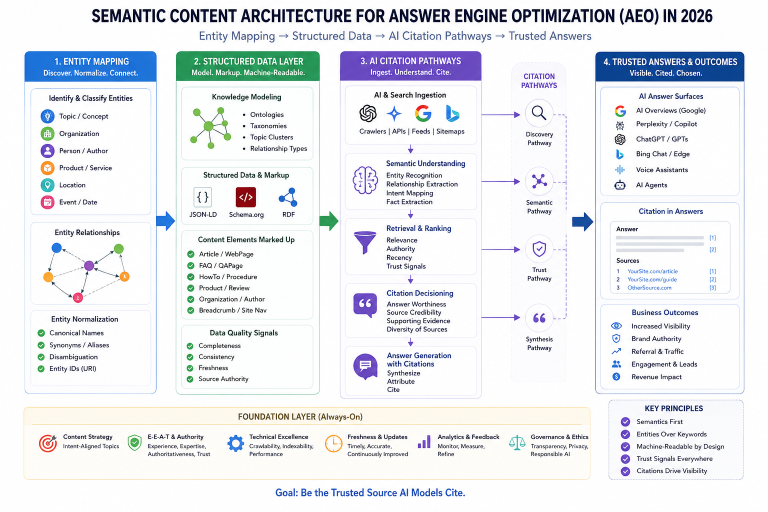
Here’s what most SEO guides skip over: large language models like the ones powering ChatGPT, Perplexity AI, and Google’s AI Overview don’t rank pages. They construct answers from patterns they’ve learned during training and, in retrieval-augmented generation (RAG) setups, from live crawled content.
What makes a source “citable” to an LLM comes down to a few interconnected signals:
1. Entity clarity and disambiguation LLMs organize knowledge around entities — people, brands, products, concepts. If your content clearly establishes who you are, what you do, and how you relate to adjacent entities in your space, you become easier for an AI to confidently reference. Vague, generic copy doesn’t give LLMs enough semantic footholds.
2. Consistent answer-shaped content Perplexity AI, in particular, is designed to surface responses that directly answer questions. Pages structured around clear questions with authoritative, concise answers are significantly more likely to be cited. According to research from BrightEdge on AI search behavior, content formatted as direct answers — rather than keyword-stuffed prose — performs measurably better in AI-generated summaries.
3. Topical authority depth LLMs don’t reward single great articles. They reward domains with deep, consistent coverage of a topic. A brand that has published 30 interconnected, well-structured pieces on a subject is more likely to be treated as a knowledge authority than one with a single viral post.
4. Structured data and schema signals Machine-readable metadata is how you communicate directly to AI crawlers in a language they prefer. Google’s documentation on structured data confirms that schema markup helps search systems understand page content — but this is equally true for AI-powered systems that ingest that same markup.
The Semantic SEO Layer Most Brands Are Ignoring
Semantic SEO isn’t new — but the stakes attached to it just went up dramatically.
Where keyword-focused SEO asked “what words does Google see on this page?” semantic SEO asks “does Google (or any LLM) understand what this page is actually about?” The distinction sounds philosophical. The impact is anything but.
When you structure content around topic clusters and entity relationships rather than keyword repetition, you’re essentially building a knowledge map that AI systems can traverse. Each piece of content becomes a node. The way you link them, reference common concepts, and define terms within your writing helps LLMs build an accurate model of your expertise.
Practical semantic SEO for AI search visibility looks like this:
- Define your core entity clearly and early. Every key page on your site should establish what your brand is, what category it operates in, and what problem it solves — in language an LLM can extract without ambiguity.
- Build content clusters, not silos. A pillar page on “AI-powered organic growth” should link naturally to supporting pieces on structured data, entity SEO, NLP optimization, and AI crawlers. This cluster architecture signals depth.
- Use NLP-friendly language patterns. Write the way people ask questions. Use headers as answers. Favor subject-verb-object sentence structures that LLMs can parse and quote cleanly.
Promoto AI’s AI Content Generation engine is built around exactly this semantic architecture — generating content that isn’t just readable, but machine-understandable and LLM-citable.
Optimizing Specifically for Perplexity AI (And Why It’s Different)
Perplexity AI deserves its own strategic section because it behaves differently from ChatGPT and Google’s AI Overview in ways that matter to content creators.
Perplexity is a retrieval-augmented answer engine — meaning it actively crawls and cites sources in real time rather than relying solely on pre-trained knowledge. This makes it both more transparent about where its answers come from and more responsive to fresh, well-structured content.
What Perplexity consistently favors:
- Cited, factual content with clear sourcing. Pages that reference data, studies, or expert opinions tend to be cited more frequently. Perplexity is designed to surface credible information, so your content needs to look credible at a structural level — not just say it is.
- Conversational but authoritative phrasing. Perplexity users tend to ask natural questions. Content written in Q&A format, or with headers that mirror common queries, aligns better with the intent-matching logic Perplexity applies.
- Fast-loading, well-structured pages. Perplexity’s crawler favors content it can quickly parse. Clean HTML structure, proper heading hierarchies, and minimal JavaScript blocking improve crawlability significantly.
- Fresh content with clear publication dates. Unlike some AI systems that rely on training snapshots, Perplexity indexes recent content. Keeping your high-priority pages updated improves your chances of being included in live responses.
If you’re not already auditing your content through the lens of “would Perplexity cite this?”, that audit is overdue.
Structured Data: The Shortcut Most Brands Are Leaving on the Table
Let’s be direct: if your website doesn’t implement structured data, you are making it harder for every AI system — not just Google — to accurately represent your brand in generated answers.
Schema markup is machine-readable context. It tells crawlers and AI systems: here’s who we are, here’s what this page is about, here’s the question this page answers, here’s how this relates to adjacent topics.
The most impactful schema types for AI search visibility right now:
- FAQ schema — Directly surfaces your Q&A content in AI answer summaries. One of the highest-ROI implementations for brands targeting featured snippet and AI overview visibility.
- Article / BlogPosting schema — Establishes publication date, author authority, and content category. Critical for freshness signals in RAG-based systems like Perplexity.
- Organization schema — Defines your brand entity: name, description, URL, social profiles, founding details. This is the schema that tells LLMs who you are with authority.
- HowTo and Product schema — For SaaS brands and e-commerce, these schemas create direct pathways for AI systems to cite your content when answering instructional or purchasing queries.
Promoto AI’s platform auto-generates JSON-LD schema as part of every content piece — a capability that typically requires a developer or a separate technical SEO workflow when done manually.
Building Scalable Organic Growth That Works Across AI and Traditional Search
Here’s the good news: content optimized for AI search visibility isn’t at odds with traditional SEO. It actually performs better across the board.
The reason is that LLM-friendly content shares nearly all the characteristics of high-quality traditional SEO content: it’s clear, well-structured, authoritative, comprehensive, and useful. The difference is that LLM-optimized content adds an extra layer — semantic clarity, entity signals, and schema — that traditional keyword-stuffed content never had.
A scalable organic growth strategy for 2026 looks like this:
Audit your existing content for semantic gaps. Identify pages where your entity isn’t clearly defined, where schema is missing, or where content is too thin to be citable. These are your quick wins.
Build topic clusters with intention. Every cluster should have a pillar page (authoritative and comprehensive) supported by satellite pieces that answer related sub-questions. Internal linking between them should be purposeful, not mechanical.
Create content at the pace AI search rewards. Perplexity favors freshness. Google’s AI Overview rewards consistent domain authority. Both are served by a steady publishing cadence — which is where AI-powered content automation through Promoto AI becomes a genuine competitive advantage, not just a convenience.
Track the right metrics. Traditional CTR and page position matter, but you also need to monitor brand mention frequency in AI-generated responses, and how often your domain appears in Perplexity citations. Tools and manual audits both have a role here.
The brands winning in AI search right now aren’t necessarily spending more. They’re structuring their content more intelligently — and publishing consistently enough that LLMs can build a rich, reliable picture of their expertise.
What “EEAT” Means When the Reader Is an AI
Google’s Experience, Expertise, Authoritativeness, and Trustworthiness framework was designed to help human quality raters assess content. But it turns out these signals matter even more when the “reader” is an LLM.
AI systems are essentially doing a constant, automated version of the EEAT assessment as they decide which sources to trust and cite. A few practical implications:
Author signals matter more than ever. Pages attributed to named authors with demonstrated expertise — professional bios, consistent bylines, social profiles — are more citable than anonymous content. LLMs can parse author information and use it as a trust signal.
First-hand experience language stands out. Phrases that signal real-world application (“in our testing,” “across our client base,” “based on analysis of X data points”) create differentiation from generic, information-aggregating content. This is content an LLM can attribute as a unique perspective — not just a reformulation of common knowledge.
Your off-site presence feeds your on-site visibility. If your brand is mentioned consistently in third-party publications, industry forums, podcasts, and review platforms, LLMs absorb that signal. Your Wikipedia presence (if applicable), Crunchbase entry, and media mentions all contribute to how confidently an AI can recommend you.
The Strategic Summary: A Framework for LLM Visibility
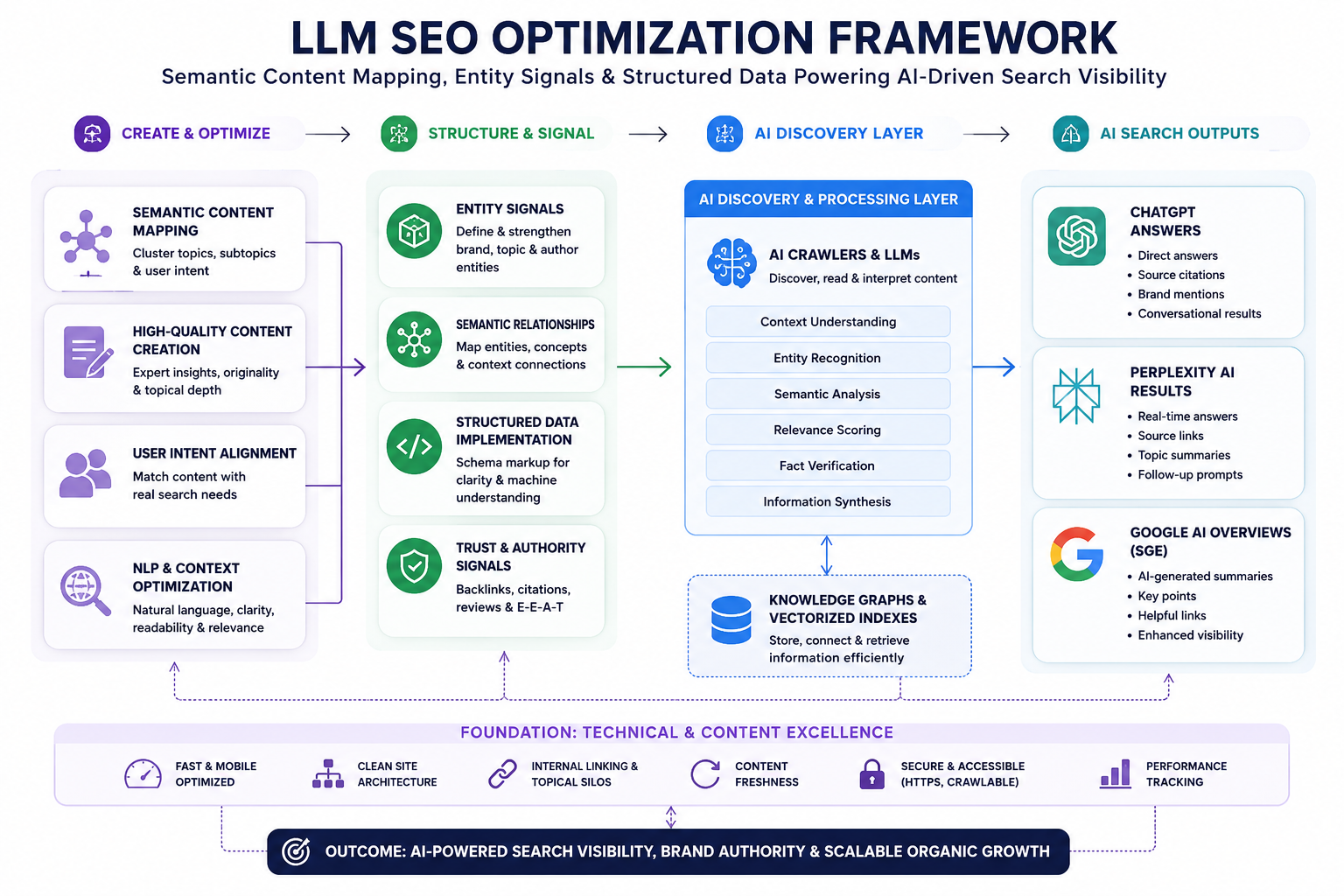
If you want your brand to be the answer when AI search engines respond to your target audience, here’s the framework in plain terms:
- Entity clarity — Define who you are, what you do, and where you sit in your category. Do this explicitly, on-page, in metadata, and in schema.
- Semantic depth — Build content clusters that demonstrate expertise across related topics. Depth signals authority to LLMs.
- Answer-shaped content — Structure pages so that the question is clear and the answer is extractable. Headers, FAQ sections, and concise summaries are your best tools.
- Schema everywhere — Implement FAQ, Article, Organization, and HowTo schema on every relevant page. Automate this where possible.
- Freshness cadence — Publish consistently and keep high-priority pages updated. Retrieval-augmented systems reward recency.
- Off-site presence — Build the third-party signal layer: media mentions, directories, authoritative backlinks, social proof. LLMs use this to calibrate trust.
This is what Promoto AI’s full-stack GEO optimization platform is designed to execute — not as a one-off audit, but as an ongoing, automated workflow that compounds over time.
Key Takeaways
- Traditional keyword SEO and LLM SEO optimization are different disciplines. Winning in 2026 requires both.
- LLMs source answers based on entity clarity, semantic depth, answer-shaped content, and schema signals — not keyword density.
- Perplexity AI is a retrieval-augmented system that actively crawls and cites sources, making fresh, well-structured content especially impactful there.
- Structured data (FAQ, Organization, Article, HowTo schema) is a direct communication channel to AI crawlers and should be on every important page.
- EEAT signals — author authority, first-hand experience, off-site brand mentions — matter to LLMs just as they do to human quality assessors.
- Scalable organic growth in the AI search era requires content depth, entity optimization, and publishing consistency — all of which can be systematized with the right platform.
Conclusion
Your Brand Deserves to Be the Answer
Every day, your ideal customers are asking AI search engines questions that your content could — and should — be answering. The brands that understand LLM SEO optimization and invest in semantic content architecture now are building a compounding visibility advantage that will be very difficult to close later.
Promoto AI was built to close that gap — with AI-powered content generation optimized for both traditional search and AI answer engines, automated schema implementation, and publishing workflows that scale without scaling your team.
Start your free 14-day trial → No credit card required. See how your brand performs in AI search — and what it takes to become the answer.
Or book a demo and let us walk you through exactly how our GEO and LLM optimization features work for your specific use case.
More Articles to Read
- How to Optimize for AI Engines and Boost Digital Visibility
- AI Overview Optimization: How to Maximize Digital Visibility Using Scalable Strategies
- How AI Content Visibility Drives Scalable Organic Growth Strategies
- Benefits of Using PromotoAI for Organic Traffic Growth
- How AI Content Visibility Can Transform Your Organic Growth Strategy
FAQ Section
1. What is LLM SEO optimization, and how is it different from traditional SEO? LLM SEO optimization (also called GEO or AEO) is the practice of structuring your content so that large language models like ChatGPT, Perplexity AI, and Google’s AI Overview can accurately identify, understand, and cite your brand in AI-generated responses. Traditional SEO focuses on keyword placement and backlinks to improve page rankings. LLM optimization adds semantic content architecture, entity signals, and structured data to make your content machine-readable and citable by AI systems.
2. How do I get my brand mentioned in Perplexity AI answers? Perplexity AI uses retrieval-augmented generation, meaning it crawls and cites live web content. To improve your chances of being cited, publish authoritative, question-answering content on your topic, implement FAQ and Article schema, keep content updated, and ensure your pages load quickly with clean HTML structure. Building third-party citations — media mentions, industry directories, review platforms — also improves how confidently Perplexity references you.
3. Does schema markup really help with AI search visibility? Yes, significantly. Structured data (JSON-LD schema) gives AI crawlers and LLMs machine-readable context about your page — what it’s about, what questions it answers, who published it, and when. FAQ schema in particular has a direct line to AI answer summaries. Organization schema helps establish your brand entity. These signals improve how accurately and confidently AI systems represent your brand.
4. What is semantic SEO and why does it matter for AI search? Semantic SEO is the practice of structuring content around topic relationships, entity signals, and natural language patterns — rather than just keyword repetition. LLMs organize knowledge around entities and concepts, not keywords. A semantically rich content strategy gives AI systems a richer, more accurate understanding of your expertise, which translates to more confident citations and recommendations in AI-generated responses.
5. How many pieces of content do I need before AI search engines start recognizing my brand? There’s no fixed number, but topical depth matters more than volume. A tightly organized cluster of 10–15 interconnected, high-quality pieces on a core topic will typically outperform 50 loosely related posts. The key is demonstrating consistent, authoritative coverage of your subject area so LLMs build confidence in your brand as a reliable knowledge source.

Disharth Thakran is a rising star in digital marketing, bringing two years of hands‑on expertise in SEO, performance ads, and growth hacking to B2B and B2C brands. His data‑driven approach and technical know‑how have already delivered standout results: 200% boost in organic traffic for Free Culture in just three months, and 10,000‑reach milestone achieved within the first 28 days ₹10,000 Facebook ad spend for Shri Vrinda Group that directly generated over ₹6 million in real‑estate sales 4× LinkedIn page growth in six months through targeted content, connection strategies, and on‑page optimizations Deep expertise in technical SEO, on‑page SEO, and comprehensive site audits ensuring fast indexation, crawl efficiency, and maximum visibility Combining a relentless focus on metrics with hands‑on execution