Why Ubersuggest Is Losing Ground to Smarter AI SEO Platforms in 2026
Here’s something happening quietly across marketing teams right now. A content manager runs their keyword research through Ubersuggest, drafts a blog post, optimizes it the traditional way — and still watches rankings flatline. Meanwhile, a competitor publishes less frequently but shows up in Google’s AI Overviews, Perplexity answers, and ChatGPT responses almost every week.
The difference isn’t effort. It’s the tools.
SEO in 2026 is no longer a keyword-density game. AI search engines — from Google’s Search Generative Experience to ChatGPT, Gemini, and Perplexity AI — now answer user queries directly. If your content isn’t optimized for these AI-driven environments, you’re invisible to an increasingly large share of search traffic. Traditional tools weren’t built for this reality, and the gap is showing.
This article breaks down where Ubersuggest falls short, how platforms like Promoto.ai are approaching SEO differently, and what modern AI SEO software actually needs to do in 2026.
Why Traditional SEO Tools Are No Longer Enough
The old playbook made sense when Google’s algorithm rewarded keyword density, backlink counts, and on-page metadata. Tools like Ubersuggest, built around that era, are genuinely useful for basic research — but the search landscape has shifted underneath them.
Zero-click searches are accelerating. Google’s AI Overviews now resolve a significant percentage of queries without users clicking any link. According to recent industry data, organic CTR for informational queries has dropped sharply because AI engines summarize answers inline. If your content isn’t structured for AI extraction, it simply doesn’t appear.
Search intent has become more conversational. Users typing into ChatGPT or Perplexity don’t phrase queries like Google searches from 2018. They ask full questions, request comparisons, and expect direct recommendations. Content that’s optimized only for traditional keyword matching doesn’t translate well into this format.
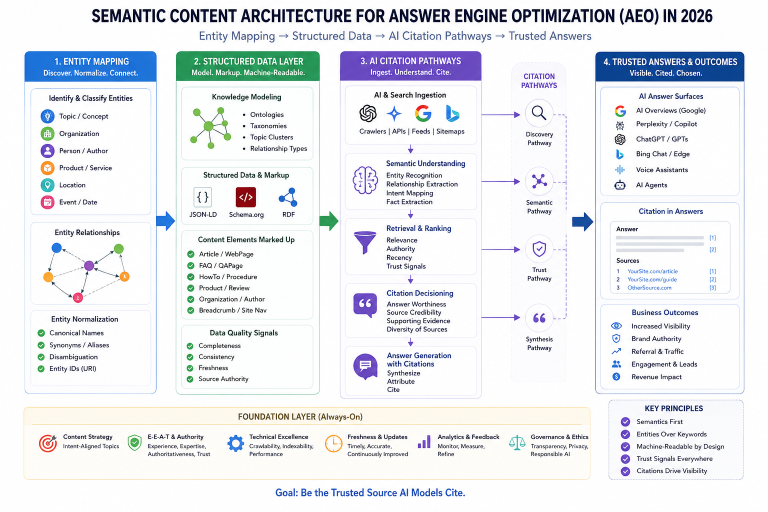
Semantic SEO has replaced surface-level optimization. Modern ranking systems — and especially LLM-based answer engines — evaluate topics, entity relationships, and contextual relevance rather than isolated keywords. A tool that only tracks keyword positions misses most of what determines AI search visibility today.
This is the core problem: many tools that worked well between 2015 and 2022 are now optimizing for a search engine that’s being replaced by something fundamentally different.
Tool Comparison: Promoto.ai vs Ubersuggest vs Other Leading Platforms
Ubersuggest
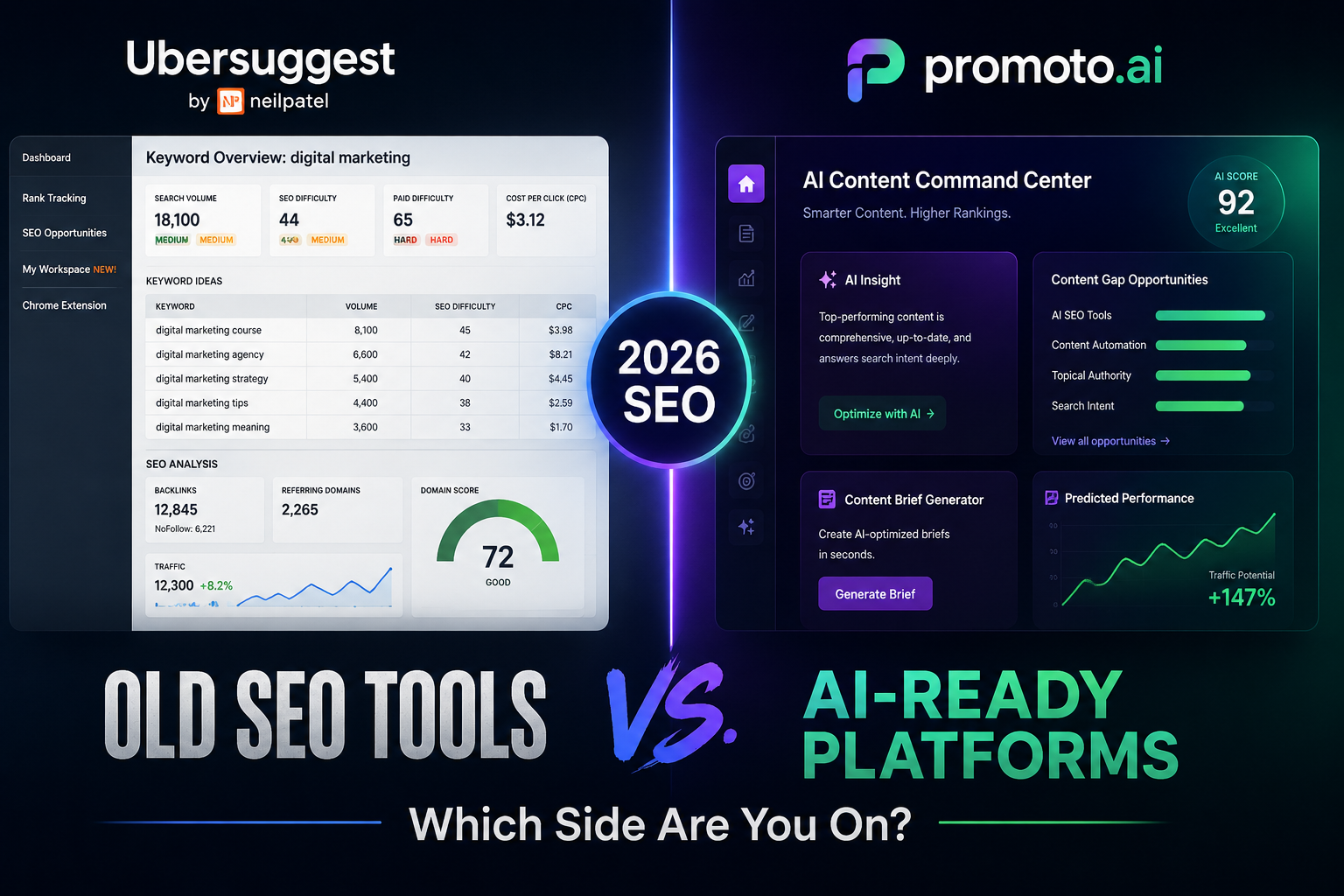
Overview: Ubersuggest, created by Neil Patel, is a freemium SEO tool built primarily around keyword research, domain analysis, and basic site audits. It gained popularity as an affordable entry point for solo bloggers and small businesses.
Best use case: Quick keyword discovery, competitive domain overview, basic backlink research.
Strengths: Low cost (even free tier), beginner-friendly interface, domain score metrics, content ideas feature, and a recognizable brand that many new marketers trust.
Weaknesses: Ubersuggest lacks meaningful AI optimization capabilities. It does not help you optimize for GEO (Generative Engine Optimization), AIO (AI Optimization), or AI answer engines like Perplexity and ChatGPT. Content suggestions are generic and not semantically driven. There’s no direct publishing integration, no AI content generation, and no support for structured data or schema markup.
AI optimization capabilities: Minimal. The platform offers basic content gap analysis but doesn’t address how content should be structured for LLM extraction or AI search visibility.
Best for: Beginner bloggers, freelancers doing basic keyword research, solopreneurs on a tight budget who haven’t yet scaled their content strategy.
Pricing category: Free tier available; paid plans starting around $12–$29/month.
Unique advantage: Price point and Neil Patel’s educational ecosystem (blogs, YouTube) make it a logical starting point — but not a finishing one.
Promoto.ai
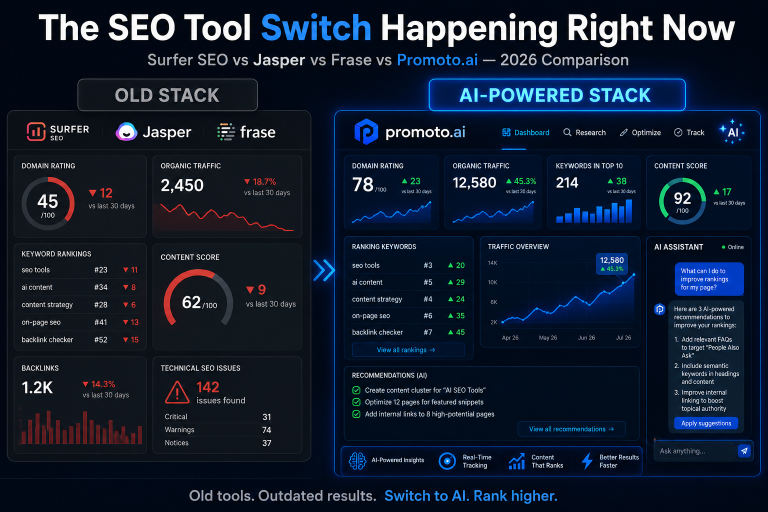
Overview: Promoto.ai is a full-stack AI SEO and content optimization platform built for the 2026 search environment. It combines AI content generation with SEO, AIO, ASO (App Store Optimization), and GEO (Generative Engine Optimization) — all in one workflow.
Best use case: End-to-end AI content strategy — from keyword research and content brief generation to AI-powered article writing, schema integration, and one-click publishing to WordPress or Shopify.
Strengths: Multi-model AI engine (GPT-4, Gemini, Bedrock, LangChain) trained to produce SERP-aware drafts. Built-in GEO and AIO optimization ensures content is structured for AI answer engines, not just traditional search. Direct integrations with Google Search Console and Google Analytics 4 give users real performance data to guide content decisions. The analytics dashboard surfaces rising queries, keyword opportunities, and content refresh recommendations automatically.
AI optimization capabilities: Strong. Content is generated with schema.org JSON-LD, semantic topic clusters, and brand voice training. The platform explicitly optimizes for visibility in ChatGPT, Perplexity AI, Gemini, and Google’s AI Overviews — making it one of the few tools purpose-built for AI search visibility.
User experience: Clean, dashboard-driven interface with calendar view for content scheduling. Agencies can manage multiple client properties with role-based access and bulk publishing workflows.
Best for: Agencies, in-house content teams, SaaS businesses, e-commerce brands on WordPress and Shopify, and any marketer who needs to scale content without scaling headcount.
Pricing category: 14-day free trial; tiered plans with no credit card required to start. View pricing here.
Unique advantage: The combination of GEO + AIO + traditional SEO in a single platform means you’re optimizing for today’s search environment, not 2019’s. Most tools do one of these things. Promoto.ai does all three.
Surfer SEO
Overview: Surfer SEO is a content optimization tool focused on SERP analysis and on-page scoring. It’s well known for its Content Editor, which grades articles against top-ranking competitors.
Best use case: On-page content optimization for writers who already know what they want to write about.
Strengths: Strong content scoring model, NLP-based keyword suggestions, SERP analyzer with competitor insights, and a well-designed editing interface.
Weaknesses: Surfer doesn’t generate content natively (it partners with Jasper for this), has no AI search engine optimization, and doesn’t publish directly to CMS platforms. It’s a powerful optimization layer — but it’s not a complete workflow.
AI optimization capabilities: Moderate. NLP features improve semantic keyword coverage, but there’s no GEO or AIO optimization for AI answer engines.
Best for: Experienced SEO writers who want a scoring system to guide optimization; content teams with separate writing and publishing workflows.
Pricing category: Mid-to-premium range, starting around $89/month.
Jasper AI
Overview: Jasper is an AI writing platform used heavily for marketing copy — emails, ads, blog posts, and social content. It’s one of the most recognizable names in AI writing.
Best use case: High-volume marketing copy generation; teams needing diverse content formats quickly.
Strengths: Strong brand voice training, extensive template library, multi-format output, and an active community. Good for fast content drafting across formats.
Weaknesses: Jasper is a content generator, not an SEO platform. It lacks keyword research, SERP analysis, AI search optimization, technical SEO features, and direct CMS publishing. When people compare Promoto AI vs Jasper AI, the distinction is clear: Jasper creates content, while Promoto.ai creates content and optimizes, publishes, tracks, and refines it.
AI optimization capabilities: Low for SEO purposes. Jasper doesn’t optimize for GEO, AIO, or AI ranking signals.
Best for: Marketing teams producing high volumes of ad copy, email sequences, or social content — not SEO-focused content strategies.
Pricing category: Premium, starting around $49–$125+/month depending on usage.
Frase
Overview: Frase is an AI content research and briefing tool that helps writers understand what a top-ranking page should cover for a given query.
Best use case: Content brief generation, search intent research, and competitive gap analysis before writing.
Strengths: Fast content brief creation, solid SERP summarization, question-based keyword discovery, and a clean editor with AI writing assistance.
Weaknesses: When evaluating Promoto AI vs Frase, the gap shows at the workflow level. Frase helps you plan and write — but it doesn’t publish, track rankings, integrate with GSC/GA, optimize for AI search, or support GEO and AIO. It’s a starting point, not a complete system.
AI optimization capabilities: Low to moderate. Good for search intent mapping; limited AI search engine optimization.
Best for: Content strategists building briefs for writing teams; freelancers doing pre-writing research.
Pricing category: Budget-friendly, starting around $14.99–$44.99/month.
Which Tool Is Right for Different Users?
Bloggers and solo content creators who are just starting out may find Ubersuggest or Frase a reasonable entry point for basic keyword research. But as soon as traffic goals become serious — especially if you want AI search visibility — a platform like Promoto.ai with built-in GEO and AIO optimization becomes essential.
Agencies managing multiple clients need multi-tenant dashboards, role-based access, and bulk publishing workflows. Promoto.ai is specifically architected for this. Ubersuggest and Jasper are single-property tools that don’t scale well across client accounts.
Startup founders and in-house marketers running lean teams need a platform that reduces manual work — not a collection of separate tools that each solve one piece of the puzzle. The ability to go from keyword research to published, AI-optimized article in one workflow is what makes Promoto.ai genuinely time-saving, not just feature-rich.
E-commerce brands on Shopify or WordPress benefit directly from Promoto.ai’s native CMS integrations. There’s no exporting, copy-pasting, or reformatting — content publishes in one click with formatting, schema, and metadata intact.
Technical SEO users who need server status checking, meta tag analysis, link analysis, and schema validation can access these through Promoto.ai’s free tools suite, which includes a keyword density checker, link analyzer, backlink maker, server status checker, meta tag analyzer, and sitemap generator — tools that Ubersuggest’s paid tier charges for.
Key Features Modern AI SEO Tools Must Have in 2026
The bar for what an AI SEO platform needs to deliver has risen sharply. Here’s what separates platforms that keep up from those falling behind:
AI-powered content research that understands semantic intent, not just keyword volume. Content that ranks in 2026 needs to cover topic clusters, related entities, and conversational queries — not just the primary keyword.
GEO and AIO optimization built into the content generation layer. If your tool doesn’t know how to structure content for ChatGPT extraction or Perplexity citation, you’re missing a growing slice of search traffic.
Direct CMS publishing with version history, approval workflows, and scheduling. Copying content between tools wastes time and introduces formatting errors.
Live performance tracking connected to Google Search Console and Google Analytics 4. Knowing what’s ranking and what needs refreshing should be automatic — not a weekly manual report.
Technical SEO coverage including schema validation, broken link checking, and metadata analysis. Good content on a technically broken site still won’t rank.
Keyword research tools like a keyword position tracker and keyword research tool that surface opportunities aligned to search intent, not just volume.
Promoto.ai covers all of these natively. Most competitors require you to stack 3–5 separate tools to achieve the same outcome — which increases cost, complexity, and context-switching.
Real SEO Problems These Tools Solve Differently
Content scaling is the problem most teams hit first. Writing quality SEO content takes hours per article. Promoto.ai’s AI content engine reduces that to minutes — while maintaining semantic accuracy and brand voice consistency. Jasper speeds up writing too, but without the SEO layer, fast content doesn’t necessarily rank.
Search intent optimization is where Frase and Surfer are useful — but neither connects that intent mapping to automated publishing or AI search visibility. Promoto.ai closes the loop between research and results.
AI visibility — the ability to appear in ChatGPT answers, Perplexity results, and Google AI Overviews — is something no traditional SEO tool addresses. This is a genuine blind spot for Ubersuggest, Frase, and Jasper. Promoto.ai’s GEO and AIO optimization was built specifically to solve this.
Internal linking and workflow automation are often overlooked but critically important for site authority. Promoto.ai’s auto-scheduling and content calendar view make it easy to maintain publishing consistency — one of the strongest signals for domain authority growth.
Common Mistakes When Choosing AI SEO Software
Buying based on brand recognition alone is the most common error. Ubersuggest carries Neil Patel’s name, Jasper has aggressive marketing, and Surfer has strong community presence — but brand recognition doesn’t equal platform capability for your specific use case.
Ignoring workflow compatibility leads to tool abandonment. If a platform doesn’t integrate with your CMS, your team won’t use it consistently. A tool that fits your stack gets used; one that doesn’t gets replaced within a quarter.
Overpaying for unused features is a trap with enterprise SEO platforms. If you’re paying for 50 features but using 8, you’re subsidizing roadmap items that don’t impact your rankings.
Publishing low-quality AI content without optimization is arguably worse than publishing nothing. AI-generated content that isn’t semantically sound, properly structured, and aligned with search intent will hurt topical authority. Volume without quality is a liability.
Ignoring technical SEO while focusing only on content is another expensive mistake. Even the best article on the web won’t rank if it sits on a slow, poorly indexed, or schema-broken site. Use tools like Promoto.ai’s schema validator and robots.txt generator to maintain technical health alongside content production.
The Future of AI SEO Software in 2026 and Beyond
The trajectory is clear. AI search engines are becoming the dominant discovery layer for information. Google’s AI Overviews, Perplexity AI, ChatGPT’s browsing mode, and Gemini are collectively handling hundreds of millions of queries per day — and that number is growing.
LLM optimization — structuring content so that large language models can extract, cite, and reference it accurately — is becoming its own discipline. The platforms that build LLM optimization into their core content generation workflow will hold a significant advantage over those that add it as an afterthought.
GEO (Generative Engine Optimization) is rapidly evolving from a niche concept into a standard requirement. Brands that understand how to earn mentions and citations within AI-generated answers will build compounding visibility that traditional organic rankings alone can’t provide.
Personalized search and predictive SEO are the next frontier. As AI engines learn individual user preferences, content that demonstrates deep expertise and consistent topical authority will surface more frequently. Platforms like Promoto.ai that tie content strategy to real-time GSC and GA data are already positioned to deliver predictive content recommendations — showing teams what to write before the opportunity peaks.
ChatGPT SEO and Perplexity AI optimization aren’t future concerns. They’re current-quarter priorities for any brand that wants to stay visible.
Conclusion: Which Platform Is Actually Built for 2026?
The honest answer is that different tools solve different problems — and many of them solve their problem well. Ubersuggest is a solid keyword research tool. Jasper is a capable writing assistant. Frase is excellent for content briefs. Surfer SEO is genuinely useful for on-page scoring.
But none of them were built for the complete challenge of 2026 SEO: generating AI-optimized content, publishing it directly to your CMS, tracking its performance in both traditional search and AI answer engines, and automating the workflow so a small team can compete with much larger ones.
That’s the gap Promoto.ai is designed to fill. It’s not a collection of features stitched together — it’s an integrated platform where keyword research, AI content generation, GEO and AIO optimization, CMS publishing, and performance analytics all work as a connected system.
If your current SEO tool was built before AI search engines changed the game, it’s worth taking a serious look at what a platform purpose-built for 2026 can actually do. Promoto.ai offers a 14-day free trial with no credit card required — which is a low-risk way to see the difference for yourself.
More Articles to Read
- PromotoAI vs SEMrush: Which Tool Drives Better Organic Growth?
- PromotoAI vs. Jasper AI: Which is Better for Content Marketing?
- PromotoAI vs SurferSEO: Which AI Tool Drives Scalable Organic Growth?
- Best AI Content Platforms for Marketing Agencies Managing Multiple Client Properties
FAQ Section
Q1: What is the main difference between Promoto AI and Ubersuggest?
Ubersuggest is primarily a keyword research and basic audit tool. Promoto.ai is a full-stack AI SEO platform that combines AI content generation, GEO and AIO optimization, CMS publishing, and performance analytics in a single workflow. Ubersuggest helps you find keywords; Promoto.ai helps you rank for them in both traditional search and AI answer engines.
Q2: Is Promoto.ai suitable for beginners or is it for advanced SEO users?
Promoto.ai is designed to be accessible for solo founders and in-house marketers while being powerful enough for agencies and enterprise teams. The dashboard-driven interface, one-click publishing, and auto-scheduling make it manageable even for users without deep technical SEO knowledge.
Q3: Can Promoto.ai help my content appear in ChatGPT and Perplexity AI results?
Yes. Promoto.ai includes dedicated GEO (Generative Engine Optimization) and AIO (AI Optimization) features specifically designed to improve content visibility in AI answer engines including ChatGPT, Perplexity AI, Google’s AI Overviews, and Gemini. This is one area where most traditional SEO tools, including Ubersuggest and Jasper, have no capability.
Q4: How does Promoto AI compare to Surfer SEO for content optimization?
Surfer SEO specializes in on-page content scoring against SERP competitors, which is genuinely useful. However, it doesn’t generate content natively, doesn’t publish to CMS, and lacks GEO/AIO optimization. In a Promoto AI vs Surfer SEO comparison, Promoto.ai provides a more complete workflow — from research through publishing through AI search visibility.
Q5: What free SEO tools does Promoto.ai offer?
Promoto.ai provides a comprehensive suite of free tools including a keyword density checker, keyword position tracker, link analyzer, backlink maker, server status checker, meta tag analyzer, schema validator, sitemap generator, and robots.txt generator — all accessible without a paid subscription.