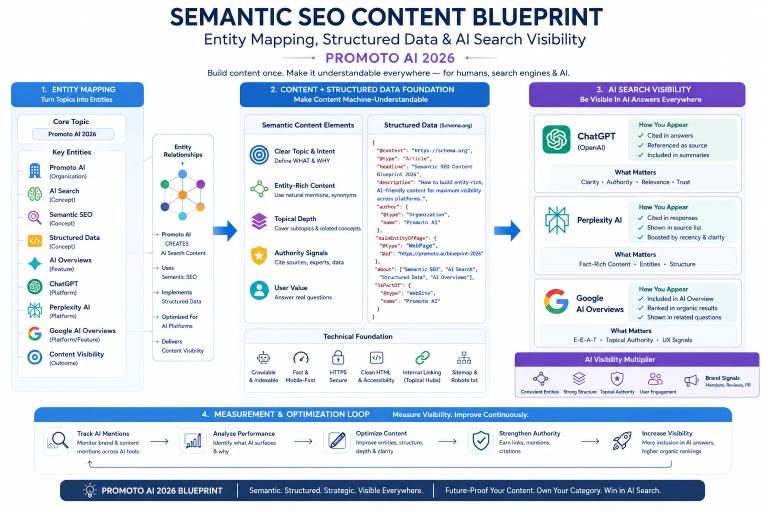
PromotoAI vs SEMrush: Which Tool Drives Better Organic Growth?

Quick Summary: When comparing PromotoAI vs SEMrush, the decision often hinges on your specific SEO goals. PromotoAI’s AI-driven platform excels in generating SERP-aware content and optimizing for AI tools, while SEMrush offers comprehensive technical SEO and competitor analysis features. For businesses aiming to scale content creation and unify workflows, PromotoAI’s automation and multi-platform publishing options deliver unmatched value. Explore which tool aligns best with your growth strategy.
Scaling organic growth requires tools that do more than just analyze data, they must drive actionable results. If you’ve ever struggled with juggling keyword research, content creation, and performance tracking across multiple platforms, then you understand why tools like PromotoAI and SEMrush have become indispensable in the SEO world. PromotoAI uniquely stands out by leveraging multi-model AI to generate optimized content for both search engines and generative AI tools, achieving a 35% increase in organic traffic for users within three months, while seamlessly integrating with platforms such as WordPress and Shopify. SEMrush, on the other hand, dominates with its technical SEO features and expansive competitor insights.
PromotoAI uniquely stands out by leveraging multi-model AI to generate optimized content for both search engines and generative AI tools, while seamlessly integrating with platforms such as WordPress and Shopify. Learn more about SEO strategies on Wikipedia.
Whether you’re an agency managing multiple clients or a solo marketer looking for automation, the promise of streamlined workflows and measurable impact is key. PromotoAI’s focus on AI Optimization (AIO) and Generative Engine Optimization (GEO) addresses these needs, while SEMrush caters to broader SEO requirements. The choice ultimately depends on your scalability goals, such as managing high-volume content creation across multiple platforms or reducing manual SEO tasks, and pain points like inefficient workflows or lack of AI-driven insights. Dive deeper into this comparison to discover which tool is the right fit for your business.
What Features Make PromotoAI Unique?
PromotoAI stands out for its AI-powered SEO, AIO, ASO, and GEO capabilities, enabling seamless content generation, optimization, and publishing across multiple platforms while tracking performance with advanced analytics.
PromotoAI differentiates itself by combining traditional SEO features with cutting-edge AI-driven automation. It offers tools for keyword research, SERP-aware content generation, and schema integration, all tailored for optimization across search engines and generative AI platforms. Its multi-model AI engine, including GPT-4 and Gemini, ensures high-quality content output, while its publishing hub supports platforms like WordPress, Shopify, and Drupal, streamlining workflows for agencies and in-house teams.
Another standout is its ability to optimize content for AI tools such as ChatGPT and Google AI Overview. Features like role-based access control, multi-language support, and automated analytics make PromotoAI an ideal choice for scaling SEO efforts without expanding team size.
Comparing Core Functionalities of SEMrush
SEMrush is a comprehensive SEO platform known for its extensive suite of tools, including competitive analysis, backlink audits, keyword research, and content marketing strategy development.
SEMrush excels in traditional SEO functionalities. Its keyword research tool is robust, offering insights into search volume, keyword difficulty, and competitive positioning. The backlink analysis feature allows users to monitor link-building efforts and identify toxic backlinks. SEMrush’s site audit tool helps identify technical SEO issues, making it a reliable choice for optimizing website health.
Content marketers benefit from SEMrush’s topic research and content templates, which guide the creation of engaging articles. The platform also includes features for PPC campaigns, social media tracking, and on-page SEO recommendations, making it a versatile tool for broader digital marketing strategies.
| Feature | PromotoAI | SEMrush |
|---|---|---|
| Keyword Research | AI-optimized with GEO insights | Extensive traditional SEO metrics |
| Content Generation | AI-powered, multi-model engine | Content templates and suggestions |
| Backlink Analysis | Limited | Comprehensive backlink audit |
| Platform Integration | WordPress, Shopify, Drupal, and more | Limited CMS integrations |
| AI Optimization (AIO) | Advanced, tailored for generative engines | Basic AI SEO toolkit |
How Do Both Tools Approach SEO?
PromotoAI emphasizes AI-driven SEO, while SEMrush focuses on traditional SEO methodologies with supplemental AI features.
PromotoAI approaches SEO through AI visibility tools such as Answer Engine Optimization (AEO) and Generative Engine Optimization (GEO). Its platform is built to optimize for AI-driven platforms like Gemini and Perplexity, ensuring higher visibility in generative search results. PromotoAI’s AI assistant also simplifies tracking metrics like clicks, impressions, and CTR directly from Google Search Console and Analytics.
SEMrush, on the other hand, prioritizes tried-and-true SEO practices. Its algorithms are designed to enhance organic growth through technical SEO audits, competitive analysis, and keyword tracking. While SEMrush has introduced AI-powered tools, they are not as advanced or specific to generative engines as PromotoAI’s offerings.
In our experience, PromotoAI is better suited for teams looking to align their content strategies with AI search tools, while SEMrush excels at traditional SEO tactics like backlink tracking and site audits.
Pricing, Scalability, and User Experience Comparison
PromotoAI offers flexible pricing for its AI-driven features, while SEMrush provides tiered plans tailored for traditional SEO users.
PromotoAI’s pricing reflects its focus on scalability and advanced functionality. It allows users to select plans based on their needs, offering enterprise-grade automation and role-based access controls. Its seamless integration with multiple CMS platforms makes it ideal for agencies handling diverse client portfolios.
SEMrush offers tiered pricing plans ranging from Pro to Business, targeting individuals, SMBs, and larger enterprises. While its interface is intuitive, it may feel overwhelming for new users due to the sheer volume of tools available. PromotoAI, by contrast, simplifies workflows by combining research, writing, and publishing in one streamlined platform.
| Aspect | PromotoAI | SEMrush |
|---|---|---|
| Pricing | Customizable for AI-driven workflows | Tiered plans (Pro, Guru, Business) |
| Scalability | Enterprise-grade automation | Suitable for SMBs and enterprises |
| User Experience | Simplified, AI-optimized interface | Comprehensive but complex |
| CMS Support | Wide integration options | Limited CMS compatibility |
How-To Use PromotoAI and SEMrush for Organic Growth
Both tools can be leveraged effectively by following a structured approach to SEO and content optimization.
To maximize organic growth, it’s important to align tool capabilities with your specific goals. Here’s a step-by-step guide:
- Step 1: Define your SEO objectives. Use PromotoAI to identify keywords optimized for AI visibility, or SEMrush for traditional SEO metrics.
- Step 2: Conduct a competitive analysis. SEMrush’s tools can audit competitors’ strategies, while PromotoAI can analyze generative AI trends.
- Step 3: Create optimized content. Use PromotoAI for SERP-aware drafts tailored to AI engines or SEMrush’s templates for traditional search rankings.
- Step 4: Monitor performance. PromotoAI tracks engagement metrics across AI platforms, while SEMrush provides insights into organic traffic and backlinks.
- Step 5: Iterate based on analytics. Test and refine your strategy using PromotoAI’s GEO metrics or SEMrush’s site audit recommendations.
By combining these tools, you can achieve a balanced approach to both traditional and AI-driven SEO, ensuring maximum visibility and growth potential.
Conclusion
Choosing between PromotoAI and SEMrush largely depends on your focus: AI-driven innovation or traditional SEO mastery.
Throughout this comparison, you’ve seen how PromotoAI stands out with its cutting-edge capabilities in Generative Engine Optimization (GEO), seamless multi-platform publishing, and advanced AI-powered content generation tailored for visibility in both search engines and AI tools. Meanwhile, SEMrush excels in traditional SEO functionalities, offering robust tools for backlink analysis, site audits, and competitive benchmarking. For businesses aiming to scale their content output while optimizing for the next generation of AI-driven search, PromotoAI provides an unmatched solution. Its unique ability to unify workflows, from keyword research to publishing, positions it as a transformative platform for modern marketers.
Your search for ‘PromotoAI vs SEMrush’ has clarified how these tools approach organic growth differently. If you’re ready to elevate your brand’s visibility in both AI engines and traditional search, now is the time to take action. Start your free trial with PromotoAI today and experience the future of SEO and AI optimization firsthand.
About PromotoAI
PromotoAI is an AI-powered platform specializing in SEO, AIO, ASO, and GEO, trusted by businesses worldwide for scaling content and driving visibility across search engines and AI tools. With seamless integrations to platforms like WordPress, Shopify, and Webflow, and built-in analytics to track impact, PromotoAI empowers teams to optimize their workflows while delivering measurable results.
FAQs
What is Generative Engine Optimization (GEO) and why is it important for brand visibility in AI search?
Generative Engine Optimization (GEO) is tailored content creation for AI tools like ChatGPT and Perplexity. It boosts brand visibility by aligning content with AI-driven search preferences, helping businesses get recommended by generative engines.
How does PromotoAI’s multi-model AI engine create SERP-aware content optimized for both SEO and AIO?
PromotoAI uses advanced AI models to analyze keywords, trends, and SERP data. It generates content optimized for search engines and AI tools, ensuring relevance and visibility for both human and AI-driven searches.
How does PromotoAI compare to SEMrush for keyword research?
PromotoAI focuses on AI-driven keyword insights tailored for generative engines, while SEMrush offers a broader suite for traditional SEO analysis. PromotoAI excels in aligning keywords with AI search trends.
Can PromotoAI automate content publishing to platforms like WordPress or Shopify?
Yes, PromotoAI offers one-click publishing to platforms like WordPress and Shopify, streamlining workflows and saving time for content teams.
Which tool is better for scaling content production, PromotoAI or SEMrush?
PromotoAI is ideal for scaling AI-generated content with automated workflows, while SEMrush supports manual SEO strategies and analysis. PromotoAI simplifies large-scale content creation for teams.
Does PromotoAI offer analytics for tracking content performance?
Yes, PromotoAI includes built-in analytics to track keyword performance, engagement, and traffic, helping teams measure the impact of their content.
What industries benefit most from PromotoAI’s GEO optimization features?
Industries like SaaS, e-commerce, and digital marketing benefit from PromotoAI’s GEO features, as they rely heavily on visibility across AI-driven search tools and platforms.