The Semantic Content Blueprint: How to Build a Website AI Answer Engines Actually Trust (And Cite)
Here’s a reality check most SEO guides are too comfortable to give you.
You could be ranking on page one of Google right now — and still be completely invisible to the buyer who just asked ChatGPT, Perplexity, or Google’s AI Overview for a recommendation in your space.
That’s not a traffic dip. That’s a structural problem.
The shift from keyword-based search to AI-generated answers has fundamentally changed what “findable” means. Traditional SEO taught us to optimize pages. Answer engine optimization demands we build an entire content system — one that AI models can read, trust, and pull from with confidence.
This guide breaks down that system layer by layer. Every principle here reflects how LLMs actually process, evaluate, and cite web content.
Why AI Answer Engines Ignore Most Websites (Even Well-Ranked Ones)
There’s a widespread misconception that ranking on Google automatically earns you a spot in AI-generated answers. It doesn’t.
Language models like GPT-4, Gemini, and Perplexity’s retrieval system don’t read your site like a human. They extract meaning — looking for coherent entity relationships, clearly defined concepts, and structured facts they can cite with confidence.
Most websites fail this test. Their content is organized for clicks, not comprehension.
Paragraphs bury key insights in fluffy preamble. Page structures make it hard for AI crawlers to isolate the answer from the noise. The result? A competitor with 60% of your traffic but a semantically cleaner site gets recommended — and you don’t.
Understanding how answer engine optimization works is the starting point. Building a site-wide semantic architecture is what actually moves the needle.
What “Semantic Content Architecture” Actually Means
Semantic content architecture is how you structure your website’s knowledge so AI systems understand not just what you write about, but who you are and why you’re trustworthy.
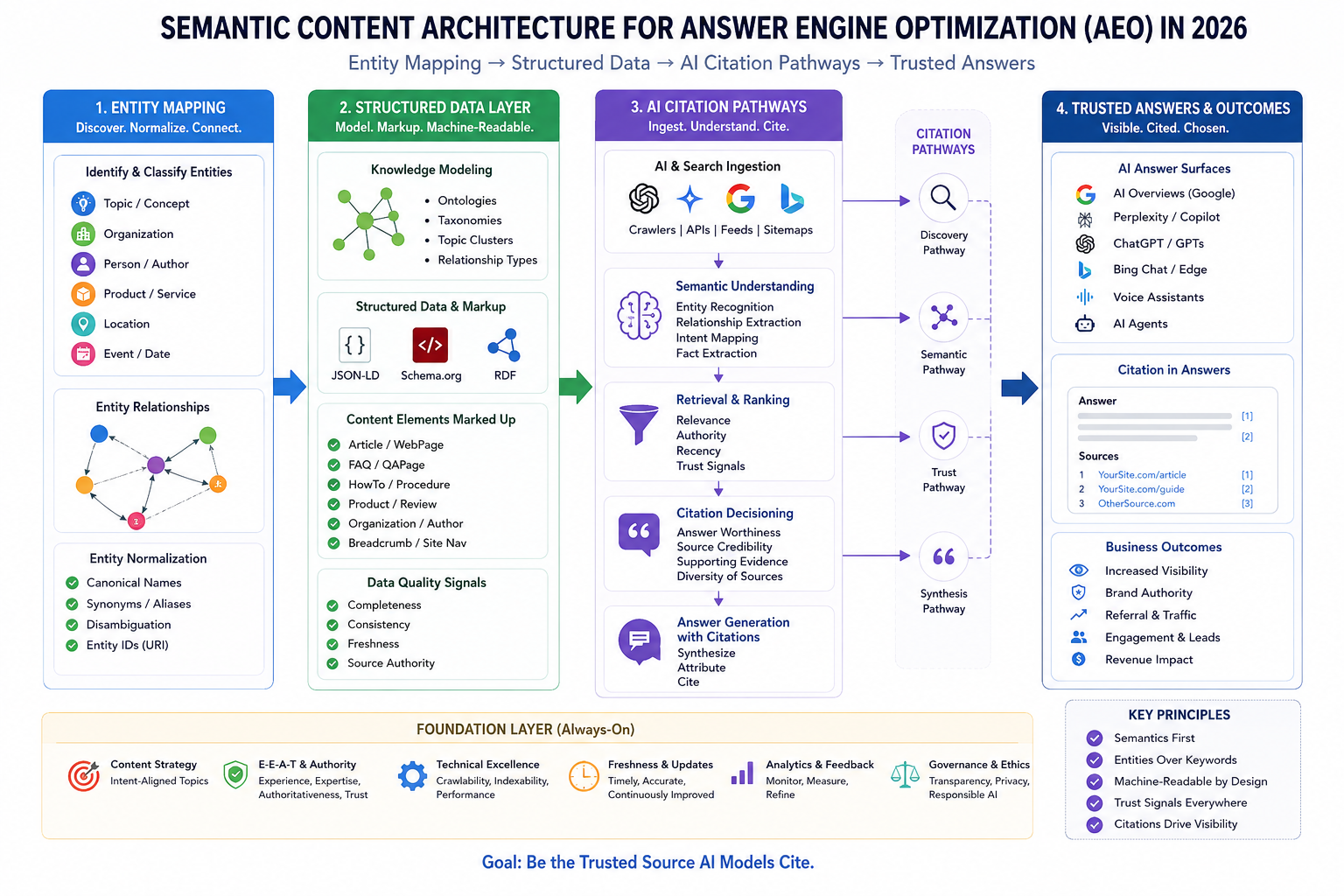
It operates across three distinct layers:
Layer 1 — Entity Definition: Who and what your brand represents — company name, founders, products, specializations, and niche associations.
Layer 2 — Topical Authority: How deeply and consistently you cover a subject domain, signaled through topic clusters, internal link structure, and content breadth.
Layer 3 — Structured Signals: Schema markup, FAQ implementations, and JSON-LD data that give AI systems machine-readable context about your content.
All three layers must work together. Missing one weakens the entire structure.
Building Layer 1: Entity SEO and Brand Disambiguation
The first thing an AI model needs to do with your content is understand who is speaking. Most websites make this surprisingly difficult.
Entity SEO is the practice of making your brand, people, and products clearly recognizable as distinct entities — not just a collection of pages. Think of it as giving AI systems a reliable identity map for your organization.
Here’s what strong entity signals look like in practice:
- Your About page should state your company’s founding context, expertise areas, geographic presence, and team members with factual — not marketing — language.
- Author bios should link out to LinkedIn profiles and published work, strengthening the E-E-A-T signals LLMs use as trust proxies.
- Your brand name and key descriptors should appear consistently across your website, schema markup, Google Business Profile, and any external citations.
Inconsistency across the web creates “entity disambiguation failure.” AI systems become uncertain which entity they’re dealing with — and default to omitting the mention altogether.
Use Promoto AI’s structured data implementation tools to validate your schema and keep entity signals machine-readable and consistent.
Building Layer 2: Topical Authority Through Semantic Content Mapping
If Layer 1 answers “who are you,” Layer 2 answers “what do you genuinely know.”
AI answer engines recognize the difference between a site that published one blog post on a topic and one that has built a deep knowledge base around it. Topical authority — the coherence and depth of your subject coverage — is one of the strongest citation signals that exists.
Semantic content mapping is how you build it.
Start with your core domain. Then map every sub-concept within it: LLM SEO optimization, structured data implementation, AI crawler behavior, NLP content signals, entity disambiguation, and so on.
Each sub-concept becomes a content node. The nodes link to each other in a way that mirrors how the concepts are actually related — not just for SEO, but for genuine comprehension.
This goes deeper than traditional pillar-and-cluster models. In semantic content mapping, you’re encoding relationships, not just creating links. A page on “how to rank in ChatGPT answers” should naturally mention Perplexity AI, Google AI Overviews, and structured data — because those concepts are genuinely interconnected.
LLMs recognize conceptual co-occurrence. They trust content that demonstrates real depth through natural use of related entities.
This is also where keyword analysis and search intent research become critical — not for inserting keywords, but for understanding exactly which questions your audience asks and mapping content to answer each one precisely.
Building Layer 3: Structured Data Implementation That Actually Works
This is the layer most brands either skip entirely or implement badly. It’s also one of the highest-leverage investments you can make for AI-powered search visibility.
Structured data — specifically Schema.org markup implemented via JSON-LD — gives AI systems a direct translation layer. Instead of inferring what your page means, they can read it explicitly.
When AI crawlers are confident about what a page says, they’re far more likely to cite it.
The schemas that matter most for AEO and GEO right now:
Article / BlogPosting Schema — Tells AI systems the title, author, publish date, and topic of your content. Basic, but frequently missing or incomplete on most sites.
FAQPage Schema — One of the strongest signals for getting featured in AI-generated answers. Each FAQ item is a discrete question-answer pair that LLMs can extract and cite directly. Every substantive blog post should include a properly marked-up FAQ section.
Organization Schema — Defines your brand as a distinct entity with a name, URL, logo, founding date, social profiles, and contact information. This is foundational for brand visibility in AI tools.
BreadcrumbList Schema — Signals your site architecture to AI crawlers, helping them understand which content is most authoritative within a section.
SpeakableSpecification Schema — Designates specific content portions as optimized for AI answer extraction.
Schema implementation isn’t set-and-forget. AI crawlers evolve. Using Promoto AI’s GEO optimization platform ensures your structured data stays aligned with what current AI systems are actually looking for.
How to Write Content That AI Answer Engines Actually Extract
Structural signals matter, but content itself must be written so AI systems can pull from it cleanly.
This comes down to what NLP researchers call “extractability” — how easily a system can isolate the most accurate, citable version of your answer from a block of text.
Four writing principles for extractable, AEO-ready content:
1. Answer First, Explain After. Start every section with the core answer in one or two clear sentences, then expand. AI models prioritize opening sentences for extraction. Burying your answer in preamble means it gets skipped.
2. Use Definitional Framing for Key Concepts. When introducing concepts AI systems might be asked to define — like “what is answer engine optimization” or “how does LLM SEO optimization work” — give a crisp standalone definition first. These are prime citation targets.
3. Write with Conceptual Specificity. Vague content doesn’t get cited. “Content is important for SEO” tells an AI model nothing citable. “FAQ schema implementation increases citation rates in Perplexity AI by making discrete question-answer pairs machine-readable” gives the model something extractable and specific.
4. Maintain Consistent Terminology. If your primary term is “answer engine optimization,” use it consistently. Don’t alternate between AEO, answer optimization, and AI search optimization within the same article. Semantic consistency helps NLP systems recognize you as an authoritative source — not a generalist.
Optimizing Content for Perplexity AI: What’s Different
Perplexity AI deserves its own section. Its retrieval architecture differs meaningfully from how Google or ChatGPT surface content — and most guides lump them together inaccurately.
Perplexity operates as a real-time retrieval-augmented generation (RAG) system. It actively fetches web content at query time, synthesizes it, and cites its sources. Your content doesn’t need to be pre-ingested into a training dataset — it needs to be findable, credible, and clean at the moment of query.
What “clean” means for Perplexity retrieval:
Pages with minimal ad clutter, clear visual hierarchy, and fast load times are consistently preferred by Perplexity’s fetcher. Mobile responsiveness isn’t optional — it’s a retrieval signal.
Content that directly answers the phrasing of common queries performs significantly better. Perplexity users ask conversational, multi-part questions. Pages using question-formatted subheadings align well with this pattern.
Perplexity also heavily weights domain authority and citation quality. Getting cited in Perplexity often starts with getting cited by other authoritative sources — which loops back to entity SEO and building a credible web presence.
For brands using Promoto AI’s AI content generation tools, structuring content output with Perplexity’s retrieval pattern in mind is a meaningful competitive edge.
The Scalable Organic Growth System: Putting It All Together
One of the biggest mistakes brands make is treating semantic SEO and AEO as one-time optimizations.
The websites that build sustainable brand visibility in AI tools treat this as an ongoing content operation — not a project with an end date.
Here’s what a scalable AEO system looks like in practice:
Ongoing entity signal reinforcement — Regularly publish bylined content, earn press mentions, maintain consistent social profiles, and update your schema as your organization evolves. Entity signals decay without reinforcement.
Topical coverage expansion — As your core domain deepens, systematically expand into adjacent sub-topics. Each new content node strengthens topical authority across your entire cluster.
Structured data auditing — Schema markup breaks with site updates. Regular audits keep your AI-readable signals intact. Promoto AI’s schema validator tool turns this into a routine workflow rather than an emergency fix.
AI answer monitoring — Track whether your brand appears in ChatGPT and Perplexity responses for target queries. When you appear, analyze why. When you don’t, diagnose what’s missing. Promoto AI’s analytics dashboard gives you the performance data that informs these decisions.
The brands winning in AI search aren’t the ones who published the most content. They’re the ones who built the most trustworthy, machine-readable knowledge architecture — and scaled it systematically.
Key Takeaways
- Answer engine optimization is not keyword optimization. It’s a full-site semantic architecture that signals trust, authority, and clarity to AI systems.
- Entity SEO is foundational. AI tools can only cite brands they can clearly identify. Consistent naming, schema, and cross-web presence matter enormously.
- Topical authority beats content volume. Depth and conceptual interconnection outperform publishing frequency every time.
- Structured data is the translation layer. FAQPage, Organization, and Article schemas give AI crawlers extractable, citable facts — without inference.
- Write for extractability. Answer first, be specific, use definitional framing, and maintain consistent terminology throughout.
- Perplexity AI has its own retrieval logic. Clean pages, conversational subheadings, and domain credibility drive citations on real-time RAG systems.
- This is a system, not a sprint. Scalable organic growth through AI search requires ongoing entity reinforcement, topical expansion, and structured data auditing.
Conclusion
Ready to Build a Website That AI Answer Engines Actually Cite?
Most brands won’t make this shift this year. That’s the opportunity.
Promoto AI is built specifically for the new search reality — combining semantic content generation, structured data integration, GEO optimization, and AI-powered analytics into one platform designed for founders, agencies, and in-house teams.
Start your free trial today and see what AI-powered search visibility looks like for your brand.
👉 Start Free Trial — No Credit Card Required 👉 Explore Promoto AI’s GEO & AEO Features 👉 Run a Free Instant SEO Audit
About promotoai
PromotoAI is a leading AI-powered platform specializing in SEO, AIO, ASO, and GEO solutions. With the ability to publish directly to platforms like WordPress and Shopify, and track performance through real-time analytics, PromotoAI simplifies complex workflows for agencies and enterprises. Trusted by teams across industries, PromotoAI leverages advanced AI models to deliver scalable, optimized content strategies that drive measurable results.
More Articles
Promoto AI Dashboard and Analytics Overview
Promoto AI: Streamline Content Scheduling and Automated Publishing Workflows
Mastering AI Overview Optimization: Boost Your Google Visibility with Intelligent Strategies
AI Bulk Blog Post Generator for Agencies: Scale Content Production & Boost SEO
PromotoAI vs SEMrush: Which AI-Powered SEO Tool Delivers Better Organic Growth?
FAQ Section
1. What is answer engine optimization (AEO) and how is it different from traditional SEO?
Answer engine optimization (AEO) is the practice of structuring content so AI-powered systems — like ChatGPT, Perplexity AI, and Google’s AI Overviews — can extract, trust, and cite it in generated responses.
Traditional SEO focuses on ranking in keyword-based search results. AEO focuses on being selected and cited by AI systems that synthesize information before presenting it to users.
AEO requires semantic content architecture, structured data, entity signals, and extractable writing — not just keyword placement.
2. How do I get my brand cited in ChatGPT and Perplexity AI answers?
Getting cited in AI-generated answers requires strong entity signals (so AI systems clearly identify your brand), topical authority (deep, consistent subject coverage), and structured data — especially FAQPage and Organization schema.
Extractable content writing — where answers are stated clearly at the start of each section — is equally critical.
Perplexity AI additionally favors pages with clean layouts, fast load times, and real-time web accessibility.
3. What is semantic content mapping and why does it matter for AI search?
Semantic content mapping is the process of planning your content around conceptual relationships, not just individual keywords.
It creates a knowledge architecture where each content piece connects to related concepts, reinforcing topical authority across your entire site.
LLMs favor sources that demonstrate genuine depth and coherence within a subject domain — not surface-level coverage — and semantic content mapping is how you build that depth systematically.
4. Which structured data schemas are most important for AEO and GEO?
The highest-impact schemas for answer engine optimization and generative engine optimization are:
- FAQPage — enables direct question-answer extraction by AI systems
- Organization — establishes brand entity clarity
- Article / BlogPosting — signals content type, authorship, and publish date
- BreadcrumbList — communicates site architecture to AI crawlers
- SpeakableSpecification — designates content portions optimized for AI extraction
All schemas should be implemented via JSON-LD for maximum compatibility.
5. How is Perplexity AI different from ChatGPT when it comes to content optimization?
Perplexity AI uses a real-time retrieval-augmented generation (RAG) system — it fetches live web content at the moment of each query, not just pre-trained data.
This means your content must be findable and clean at query time: fast load speeds, minimal clutter, and conversational subheadings that match how users naturally phrase questions.
ChatGPT’s browsing mode works similarly, but Perplexity’s visible citation architecture makes source attribution far more valuable for direct brand awareness.