
Why Smart Content Teams Are Moving Away From Surfer SEO in 2026
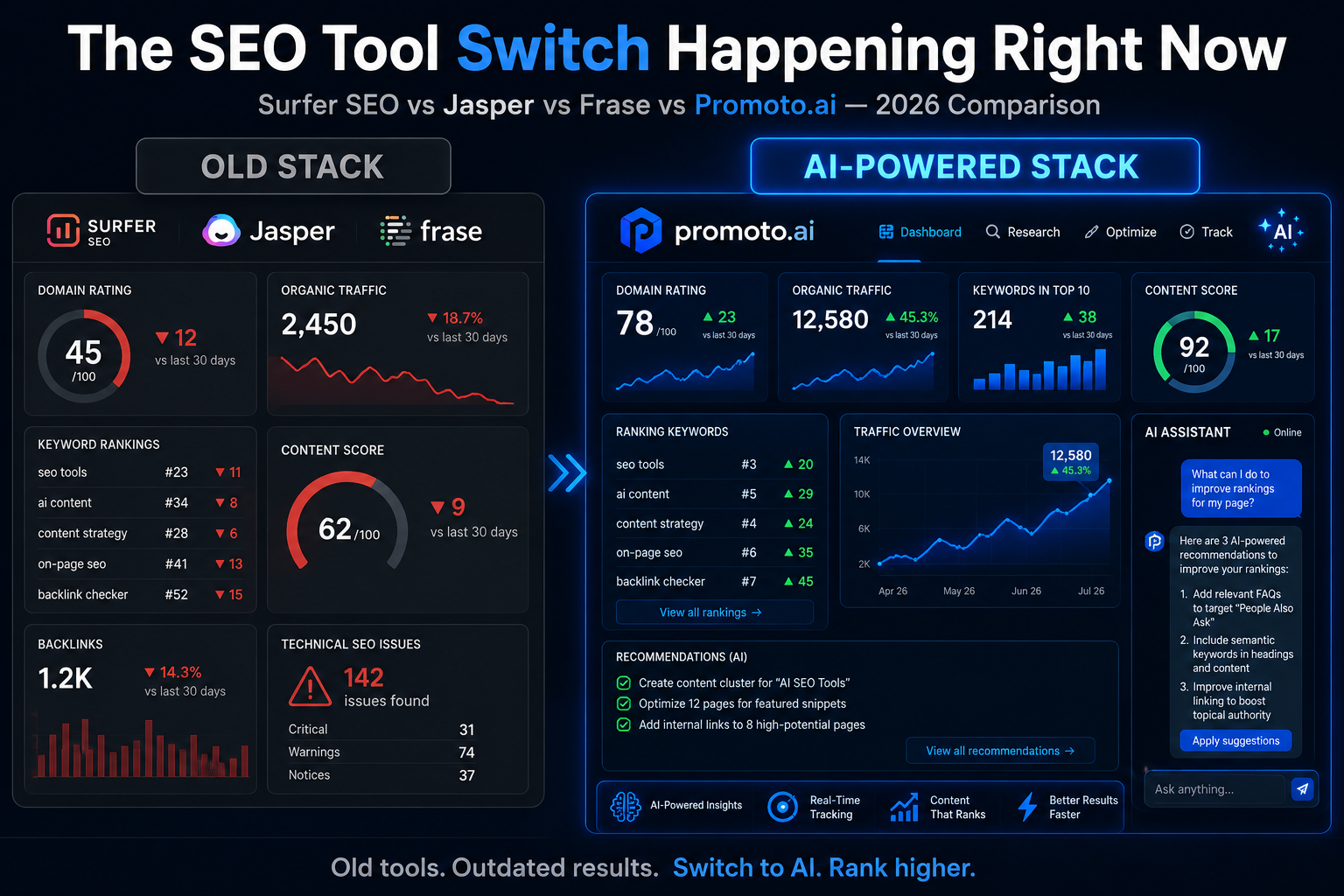
Here’s a conversation that’s becoming common inside marketing Slack channels right now. Someone asks, “Is anyone else finding that Surfer just isn’t cutting it anymore?” And the thread explodes with responses.
It’s not that Surfer SEO is a bad product. For years, it was genuinely useful. But search in 2026 looks nothing like it did even 18 months ago. Google’s AI Overviews answer questions before users click anything. ChatGPT and Perplexity are fielding millions of queries daily. And the tools marketers once relied on — built for a keyword-density world — are struggling to keep pace.
The question isn’t really “Which is better, Surfer SEO or something else?” The better question is: What does a modern AI content workflow actually need in 2026?
This guide breaks that down honestly. We compare Surfer SEO, Jasper AI, Frase, and SEMrush against Promoto.ai — not to declare a winner, but to help you figure out which tool matches how your team actually works.
Why Traditional SEO Tools Are Struggling to Keep Up
The core problem isn’t features. Most established SEO platforms have plenty of those. The problem is that they were engineered for a search environment that has fundamentally changed.
Zero-click search is accelerating. Studies from SparkToro suggest that over 60% of Google searches in 2024 ended without a click. With AI Overviews expanding aggressively through 2025 and into 2026, that number is only rising. Tools that optimize purely for ranking position — without thinking about whether that position drives traffic — are solving yesterday’s problem.
AI search engines have entered the mainstream. ChatGPT now handles over 100 million searches per day. Perplexity, Gemini, and Claude pull information from indexed content and summarize it for users who never visit the source. If your content isn’t structured for AI parsing — with clear semantic relationships, entity signals, and answer-ready formatting — it simply won’t get cited. Traditional content scoring tools don’t account for this at all.
Workflow fragmentation is killing productivity. The average content team in 2025 uses between 4–7 separate tools to complete a single article: one for keyword research, one for writing, one for optimization scoring, one for publishing, one for analytics. That’s not a content workflow — it’s a tax on everyone’s time.
Modern AI SEO software needs to address all of these problems together, not just optimize for one slice of the process.
Tool-by-Tool Comparison: What Each Platform Actually Does Well
1. Surfer SEO
Overview: Surfer built its reputation on SERP analysis and content scoring. You paste in a target keyword, and it tells you what your page should look like based on top-ranking competitors — word count targets, keyword frequency, heading structure, and NLP terms to include.
Best use case: Writers who want structured guidance on what content to include for a specific keyword.
Strengths: The content editor is clean and practical. The SERP analyzer is still one of the most visual in the market. Audit features help identify quick on-page wins for existing content.
Weaknesses: Surfer is primarily reactive — it tells you how to mimic what’s already ranking. It doesn’t generate content, doesn’t help with AI search visibility, doesn’t support direct publishing, and has no GEO optimization layer. Its scoring model rewards volume and frequency patterns, which has become less predictive as Google’s algorithms evolve.
AI optimization capabilities: Limited. There’s a basic AI writing assistant, but it’s bolt-on, not deeply integrated into the workflow.
Best for: Mid-level SEO specialists who want data-guided editing assistance.
Pricing category: Mid-tier ($89–$219/month for most plans).
Unique advantage: Strong visual SERP analysis that’s genuinely useful for competitive research.
The gap: Teams that need to produce content at scale, publish directly to CMS, and optimize for AI answer engines will hit Surfer’s ceiling quickly.
2. Jasper AI
Overview: Jasper is primarily a long-form AI writing tool with SEO integration added later through partnerships and internal features. It generates content using GPT-4 and branded templates, and integrates with Surfer SEO for optimization scoring.
Best use case: Content teams that need to produce large volumes of written drafts quickly, particularly for brand-voice consistency.
Strengths: Jasper is genuinely good at writing in a specific tone. Its brand voice controls are some of the best in the market. Template variety is impressive for teams that produce diverse content types.
Weaknesses: Jasper doesn’t do keyword research natively. Its SEO features depend on third-party integrations, meaning you’re managing multiple platforms. There’s no built-in publishing layer, no analytics, and no GEO optimization for AI search visibility. It also carries a significant cost premium.
AI optimization capabilities: Content generation is strong, but AI search optimization — structuring content to appear in ChatGPT, Perplexity, or Gemini answers — is absent.
Best for: Established marketing teams with a separate SEO stack who primarily need writing speed.
Pricing category: Premium ($49–$125+/month, with enterprise pricing on request).
Unique advantage: Best-in-class brand voice consistency for large content teams.
The gap: High cost, no native SEO or publishing workflow, and zero AI engine optimization make it difficult to justify as a standalone investment for results-focused teams.
3. Frase
Overview: Frase positions itself as a research and optimization tool. It generates content briefs automatically, pulls top SERP competitors, and provides an AI-assisted writing environment with optimization scoring.
Best use case: Freelancers and small teams who need to research and write content in one place without bouncing between tabs.
Strengths: Brief generation is fast and well-structured. The SERP research panel is genuinely useful, especially for new topics. Frase’s AI writer produces decent first drafts when given a solid brief.
Weaknesses: The writing quality tends to be generic compared to tools using newer model architectures. Publishing integrations are limited. The platform hasn’t invested heavily in LLM optimization or semantic SEO beyond standard topic coverage scoring.
AI optimization capabilities: Moderate. Frase helps with topic coverage and search intent, but doesn’t specifically optimize for AI citation patterns or structured data.
Best for: Freelancers and solo content marketers managing multiple clients on a budget.
Pricing category: Budget-to-mid ($14.99–$114.99/month).
Unique advantage: The brief creation workflow is fast and accessible for non-SEO specialists.
The gap: Limited scalability, no CMS publishing, and a lack of AI search visibility features make it insufficient for teams with growing output demands.
4. SEMrush
Overview: SEMrush is the closest thing the industry has to an all-in-one SEO platform — covering keyword research, site audits, backlink analysis, competitor tracking, and content tools under one roof.
Best use case: Agencies and in-house SEO teams that need deep technical and competitive intelligence alongside content workflows.
Strengths: The breadth of SEMrush’s data is unmatched. Keyword databases, backlink indexes, site audit capabilities, and competitive gap analysis are all genuinely powerful. Its SEO analytics platform features are among the most comprehensive available.
Weaknesses: SEMrush is not built for content production. The writing and optimization tools feel secondary to the core analytics product. Publishing to WordPress or Shopify isn’t native. The cost is steep — enterprise plans run well over $400/month — and teams often end up using it alongside 2–3 other tools anyway.
AI optimization capabilities: Growing, but focused on traditional search. AI Overviews tracking has improved, but GEO optimization for platforms like ChatGPT and Perplexity is still early.
Best for: Experienced SEO professionals and agencies that prioritize technical SEO and competitor intelligence.
Pricing category: Premium ($139–$499+/month).
Unique advantage: The most comprehensive keyword and backlink database available to marketing professionals.
The gap: Expensive, complex, and not purpose-built for content creation or AI search optimization. Teams without a dedicated SEO analyst often underuse the platform significantly.
5. Promoto.ai
Overview: Promoto.ai is a full-stack AI SEO platform built for the way search actually works in 2026. It handles keyword research, AI content generation, semantic optimization, GEO optimization, direct CMS publishing (WordPress and Shopify), analytics, and AI engine visibility — all in one place.
Best use case: Content-driven businesses, agencies managing multiple properties, and startup founders who need a complete SEO workflow without managing five separate tools.
Strengths: The platform covers the entire content lifecycle from keyword research to published article. The AI content engine uses multiple models (GPT-4, Gemini, Bedrock) and is tuned for both traditional search and AI answer engine citation. Built-in keyword analysis and one-click publishing to WordPress and Shopify eliminate the biggest friction points in content workflows.
Promoto.ai also includes a suite of free technical tools — keyword density checker, link analyzer, backlink maker, server status checker, and meta tag analyzer — that most competitors charge for separately or don’t offer at all.
AI optimization capabilities: Purpose-built for AIO (AI Optimization), GEO (Generative Engine Optimization), and ASO (App Store Optimization) alongside traditional SEO. Content is optimized to appear in AI Overviews, ChatGPT responses, and Perplexity answers — not just Google’s blue links.
Best for: Agencies, content-heavy startups, freelancers managing multiple clients, and in-house teams that want one platform instead of three.
Pricing category: 14-day free trial; competitive subscription tiers with transparent pricing.
Unique advantage: The only platform in this comparison that integrates AI content generation, GEO optimization, direct CMS publishing, and analytics under a single dashboard — purpose-built for 2026 search realities.
Which Tool Is Right for Your Situation?
Bloggers and solo content creators benefit most from an integrated research-to-publish workflow. Frase handles the entry-level use case reasonably well, but Promoto.ai offers significantly more for a comparable price point — particularly the one-click WordPress publishing and built-in keyword research tools.
Agencies managing multiple client websites need multi-property dashboards, role-based access, and scalable content operations. SEMrush provides the deepest data, but it doesn’t produce or publish content. Promoto.ai’s agency-focused features — bulk publishing, multi-tenant architecture, and approval workflows — are built exactly for this workflow.
Startups and founders operating without a dedicated content team need automation that doesn’t require SEO expertise to use. Promoto.ai’s auto-scheduling, AI content generation, and platform integrations let a single non-technical marketer run a consistent content operation. Surfer SEO and SEMrush both require someone who knows how to interpret their outputs.
Freelancers managing diverse clients need flexibility and cost efficiency. Frase is budget-friendly, but the workflow is fragmented. Promoto.ai’s all-in-one approach means fewer subscriptions and less tool-switching — which adds up meaningfully over a year.
Technical SEO users who need deep auditing, backlink analysis, and competitive intelligence will find SEMrush hard to replace on those dimensions. But for the content production and AI visibility layer, pairing SEMrush’s data with Promoto.ai’s content engine covers both needs efficiently.
Key Features That Modern AI SEO Tools Actually Need
Not all “AI SEO” tools are the same. Here’s what to look for when evaluating any platform in this category:
AI-powered content research. The tool should surface topic clusters, identify content gaps, and build briefs based on search intent — not just raw keyword volume. Promoto.ai’s integration with Google Search Console and GA4 enables genuinely data-driven content prioritization.
Semantic SEO optimization. Content scoring should account for entity relationships and topical authority, not just keyword frequency. Tools that still optimize for keyword density alone are working from a 2019 playbook.
GEO and LLM optimization. Content needs to be formatted for AI citation — direct answers, structured definitions, and semantic clarity that makes it easy for ChatGPT, Gemini, and Perplexity to pull from. Use Promoto.ai’s Rank on AI Engine feature to see how your content performs across answer engines.
Native publishing integrations. Exporting a Google Doc and manually pasting into WordPress is a time sink that compounds across 20 articles per month. Direct WordPress and Shopify integrations aren’t a luxury — they’re a baseline requirement for any scalable operation.
Free technical SEO utilities. Access to tools like broken link checkers, sitemap generators, and robots.txt generators without paying extra is a meaningful differentiator.
Real Problems That AI SEO Tools Are Solving Right Now
The value of a modern AI content platform isn’t abstract. Here’s where teams are seeing the most practical impact:
Content scaling without headcount increases. A three-person marketing team can now produce and publish 20–30 SEO-optimized articles per month using Promoto.ai’s AI generation and auto-scheduling, work that previously required hiring 2–3 additional writers.
Search intent alignment. AI tools that analyze SERP intent and structure content accordingly produce articles that answer the actual question being searched — which is increasingly what both Google and AI answer engines reward.
Internal linking automation. One of the most consistently neglected SEO tasks. Platforms that surface internal linking opportunities during the content creation process — rather than as a post-publishing audit — see meaningfully better site architecture outcomes.
Predictive content refresh. Knowing which existing articles are losing ranking position before they’ve fully declined allows teams to refresh strategically rather than reactively. This is where GSC and GA4 data integration pays real dividends.
Common Mistakes When Evaluating AI SEO Software
A few patterns consistently lead to poor purchasing decisions in this category:
Buying based on feature lists rather than workflow fit. A platform with 80 features you don’t use is less valuable than one with 20 features that integrate cleanly into your process. Before purchasing, map out your actual weekly content workflow and test whether the tool serves each step.
Ignoring AI engine optimization entirely. Teams that focus purely on Google rankings and ignore ChatGPT and Perplexity visibility are leaving a growing traffic channel unaddressed. The shift is real and measurable.
Treating AI content generation as a replacement for strategy. AI tools produce better output when given clear briefs, strong target keywords, and defined audience parameters. They amplify strategic thinking — they don’t replace it.
Overlooking technical SEO. Even the best content won’t rank if your site has crawlability issues, broken internal links, or missing schema markup. Tools like Promoto.ai’s schema validator and meta tag generator handle these fundamentals without requiring a separate technical audit tool.
Overinvesting in legacy platforms out of familiarity. Switching costs are real, but so is the cost of using an underperforming tool for another 12 months. If your current platform doesn’t support AI engine optimization, the gap will widen, not close.
The Future of AI SEO: What the Next 12 Months Look Like
The direction is clear even if the details are still evolving.
LLM optimization becomes a core discipline. Optimizing for AI model citation patterns — structured answers, semantic entity coverage, factual density — will be as standard as on-page SEO optimization is today. Platforms that build this into their content workflows now, like Promoto.ai’s GEO optimization features, will have a significant head start.
Personalized search continues to fragment the audience. Google’s ability to serve different results to different users based on behavior, location, and history means that traditional rank tracking becomes less meaningful as a primary success metric. Impression and click data at the intent level — which platforms with GSC integration surface automatically — becomes more important.
ChatGPT SEO matures as a practice. As more marketers recognize that ChatGPT citations drive real referral traffic, optimizing specifically for AI answer engine visibility will stop being a differentiator and start being table stakes. Tools that don’t support this will lose relevance.
GEO optimization goes mainstream. Generative Engine Optimization — structuring content for AI answer engines rather than traditional crawlers — is the fastest-growing category in SEO tooling right now. Early adopters are already seeing measurable visibility gains in AI-generated search results.
Predictive SEO becomes standard. Platforms that surface content opportunities before competitors have moved on them — using keyword velocity data, ranking trend signals, and AI-generated topic forecasts — will define what “good” looks like in content strategy planning.
Conclusion: The Switch Is Already Happening
The most telling signal about where AI SEO tooling is headed isn’t in any product announcement. It’s in those Slack threads where experienced content marketers — people who’ve used Surfer SEO, Jasper, and SEMrush for years — are quietly asking each other what they’re moving to next.
The answer they’re landing on, with increasing frequency, is something purpose-built for how search actually works today: unified content workflows, built-in AI engine optimization, native publishing, and integrated analytics.
If you’re evaluating your current SEO stack, the practical starting point is honest about what your tools don’t do. If they can’t optimize for ChatGPT or Perplexity, can’t publish directly to your CMS, and don’t integrate keyword research with content generation, they’re costing you more than their subscription fees in compounded inefficiency.
Promoto.ai was built specifically for this transition — from an SEO world defined by keyword density and backlink counts to one where AI visibility, semantic authority, and workflow automation determine who ranks and who gets cited. It’s worth exploring what a fully integrated AI SEO workflow actually looks like before committing to another year of tool-juggling.
Start your free 14-day trial and see how much of your current SEO stack it replaces.
MORE ARTICLES TO READ
- Your Brand Is Invisible to AI Search — Here’s How Answer Engine Optimization Changes That
- The LLM SEO Playbook: How to Engineer Your Brand Into Every AI Answer
- The Technical SEO Audit Playbook for 2026: How AI-Driven Tools Are Closing the Gaps Agencies Still Miss
- The Smart SEO Stack: How to Use AI-Driven SEO Strategies and the Best SEO Tools in 2026
- Why Ubersuggest Is Losing Ground to Smarter AI SEO Platforms in 2026
FAQ SECTION
Q1: Is Surfer SEO still worth using in 2026?
Surfer SEO remains useful for content scoring and SERP analysis, particularly for teams already invested in its workflow. However, it doesn’t support AI engine optimization, direct CMS publishing, or GEO optimization — capabilities that have become increasingly important as AI search tools like ChatGPT and Perplexity capture a larger share of search traffic. Teams building new workflows from scratch will likely find more value in platforms that address the full content lifecycle.
Q2: What’s the main difference between Promoto.ai and Jasper AI?
Jasper AI is primarily a long-form writing tool with SEO integrations added through third parties. Promoto.ai is a full-stack AI SEO platform that handles keyword research, content generation, semantic optimization, GEO/AIO optimization, direct WordPress and Shopify publishing, and analytics in one place. Jasper is strong for brand-voice writing; Promoto.ai is stronger for teams that need results-driven content operations without managing multiple tools.
Q3: What is GEO optimization and why does it matter for SEO in 2026?
GEO (Generative Engine Optimization) is the practice of structuring content so that AI-powered answer engines — like ChatGPT, Perplexity, Google’s AI Overviews, and Gemini — cite your content in their responses. As AI search handles a growing percentage of queries, appearing in AI-generated answers drives real referral traffic. Tools that optimize only for traditional Google rankings miss this channel entirely.
Q4: How does Promoto.ai compare to SEMrush for agencies?
SEMrush provides deeper competitive intelligence and backlink data, making it valuable for technical SEO analysis. Promoto.ai focuses on content production, AI optimization, and publishing workflows — features that SEMrush handles less effectively. Many agencies use both: SEMrush for research and auditing, Promoto.ai for content creation and AI engine visibility. For agencies that need to reduce tool costs, Promoto.ai’s integrated approach covers most content-side SEO needs without a separate writing or publishing platform.
Q5: What are the best free SEO tools available in 2026?
Promoto.ai offers a substantial suite of free tools including a keyword density checker, keyword research tool, link analyzer, backlink maker, meta tag analyzer, server status checker, sitemap generator, and schema validator — all accessible without a paid subscription.