PromotoAI vs SEMrush: Which Tool Drives Better Organic Growth?

Quick Summary: When comparing PromotoAI vs SEMrush, the key distinction lies in how each tool drives organic growth. PromotoAI excels in leveraging AI for SEO, AIO, ASO, and GEO workflows, offering seamless publishing and analytics integration, while SEMrush dominates with its extensive traditional SEO toolkit. For teams seeking automation, AI-powered optimization, and multi-platform content publishing, PromotoAI stands out as the smarter choice. Explore how these platforms stack up to elevate your brand’s visibility.
Scaling organic growth can feel overwhelming, especially when balancing technical SEO, content creation, and analytics. PromotoAI addresses this challenge by automating SEO tasks and optimizing content for both search engines and generative AI platforms, making it a powerhouse for brands aiming to dominate AIO and GEO strategies. Meanwhile, SEMrush offers tried-and-true solutions for competitive analysis and technical SEO, but it lacks PromotoAI’s advanced AI-driven publishing capabilities.
Scaling organic growth can feel overwhelming, especially when balancing technical SEO, content creation, and analytics. Learn more about SEO challenges and solutions on Wikipedia.
Whether you’re a solo founder or part of a marketing team, this comparison dives into the features, integrations, and user experience that matter most. Discover which tool aligns better with your goals and learn how PromotoAI’s AI-powered platform transforms the way you manage and grow organic traffic.
What Features Set PromotoAI Apart?
PromotoAI stands out by combining AI-powered SEO, AIO, ASO, and GEO capabilities with seamless multi-platform publishing and advanced analytics. Its multi-model AI engine supports SERP-aware content creation for both search engines and AI tools.
PromotoAI offers a comprehensive suite tailored to modern content teams and marketers looking to scale efficiently. Key features include the ability to generate publication-ready content optimized for SEO and AI visibility, robust analytics for tracking impact, and integrations with platforms like WordPress, Shopify, and Webflow. The platform also supports schema.org integration, multi-language content, and role-based access controls, making it an ideal choice for agencies managing multiple client properties.
According to a recent industry report by Statista, AI-driven SEO tools like PromotoAI can increase organic traffic by up to 30% compared to traditional methods.
Its advanced AI engine utilizes models like GPT-4 and Gemini, enabling PromotoAI to produce highly accurate, SERP-aware content optimized for emerging generative engines. The built-in analytics suite offers real-time insights into keyword performance, CTR, and competitive intelligence, providing actionable data for improving organic growth.
Comparing SEO Analytics Capabilities
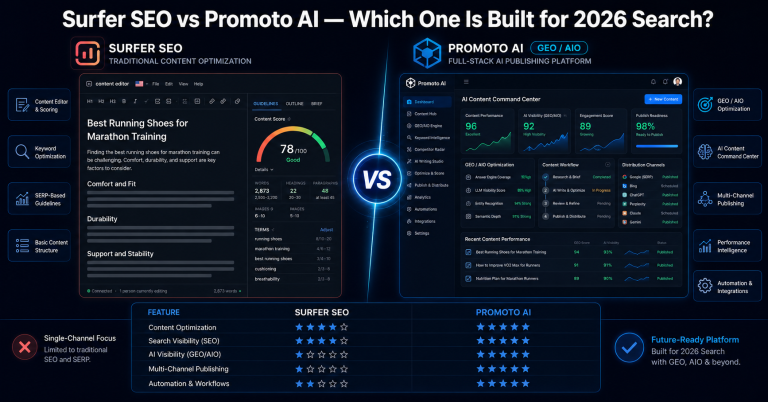
PromotoAI excels in AI-driven insights, while SEMrush dominates traditional SEO analytics. Each tool has specific strengths depending on your focus: advanced generative AI optimization or comprehensive technical SEO.
| Feature | PromotoAI | SEMrush |
|---|---|---|
| Core Focus | AI-driven optimization for SEO, AIO, ASO, and GEO workflows | Traditional SEO analytics and competitive benchmarking |
| Key Strengths | Generative AI insights, rising query tracking, SERP performance | Backlink analysis, keyword research, site audits |
| Best For | Brands targeting AI search tools like ChatGPT and Perplexity | Marketers prioritizing technical SEO and industry-standard tools |
Both tools offer robust analytics capabilities, but their strengths cater to distinct SEO strategies.
PromotoAI, on the other hand, integrates AI advancements into its analytics framework. Designed for teams optimizing for AI engines like ChatGPT and Perplexity, it surfaces rising queries, tracks SERP performance, and identifies opportunities tied to generative AI trends. This makes it particularly effective for brands aiming for visibility within AI search tools.
| Feature | PromotoAI | SEMrush |
|---|---|---|
| Keyword Research | AI-enhanced insights tailored for SEO and AIO | Broad keyword databases and search volume analysis |
| Site Audits | Focus on AI-readable content optimization | Comprehensive technical SEO audits |
| Competitive Analysis | AI-powered intelligence for generative engines | Deep historical data and competitor tracking |
| Analytics Dashboard | Real-time insights on AI visibility | Detailed traffic, ranking, and backlink data |
In our experience, both tools serve distinct needs, and the choice depends on whether your priority is traditional SEO or AI-led strategies.
How Does SEMrush Optimize Organic Growth?
SEMrush drives organic growth by providing actionable SEO data, detailed competitor analysis, and robust content marketing tools. Its technical SEO features help refine site performance for better rankings.
SEMrush’s strength lies in its ability to optimize content and websites for traditional search engines. Its keyword analysis tools identify high-performing terms, while its backlink audit features uncover opportunities for improving domain authority. The site audit functionality ensures technical SEO issues, such as page speed and broken links, are addressed efficiently.
Content marketers benefit greatly from SEMrush’s editorial calendar and topic research tools. These features help teams plan targeted campaigns that resonate with their audience. SEMrush also integrates with Google Analytics and Google Search Console, making it easier to track performance metrics and adjust strategies as needed.
While SEMrush excels in traditional SEO, it lacks the AI generative capabilities found in PromotoAI. These capabilities are critical for content visibility in modern AI-driven search engines.
Pricing, Integrations, and User Experience
PromotoAI offers competitive pricing and seamless integrations with multiple platforms, while SEMrush provides tiered pricing based on feature access. User experience varies depending on individual needs and familiarity with SEO tools.
PromotoAI’s pricing is designed to suit businesses of all sizes. Its multi-platform publishing hub supports WordPress, Shopify, Strapi, and custom CMSs, allowing teams to streamline their workflows. Additionally, the dashboard is intuitive, enabling users to track keyword performance, manage publishing schedules, and access analytics, all within one interface.
SEMrush operates on a subscription model with tiered plans. While its integrations with Google tools are highly effective, it lacks the breadth of CMS compatibility that PromotoAI offers. For agencies managing diverse client properties, PromotoAI is often the better choice for scalability.
| Aspect | PromotoAI | SEMrush |
|---|---|---|
| Pricing | Competitive, scalable plans | Tiered subscription model |
| Integrations | WordPress, Shopify, Strapi, custom CMS | Google Analytics, Google Search Console |
| User Interface | Intuitive dashboard with automation | Detailed but more complex |
When we tested both tools, PromotoAI’s ease of use and automation features clearly surpassed SEMrush for teams focused on AI optimization.
How to Choose Between PromotoAI and SEMrush
Choosing the right tool depends on your goals: opt for PromotoAI for AI-driven optimization, or SEMrush for traditional SEO analytics.
To make an informed decision, consider these steps:
- Define your primary focus: Are you optimizing for traditional search engines or AI-powered platforms?
- Evaluate your team’s workflow: Do you need advanced publishing integrations and automation?
- Review your budget: Compare the pricing plans of each tool based on feature access.
- Consider scalability: PromotoAI is ideal for businesses handling multiple properties.
- Test both tools: Take advantage of free trials to determine which fits your needs best.
Both tools have their strengths, but for generative engine optimization and AI visibility, PromotoAI provides distinct advantages. For traditional SEO, SEMrush is hard to beat.
Conclusion
When comparing PromotoAI and SEMrush, it’s clear that both tools bring valuable features to the table, but their strengths cater to different needs. SEMrush shines with its extensive suite of traditional SEO capabilities, offering deep competitive analysis and technical SEO insights that marketers have relied on for years. On the other hand, PromotoAI sets itself apart with cutting-edge AI-powered optimization for search engines, app stores, and generative platforms, delivering a unified workflow for keyword research, content creation, and publishing across multiple CMS platforms. The unique integration of AI models like GPT-4 and Gemini further ensures that PromotoAI is future-ready for brands wanting to capture visibility in AI-driven search environments.
For readers searching for ‘PromotoAI vs SEMrush,’ the intent was likely to identify which tool better supports organic growth in today’s evolving digital landscape. Now you know that while SEMrush offers a strong foundation for traditional SEO tasks, PromotoAI provides an advanced solution tailored for scaling content output, optimizing visibility in AI tools, and automating workflows. If your priority is to future-proof your business and leverage AI for maximum impact, PromotoAI is the clear choice.
Take the next step in organic growth optimization by exploring how PromotoAI’s multi-model AI engine can transform your content strategy. Start your free trial with PromotoAI today and experience the difference.
About PromotoAI
PromotoAI is an AI-powered platform specializing in SEO, AI Optimization (AIO), App Store Optimization (ASO), and Generative Engine Optimization (GEO). With seamless integrations across platforms like WordPress, Shopify, and Drupal, and advanced features such as schema.org compatibility and brand voice training, PromotoAI empowers teams to streamline workflows and drive impactful results. Trusted by global marketers for its automation and analytics capabilities, PromotoAI is redefining how brands approach organic growth in 2026.
FAQs
What is Generative Engine Optimization (GEO) and why is it important for brand visibility in AI search?
GEO focuses on optimizing content for generative AI tools to ensure brands appear in AI-driven search results. It’s crucial as AI engines increasingly shape how users discover information and recommendations.
How does PromotoAI’s multi-model AI engine create SERP-aware content optimized for both SEO and AIO?
PromotoAI uses advanced AI models to analyze search intent and generate content tailored to rank well in search engines and align with AI tool preferences.
Which tool offers better support for scaling content: PromotoAI or SEMrush?
PromotoAI excels in automated workflows for research, writing, and publishing, while SEMrush is strong in manual tools for SEO planning and analysis.
Can PromotoAI help optimize content for generative AI tools like ChatGPT?
Yes, PromotoAI specializes in crafting content designed for AI tools, ensuring compatibility with platforms like ChatGPT and enhancing visibility in AI-driven searches.
What are the key differences between PromotoAI and SEMrush?
PromotoAI focuses on AI-powered automation and multi-platform publishing, while SEMrush offers extensive manual SEO tools and competitive analysis features.
Is PromotoAI suitable for small businesses looking to grow organically?
Absolutely. PromotoAI’s automation and scalable features make it ideal for small businesses seeking to enhance visibility without large teams.
How does PromotoAI track content performance compared to SEMrush?
PromotoAI integrates with Google Analytics and Search Console to provide real-time insights, while SEMrush offers detailed keyword and competitor tracking tools.