The SEO Stack Is Broken — Here’s How AI-Driven Strategies Are Fixing It in 2026
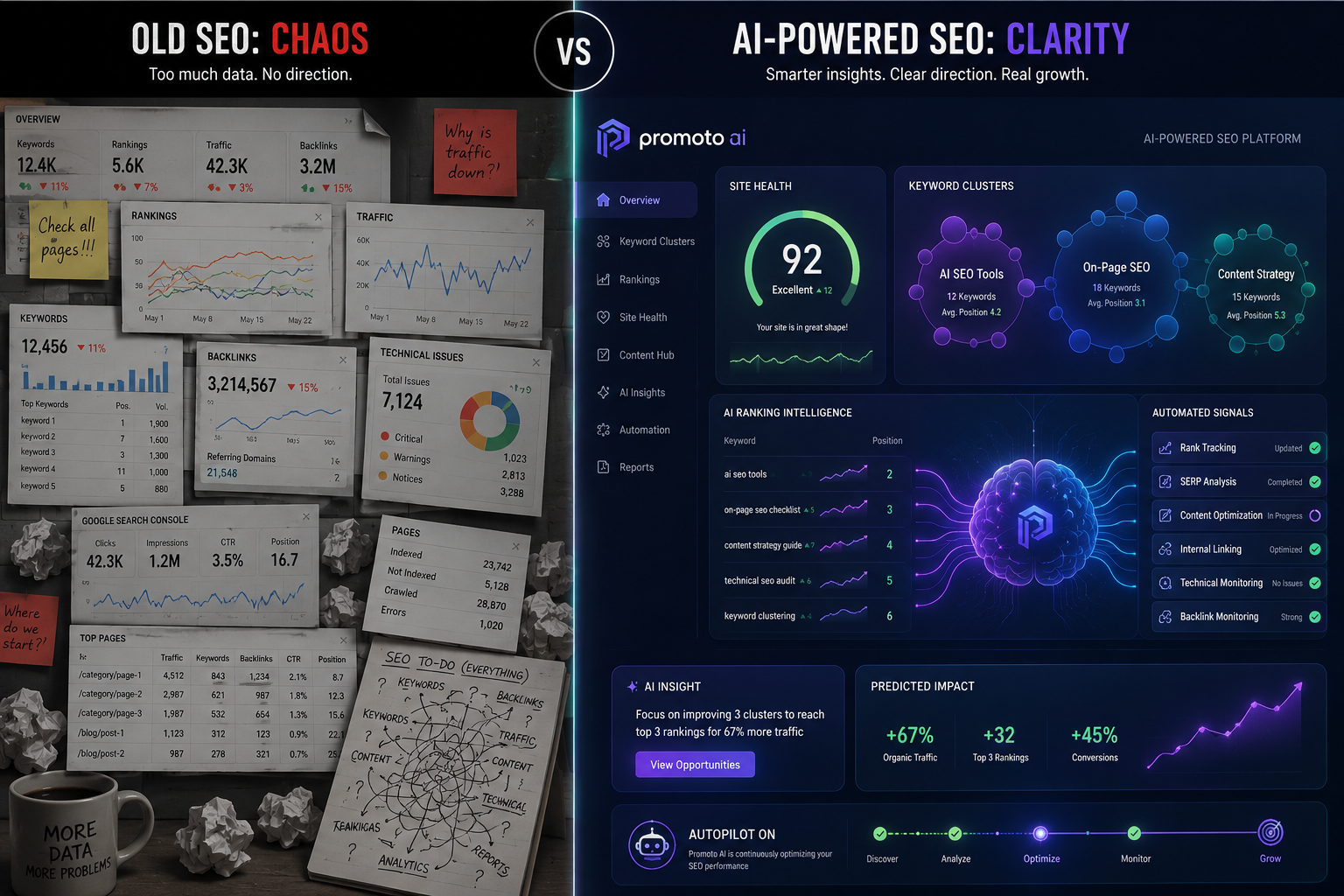
Something is quietly breaking inside most SEO workflows — and most people haven’t noticed yet.
The tools haven’t changed. The thinking hasn’t changed. But the search landscape? Completely transformed.
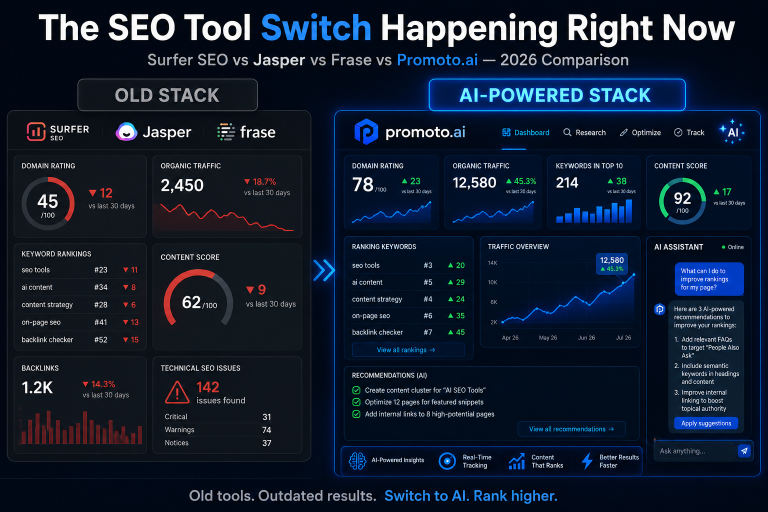
In 2026, AI answer engines, generative search results, and semantic indexing are rewriting the rules faster than traditional SEO playbooks can keep up. If your stack still relies on disconnected tools, manual audits, and guesswork-based keyword lists, you’re already falling behind the brands that have moved on.
This guide is your reset. Let’s break down what the best SEO tools in 2026 actually look like — and how AI-driven strategies are quietly becoming the only strategies that work.`
Why Traditional SEO Tools Are Losing Ground
Most SEO tools were designed for a different internet. One where Google ranked ten blue links. Where stuffing the right phrase in the right place was enough.
That era is over.
Today, Google’s AI Overviews, ChatGPT’s browsing capabilities, and Perplexity’s answer engine are reshaping how users find and trust content. Search is no longer just about ranking — it’s about being referenced by AI systems as a credible, authoritative source.
Traditional tools weren’t built for that. AI-driven SEO strategies are.
What Makes a Great SEO Tool in 2026?
Before diving into the stack, it’s worth defining what “great” means now.
A modern SEO tool should do more than pull data. It should interpret it, act on it, and ideally automate the next move. The best SEO tools in 2026 share three qualities:
- Contextual intelligence — they understand intent, not just keywords
- Cross-channel visibility — they optimize for Google and AI search engines
- Workflow integration — they connect to your CMS, analytics, and publishing pipeline
With that in mind, let’s walk through the tools and strategies that actually deliver.
AI for Keyword Research: Going Deeper Than Search Volume
Keyword research used to mean finding high-volume, low-competition phrases and sprinkling them into your content. That’s still part of the picture — but it’s the surface layer.
In 2026, the smartest brands use AI for keyword research to uncover:
- Semantic clusters — groups of related queries that signal topical authority
- Intent mapping — understanding why someone is searching, not just what
- Predictive trending — identifying rising keywords before they hit peak competition
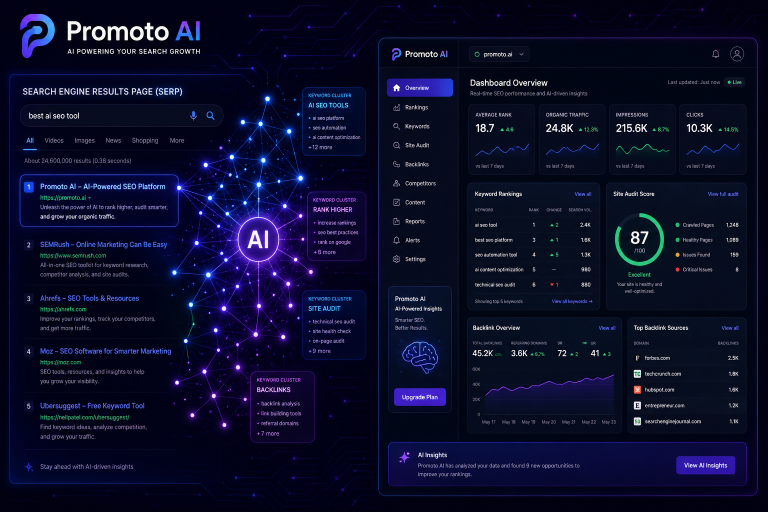
Platforms like Ahrefs and Semrush have integrated AI layers into their keyword tools. But standalone AI platforms are going further — generating full topic architectures from a single seed keyword.
Pro tip: Use Promoto AI’s Keyword Research Tool to discover semantically related terms that traditional tools miss — then map them into a content cluster strategy for compounding topical authority.
Once you have your keyword clusters, pair them with Promoto AI’s Keyword Position Tracker to monitor exactly where each cluster ranks over time, across devices and locations.
Keyword Density Checker: Still Relevant, Now Smarter
Here’s a nuanced truth: keyword density still matters — just not in the way it used to.
Over-optimization triggers Google’s spam filters. Under-optimization leaves semantic signals on the table. The sweet spot is contextual placement — using your primary phrase naturally, supported by related terms that reinforce topical relevance.
A good keyword density checker doesn’t just count occurrences. It flags over-stuffing, identifies underused semantic variants, and suggests where to naturally insert related terms for better AI comprehension.
Use Promoto AI’s Keyword Density Tool to check your content before publishing. It’s one of those deceptively simple tools that prevents costly on-page SEO mistakes — the kind that quietly tank rankings months after launch.
Site Audit Best Practices: The Foundation Nobody Talks About Enough
You can publish the best content in your niche and still rank nowhere if your technical foundation is broken.
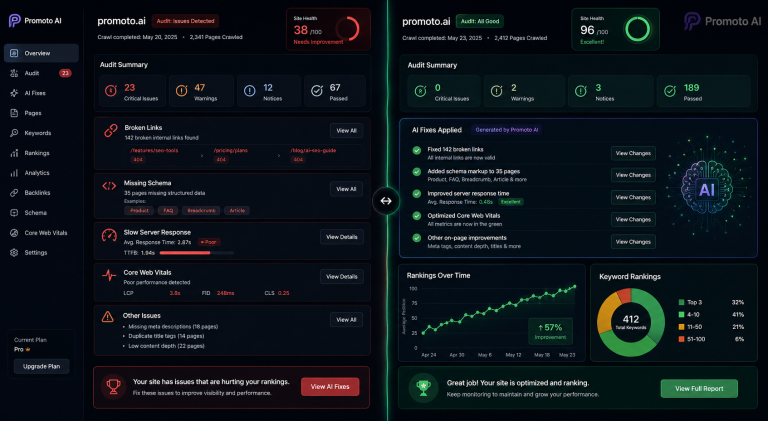
Site audits have always been essential. But in 2026, they need to catch a wider range of issues — including those that affect AI crawlability, not just Googlebot.
What a Modern Site Audit Should Cover
Core technical checks:
- Crawlability and indexability
- Page speed and Core Web Vitals
- Mobile usability
- HTTPS implementation
- Duplicate content and canonical errors
AI-era additions:
- Schema markup completeness (are you giving AI systems structured signals?)
- JSON-LD implementation
- Structured data validation
- Internal link architecture for semantic clustering
For schema validation, Schema.org remains the gold standard reference — and Google’s Rich Results Test is essential for checking structured data implementation.
Internal audit workflow: Start with Promoto AI’s Meta Tag Analyzer to catch missing or malformed meta data. Then use the Broken Links Checker to identify dead internal and external links that quietly bleed link equity.
Backlink Maker Tool: Building Authority the Right Way
Backlinks remain one of the most powerful ranking signals in 2026. But the definition of a “good” backlink has evolved significantly.
Quantity barely matters anymore. What matters is:
- Relevance — does the linking site operate in your niche?
- Authority — does Google trust that domain?
- Diversity — do links come from a range of source types?
- Context — are links editorially placed, or manufactured?
A backlink maker tool today should help you identify linkable assets, track new and lost backlinks, and flag toxic links that could trigger manual penalties.
Use Promoto AI’s Backlink Maker Tool to build initial link equity for new pages while your long-term link-earning strategy matures. Pair it with the Link Analyzer Tool to audit the quality and distribution of your existing link profile.
For deeper competitive backlink analysis, Moz’s Link Explorer and Ahrefs’ Backlink Checker offer authoritative domain-level data worth referencing alongside your own audits.
Link Analyzer Tool: Understanding What You Have Before Building More
Most brands focus on acquiring new links without properly auditing what they already have. This is a strategic mistake.
A strong link analyzer tool gives you:
- Anchor text distribution (over-optimized anchors are a red flag)
- Do-follow vs no-follow ratio
- Link velocity trends
- Internal linking gaps — pages that should be linked but aren’t
Internal linking is especially underrated for AI search visibility. When pages are logically connected, AI systems can more easily map your site’s topical authority and surface the right content in answer engines.
Promoto AI’s Link Analyzer makes this audit fast and actionable — especially when combined with the Sitemap Generator to ensure your entire crawlable architecture is structurally sound.
Server Status Checker: The Silent Ranking Factor
Here’s one most content teams overlook completely: your server’s reliability directly impacts your rankings.
If Googlebot or an AI crawler attempts to access your site and encounters repeated 5xx errors, downtime, or slow response times, your crawl budget gets wasted and your rankings suffer. Over time, persistent server issues erode the trust signals that power rankings.
A server status checker should be part of every technical SEO workflow — not as a once-monthly task, but as an ongoing health monitor.
Promoto AI’s Server Status Checker gives you a quick, reliable read on how your server is responding — an often-overlooked first step before any serious site audit or content push.
Schema Markup: Your Direct Line to AI Search Systems
If there’s one technical SEO investment that pays off disproportionately in the AI search era, it’s schema markup.
Structured data tells search engines — and AI answer engines — exactly what your content is, not just what it says. This is how you get featured snippets, rich results, and — increasingly — direct citations in AI-generated answers.
Schema Types Worth Prioritizing in 2026
- Article and BlogPosting — for content visibility
- FAQPage — for AI answer engine citation
- HowTo — for featured snippet dominance
- Organization and WebSite — for brand entity recognition
- Product and Review — for e-commerce visibility
Validate your implementation using Promoto AI’s Schema Validator before pushing to production. Cross-reference with Schema.org’s full specification for advanced markup types.
For brands building on WordPress or Shopify, Promoto AI’s platform-specific solutions — WordPress SEO and Shopify SEO — include built-in JSON-LD generation, removing the technical barrier entirely.
AI Search Visibility: Optimizing Beyond Google
Here’s the shift most SEO guides are still ignoring: Google is no longer the only search system that matters.
ChatGPT, Perplexity, Google’s AI Overview, and emerging AI-native search engines are answering millions of queries daily — often without sending users to any website at all. Being cited by these systems is the new first position.
Promoto AI calls this AIO (AI Optimization) and GEO (Generative Engine Optimization) — and they’re core to the platform’s content generation engine. Content created through Promoto AI is specifically optimized for these AI answer systems, not just traditional SERPs.
According to HubSpot’s State of Marketing Report, brands that prioritize AI-search-ready content are seeing significantly higher engagement rates as users increasingly migrate to AI-first search behaviors.
Ready to build content that ranks on both Google and AI answer engines? Explore Promoto AI’s AI Content Generation — SERP-aware drafts with built-in AIO and GEO optimization.
The Integrated SEO Stack for 2026
Here’s what an AI-driven SEO workflow actually looks like when all the pieces connect:
- Research phase → Use Keyword Research + Keyword Position to map clusters and baselines
- Content creation → Use Promoto AI’s content engine to generate SERP-aware, schema-optimized drafts
- On-page audit → Run Keyword Density + Meta Tag Analyzer before publishing
- Technical audit → Check Broken Links, Link Analyzer, and Server Status
- Schema validation → Validate structured data with Schema Validator
- Publish & track → Push to WordPress or Shopify, monitor with Analytics Dashboard
This is a closed-loop system — not a collection of disconnected tools.
Key Takeaways
- AI-driven SEO strategies require both content intelligence and technical precision — not just keyword targeting
- The best SEO tools in 2026 integrate AI, automate audits, and optimize for AI answer engines alongside Google
- Keyword research should map semantic clusters and intent, not just volume
- Schema markup and structured data are now non-negotiable for AI search visibility
- Server status, broken links, and link analysis are foundational technical checks that directly impact rankings
- Backlink quality over quantity — relevance, authority, and editorial context are what matter
- AI-optimized content must be designed to be cited by systems like ChatGPT and Google AI Overviews — not just indexed
Conclusion
SEO in 2026 isn’t harder — it’s just different. The brands winning right now aren’t necessarily spending more or publishing more. They’re working with smarter systems.
An AI-driven SEO strategy connects your keyword intelligence, technical health, content quality, and structured data into one coherent signal that both Google and AI search engines can trust. Every piece of the stack matters — from server status to schema markup.
The good news? You don’t need to build this stack from scratch. Promoto AI brings every layer of this workflow together in one platform — from keyword analysis and AI content generation to platform integrations and a real-time analytics dashboard.
If you’re ready to stop guessing and start ranking — start your free trial today. No credit card required.
More Articles
How AI Search Snippet Optimization Boosts Organic Visibility
Automating SEO Workflows with PromotoAI: A Comprehensive Guide
How to Choose the Best AI Content Tool for Scalable Organic Growth
How AI Search Snippet Optimization Boosts Organic Growth Strategies
How AI Content Visibility Boosts Organic Growth Across Digital Platforms
FAQ
1. What are the best SEO tools to use in 2026? The best SEO tools in 2026 combine AI keyword research, automated site auditing, schema markup validation, backlink analysis, and content generation optimized for both Google and AI search engines. Platforms like Promoto AI offer an all-in-one approach, while tools like Ahrefs, Semrush, and Moz complement specific research functions.
2. How does AI for keyword research differ from traditional keyword tools? Traditional tools show search volume and competition. AI-driven keyword research maps semantic clusters, predicts intent, identifies topical gaps, and generates content strategies — not just keyword lists. This makes it far more effective for building topical authority.
3. Why is keyword density still important in 2026? Keyword density helps ensure your primary and semantic terms appear naturally without over-optimization. It’s less about hitting a specific number and more about balance — enough to reinforce relevance, not so much it triggers spam filters. A keyword density checker helps you find that balance before publishing.
4. What is schema markup and why does it matter for AI search? Schema markup is structured data code (typically JSON-LD) that tells search engines and AI answer systems exactly what your content means. In 2026, it’s one of the primary ways AI systems like Google’s AI Overview and ChatGPT identify and cite trustworthy sources.
5. How often should I run a site audit? A comprehensive site audit should run monthly at minimum — and continuously for technical checks like server status and broken links. Any major site change (CMS migration, new templates, large content additions) should trigger an immediate audit.