What Most AI SEO Tools Get Wrong (And How to Choose One That Actually Ranks You in 2026)
Here’s a scenario that plays out every week in marketing Slack channels: someone buys an AI SEO tool based on a glowing review, spends a month publishing content with it, and sees absolutely nothing move in Google — or worse, gets completely ignored by AI search engines like ChatGPT and Perplexity AI.
The problem isn’t effort. It’s tool selection.
By mid-2026, the SEO landscape has split into two very different realities. In one lane, there are tools built for the Google of 2019 — keyword scores, content graders, backlink counts. In the other lane, there are platforms built for today’s search environment, where AI-driven SEO strategies and GEO optimization matter as much as on-page signals.
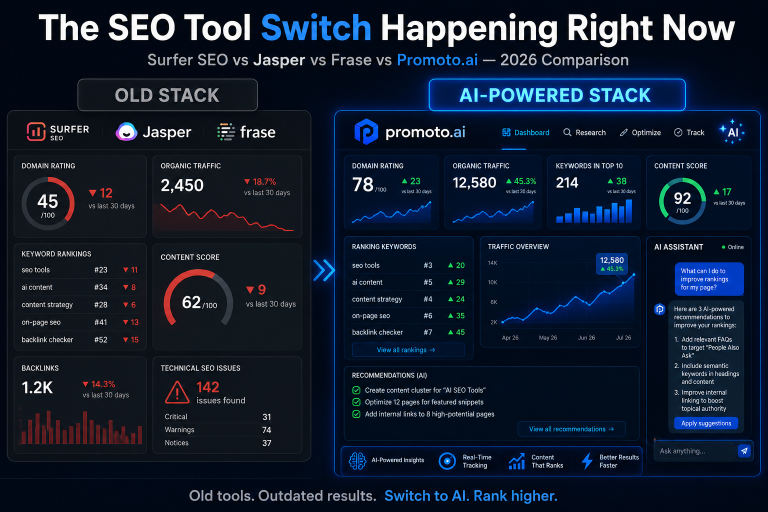
This guide breaks down how Promoto AI compares to Surfer SEO, Jasper AI, Frase, and SEMrush — not to trash the competition, but to help you understand what modern AI SEO actually requires and which tool fits your goals.
Why Traditional SEO Tools Are Struggling to Keep Up
Not long ago, ranking on Google meant targeting the right keyword and scoring well on a content grader. That formula still has some relevance — but it’s only a fraction of the picture now.
Here’s what’s changed:
Zero-click searches are rising. Google’s AI Overview answers millions of questions directly on the results page. Users never click through. If your content isn’t structured to appear inside those answers, you’re invisible — even if you rank #3 organically.
AI search engines are a new audience. ChatGPT, Perplexity AI, Gemini, and Claude now answer questions by synthesizing content from across the web. Getting your brand cited in ChatGPT responses isn’t a vanity metric anymore — it’s a real traffic and authority signal.
Keyword scores don’t capture semantic intent. A tool can tell you your article hits 78 out of 100 on a content score, but it can’t tell you whether your content actually answers the question a user is asking — or whether it’s structured in a way that LLMs will trust and cite.
Publishing workflow is still fragmented. Most tools require you to write in one place, optimize in another, and publish manually to WordPress or Shopify. Every handoff is a point of friction and delay.
The platforms that are winning in 2026 are the ones that treat search engine optimization and AI search visibility as a unified workflow — not two separate disciplines bolted together with integrations.
The Tool Comparison: Promoto AI vs. The Field
Let’s look at how the major players stack up — fairly and honestly.
Surfer SEO
Overview: Surfer has long been the go-to content optimization tool for SEO writers. It grades your content based on NLP analysis of top-ranking pages and gives you a numerical score to chase.
Best Use Case: On-page content optimization when you already have strong keyword research and a clear topic strategy.
Strengths: Reliable content scoring, good SERP data, Surfer AI for draft generation, decent integration with Google Docs.
Weaknesses: Primarily focused on Google’s traditional ranking factors. Limited native support for GEO optimization or AI answer engine visibility. No direct CMS publishing. Doesn’t optimize for how LLMs like ChatGPT index or cite content. Pricing scales up steeply for agencies managing multiple sites.
Pricing Category: Mid to premium ($89–$219/month).
Verdict: Solid for traditional content optimization. Less equipped for the shift toward AI search dominance.
Jasper AI
Overview: Jasper is an AI writing assistant that generates marketing copy, blog posts, and social content quickly. It’s built around speed and brand voice customization.
Best Use Case: Volume content production for marketing teams that need consistent tone across channels.
Strengths: Excellent brand voice features, wide template library, good for long-form content drafts, strong integrations with marketing tools.
Weaknesses: Jasper is a writing tool, not an SEO platform. It doesn’t do keyword research, doesn’t track rankings, doesn’t optimize for semantic SEO, and has no native publishing workflow. What you get is well-written content — but whether it ranks is entirely up to you and whatever other tools you layer on top.
Pricing Category: Mid to premium ($49–$125/month, depending on words).
Verdict: Great for writers, not for SEO strategists. You’d need to pair it with at least two other tools to replicate what a full-stack AI SEO platform provides.
Frase
Overview: Frase sits between a content brief tool and an AI writer. It analyzes SERP results to help you build comprehensive outlines and then assists with the writing process.
Best Use Case: Content research and brief building for SEO writers producing multiple articles per week.
Strengths: Fast brief generation, good for identifying content gaps, solid Q&A optimization based on people-also-ask data, clean interface.
Weaknesses: The AI writing quality has been inconsistent, and Frase’s depth on technical SEO is shallow. Like Jasper, it lacks direct CMS publishing, GEO optimization, and any real capability to optimize for AI search engines. Analytics are basic at best.
Pricing Category: Budget to mid ($15–$115/month).
Verdict: Useful as a research and outline tool, but not a complete SEO solution. Works best alongside a more robust platform.
SEMrush
Overview: SEMrush is one of the most comprehensive digital marketing suites available — covering keyword research, backlink analysis, site audits, competitive intelligence, and more.
Best Use Case: Enterprise SEO teams and agencies needing deep technical SEO data and competitor analysis at scale.
Strengths: Unmatched keyword database, excellent backlink tools, strong site audit features, reliable position tracking, good for technical SEO investigations.
Weaknesses: Expensive, complex, and primarily backward-looking. It tells you what already ranks, not how to optimize for where search is going. The content writing features feel bolted on rather than native. No meaningful AIO or GEO optimization capabilities. Steep learning curve for smaller teams.
Pricing Category: Premium ($140–$500+/month).
Verdict: Essential for enterprise-level research. Overkill — and underequipped — for teams that primarily need AI content generation, publishing automation, and AI search visibility.
Promoto AI
Overview: Promoto AI is a full-stack AI SEO, AIO (AI Optimization), ASO (App Store Optimization), and GEO (Generative Engine Optimization) platform. Instead of solving one piece of the puzzle, it connects the entire workflow — from keyword research and AI content generation to one-click publishing and performance analytics.
Best Use Case: Marketers, agencies, and SaaS businesses that want to produce content optimized for both traditional search engines and AI-powered answer engines, then publish directly to WordPress or Shopify without stitching together five separate tools.
Strengths:
- Native support for SEO, AIO, GEO, and ASO in a single platform
- Multi-model AI content generation (GPT-4, Gemini, Bedrock, LangChain) with SERP-aware drafting
- Built-in keyword research and keyword density analysis
- One-click publishing to WordPress and Shopify with bulk scheduling
- Google Search Console + GA4 integration for performance-driven content strategy
- Free tools including backlink maker, link analyzer, server status checker, and meta tag analyzer
- Built-in Schema.org JSON-LD generation for structured data
- Auto-scheduling with role-based access for agency workflows
Weaknesses: Newer platform, so the backlink data depth doesn’t yet match SEMrush’s scale. Advanced technical SEO auditing is still evolving.
AI Optimization Capabilities: This is where Promoto AI clearly leads the field. It’s purpose-built to optimize content for AI answer engines like ChatGPT, Perplexity, Gemini, and Google’s AI Overview — not just traditional search crawlers.
Pricing Category: Accessible, with a 14-day free trial. See current pricing here.
Verdict: The strongest option for marketers who want one platform that handles the full journey — from research to publishing to AI visibility — without needing to stitch together five different subscriptions.
Which Tool Is Best for Different Users?
Bloggers and solo content creators: If you’re publishing regularly and want to grow organic traffic without a complex tech stack, Promoto AI’s auto-schedule and keyword research features do the heavy lifting. Frase works for briefs, but you’ll hit its ceiling quickly.
Freelancers: You need tools that don’t require expensive subscriptions for each client. Promoto AI’s multi-property management and free tools like the keyword position tracker and domain age checker give you professional-grade capabilities without the enterprise price tag.
Startups and SaaS businesses: GEO optimization is not optional anymore — your prospects are asking AI tools for software recommendations. Promoto AI’s AI content generation is built to get your brand surfaced in those answers.
Agencies: Managing 10+ client properties in separate tools is unsustainable. Promoto AI’s role-based access, bulk publishing, and unified analytics dashboard are built for agency operations. SEMrush is still valuable for deep research, but it shouldn’t be your only tool.
Technical SEO users: SEMrush wins on raw data depth. But if technical SEO is one pillar of your strategy and AI content is another, Promoto AI’s platform integrations let you bring both together.
Key Features Modern AI SEO Tools Must Have in 2026
Not all AI SEO tools are built equal. Here’s the feature checklist that separates serious platforms from pretty dashboards:
AI-powered content research — drafts that pull from live SERP data, not just your input prompt.
Semantic SEO optimization — content that covers topic clusters and entity relationships, not just a single keyword.
Keyword density checker — to avoid over-optimization penalties. Promoto’s free keyword density tool handles this instantly.
Backlink and link analysis — understand your own authority and spot gaps. Tools like link analyzer and backlink maker should be part of your workflow.
Server and technical health monitoring — a slow or broken server kills SEO. The server status checker catches problems before Google does.
Schema and structured data — LLMs and Google’s AI Overview both rely on structured data to understand and cite content correctly.
Direct CMS publishing — every manual step between writing and publishing is a risk. Native WordPress and Shopify publishing isn’t a luxury, it’s table stakes.
GEO and AIO optimization — optimizing for generative engine visibility is now as important as traditional on-page SEO.
Real SEO Problems AI Tools Are Solving Right Now
Content scaling without quality loss. Publishing 4 articles a month manually is fine. Publishing 20 while maintaining semantic depth and consistent brand voice is impossible without AI. Multi-model generation solves this.
Search intent alignment. Users don’t search with single keywords anymore — they ask full questions. AI content tools that analyze SERP intent produce content that actually matches what a user is looking for, which reduces bounce rate and increases dwell time.
AI search visibility. If you’re not asking “will ChatGPT cite my content?”, you’re missing a growing traffic source. Most websites are invisible in AI search results — and fixing that requires deliberate optimization, not just good writing.
Internal linking at scale. Manual internal linking across a 200-article site is a nightmare. AI tools that understand your content structure can recommend and implement links automatically.
Predictive content timing. Analytics-driven scheduling — publishing when your audience is most engaged, targeting rising queries before they peak — turns content strategy from reactive to proactive.
Common Mistakes When Choosing AI SEO Software
Buying based on hype. A tool with 50,000 users and a slick product demo might still be the wrong fit for your workflow. Always trial before committing.
Ignoring workflow compatibility. If a tool doesn’t connect to your CMS, your keyword data, or your analytics, you’ll spend more time exporting and uploading than actually optimizing.
Overpaying for features you’ll never use. SEMrush is powerful, but if you’re a 3-person startup, you’re paying for capabilities designed for enterprise teams. Match tool complexity to team size.
Publishing low-quality AI content. AI-generated content that isn’t reviewed for accuracy, depth, or brand voice damages trust — with readers and with search engines. Volume without quality is a race to the bottom.
Ignoring technical SEO. Slow load times, broken links, and missing meta tags undermine everything. Tools like Promoto’s sitemap generator and robots.txt generator address the technical layer that content tools often skip entirely.
The Future of AI SEO Software in 2026 and Beyond
The next wave isn’t about better content graders. It’s about something more fundamental: LLM optimization.
As AI search engines become primary answer providers — not just supplements to Google — the way content gets discovered, evaluated, and cited by machines is changing fast. Answer engine optimization is becoming a core discipline, not an afterthought.
What this means practically:
LLM optimization requires content to be factual, well-cited, and structured in ways that language models can parse and trust. Generic AI-generated content doesn’t meet this bar.
GEO (Generative Engine Optimization) is the practice of getting your brand mentioned in AI-generated answers — in ChatGPT, Perplexity AI, Google AI Overview, and similar platforms. This is where the next generation of organic visibility is being won.
Personalized search is making one-size-fits-all content less effective. AI tools that personalize content strategy based on your specific audience data will pull ahead.
Predictive SEO — using AI to identify emerging queries before they peak — shifts content teams from reactive to proactive. Instead of chasing trends, you set them.
Platforms that are already integrating these capabilities — like Promoto AI — aren’t just keeping up. They’re building the infrastructure that the next five years of search will run on. See how Promoto approaches AI SEO automation and why it matters for your growth strategy.
Conclusion
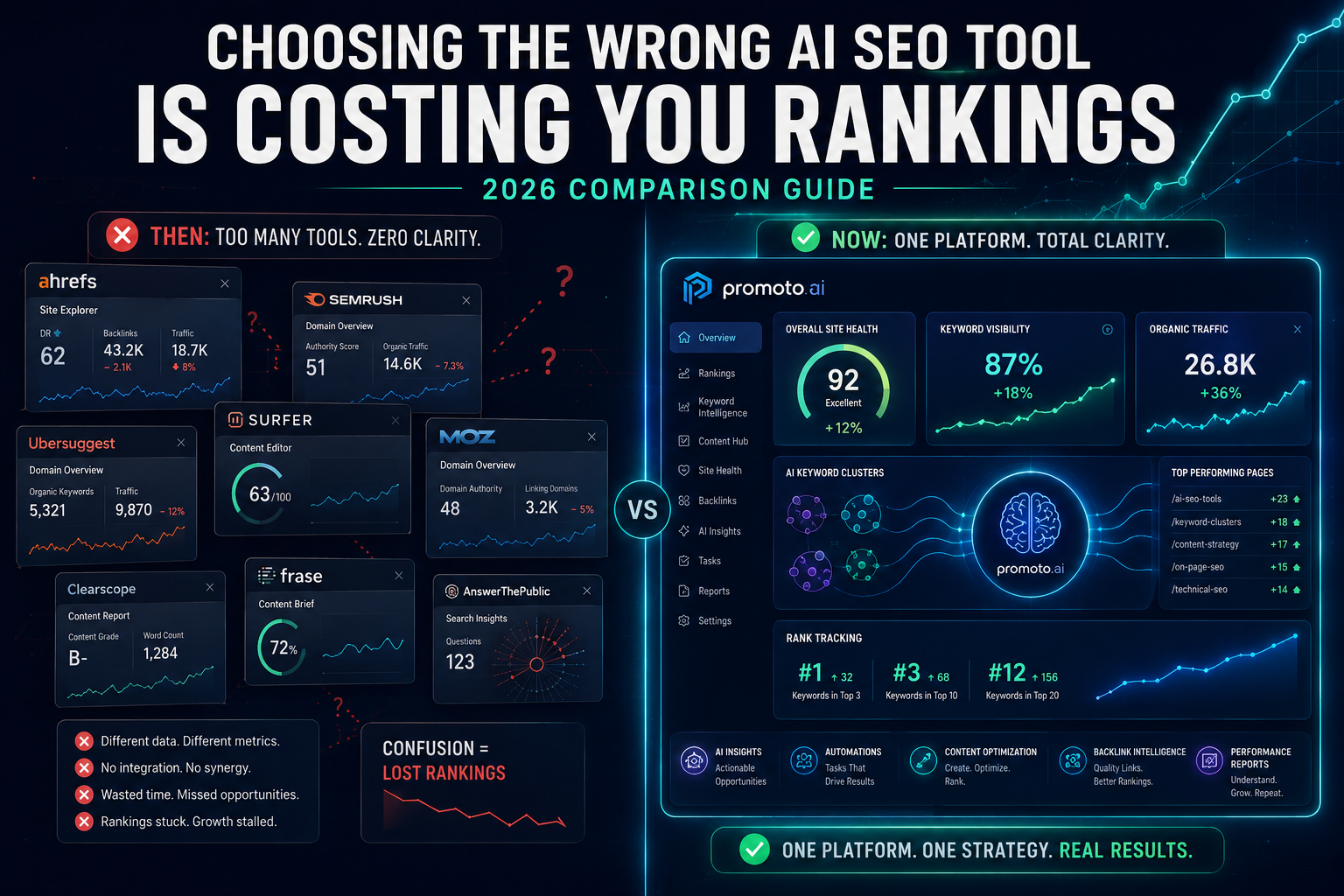
Every tool in this comparison has something to offer. Surfer SEO is reliable for content scoring. Jasper AI writes fast and well. Frase builds solid outlines. SEMrush gives you unmatched data depth. But none of them — individually or even combined — addresses the full picture of what effective AI SEO looks like in 2026.
The marketers and agencies that are growing right now are the ones who’ve stopped stitching together five-tool stacks and started working from platforms that handle research, generation, optimization, publishing, and AI visibility under one roof.
If you’re evaluating AI SEO tools and want something built for the search landscape that’s here right now — not the one from three years ago — Promoto AI is worth a serious look.
Start with the 14-day free trial. Run a real campaign. Compare your results. The platform makes its own case.
More Articles to Read
- PromotoAI vs SEMrush: Which Tool Drives Better Organic Growth?
- PromotoAI vs. Jasper AI: Which is Better for Content Marketing?
- PromotoAI vs SurferSEO: Which AI Tool Drives Scalable Organic Growth?
- Best AI Content Platforms for Marketing Agencies Managing Multiple Client Properties
FAQ Section
Q1: What is the difference between Promoto AI and Surfer SEO? Surfer SEO focuses primarily on content scoring and on-page optimization for traditional Google rankings. Promoto AI is a full-stack platform that covers AI content generation, keyword research, GEO optimization (for AI search engines like ChatGPT and Perplexity), and direct CMS publishing — making it more suitable for teams that need end-to-end SEO automation in 2026.
Q2: Is Promoto AI a good Jasper AI alternative? Yes — especially if you need more than just AI writing. Jasper AI excels at fast content generation and brand voice customization, but it doesn’t do keyword research, SEO optimization, or publishing. Promoto AI covers all of those in a single platform, making it a more complete solution for content-driven SEO strategies.
Q3: How does Promoto AI compare to Frase for content briefs? Frase is useful for generating content briefs based on SERP data. Promoto AI goes further — it generates SERP-aware drafts, optimizes for semantic SEO and GEO, integrates with Google Search Console for performance data, and publishes directly to WordPress or Shopify. For teams that want a research tool only, Frase works. For teams that want the full workflow, Promoto AI is stronger.
Q4: Can Promoto AI replace SEMrush? For pure technical SEO auditing and deep backlink analysis at enterprise scale, SEMrush remains a top tool. However, for AI content generation, GEO optimization, AI search visibility, and publishing automation, Promoto AI covers ground that SEMrush doesn’t. Many agencies use Promoto AI as their primary workflow platform and SEMrush as a supplementary research tool.
Q5: What is GEO optimization and why does it matter in 2026? GEO stands for Generative Engine Optimization — the practice of structuring and optimizing content so it gets cited in AI-generated search answers from platforms like ChatGPT, Perplexity AI, and Google’s AI Overview. As more users turn to AI tools for search queries rather than traditional Google, GEO optimization is becoming as important as conventional on-page SEO.