The LLM SEO Playbook: How to Engineer Your Brand Into Every AI Answer (Before Your Competitors Do)
Here’s what no one warned you about when AI search went mainstream.
A potential customer opens Perplexity AI and types: “What’s the best platform for AI-powered SEO?”
Perplexity responds instantly. It names three tools. Explains each one. Links to two of them.
Your brand isn’t there. Not because your product isn’t good enough — but because the AI literally doesn’t know you exist in a way it can trust.
This is the quiet catastrophe playing out across thousands of industries right now. And the brands that understand why it’s happening — and how to reverse it — are pulling ahead at a pace traditional SEO simply can’t match.
The solution isn’t more blog posts. It’s not better backlinks. It’s a fundamentally different discipline: LLM SEO optimization. And once you understand how it actually works, you’ll never look at your content strategy the same way again.
What LLM SEO Optimization Actually Means (And Why It’s Different)
Most people still think of SEO as a relationship with Google’s crawlers. Write good content, earn links, optimize your title tags, watch your rankings climb. That model made sense for two decades.
But the emergence of large language models as search interfaces breaks that loop entirely.
When someone asks ChatGPT a question, there’s no SERP to rank on. No position one. No page two. There’s just an answer — and either your brand is part of it or it isn’t. The same is true for Perplexity AI, Google’s AI Overviews, Microsoft Copilot, and every other generative answer engine pulling from the web.
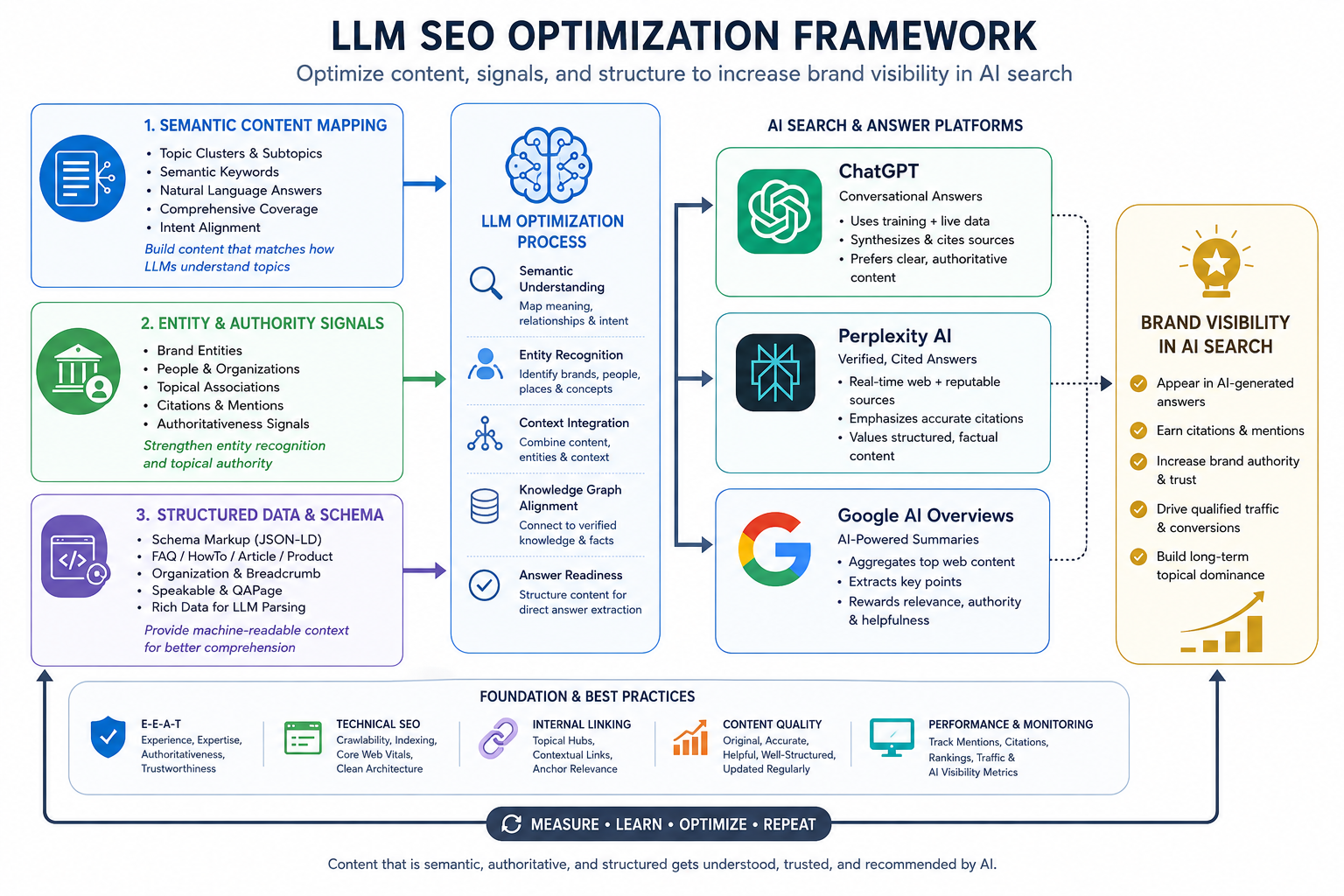
LLM SEO optimization is the discipline of structuring your content, entity presence, and digital footprint so that AI language models understand who you are, what you’re authoritative about, and why they should surface you when a relevant question is asked.
It’s not a replacement for traditional SEO — it’s an evolution of it. And the brands winning right now are doing both.
Why Most Content Is Invisible to AI Answer Engines
Before you can fix the problem, you need to understand what’s causing it.
Large language models don’t read your website the way a human does. They build a probabilistic understanding of your brand based on signals collected across their training data and real-time retrieval systems. Those signals come from several distinct sources:
- Entity recognition: Has your brand been mentioned frequently enough, across authoritative enough sources, to be considered a “known entity”?
- Topical authority: Is your content consistently associated with specific, well-defined topics — or is it scattered across dozens of loosely related subjects?
- Semantic clarity: When an AI parses your content, does it clearly understand the relationships between concepts you cover, not just the keywords you use?
- Structured signals: Have you used schema markup and structured data to tell machines what your content is, not just what it says?
- Citation patterns: Is your content being cited, referenced, or linked to in ways that build trust signals across the broader web?
Most websites fail on at least three of these five dimensions. The result isn’t a bad ranking — it’s complete absence from AI-generated answers.
This is why Promoto AI’s GEO optimization capabilities take a fundamentally different approach to content generation. The platform builds these signals into every piece of content it creates — not as an afterthought, but as the foundation.
The Four Pillars of a Scalable LLM SEO Framework
Pillar 1: Semantic Content Architecture
Keyword density is dead. Semantic relevance is everything.
AI models don’t look for exact-match phrases — they model meaning. They understand that “best tool for automated blog publishing” and “platform for AI-powered content scheduling” are variations of the same intent. What they reward is content that thoroughly covers a topic from multiple angles, addresses related questions, and connects ideas in ways that mirror how an expert would actually think about the subject.
This is what semantic SEO content strategy looks like in practice:
- Topic clusters over isolated articles. Build a pillar page that defines your core subject deeply, surrounded by supporting content that covers every meaningful sub-topic. The goal is to become the most complete resource on a subject, not just the most keyword-optimized one.
- Concept mapping before writing. Before a single word is drafted, map out the entities, subtopics, and questions your content should address. Tools like Promoto AI’s Keyword Analysis can identify semantic gaps in your existing coverage.
- NLP-aware sentence construction. Write in clear, declarative statements when explaining concepts. AI systems extract information more reliably from content that follows subject-predicate-object patterns rather than flowing literary prose.
Pillar 2: Entity Building and Brand Authority
If Google’s Knowledge Graph doesn’t know you exist as an entity, AI models are far less likely to surface you confidently.
Entity SEO is the practice of ensuring that AI systems — and the structured web they rely on — have consistent, clear, cross-referenced information about who you are. This means:
- Consistent NAP data (name, address, phone) across directories, your website, and structured profiles
- A well-maintained Google Business Profile with complete category and description data
- Wikipedia or Wikidata presence for brands with sufficient notability
- Author entity pages that establish the humans behind your content as credible, named experts with verifiable credentials
- Social profile completeness and cross-linking between your site and official social accounts
This might sound like basic digital housekeeping — and it is. But the brands that have done it thoroughly are the ones AI models reference by name when answering questions in their space.
Pillar 3: Structured Data Implementation
This is the most underleveraged tactic in the entire AI search visibility playbook, and the gap between brands that have done it and brands that haven’t is growing wider every quarter.
Structured data — specifically Schema.org JSON-LD markup — is how you speak directly to machines. When you implement it correctly, you’re not just hinting at what your content covers. You’re providing a machine-readable contract that says: “This page is an Article. The author is [Name]. The topic is [Subject]. Here is a summary in 160 characters. Here are the key questions this content answers.”
For answer engine optimization, the most impactful schema types to implement are:
FAQPage— Directly feeds structured Q&A pairs into AI answer poolsHowTo— Signals actionable, step-by-step content that AI assistants love to pull fromArticlewithauthoranddateModified— Establishes freshness and attributionOrganizationwithsameAslinks to your social profiles — Builds entity connectionsBreadcrumbList— Reinforces topical hierarchy and content relationships
Promoto AI’s Schema Validator tool can audit your existing structured data for errors before you submit, and the platform’s AI Content Generation automatically includes JSON-LD as part of every article it produces.
Pillar 4: Answer-First Content Formatting
Here’s a counterintuitive truth about optimizing for AI answer engines: the format of your content matters as much as the substance.
AI systems — particularly retrieval-augmented generation (RAG) models like the one powering Perplexity AI — pull passages from web content, not entire pages. They’re looking for clear, self-contained answers that can be extracted and presented without losing their meaning.
Optimized content for Perplexity AI and ChatGPT tends to share these structural characteristics:
- Direct answer in the first two sentences. Don’t bury the lead. State your position or conclusion immediately, then support it.
- Definitions placed near the top. When introducing a concept, define it clearly before you elaborate. AI models prioritize definitional clarity.
- Short paragraphs (2–4 sentences). Dense walls of text are harder to extract from. Short, complete paragraphs are more likely to surface intact in AI answers.
- Headers as questions. Phrasing your H2 and H3 headings as the actual questions your audience is asking dramatically improves the likelihood that your content matches query intent in AI systems.
- Numbered lists for processes, bullets for attributes. These formats make information extractable in a way that flowing prose doesn’t.
How to Actually Rank in ChatGPT Answers: The Overlooked Signal Stack
People ask constantly: how to rank in ChatGPT answers? The honest answer is that there’s no single lever. But there is a signal stack — a layered set of trust indicators that, when built consistently, increase the probability that AI models treat your brand as a reliable source.
The five signals that matter most:
- Citation frequency in authoritative publications. When Forbes, TechCrunch, Search Engine Journal, or industry-specific publications mention your brand in the context of your core topic, that’s an extremely high-value signal.
- Reddit and forum presence. This surprises most marketers. But AI models trained on web data absorb enormous amounts of Reddit content. Genuine, helpful brand mentions on relevant subreddits build real signal.
- YouTube transcript indexing. AI crawlers process video transcripts. Authoritative video content on your subject area — even if the channel is modest in size — contributes to topical authority.
- Consistent content publication cadence. AI models weight recency in retrieval. A brand that publishes relevant, high-quality content consistently is treated as more authoritative than one that publishes sporadically.
- Internal link architecture. Well-structured internal linking reinforces topical relationships and makes your knowledge map legible to both traditional and AI crawlers.
Promoto AI’s Analytics Dashboard tracks ranking movement and content performance across traditional and AI search contexts, giving you the visibility to know which signals are actually moving.
The Compounding Advantage: Why Early Movers Win
There’s a dynamics argument that rarely gets made clearly enough in the AI SEO conversation.
AI models build associations over time. A brand that establishes strong entity presence, topical authority, and structured data signals today will be the default assumption in those models tomorrow — not because the algorithm is loyal, but because the training data and retrieval patterns will consistently reinforce that association.
This is scalable organic growth in its most literal sense. The work you do today to build AI-readable authority isn’t just optimizing for today’s search landscape. You’re building an asset that compounds in value as AI search continues to expand — and it will continue to expand.
The window for being an early mover in your category is still open. But it’s narrowing.
Where to Start: A Practical First-Week Action Plan
You don’t need to rebuild your entire content operation overnight. Here’s a sequenced starting point:
Day 1–2: Entity audit. Check your brand’s Knowledge Panel status, review NAP consistency across the web, and identify any conflicting information about your brand that might be confusing AI systems.
Day 3–4: Schema audit. Use a tool like Promoto AI’s Schema Validator to check what structured data you currently have, identify errors, and prioritize which pages need FAQPage and HowTo markup first.
Day 5–7: Content gap mapping. Identify your top five commercial topics and audit whether your existing content addresses the full semantic field around each one. Map out the cluster, identify missing nodes, and brief the content.
From there, the goal is systematization — building the kind of consistent, structured, AI-readable content operation that tools like Promoto AI’s AI Content Generation platform are designed to support at scale.
The Brands That Will Win AI Search Aren’t Just Creating More Content
They’re creating smarter content. Content that understands the machine before it tries to speak to the human. Content that earns topical authority through depth, not just volume. Content with enough structural integrity that an AI can extract a clean, confident answer from it and attribute it to a specific brand.
That’s the real promise of LLM SEO optimization. Not just ranking in one more channel — but building the kind of digital presence that earns trust from the systems increasingly deciding what the world reads.
The playbook is still young. The opportunity is genuinely significant. And the brands moving on it right now are building advantages that will be very hard to replicate twelve months from now.
KEY TAKEAWAYS
- LLM SEO optimization is distinct from traditional SEO — it’s about making your brand intelligible, trustworthy, and citable to AI language models, not just Google’s crawlers.
- AI answer engines like ChatGPT and Perplexity AI surface brands based on entity recognition, topical authority, semantic clarity, structured data signals, and cross-web citation patterns.
- Semantic content architecture — topic clusters, concept mapping, and NLP-aware writing — is more important than keyword density in AI search contexts.
- Structured data implementation (especially FAQPage, HowTo, and Article schema) is the most underleveraged tactic for AI search visibility and should be a baseline for every published page.
- Answer-first content formatting — direct opening answers, definitional clarity, short paragraphs, question-phrased headers — dramatically improves how well AI systems can extract and attribute your content.
- The brands investing in these signals today are building compounding advantages that will be increasingly difficult to replicate as AI search continues to grow.
CTA SECTION
Ready to Engineer Your Brand Into the AI Answer Stack?
You now have the framework. The next step is execution — and that’s where most brands stall.
Promoto AI is built specifically for the AI search era. From structured content generation that includes JSON-LD schema automatically, to keyword analysis that maps the full semantic field around your core topics, to analytics that show you exactly how your AI search presence is performing — it’s a single platform designed to make LLM SEO optimization scalable.
Start your free 14-day trial → No credit card required. No complex setup. Just AI search visibility, built systematically.
Or explore how Promoto AI helps brands rank on AI engines to see the full capability set.
More Articles
How AI Search Snippet Optimization Boosts Organic Visibility
Automating SEO Workflows with PromotoAI: A Comprehensive Guide
How to Choose the Best AI Content Tool for Scalable Organic Growth
How AI Search Snippet Optimization Boosts Organic Growth Strategies
How AI Content Visibility Boosts Organic Growth Across Digital Platforms
FAQ SECTION
Q1: What is LLM SEO optimization and how is it different from traditional SEO?
LLM SEO optimization is the practice of structuring your content, entity presence, and digital signals so that large language models — like those powering ChatGPT, Perplexity AI, and Google’s AI Overviews — understand, trust, and surface your brand when answering relevant questions. Unlike traditional SEO, which focuses on ranking positions in a SERP, LLM SEO optimization targets inclusion in AI-generated answers where there is no ranked list — only a response.
Q2: How does answer engine optimization differ from search engine optimization?
Answer Engine Optimization (AEO) focuses specifically on earning placement in direct, AI-generated answers rather than ranked search results. Where traditional SEO optimizes for clicks and position, AEO optimizes for citation — ensuring that when an AI system constructs an answer, your brand is the one it draws from. The techniques overlap but the success metrics and content structures are meaningfully different.
Q3: What structured data types are most important for AI search visibility?
The most impactful schema types for AI answer engine visibility are FAQPage (which feeds Q&A pairs directly into AI retrieval systems), HowTo (for actionable, step-by-step content), Article with complete author and dateModified fields, and Organization with sameAs cross-links to verified social profiles. These schema types help AI crawlers understand not just what your content says, but what type of information it represents.
Q4: How do I get my brand cited in Perplexity AI or ChatGPT responses?
Earning citations in AI-generated responses requires building a layered signal stack: consistent entity presence across the web, topical authority built through comprehensive content clusters, structured data markup on key pages, citations in authoritative third-party publications, and genuine mentions in community forums and discussion platforms that AI training data sources heavily. There’s no single shortcut — but the brands that have built all five layers are being cited consistently.
Q5: What is semantic SEO and why does it matter for AI-first search?
Semantic SEO is the practice of optimizing content for meaning and conceptual relationships rather than exact-match keywords. It matters enormously for AI search because language models don’t match keywords — they model meaning. Content that comprehensively covers a topic, connects related concepts, and uses natural, expert-level language is far more likely to be treated as authoritative by AI systems than content that merely repeats target keywords at an optimized density.