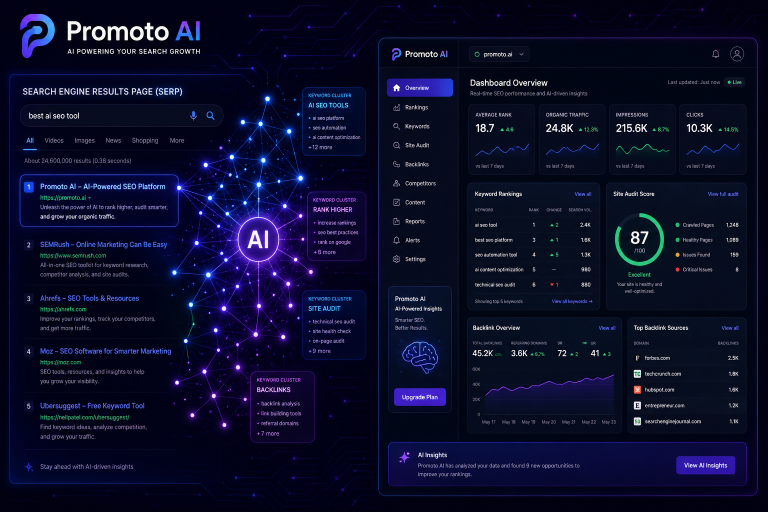
The Hidden SEO Stack: How AI-Driven Keyword Research and Technical Tools Are Quietly Rewriting Rankings in 2026
Most SEO professionals think they have a solid strategy. A few tools, some keyword research, regular publishing. It feels like enough.
But quietly, something has changed. AI search engines are rewriting what “ranking” even means. And the teams that haven’t updated their technical SEO stack are already losing ground they don’t even know they’ve lost.
This guide is your wake-up call — and your action plan.
Why Your Current SEO Stack Might Already Be Outdated
We’re no longer optimizing for a single algorithm. In 2026, your content needs to perform across Google, AI Overviews, ChatGPT, and Perplexity simultaneously.
That shift demands more than great writing. It demands a smarter technical foundation — one built around AI-assisted workflows, semantic signals, and real-time diagnostics.
Traditional tools weren’t designed for this. Most were built when Google was the only answer engine that mattered.
The good news? A new generation of AI-driven SEO strategies and free technical tools has emerged to fill that gap — and many of them are more accessible than you’d expect.
What AI-Driven SEO Strategies Actually Look Like in 2026
It’s Not About More Content — It’s About Smarter Signals
The old playbook said: publish more, target more keywords, build more links. Volume was the strategy.
AI-driven SEO is different. It’s about semantic depth, entity relationships, and structured signals that help both Google and AI engines understand your content’s true context.
Think of it this way: traditional SEO tells search engines what your page is about. AI-driven SEO tells them why it matters, who it’s for, and how it fits into a broader knowledge graph.
That’s a fundamentally different job — and it requires fundamentally different tools.
The Core Technical SEO Stack You Need Right No1. Start With a Site Audit You Can Actually Trust
A thorough website audit is the non-negotiable starting point. Before you optimize a single page, you need to know what’s broken, what’s slow, and what’s leaking crawl budget.
Site audit best practices in 2026 include:
- Identifying orphaned pages and crawl dead-ends
- Flagging duplicate meta tags and thin content
- Catching Core Web Vitals failures before they kill rankings
- Detecting mobile usability issues across device segments
AI-enhanced audit platforms go further. They don’t just surface problems — they prioritize them by estimated ranking impact, saving hours of manual triage.
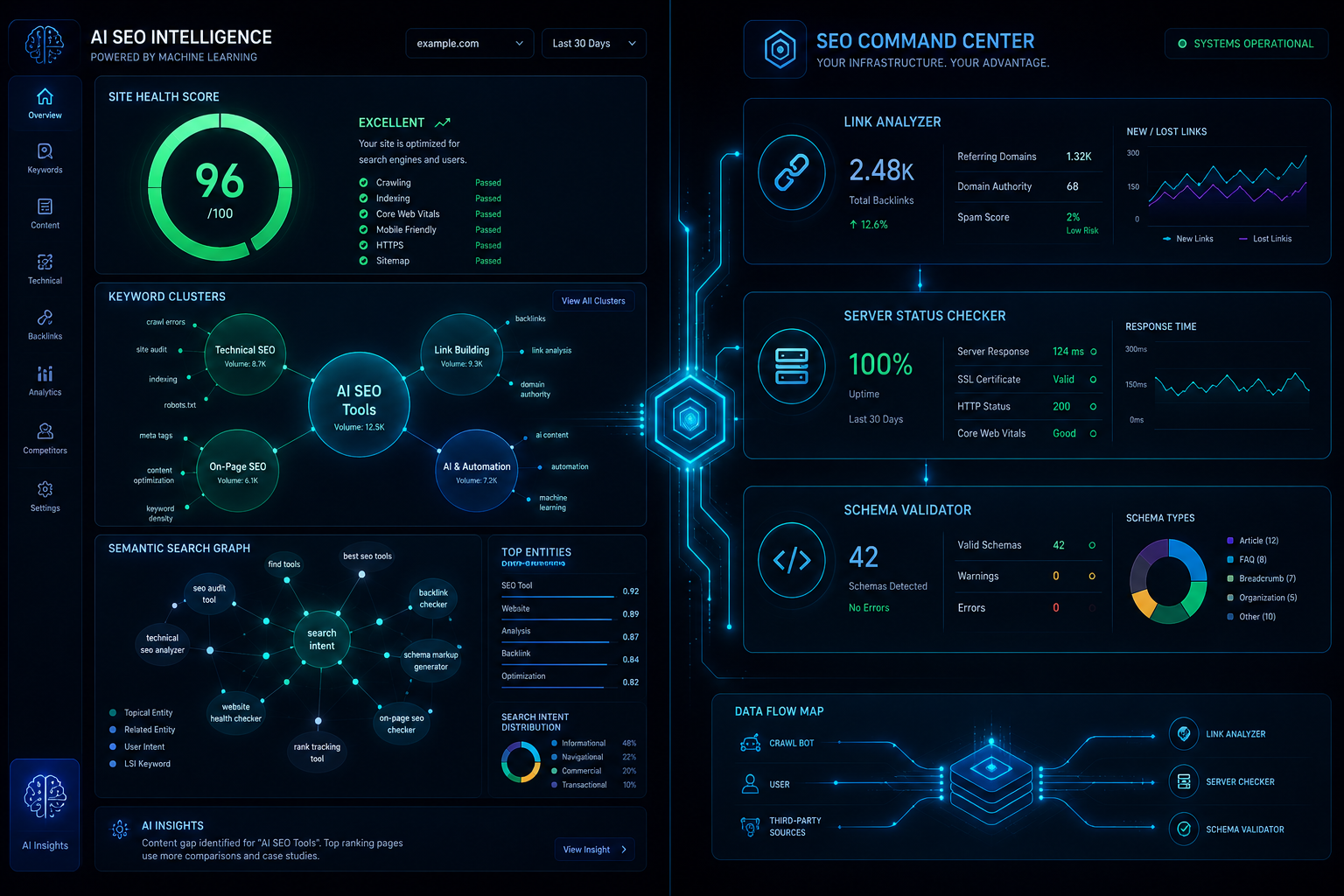
For quick technical diagnostics, tools like Promoto AI’s Meta Tag Analyzer and Broken Links checker let you surface critical on-page errors instantly, without logging into a full platform.
2. Keyword Research That Goes Beyond Search Volume
The keyword research game has shifted. Volume matters less than intent alignment and semantic relevance in 2026.
AI-assisted keyword research tools now cluster keywords by topic, map user intent stages, and flag which phrases are being picked up by AI answer engines — not just Google.
What modern AI for keyword research should give you:
- Intent-segmented keyword clusters (informational, commercial, navigational)
- Semantic co-occurrence data (what concepts should appear alongside your target keyword)
- SERP volatility scores — indicating how likely a keyword is to be disrupted by AI summaries
- Question-based variants optimized for featured snippets and AI answers
Promoto AI’s Keyword Research tool and Keyword Position tracker are built exactly for this kind of layered analysis — giving you data you can act on, not just data you can screenshot.
According to Ahrefs’ keyword research documentation, intent-matching is now one of the most critical ranking factors — something AI-native tools are better equipped to analyze than traditional keyword explorers.
3. Keyword Density — A Misunderstood Signal That Still Matters
Keyword stuffing is dead. But keyword balance is very much alive.
A keyword density checker helps you ensure your primary and secondary terms appear naturally — not so sparse that search engines miss the relevance signal, not so frequent that you trigger a spam filter.
The sweet spot is typically 1–2% for primary keywords, with LSI (Latent Semantic Indexing) terms woven organically throughout. AI-optimized content hits this balance naturally when built on proper semantic briefs
4. Link Analysis — The Signal Most Teams Undervalue
Backlinks remain one of Google’s top three ranking factors, according to Google Search Central’s documentation. But raw link count is far less useful than link quality, relevance, and anchor text distribution.
A proper link analyzer tool gives you visibility into:
- Which pages on your site attract the most inbound authority
- Toxic or low-quality links that may be suppressing rankings
- Internal linking gaps that are isolating important pages from PageRank flow
- Anchor text patterns that may look unnatural to algorithms
Pair this with a backlink maker tool to systematically build citations from relevant, high-DA sources — and your link profile starts working for you rather than against you.
5. Server Status — The Technical Signal Nobody Talks About
Here’s something that surprises most marketers: your server’s response behavior directly affects how search engines crawl and index your site.
A server status checker tells you whether your site is returning the correct HTTP response codes (200, 301, 404, 503) to crawlers. If Googlebot hits a 503 on a key page during crawl, that page may drop from the index entirely — no warning, no notification.
Regular server status monitoring catches these issues before they become ranking losses. It’s one of the lowest-effort, highest-impact technical habits you can build.
Structured Data and Schema — The Secret Layer AI Search Engines Love
If there’s one technical investment that pays dividends in both Google and AI search, it’s schema markup.
Structured data tells search engines — and AI answer engines — exactly what your content contains. Product names, review scores, FAQ answers, author credentials, event dates. It’s how you go from “a page about X” to “a definitively structured source about X.”
Schema.org provides the full vocabulary. The practical challenge is implementation: generating clean, valid JSON-LD markup and embedding it correctly without breaking existing page structure.
Promoto AI’s Schema Validator lets you test your structured data in real-time, catching malformed markup before it reaches Googlebot. If you’re building schema from scratch, the Meta Tag Generator pairs well to ensure your meta layer is equally clean.
High-priority schema types in 2026:
FAQPage— directly feeds AI answer engines and featured snippetsArticle/BlogPosting— signals content type and authorshipHowTo— powerful for instructional content and voice searchOrganization— builds entity recognition and brand trust signals
According to Moz’s technical SEO guide, pages with correctly implemented schema markup have a measurably higher chance of appearing in rich results — and rich results consistently outperform standard blue links for CTR.
AI Search Visibility — The New KPI Nobody Measured in 2024
Let’s talk about the metric that didn’t exist two years ago: AI search visibility.
It’s not just about ranking on page one anymore. It’s about whether ChatGPT, Perplexity, or Google’s AI Overviews mention your brand, cite your content, or recommend your product when someone asks a relevant question.
Promoto AI was built with this shift in mind. Its Rank on AI Engine solution specifically addresses how to optimize content for citation in AI-generated answers — a capability most legacy SEO tools simply don’t have.
If your competitors are appearing in AI answers and you’re not, that’s a form of invisibility that no amount of Google rankings can fully compensate for. Getting there requires the combination of deep content quality, structured data, entity building, and semantic optimization outlined in this guide.
Building an AI-Powered SEO Workflow — Step by Step
Here’s how a modern, AI-driven SEO workflow actually looks in practice:
- Run a site audit — identify technical blockers, crawl errors, and Core Web Vitals issues
- Check server status — confirm your site responds correctly to all crawler requests
- Conduct intent-based keyword research — cluster by topic, not just volume
- Analyze keyword density — balance primary and semantic keywords naturally
- Audit your link profile — assess quality, relevance, and internal linking gaps
- Implement and validate schema markup — prioritize FAQ, Article, and HowTo
- Optimize meta tags — craft compelling, click-worthy titles and descriptions
- Publish and track — monitor keyword positions and adjust based on AI answer engine visibility
This workflow scales. Whether you’re managing one website or fifty, the same sequence — powered by the right tools — delivers compounding results.
Key Takeaways
- AI-driven SEO strategies require a deeper technical foundation than traditional approaches
- Keyword research must now account for AI search intent, not just Google volume
- Schema markup is your most powerful bridge between traditional and AI search visibility
- Server status, link analysis, and keyword density are underutilized but high-impact signals
- The best SEO tools in 2026 combine diagnostics, semantic optimization, and AI engine readiness
Conclusion
SEO in 2026 isn’t harder than it used to be. It’s just different — and the teams winning are the ones who’ve updated their stack to match.
The combination of AI-assisted keyword research, technical auditing, schema markup, and AI search visibility optimization forms a complete strategy that works across every major discovery channel: Google, AI Overviews, ChatGPT, and beyond.
Promoto AI gives you the tools, the platform, and the intelligence to execute this workflow — from free technical utilities to a full AI-powered content and analytics engine.
Start with a free instant SEO audit on your site. See what you’re missing. Then build forward.
Frequently Asked Questions
Q1: What are AI-driven SEO strategies? AI-driven SEO strategies use machine learning and artificial intelligence to automate and enhance traditional SEO tasks — including keyword research, content optimization, schema generation, and technical auditing. They’re designed to optimize content for both Google and AI answer engines like ChatGPT and Perplexity.
Q2: What are the best SEO tools in 2026? The best SEO tools in 2026 combine traditional capabilities (keyword research, site audit, link analysis) with AI-native features like semantic clustering, AI search visibility tracking, and structured data automation. Platforms like Promoto AI, Ahrefs, and Semrush are leading this evolution.
Q3: Why is keyword density still important? Keyword density helps search engines confirm topical relevance without triggering over-optimization penalties. A balanced density — typically 1–2% for primary keywords — combined with natural semantic variation is the current best practice for on-page SEO.
Q4: What is a link analyzer tool and why do I need one? A link analyzer tool audits the inbound and outbound links on your website, showing link quality, anchor text distribution, and internal linking structure. It helps you identify toxic backlinks, internal linking gaps, and opportunities to improve PageRank flow across your site.
Q5: How does schema markup improve AI search visibility? Schema markup gives structured, machine-readable signals to both Google and AI answer engines about the exact content of your pages. FAQPage schema, for instance, is directly ingested by AI engines to populate answers — making it one of the most reliable ways to appear in AI-generated search responses.
Q6: What does a server status checker reveal about my SEO? A server status checker reveals how your server responds to HTTP requests. Errors like 503 (service unavailable) or misconfigured 301 redirects can prevent proper crawling and indexing. Regular monitoring ensures Googlebot always gets the correct signals when visiting your site.
Q7: How do I start optimizing for AI search engines? Begin with technical fundamentals: clean schema markup, fast Core Web Vitals, and authoritative content with strong entity signals. Then use a platform like Promoto AI’s Rank on AI Engine solution to specifically optimize for citation in AI-generated answers — the newest and fastest-growing search surface in 2026.