
Your Website Is Leaking Rankings — Here’s the AI-Powered Technical SEO Audit That Fixes It
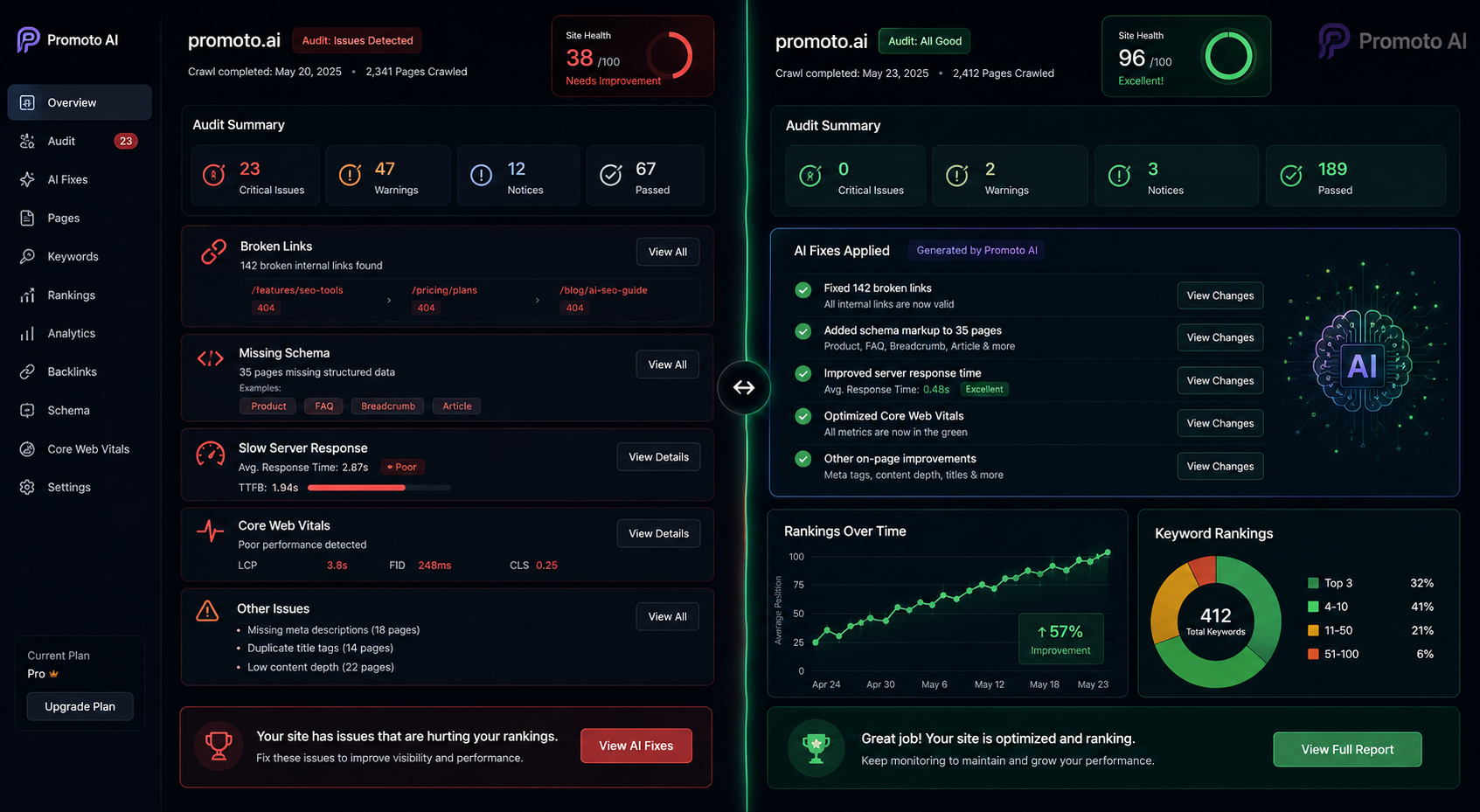
Most websites don’t fail because of bad content. They fail silently — one broken link, one missing schema tag, one undetected server error at a time.
By the time rankings drop, the damage is already done. And in 2026, with AI search engines crawling your site faster than ever, the margin for error is razor-thin.
This is the technical SEO audit guide built for what search actually looks like today.
Why Technical SEO Matters More Than Ever in 2026
Search has changed structurally. Google’s AI Overviews, ChatGPT search, and Perplexity AI don’t just read your content — they evaluate your site’s trustworthiness, crawlability, and structural integrity before surfacing it to users.
A technically flawed site doesn’t just rank lower. It gets filtered out of AI-generated answers entirely. That’s traffic you never even knew you were losing.
AI-driven SEO strategies in 2026 combine traditional site health signals with new standards around structured data, semantic clarity, and machine-readable content architecture. Getting the technical layer right isn’t optional anymore — it’s the foundation everything else is built on.
What a Modern Technical SEO Audit Actually Covers
A proper audit in 2026 goes well beyond checking for 404s. Here’s what it needs to address:
- Server health and response codes — Is your server actually reachable and responding correctly?
- Crawl accessibility — Can search bots reach and index your key pages?
- Internal link architecture — Are your links passing authority where it matters?
- Keyword density and on-page signals — Is your content semantically structured for relevance?
- Schema markup and structured data — Are you feeding search engines the context they need?
- Meta tags and indexing directives — Are your metadata signals clean and consistent?
- Broken and toxic links — What’s silently damaging your crawl budget and trust signals?
Each of these layers feeds into how both traditional search engines and AI answer engines interpret your site. Miss one, and you’re leaving rankings — and visibility — on the table.
Step 1: Start With Server Status and Site Accessibility
Before anything else, you need to confirm that your site is actually reachable — by users and by crawlers. This sounds obvious, but intermittent server issues are one of the most underdiagnosed causes of ranking drops.
Use Promoto AI’s free Server Status Checker to instantly verify your server’s HTTP response codes. A 200 OK means you’re live. A 5xx error means crawlers are hitting a wall — and every minute that continues costs you crawl equity.
Pay attention to response times too. Google Search Central has confirmed that slow server response rates directly affect how frequently Googlebot crawls your site. Faster servers get crawled more often. More crawls mean fresher indexing.
Step 2: Audit Your Links — Both Internal and External
Links are still the circulatory system of SEO. Broken ones are like blocked arteries — authority stops flowing, and crawl bots get stuck.
Run your site through Promoto AI’s Link Analyzer Tool to map every internal and external link on your key pages. You’re looking for broken destinations, redirect chains, and orphaned pages that receive no internal links at all.
Internal link structure is especially important for AI search visibility. Answer engines follow semantic pathways through your site. If your most authoritative content is buried three clicks deep with no strong internal links pointing to it, it’s essentially invisible to both Google and AI crawlers.
Once you’ve identified gaps, use Broken Links Checker to run a full sweep. Fix or redirect every broken link — especially those pointing to your core product and service pages.
A clean link graph also signals trust to external ranking systems. According to Ahrefs, internal linking is one of the highest-ROI technical fixes a site can make, yet it’s consistently overlooked in standard audits.
Step 3: Check Keyword Density and On-Page Relevance
One of the most common on-page mistakes in 2026 is writing content that feels optimized but doesn’t actually signal relevance to AI-driven indexing systems. Keyword density still matters — but it needs to be balanced, not forced.
Use Promoto AI’s Keyword Density Checker to analyze how frequently your target terms appear in relation to your total word count. The sweet spot for most primary keywords sits between 0.5% and 2%. Below that, you’re under-signaling. Above that, you risk triggering over-optimization filters.
More importantly, look at your semantic keyword spread. Are you using related terms, synonyms, and entity-level language naturally throughout the content? AI search systems like Google’s Knowledge Graph evaluate topical coverage holistically — not just primary keyword frequency.
If you’re building a new content strategy from scratch, start with Keyword Research to identify semantically related terms that strengthen your topical authority before you even write a word.
Step 4: Validate Schema Markup and Structured Data
This is where most audits fall short — and where the biggest wins are hiding in 2026.
Structured data is the language AI search engines speak. When your schema markup is clean and validated, you’re essentially giving Google, ChatGPT search, and Perplexity AI a direct briefing on who you are, what your content covers, and why you’re trustworthy.
Use Promoto AI’s Schema Validator to check every critical page for valid JSON-LD markup. Common failures include missing @type declarations, malformed property values, and schema that doesn’t match visible page content — all of which suppress your chances of appearing in rich results and AI-generated answers.
Schema.org provides the full vocabulary reference for structured data types. For most sites, priority schema types to implement include Article, FAQPage, BreadcrumbList, Organization, and WebPage. Each one expands the surface area of how your content gets surfaced.
According to Moz, pages with validated schema markup earn significantly higher click-through rates in SERPs — largely because they qualify for rich snippets that take up more visual real estate.
Step 5: Audit Your Meta Tags and Indexing Signals
Metadata is the first thing both crawlers and users see. It shapes click-through rates, crawl priorities, and how your content is categorized in search indexes.
Run your top-performing pages through Promoto AI’s Meta Tag Analyzer to verify that every page has a unique, keyword-aligned title tag, a compelling meta description under 155 characters, and correct robots directives.
Watch for duplicate meta titles across similar pages — this is one of the clearest signals of poor site architecture and confuses search engines trying to establish topical hierarchy.
If you need to build metadata from scratch for new pages, the Meta Tag Generator makes it fast and consistent. Pair that with a clean Sitemap Generator output to ensure every page you want indexed is being actively submitted.
Step 6: Build Backlink Signals the Right Way
Backlinks remain one of the strongest authority signals in 2026 — but quality still dominates quantity. A handful of relevant, high-authority links outperforms hundreds of low-value ones every time.
Use Promoto AI’s Backlink Maker Tool to begin building foundational backlink signals to your site. This is particularly useful for new pages or recently published content that hasn’t yet accumulated any external link equity.
For deeper competitive link analysis, Semrush’s Backlink Analytics gives you a full picture of your domain’s link profile versus competitors — helping you identify which link-building opportunities to prioritize.
The key principle: every backlink you earn should be from a page that’s genuinely relevant to your content topic. Relevance-weighted link authority is a critical signal in both Google’s Helpful Content framework and AI search evaluation models.
Step 7: Tie It All Together With AI-Powered Content Optimization
Once your technical foundation is clean, the final layer is making sure your content itself is built to rank in both traditional and AI-driven search environments.
Promoto AI’s AI Content Generation and Keyword Analysis platforms are built specifically for this intersection — generating SERP-aware, semantically rich content that aligns with the technical signals your audit has just cleaned up.
The goal is a site where every layer reinforces every other layer: clean server signals, strong link architecture, validated schema, balanced keyword density, and content that answers the exact questions AI search engines are trying to surface.
That’s what a winning SEO strategy looks like in 2026. Not a checklist. A system.
Key Takeaways
- Technical SEO in 2026 directly affects your visibility in AI-generated search answers — not just traditional rankings.
- Start every audit with server status verification before moving to on-page signals.
- Use a link analyzer to identify both broken links and internal linking gaps that suppress authority flow.
- Keyword density should be balanced (0.5–2%) and supported by semantic keyword spread across the full page.
- Validated schema markup is the single highest-leverage technical change for AI search visibility.
- Clean meta tags + a submitted sitemap ensure crawlers are reading and indexing the right pages.
- Backlinks still matter — but relevance-weighted links outperform volume every time.
Conclusion
A technically sound website isn’t a luxury — it’s the price of entry for competing in AI-powered search in 2026.
The sites that dominate AI Overviews, featured snippets, and answer engine results aren’t necessarily the ones with the most content. They’re the ones built on the cleanest technical foundations, with structured data that speaks directly to machine-readable systems.
Run this audit. Fix what’s broken. Then layer world-class AI-optimized content on top of a site that’s finally built to rank.
Promoto AI gives you every tool in this workflow — free diagnostic tools, AI content generation, keyword analysis, and publishing automation — all in one platform. Start your free audit today and see exactly what your site has been hiding.
MORE ARTICLES TO READ
- Your Brand Is Invisible to AI Search — Here’s How Answer Engine Optimization Changes That
- The LLM SEO Playbook: How to Engineer Your Brand Into Every AI Answer
- The Technical SEO Audit Playbook for 2026: How AI-Driven Tools Are Closing the Gaps Agencies Still Miss
- The Smart SEO Stack: How to Use AI-Driven SEO Strategies and the Best SEO Tools in 2026
- Why Ubersuggest Is Losing Ground to Smarter AI SEO Platforms in 2026
FAQ Section
Q1: What is a technical SEO audit and why does it matter in 2026?
A technical SEO audit is a systematic evaluation of your website’s infrastructure — covering server health, crawlability, link architecture, schema markup, and metadata. In 2026, it matters more than ever because AI search engines like Google’s AI Overviews and ChatGPT search evaluate site structure and trust signals before surfacing content in answers.
Q2: How do I check if my website has broken links?
Use Promoto AI’s free Broken Links Checker to scan your site for any URLs returning 404 or redirect errors. Broken links waste crawl budget and prevent link authority from flowing through your site correctly.
Q3: What is keyword density and what’s the ideal range?
Keyword density is the percentage of times a target keyword appears relative to your total word count. The recommended range for most primary keywords is between 0.5% and 2%. Use Promoto AI’s Keyword Density Checker to verify your on-page balance.
Q4: Why is schema markup important for AI search visibility?
Schema markup provides structured, machine-readable context to search engines and AI answer systems. Without it, AI engines have to infer what your content is about — often inaccurately. Validated schema increases your eligibility for rich results and AI-generated summaries. Validate yours with Promoto AI’s Schema Validator.
Q5: How often should I run a technical SEO audit?
For most sites, a full technical audit should be run quarterly. However, you should monitor server status and broken links continuously — especially after publishing new content, redesigning pages, or migrating your site to a new platform.