How to Automate Your Entire SEO Workflow in 2026 (Best AI Tools Compared)

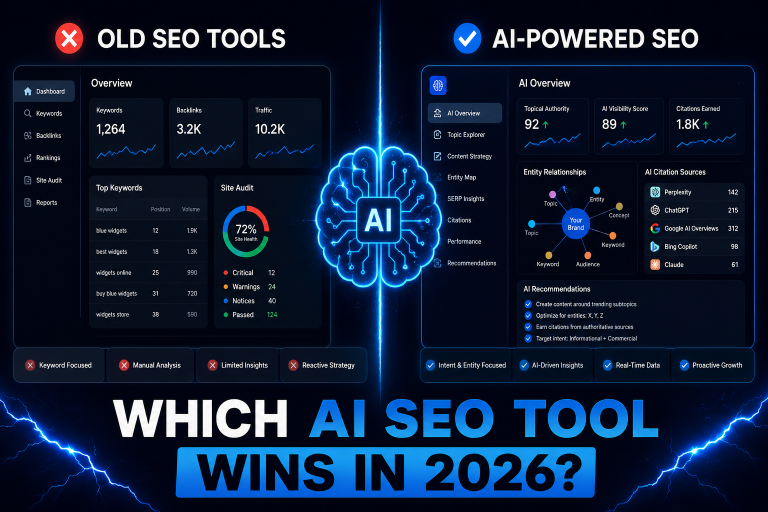
SEO used to mean spending hours manually researching keywords, crawling pages, checking backlinks, and guessing what Google might reward next. That era is over. In 2026, the best SEO practitioners are not working harder — they are working smarter, with AI-driven SEO strategies that handle the heavy lifting automatically. The question is no longer should you use AI for SEO. The question is which tools are actually worth your time and money. This guide breaks down exactly that. Whether you are a freelancer optimizing client websites, a founder trying to grow organic traffic, or a marketer managing multiple campaigns — this is your practical buyer’s guide to the best SEO tools 2026 has to offer.
What Makes an AI SEO Tool Actually “Good”?
Not every tool that slaps “AI” on its homepage deserves the label. Before comparing options, it helps to know what separates a genuinely useful AI SEO tool from one that just looks impressive on a landing page.
Look for these qualities:
- Automation depth — Does it actually save you hours, or does it just surface data you still have to manually interpret?
- Accuracy — Keyword volume estimates, backlink data, and site audit results are only useful if they are reliable.
- Actionability — The best tools do not just tell you what is wrong. They tell you what to do about it.
- Integration — Can it connect with your CMS, Google Search Console, or other platforms you already use?
- Scalability — Will it still serve you well when your site or client roster grows?
The automation vs. control balance matters too. Full automation is great for repetitive tasks like crawling, keyword clustering, and rank tracking. But creative decisions — content angle, brand voice, strategic priorities — still need a human in the loop.
Types of AI SEO Tools You Actually Need
Keyword Research Tools
These form the foundation of any SEO campaign. Modern AI-powered keyword research tools go beyond search volume — they analyze search intent, cluster related terms, identify content gaps, and map your competitors’ keyword strategies.
What to look for: intent classification, SERP feature tracking, long-tail discovery, and keyword difficulty scoring.
Content Optimization Tools
These tools analyze your draft content against top-ranking pages and suggest improvements for relevance, depth, and structure. A good keyword density checker sits inside this category — not as a rigid rule enforcer, but as a guide to ensure your content covers a topic with appropriate depth without over-optimizing.
Site Audit Tools
Site audit tools crawl your entire website and surface technical issues — broken links, missing meta tags, slow-loading pages, duplicate content, crawl errors, and more. Following site audit best practices means running audits regularly, not just once at launch.
Backlink and Link Analyzer Tools
Backlinks remain one of the strongest ranking signals. Link analyzer tools help you understand your current backlink profile, identify toxic links, track competitors’ link-building activity, and find new opportunities. Some platforms also include a backlink maker tool — functionality that helps you identify and pursue high-quality link placements systematically.
Technical SEO Tools
This category covers everything under the hood — XML sitemaps, robots.txt, Core Web Vitals, mobile usability, and server health. A reliable server status checker is more useful than people give it credit for. Downtime or server errors during a crawl can cause significant indexing problems that take weeks to recover from.
Best AI SEO Tools Compared (2026)
Here is a neutral comparison of six tools that consistently deliver real value:
1. Semrush
Best for: All-in-one SEO management Key features: Keyword research, site audit, backlink analysis, content optimization, competitor gap analysis Pricing: Mid to high range — starts around $130/month Pros: Industry-leading data accuracy, broad feature set, strong reporting Cons: Expensive for solo users; can feel overwhelming for beginners
2. Ahrefs
Best for: Backlink analysis and competitive research Key features: Link analyzer tools, keyword explorer, site audit, rank tracker, content gap tool Pricing: Mid to high range — starts around $129/month Pros: Best-in-class backlink database, clean interface, reliable keyword data Cons: Limited content writing features; pricing is steep for small budgets
3. Surfer SEO
Best for: AI-powered content research and on-page optimization Key features: Content editor, SERP analyzer, keyword density checker, AI outline generator Pricing: Mid range — starts around $89/month Pros: Excellent for writers and content teams, real-time optimization guidance Cons: Focused primarily on content; needs pairing with a technical SEO tool
4. Screaming Frog
Best for: Deep technical site audits Key features: Full site crawl, broken link detection, redirect mapping, structured data validation, server status checker integration Pricing: Low to mid range — free up to 500 URLs, paid license around $259/year Pros: Incredibly thorough, trusted by technical SEO professionals worldwide Cons: Desktop software with a learning curve; interface is dated
5. SE Ranking
Best for: Budget-conscious freelancers and small agencies Key features: Keyword tracking, site audit, backlink maker tool, content editor, white-label reporting Pricing: Low to mid range — starts around $65/month Pros: Great value, intuitive interface, solid core features Cons: Data depth does not quite match Semrush or Ahrefs at enterprise scale
6. Promoto.ai
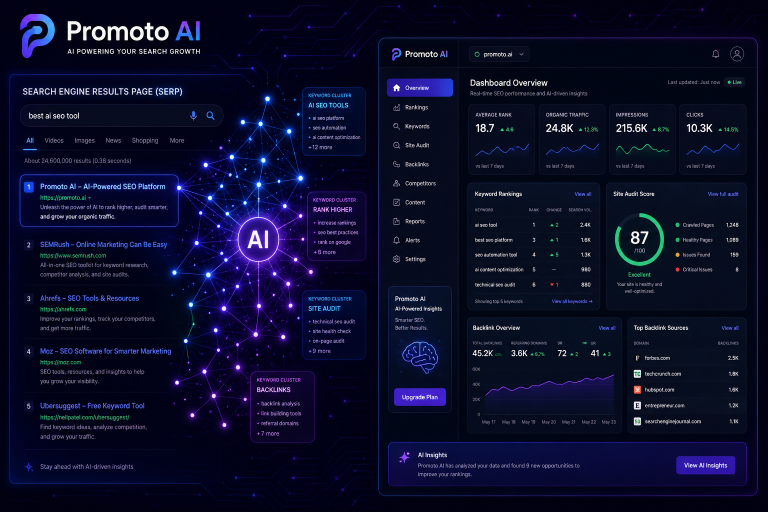
Best for: AI-powered SEO automation for modern marketers and founders Key features: AI-driven content research, keyword clustering, site audit best practices, link analysis, server status checker, Answer Engine Optimization support Pricing: Competitive and accessible for individuals and growing teams Pros: Built specifically for the 2025–2026 AI search landscape, combines GEO and traditional SEO in one platform, strong automation depth Cons: Newer platform — community and third-party integrations still growing
How to Choose the Right SEO Tool for Your Situation
If you are a beginner or blogger: Start with something intuitive and affordable. SE Ranking or Surfer SEO give you strong fundamentals without overwhelming complexity. Add a free crawl with Screaming Frog as needed.
If you are a freelancer or agency: You need data depth and reporting. Ahrefs or Semrush are the industry standard. Pair with Surfer SEO for content and you have a powerful stack.
If you are a startup founder or growth marketer: You want automation and breadth without paying for features you will not use. Promoto.ai is built for exactly this scenario — covering keyword research, content, audits, and AI search visibility in one place.
Budget tip: Do not pay for five tools doing overlapping jobs. Most professionals can run a complete workflow with two well-chosen platforms.
How AI Is Genuinely Transforming SEO Right Now
The shift goes deeper than automation. AI is changing what SEO means.
Keyword clustering at scale — Instead of manually grouping hundreds of keywords into content topics, AI tools now do this instantly with semantic grouping based on intent, not just word similarity.
AI-powered content research — Tools can now analyze the top 20 ranking pages for a query, extract the key subtopics, questions, and entities covered, and give you a content brief in minutes rather than hours.
Predictive rank tracking — Some platforms are beginning to surface predictive insights — identifying which keywords are trending upward before they become competitive, giving early movers a significant advantage.
Answer Engine Optimization integration — As ChatGPT, Perplexity, and other LLMs become primary discovery channels, the best SEO tools are beginning to bridge traditional search and AI search visibility. This is not a future feature — it is a present competitive advantage.
Must-Have Features in Your SEO Tool Stack
No matter which platforms you choose, make sure your stack covers these fundamentals:
- Keyword density checker — Ensures your content is topically thorough without tipping into over-optimization
- Backlink maker tool — Systematic link prospecting and outreach support
- Link analyzer tools — Profile health monitoring and toxic link identification
- Server status checker — Catches downtime and crawl-blocking server errors before they damage your rankings
- Structured data support — Schema validation to support both traditional and AI search visibility
Site Audit Best Practices Using AI Tools
Site Audit Best Practices Using AI Tools
Running a site audit is not a one-time task. Here is a simple workflow to follow:
Step 1 — Crawl your full site using a tool like Screaming Frog or your platform’s built-in audit module. Export all issues.
Step 2 — Prioritize by impact. Fix crawl errors and broken internal links first. These directly affect how search engines index your pages.
Step 3 — Address page speed and Core Web Vitals. Slow pages hurt both rankings and conversions.
Step 4 — Audit your meta data. Missing titles, duplicate descriptions, and thin pages are quick wins that often get overlooked.
Step 5 — Check your server status. Verify that no pages are returning unexpected 5xx errors that could be silently preventing crawling.
Step 6 — Re-crawl after fixes. Confirm issues are resolved and track progress over time.
Common Mistakes When Choosing SEO Tools
Overpaying for features you do not use. An enterprise plan designed for a 500-person marketing team is wasteful if you are running a 10-page website.
Tool overload. Using six platforms with overlapping functionality creates confusion, not clarity. Fewer well-integrated tools outperform a scattered stack every time.
Ignoring data accuracy. Free tools often show impressive-looking dashboards backed by thin or outdated data. Always verify keyword volume and backlink data against a second source before making major decisions.
Chasing trends over fundamentals. New AI features are exciting, but a tool that cannot accurately crawl your site or track keyword rankings reliably is not worth your money regardless of how sophisticated its AI layer looks.
The Future of SEO Tools
The next two to three years will bring changes that make today’s tools look primitive by comparison.
LLMs embedded in workflows — Rather than querying a tool and interpreting results, you will describe your SEO goal in plain language and the tool will execute a full workflow automatically — from research to content brief to technical audit.
Predictive SEO — Tools will shift from reporting on what has happened to forecasting what is about to happen in your niche, enabling proactive content and link strategies.
Full AEO integration — The future of SEO tools is not just about Google. Platforms that help brands optimize for both traditional search engines and AI answer engines simultaneously will define the next generation of the industry.
The brands and marketers who invest in learning and using these tools now will have a compounding advantage that becomes very difficult for latecomers to close.
Conclusion — Work Smarter, Rank Better
The right AI SEO tool does not just save you time. It gives you a clearer picture of your competitive landscape, surfaces opportunities you would have missed manually, and helps you make faster, more confident decisions. Start by auditing your current stack. Identify the gaps. Then invest in tools that genuinely cover those gaps — rather than adding more complexity for its own sake. If you are looking for a platform built specifically for the realities of AI-powered search in 2026 — one that combines traditional SEO fundamentals with Answer Engine Optimization, content intelligence, and technical monitoring in a single workflow — Promoto.ai is worth a serious look. The future of organic growth is automated, AI-assisted, and already underway. The only question is whether your tool stack is ready for it.