Promoto.ai vs Surfer SEO: Which Tool Is Actually Built for AI Search in 2026?

Here’s a situation playing out in marketing teams everywhere right now. Someone runs their article through Surfer SEO, hits a content score of 78, publishes it — and then wonders why the traffic never came. The article ranks on page two of Google. But on ChatGPT, Perplexity AI, and Google’s AI Overviews? Nowhere. This is the gap growing wider every month. Traditional content optimization tools were built to help you rank in a search engine that returns ten blue links. That search engine still exists — but it now shares the stage with AI answer engines that evaluate content on entirely different criteria. If AI search visibility is part of your strategy — and it should be — the comparison between Surfer SEO and Promoto.ai gets very relevant very quickly. This isn’t a takedown of Surfer SEO. It’s a practical look at what each tool was built to do, where each one draws its limits, and which type of team benefits most from each.
Why the SEO tool landscape shifted in 2026
The change wasn’t gradual — it was sudden. Google’s AI Overview now appears on the majority of informational searches. ChatGPT handles over 100 million queries daily. Perplexity AI has built a loyal audience of users who never touch traditional search results.
For marketers, this created a fundamental mismatch. The tools they’d invested in were optimized for one thing — helping content rank in a list of links. They were not built to help content get cited by language models or structured in ways that answer engines can cleanly extract and reference. Zero-click searches made the pressure worse. Even when a page ranks well on Google, if an AI Overview answers the question first, the click never happens. Organic CTR has dropped sharply for informational keywords across every category. AI-driven SEO strategies that account for both traditional rankings and AI search visibility became the new baseline. Tools that only addressed one of those channels started looking like partial solutions.
Surfer SEO: genuinely useful, but with real limits
Surfer SEO earned its reputation for good reason. Its content editor is one of the most useful on-page optimization tools available. Real-time scoring, NLP-based keyword suggestions, and competitor content analysis — these features have helped thousands of content teams improve their Google rankings. For writers needing guidance while drafting, Surfer’s editor is intuitive. You can see which terms are underrepresented, how your word count compares to competitors, and where your semantic coverage falls short. For traditional on-page SEO, that works well. But here’s where the limitations become difficult to ignore.
Surfer SEO optimizes for Google — specifically, the version that ranks pages based on keyword density and semantic coverage. That still applies to commercial and navigational queries. But it doesn’t address AI Overviews, and it doesn’t address what makes content citable by ChatGPT, Perplexity AI, Gemini, or Claude. There’s no GEO optimization layer. No AEO structuring guidance. No tracking of whether your content appears in AI-generated summaries. No schema validation. No multi-platform publishing. No integrated analytics. The tool does one job well — and that job now covers a smaller piece of the search landscape than it did two years ago.
Promoto.ai: built for the full search landscape
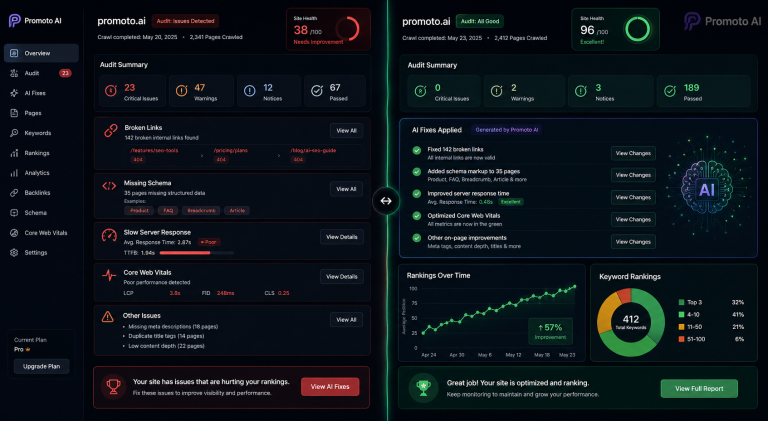
Promoto.ai was built on a different assumption. Search in 2026 means traditional search engines and AI answer engines simultaneously. A serious platform needs to address both from the same workflow — not require you to bolt together four different tools just to cover the basics. The platform covers AI content generation, keyword research, semantic SEO, GEO, AEO, technical SEO utilities, multi-platform publishing, and integrated analytics — all from a single dashboard.
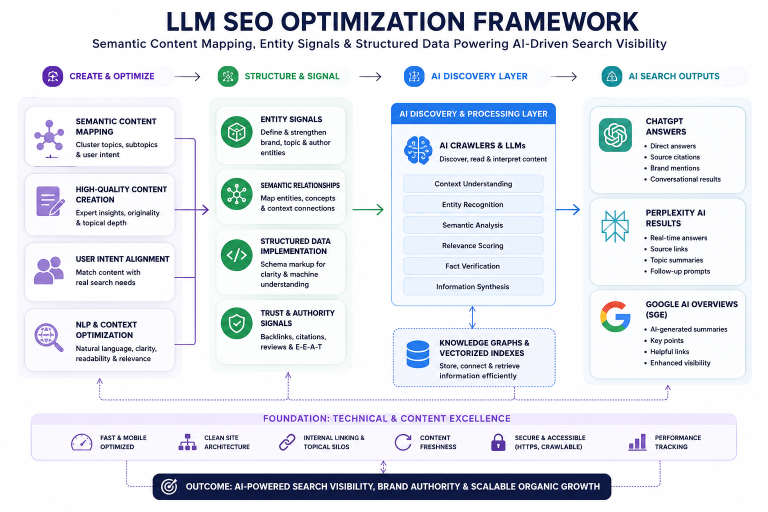
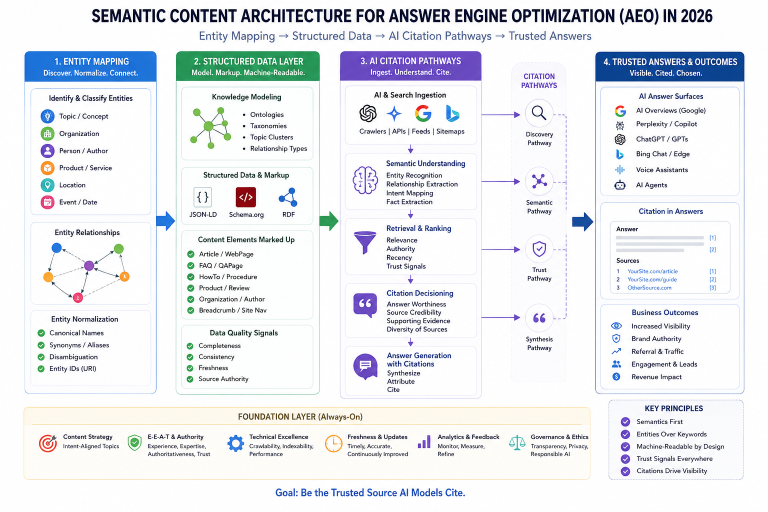
On the content side, the AI engine generates SERP-aware drafts optimized for both traditional rankings and AI citation likelihood. It incorporates schema.org JSON-LD from the start — a detail that directly improves how AI answer engines read and reference your pages. The GEO optimization layer helps structure content so language models can extract clean, citable answers. Something Surfer SEO simply doesn’t offer. The keyword research goes beyond volume and difficulty. Promoto.ai surfaces entity relationships and semantic topic clusters that build the topical authority AI search systems use when deciding which sources to cite. The Google Search Console and GA4 integrations surface ranking data and traffic insights directly inside the dashboard. No platform switching. No manual cross-referencing. You can identify opportunities, spot content needing refreshes, and time publishing around real audience behavior — all in one place. One-click publishing to WordPress and Shopify, auto-scheduling, content calendar, and bulk publishing workflows make it practical for teams producing content consistently at scale.
Honest limitation: Promoto.ai is newer. Some interface refinements Surfer has developed over years of iteration are more polished. If your only goal is maximizing a traditional on-page content score, Surfer’s editor has a slight edge for that specific task. But that’s an increasingly narrow use case in 2026.
Which tool fits which type of user?
Bloggers and solo creators — Surfer’s editor is intuitive for Google-focused writing. But for appearing in ChatGPT or Perplexity responses, you’ll need additional tools. Promoto.ai handles both natively.
Agencies — Promoto.ai’s multi-property dashboard, role-based access, bulk publishing, and AI visibility reporting across clients make it far more practical. Surfer is a per-article tool, not a content operations platform.
Startups and SaaS businesses — Topic cluster generation, auto-scheduling, and platform integrations make consistent publishing realistic without a large team. Surfer requires considerably more manual effort at scale.
Freelancers — As clients increasingly ask about GEO and AI visibility, having Promoto.ai in your stack is a meaningful service expansion that justifies higher retainers.
Technical SEO users — Promoto.ai includes schema validation, sitemap generation, link analyzer tools, server status checker, broken link detection, and meta tag analysis as native free tools. Surfer doesn’t touch any of these.
Key features any serious AI SEO platform needs in 2026
- AI-powered content research with semantic entity clustering
- GEO and AEO optimization for AI citation structuring
- Keyword density checker calibrated for NLP relevance
- Schema validation tied to AI citation patterns
- Link analyzer tools with topical context scoring
- Server status monitoring and broken link detection
- Multi-platform publishing with workflow automation
- Integrated analytics connecting content to ranking data
Promoto.ai covers all of these. Surfer SEO covers content optimization and keyword research — with meaningful gaps across the rest.
Common mistakes when choosing between these tools
Choosing based on brand recognition alone. Surfer SEO has stronger name recognition in content circles. But name recognition reflects historical positioning — not current capability relative to where search is heading.
Ignoring workflow compatibility. A tool that produces great individual article scores but requires manual coordination at scale creates real bottlenecks. Evaluate the full workflow — research, brief, draft, publish, track — not just the editor.
Underestimating fragmented tool costs. If you’re using Surfer for content, a separate keyword tool, a separate analytics platform, and a separate technical tool, the combined cost and context-switching often exceeds a unified platform — while producing less coherent output.
Treating AI search visibility as optional. If you’re not measuring whether your content appears in AI-generated responses, you’re missing a growing share of where discovery actually happens.
Conclusion
Surfer SEO is a well-built content optimization tool for traditional Google search. In 2026, that covers part of the search landscape — but not all of it. For teams that need to perform across Google rankings and AI answer engines simultaneously, Promoto.ai is the more complete and forward-looking solution. The question isn’t which tool has the better content score. It’s which tool is built for how your audience discovers content today — and where they’ll discover it six months from now. Promoto.ai offers a 14-day free trial with no credit card required. It’s worth finding out exactly where your AI search visibility stands before your competitors do.
About promotoai
PromotoAI is a leading AI-powered platform specializing in SEO, AIO, ASO, and GEO solutions. With the ability to publish directly to platforms like WordPress and Shopify, and track performance through real-time analytics, PromotoAI simplifies complex workflows for agencies and enterprises. Trusted by teams across industries, PromotoAI leverages advanced AI models to deliver scalable, optimized content strategies that drive measurable results.
More Articles
PromotoAI vs Jasper AI: Which Tool Best Powers Scalable Organic Growth?
Automating SEO Workflows with PromotoAI: A Comprehensive Guide
Getting Started with PromotoAI Content Scheduling
PromotoAI vs SurferSEO: Which AI Tool Drives Scalable Organic Growth?
PromotoAI vs SEMrush: Choosing the Best AI Tool for Organic Growth
Frequently Asked Questions
What is the main difference between Promoto.ai and Surfer SEO?
Surfer SEO focuses on on-page content optimization for traditional Google rankings. Promoto.ai covers traditional SEO alongside GEO, AEO, AI search visibility, multi-platform publishing, and integrated analytics — making it suitable for teams that need to rank in both Google and AI answer engines.
Is Surfer SEO still worth using in 2026?
For writers focused purely on traditional Google rankings, Surfer SEO is still competent. However, it doesn’t address AI search visibility, GEO or AEO optimization, multi-platform publishing, or integrated analytics — gaps that matter significantly more in 2026.
Does Promoto.ai work as a Jasper AI or Frase alternative?
Yes. Promoto.ai covers similar territory to both Jasper AI and Frase, but adds GEO and AEO optimization layers that neither tool natively provides — along with SERP-aware content generation and built-in schema markup.
Which tool is better for agencies?
Promoto.ai is significantly more practical for agencies, with multi-property dashboards, role-based access, bulk publishing, and AI visibility reporting. Surfer SEO is designed primarily for individual content workflows.
Is Promoto.ai suitable for beginners?
Yes. Despite its breadth of features, the dashboard is designed for clarity, AI recommendations are written in plain language, and onboarding guides users through setup without requiring deep technical SEO knowledge.
How does Promoto.ai handle technical SEO compared to Surfer SEO?
Promoto.ai includes schema validation, sitemap generation, link analyzer tools, server status checker, broken link detection, and meta tag analysis as native features. Surfer SEO focuses exclusively on content optimization and doesn’t cover technical SEO at all.

Awanish Kumar Singh is a trailblazing cloud and infrastructure leader with more than 15 years of experience architecting, optimizing, and scaling high‑impact digital platforms across healthtech, fintech, media, and loyalty domains. As CTO at Amar Ujala, and in key senior roles at Brevo (formerly SendinBlue), Times Internet, and Redcliffe Labs, he’s built a reputation for marrying strategic vision with hands‑on execution to drive both performance and efficiency at massive scale. Over his career, Awanish has delivered transformative cost savings and performance gains, including: 30% reduction in cloud spending for an online health‑lab platform through deep architecture audits and database optimizations 60% cut in infrastructure costs for a loyalty‑program provider by migrating core APIs to AWS API Gateway and right‑sizing compute resources 500% traffic growth absorbed on mission‑critical systems while simultaneously reducing infrastructure expenses by 40% 99.999% system uptime achieved via resilient, multi‑AZ cloud architectures and automated failover strategies 25% faster release velocity thanks to end‑to‑end DevOps pipelines, containerization, and IaC best practices Beyond FinOps and cloud optimization, Awanish has spearheaded the adoption of CI/CD frameworks, container orchestration with Kubernetes, and real‑time monitoring solutions—enabling engineering teams to move rapidly without sacrificing reliability. His leadership extends into analytics‑driven decision‑making, where he leverages cost and usage data to continuously tune environments, ensuring every rupee invested in infrastructure delivers maximum ROI. Whether guiding startups through their first cloud migrations or re‑architecting legacy systems for global enterprises, Awanish combines deep technical mastery with a relentless focus on metrics. His track record of slashing costs, accelerating delivery, and boosting resilience makes him the go‑to expert for organizations that demand both bulletproof reliability and explosive growth.