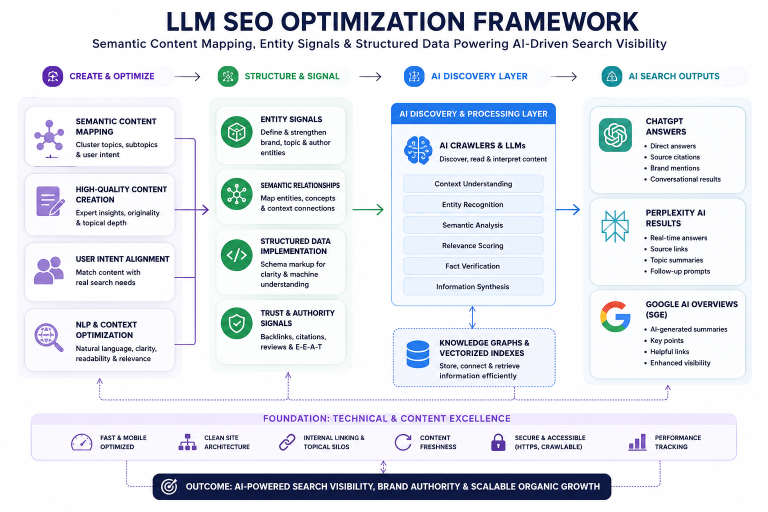
Promoto AI vs SEMrush: Which Platform Actually Moves the Needle in 2026?
You’re deep in a SEMrush audit report. The data looks clean, the recommendations are clear — yet organic traffic still isn’t moving.
That gap — between analyzing search and actually winning it — is exactly what this comparison addresses.
So if you’re evaluating Promoto AI vs SEMrush, or exploring Surfer SEO alternatives and Jasper AI alternatives, this guide gives you the honest, workflow-level picture.
Why the SEO Playbook Changed Overnight
SEMrush dominated for years — and for good reason. Keyword research, backlink audits, competitor gaps — it covered the fundamentals well.
However, search in 2026 is fundamentally different. AI-generated answers now appear above the fold for roughly 60% of informational queries, meaning users get answers from Google AI Overviews or Perplexity and never click through to your site.
As a result, ranking on page one is no longer enough if AI engines don’t cite or recommend your content. That’s the shift most traditional SEO tools weren’t built for — but Promoto AI was.
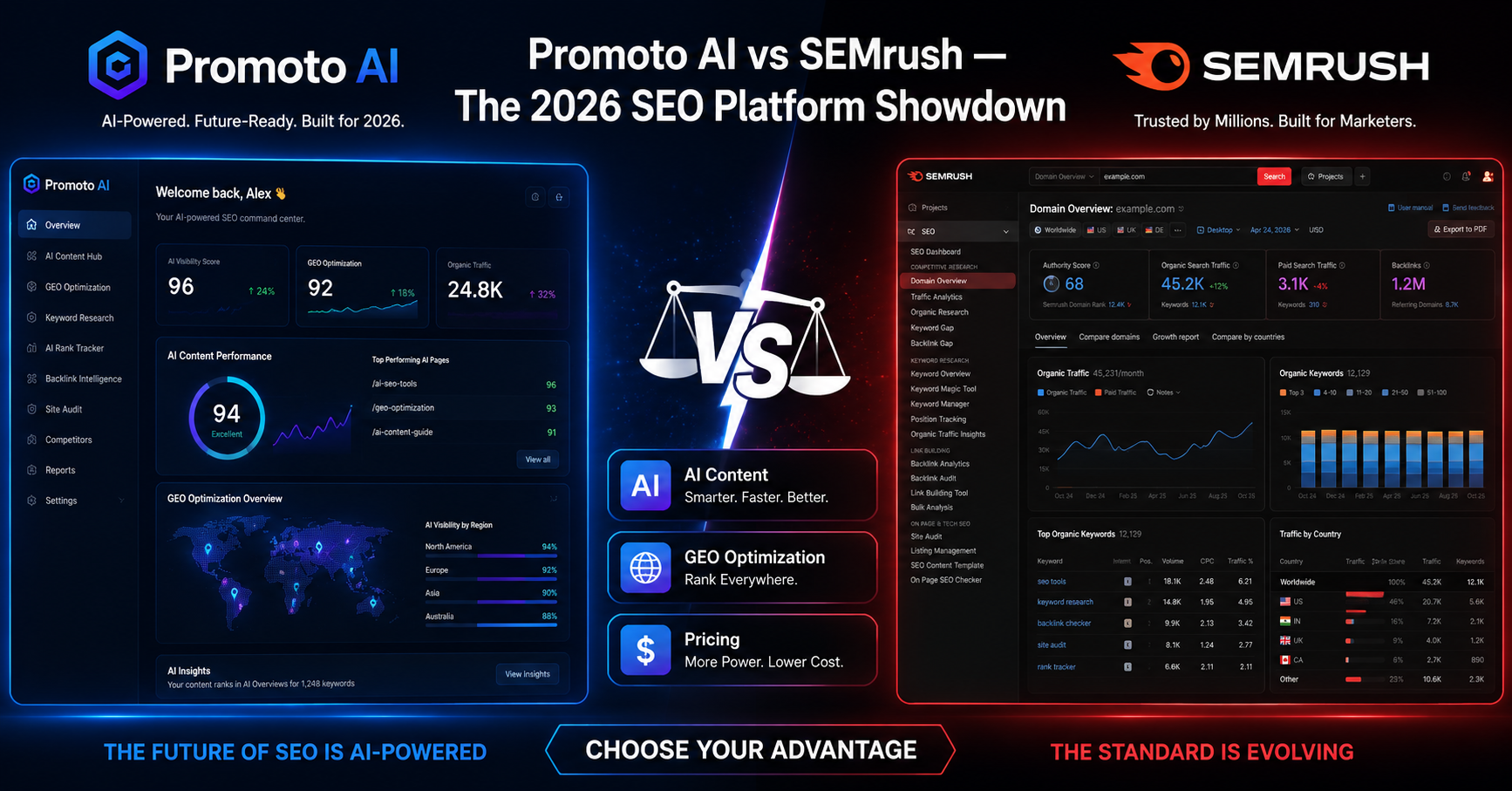
Promoto AI vs SEMrush: A Side-by-Side LooSEMrush
SEMrush is a comprehensive SEO analytics platform with over a decade of crawl data. It covers keyword research, backlink analysis, site auditing, PPC research, and competitive intelligence across 140+ countries.
Its strengths are well-established. The backlink database is industry-leading, keyword difficulty metrics are granular, and position tracking is highly reliable. For data-heavy, reporting-first SEO teams, the dashboards are genuinely excellent.
The gap shows up in execution. SEMrush doesn’t generate content, publish to your CMS, or offer any native GEO optimization or LLM optimization. Getting from insight to live article requires multiple separate tools.
Pricing starts around $130/month at the Pro tier. It’s built for enterprise teams and agencies that already have strong content production pipelines in place.
Promoto AI
Promoto AI is a full-stack AI SEO platform — content generation, keyword analysis, GEO optimization, AIO, ASO, and direct CMS publishing in one workspace.
The workflow is end-to-end. Research a keyword, generate an optimized article, and publish with one click to WordPress or Shopify — without leaving the platform.
Notably, GEO and AIO optimization are baked in, not added on. Every article is structured for featured snippets, Google AI Overviews, and LLM citations by default — so your content is ready for both traditional and AI-powered search from day one.
A free technical toolkit ships with every account — including a link analyzer, backlink maker, keyword density checker, and server status checker.
Where Promoto AI is still catching up is in backlink database depth. Teams with heavy link prospecting workflows will find SEMrush’s historical data more exhaustive for that specific use case.
Paid plans start well below SEMrush’s entry price, with a 14-day free trial available on all tiers.
How They Compare at a Glance
Promoto AI offers full multi-model AI content generation; SEMrush is not a content platform. Promoto AI has built-in GEO and LLM optimization; SEMrush does not offer this. Promoto AI supports one-click WordPress and Shopify publishing; SEMrush has no publishing layer. Both tools offer keyword research — Promoto AI’s is AI-powered, SEMrush’s is broader and historically deeper. On backlink analysis, SEMrush leads; Promoto AI’s database is growing. Promoto AI includes a free technical SEO toolkit; SEMrush’s tools require a paid plan. On pricing, Promoto AI is startup-friendly; SEMrush is enterprise-oriented. AI search visibility is a core Promoto AI capability and is unavailable in SEMrush.
Which Tool Is Right for Your Team?
Bloggers and content creators — Promoto AI is the clear fit. It handles the full cycle from keyword research to published article, with AI content generation tuned to your brand voice.
Digital agencies — Many use SEMrush for competitive data and Promoto AI for content production and publishing via platform integrations. Promoto AI’s analytics dashboard and GSC/GA4 integration often reduces the need for both.
Startups and SaaS teams — Promoto AI’s research-generate-publish-track workflow maps directly to lean teams that need organic traction without dedicated SEO headcount.
Freelancers — The free keyword research tool, keyword position tracker, and meta tag analyzer are genuinely useful without a paid subscription.
Technical SEO users — Promoto AI’s free sitemap generator, robots.txt generator, schema validator, and broken links checker cover the most common technical tasks at no cost.
What a Modern AI SEO Platform Needs to Do
A few capabilities have become non-negotiable in 2026 — regardless of which platform you choose.
AI-powered content research should surface semantic keyword clusters and entity relationships, not just volume. Keyword density and position tracking need to be real-time and tied to your CMS.
Semantic SEO optimization means structuring content around topics and entities, not isolated keywords. Tools that only measure keyword frequency are optimizing for a search model that’s already outdated.
GEO and LLM optimization means your content can be cited by AI engines — through schema markup, direct Q&A formatting, and clear factual structure. While SEMrush wasn’t designed for this, Promoto AI was built around it from the ground up.
Publishing integration is now a baseline requirement, not a bonus. Every manual step between drafting and going live compounds inefficiency, which is why one-click CMS publishing has become essential for any serious content team.
Real Problems AI SEO Tools Should Solve
Content scaling — Publishing one article a week manually isn’t competitive in most niches. Fortunately, Promoto AI’s auto-scheduling and bulk publishing let you define rules and let the platform handle the queue.
Search intent optimization — The same keyword can carry informational, commercial, or navigational intent depending on context. Therefore, AI-powered research that surfaces intent signals produces better briefs and ultimately better content.
Internal linking — Building strong topical architecture requires consistent cross-linking between related content. Promoto AI’s link analyzer combined with its content generation layer helps create exactly the kind of interconnected structures AI engines favor when selecting sources to cite.
Workflow automation — When research, writing, optimization, and publishing happen inside one platform, getting from idea to indexed article shrinks from days to hours.
Common Mistakes When Choosing an AI SEO Platform
Buying on hype — Strong marketing doesn’t equal strong SEO infrastructure. In reality, writing assistance without keyword research or a publishing layer is a writing tool, not an SEO platform.
Ignoring workflow fit — A tool that generates content but requires three manual steps to publish creates friction that erodes the automation benefit. Always evaluate the full workflow before committing.
Overpaying for unused features — If your team uses only 20% of an enterprise SEMrush plan, you’re subsidizing features you’ll never touch. Instead, match tool complexity to actual usage patterns.
Publishing low-quality AI content — AI generation needs brand voice controls, editorial review, and approval workflows. Specifically, Promoto AI’s brand training and approval features exist to prevent thin content from diluting topical authority.
Skipping technical SEO — Broken links, missing schema, and poor robots.txt configuration suppress rankings regardless of content quality. Thankfully, Promoto AI’s free server status checker and DNS lookup tool keep technical hygiene in check.
The Future AI SEO Platforms Are Already Building Toward
The platforms that win by 2027 will optimize for personalized search experiences, AI answer engine citations, and multi-surface visibility — all simultaneously.
LLM optimization is already a real differentiator. Content that appears in ChatGPT or Gemini answers captures top-of-funnel attention that never reaches traditional search results. In fact, platforms building GEO optimization natively into the content layer are already pulling ahead.
Furthermore, ChatGPT SEO and Perplexity AI optimization will become standard budget line items for growth teams within 18 months. Right now, early movers are building the citation profiles and entity authority that AI engines will reference for years.
Meanwhile, predictive SEO — publishing before keyword windows peak rather than reacting after — is where integrated GSC/GA4 data and AI-powered timing recommendations create the most durable competitive advantages.
The Bottom Line
SEMrush is a powerful analytics platform. For competitive intelligence, link research, and historical keyword data, it earns its price — and that’s not a dismissal, it’s a fair read.
However, if your team needs to produce search-visible content, publish it efficiently, and surface it in AI-generated answers, SEMrush hands you the research and leaves the rest to you.
By contrast, Promoto AI closes that entire loop — from keyword research to AI-optimized content to one-click CMS publishing, with GEO and LLM optimization built into every step.
So if you’re ready to stop analyzing and start ranking in the places that matter in 2026, Promoto AI’s 14-day free trial is the fastest way to find out.
More Articles to Read
- Surfer SEO vs Promoto AI: Why Content Teams Are Rethinking Their SEO Stack in 2026
- The Semantic Content Blueprint: How to Build AI-Powered Search Visibility That Outlasts Every Algorithm Update
- The Hidden SEO Gaps Killing Your Rankings — And How AI-Driven SEO Strategies Close Them in 2026
- The Technical SEO Audit Playbook for 2026: How AI-Driven Tools Are Closing the Gaps Agencies Still Miss
- AI SEO Tools Compared: What Promoto.ai Does That Others Still Can’t
Frequently Asked Questions
1. Is Promoto AI a direct replacement for SEMrush?
Not entirely. Promoto AI replaces SEMrush for content production, AI optimization, GEO visibility, and CMS publishing. SEMrush still leads on deep backlink research. Many teams use Promoto AI as their primary platform and supplement with standalone research tools when needed.
2. Which tool is better for AI search visibility in 2026?
Promoto AI is purpose-built for AI search visibility — optimizing for Google AI Overviews, ChatGPT, Perplexity, and Gemini through native GEO and AIO workflows. SEMrush does not offer this capability.
3. Can Promoto AI handle keyword research like SEMrush?
Promoto AI’s keyword research is AI-powered and directly integrated with content generation. SEMrush offers deeper historical competitive data. For most content-focused teams, Promoto AI’s tools — including the free keyword research and position tracker — are more than sufficient.
4. What is GEO optimization and why does it matter?
GEO (Generative Engine Optimization) is structuring content to be cited by AI-powered answer engines like ChatGPT, Perplexity, and Google’s AI Overview. As more users get answers without clicking, GEO directly impacts whether your brand gets recommended or ignored.
5. Is Promoto AI suitable for agencies with multiple clients?
Yes. Promoto AI supports multi-tenant architecture, role-based access, bulk publishing, and multiple CMS integrations — built for agencies managing multiple properties at scale.
6. How does Promoto AI compare to Jasper AI or Frase?
Jasper AI is a writing assistant without deep SEO or publishing infrastructure. Frase handles content briefs but lacks CMS publishing and GEO optimization. Promoto AI covers the full workflow: research, generation, optimization, publishing, and AI visibility.
7. Does Promoto AI offer free tools without a subscription?
Yes. The free suite includes a keyword research tool, keyword density checker, position tracker, link analyzer, backlink maker, meta tag analyzer, server status checker, sitemap generator, schema validator, and more — all accessible without a paid plan.